I had the distinct honor and privilege of attending oral argument in the Hobby Lobby/Conestoga case at the Supreme Court today. I will be writing a substantive post on the experience in the future, but for now I wanted to share with you the highlights of the corporate-focused arguments.  It will be quick because the issues of whether corporations are persons and therefore have standing under RFRA and whether corporations can have religious identies got relatively little attention during the 90 minute argument.

Justice Sotomayor lead the charge on the corporate issues challenging Paul Clement (arguing for Hobby Lobby/Conestoga) to identify where the law protects corporate religion and how can a corporation have religious beliefs.  Justice Sotomayor also asked how courts will decide the religion of the corporation– is it 51% of shareholders’ beliefs?  dependent upon officers? the board?  (This line of quesitoning tracks with an argument that I made here in an Op-ed).  Clements, pointing to the scienter doctrine, suggested that the law has already decided that corporations have beliefs and intent. Clement also suggested that the nature of a corporation’s belief could be judged by looking at corporate governance documents and that it would become a question of sincerity.  

The sincerity of the corporate religious belief is a thread that Chief Justice Roberts picked up in his questioning of Soliciter General Donald Verrilli, arguing for the Government.  Chief Justice Roberts suggested that he was willing to leave for another day questions about the extention of the exception sought by Hobby Lobby to large, public companies, noting that it would turn, in part, on the sincerity of the corporate belief.

The absence of legal precedent for corporate religious rights advanced by Verrilli was quickly countered by Justice Scalia that corporate religious rights had never been denied.

U.S. v. Lee was raised several times during the oral argument.  This case was signifcant in the oral argument, and I think will be a major part of the final opinion.  At issue in Lee was a religious exemption claim brought by an Amish employer to avoid paying social security taxes. The Lee opinion recognized that religious interests were infringed upon, but found that the countervailing interests in the social security system and the rights of the other employees tipped the balance against the exemption.  The Lee opinion discussed the choice and consequences of entering the marketplace, a theme that was returned to in oral argument today.  Drawing on Lee, both Justices Alito and Breyer questioned whether using the corporate form required the forfeiture of free exercise and religious freedoms.

The issue of whether a corporation is a “person” for purposes of RFRA was largely left to the Dictionary Act, which includes corporations.  Soliciter General Verrilli argued that “free exercise” however was not defined and left open quesitons of applicability to corporations.  No one was distracted by the corporate personhood debate today.

UPDATED:  I am participating in a Huffington Post Live recap on Hobby Lobby oral argument at 2:00 today (March 26th)–access it here.

-Anne Tucker
With oral arguments today in the Hobby Lobby case, I thought I’d pile on a few last thoughts:

(1) As I explained here, entities should be able to take on a racial, religious, or gender identity in discrimination claims.  I would add that I feel similarly about sexual orientation, but (though I think it should be) that is still not generally federally protected. To the extent the law otherwise provides a remedy, I’d extend it to the entity. 

(2) It is reasonable to inquire, why is discrimination different than religious practice?  For me, I just don’t think religious exercise by an entity is the same as extending discrimination protection to an entity.  There is something about the affirmative exercise of religion that I don’t think extends well to an entity.   That is, discrimination happens to a person or an entity. Religious practice is an affirmative act that is different.  Basically, reification of the entity to the point of religious practice crosses a line that I think is unnecessary and improper because discrimination protection should be sufficient.

As a follow up to that, I also think it’s a reasonable question to ask: Why is religion different than speech? To me it is different because entities must speak, but entities don’t have to practice religion.  The entity needs speech to conduct business. A public entity speaks in its public filings.  Speech is not just something an entity could do. It is something it must do.  Religion, at the entity level is not necessary. 

(3) Reverse piercing is not as good a solution as it might appear.  Professor Bainbridge suggests that reverse veil piercing is one way in which the religion of the shareholders could be used to justify extending a religious identity to the Hobby Lobby entity, thus allowing the entity to object to certain provisions of the federal healthcare mandate.  His argument is, as usual, reasonable and plausible. Still, as explained above, I don’t think this is necessary. 

More important, though, I don’t like expanding the use of any form of veil piercing. Veil piercing is supposed to be used (at least in my view) solely as a heightened level of fraud protection.  It is already used too often and too haphazardly, and further degradation of the line between the entity and others is a dangerous proposition, regardless of the purpose.  That is, as people (and courts) get more comfortable with disregarding the entity, they are more likely to disregard the entity.  As a general proposition, I think that’s a bad outcome. That alone is reason enough for me to hope the Court will pass on reverse veil piercing as a potential remedy. 

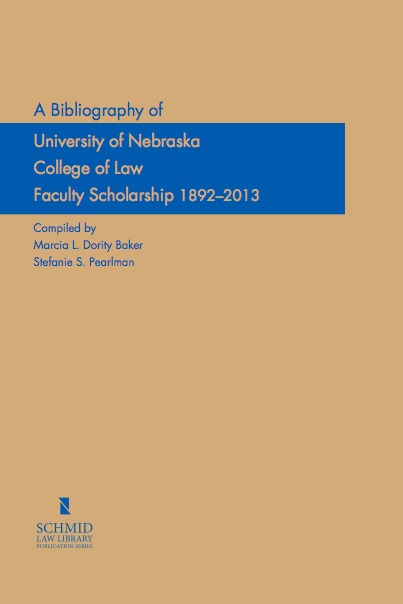
  Faculty Bib book cover

Two of the reference librarians at my school, Marcia Dority Baker and Stefanie Perlman, have compiled and published a bibliography of all the scholarship by Nebraska College of Law faculty going back to 1892: Marcia L. Dority Baker & Stefanie S. Perlman, A BIBLIOGRAPHY OF UNIVERSITY OF NEBRASKA COLLEGE OF LAW FACULTY SCHOLARSHIP 1892-2013 (2014).

I don’t know if others schools have done anything like this, but I think it’s a great idea. It’s really interesting to look at what people were writing one hundred years ago, and to consider the body of work of my current colleagues, only a couple of whom I believe were here a hundred years ago. I found the 14 pages of entries for the great legal scholar Roscoe Pound, including dozens of books, humbling.

On the domestic front, I’m happy to report that my listing is twice as long as my wife’s, although I’m not sure she will be happy to know that I reported that. I want to make it clear that she was not here a hundred years ago.

I’m trying out a new weekly blog post theme, “The Weekly BLT,” wherein I highlight a few interesting business law tweets that I’ve come across in the past week that have not yet made it to the BLPB.


The New York Times editorial board weighing in on, and against, corporate religious exemptions.

“The Supreme Court has consistently resisted claims for religious exemptions from laws that are neutral and apply broadly when the exemptions would significantly harm other people, as this one would. To approve it would flout the First Amendment, which forbids government from favoring one religion over another — or over nonbelievers.”

And they cite the corporate law professors’ brief, writing:

“as an amicus brief filed by corporate law scholars persuasively argues, granting the religious exemption to the owners would mean allowing shareholders to pass their religious values to the corporation. The fundamental principle of corporate law is a corporation’s existence as a legal entity with rights and obligations separate from those of its shareholders.”

Congratulations to the main brief writing team for a document that has generated a lot of debate and raised the profile of the corporate law issues in this case.

-Anne Tucker

Professors Lucian Bebchuk and Robert Jackson have recently posted a paper to SSRN, Toward a Constitutional Review of the Poison Pill.  In the paper, they argue that state laws that facilitate the use of “poison pills” are unconstitutional in the sense that they are in conflict with the Williams Act, because they have the potential to introduce undue delay into the tender offer process.  To the extent Profs. Bebchuk and Jackson purport to be summarizing existing doctrine, I have my doubts….

[More after the jump]

Continue Reading Are poison pills unconstitutional?

Statutory provisions allowing for the formation of Delaware Public Benefit Corporations (“PBCs“) went effective August 1, 2013.  According to the latest data I have, 87 PBCs have been formed in Delaware .

While 87 is an extremely small number when compared to the more than 1 million entities formed in Delaware, Delaware has already bested all states that have passed a benefit corporation statute, except for California.  California, which has a 20 month head-start on Delaware, has 139 benefit corporations.

Some states, like New Jersey and South Carolina have been stuck at fewer than 5 benefit corporations for well over a year.

The group of researchers I am working with now estimates that there are about 350 benefit corporations in the U.S. (including PBCs), though the data is relatively difficult to obtain from the secretary of state’s offices and obtaining reliable, complete data is even more difficult.

Currently, there are no significant tax benefits (at the state or federal level) for social enterprises (like PBCs and benefit corporations) in the U.S., but the U.K. recently announced 30% tax relief for their social enterprises. (The U.K. social enterprises are a good bit different than those in the U.S.). 

It will be interesting to see if the benefit corporation form increases in popularity or languishes. 

Obviously, if tax breaks were given to benefit corporations in the U.S., popularity would likely rise.  That said, tax breaks would also likely lead to misuse of the form and the need for additional oversight.  (Additional oversight is already in place in the U.K.)

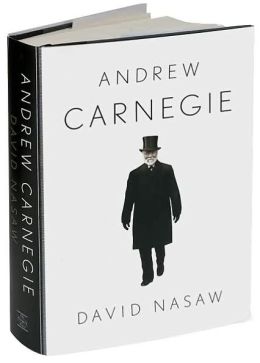
Carnegie
On spring break, I found a hardcover copy of Professor David Nasaw’s biography of Andrew Carnegie in a Boone, NC thrift shop for $1.  (Good books and good deals are two of my favorite things).  A New York Times book review is available here.

I only made it about 200 pages into the fascinating 801 page biography before returning to work.  I am currently on page 293, but already have some thoughts to share.

Before digging into this book, “failure” was one of the last words I would have associated with Andrew Carnegie.  Carnegie is well known as one of the “captains of industry” (in the steel business) and as an extremely generous philanthropist.  Even the word “struggle” is not a word I would have associated with Andrew Carnegie; from a distance, everything seemed to come easily for him.

But, like most of us, Carnegie experienced failure, and his life was marked by numerous struggles.

[More after the break] 

Continue Reading Andrew Carnegie, Struggle, and Failure

My op-ed on the Hobby Lobby case, A Bad Investment: Recognizing Religous Rights of Corporations, is available on Huffington Post. 

The Hobby Lobby arguments are couched in terms of religious freedom, but it is hard to see the net gain for liberties when such a rule could require religious disclosures and could lead to restricting investments to religiously like-minded investors. Elevating private religious beliefs to a matter of market importance threatens to chill the marketplace and erodes the long-respected boundaries between private religious beliefs, the realm of the state and the role of the marketplace.

I will be attending the Hobby Lobby oral arguments at the Supreme Court.  I will be posting updates and analysis here and at twitter (@Anne_M_Tucker) on March 25th (day of argument) and the 26th.

-Anne Tucker

It’s proxy season and the Conference Board has released a series of reports on investor engagement and corporate governance. In “The Conference Board Governance Center White Paper: What is the Optimal Balance in the Relative Roles of Management, Directors, and Investors in the Governance of Public Corporations?” the authors provide a 76-page overview of the evolution of US corporate governance, describing key trends and issues.

The report begins by discussing the history of the allocation of roles and responsibilities for governance of public companies. If I thought my law students would read it, I would assign this section to them.  The second part of the paper addresses the legal, social and market trends that have influenced the historical allocation of rights. Specifically, it reviews:

a) the increasing influence of institutional investors resulting from the concentration of ownership in institutional investment, changes in voting rules and practices and more assertive shareholder activism;

b) shifting conceptions about the purpose of the corporation and the duty to maximize corporate value, with a strong emphasis on shareholder wealth maximization;

c) decreased public trust of business leaders following the corporate scandals of 2001-2002 and 2007-2008;

d) federal regulation intended to enhance the influence of shareholders and increase board and management accountability;

e) continuing related to executive compensation and incentives; and

f) the growth of proxy advisory firms in the shareholder voting process. 

Some interesting statistics:

a) in 2013, 25% of all shareholder proposals were sponsored by two individuals and their family members and family trusts;

b) from 2006-2013, 33% of shareholder proposals submitted to Fortune 250 companies were sponsored by investors affiliated with labor; 26% by corporate gadflies; 25% by religious, social impact and public policy organizations; and 15% by other individual investors;

c) 241 activist campaigns were launched in 2012 up from 187 in 2009;

d) 69% of proxy contests against the management of Russell 3000 companies during the 2013 proxy season were launched by activist hedge funds; and

e) one third of the activist hedge fund contests sought full control of the board.

The third part of the report briefly summarizes but does not provide any conclusions about the work of Professors Bainbridge, Stout, Anabtawi, Bebchuk, Laverty, and others. It considers the following questions (but does not answer them):

a) Do federal mandates undermine the benefits of a historically state-driven corporate law?

b) Are further changes to board processes and composition desirable?

c) Should shareholders assume a more active role in corporate governance?

d) Do proxy advisory firms replace, rather than augment, the shareholder voice, and should the proxy advisory industry be subject to greater regulation and oversight?

e) Can changes to voting mechanisms improve the effectiveness of corporate governance?

f) Is short-termism a cause of concern, and is so, what are its causes and remedies?

g) What new challenges are presented by vote decoupling, high-speed trading, and hyper portfolio diversification?

In next week’s post I will discuss the “Guidelines for Engagement” and the “Recommendations of the Task Force on Corporate/Investor Engagement.” In the meantime, I highly recommend downloading these complimentary reports.