
A friend and current Delaware attorney just sent me this article from Delaware Online:  Bouchard seen as Chancery candidate.  

Interestingly, Andre Bouchard had been the chairman of the Delaware Judicial Nominating Commission since 2011, and he recently resigned from that position.  Bouchard is currently the managing partner of Bouchard Margules & Friedlander, P.A. in Wilmington, Delaware.   

From what I hear from my friends who practice in Delaware, Bouchard is well-respected and would make an excellent Chancellor.  

According to the article, and as I suspected here, current Vice Chancellor Travis Laster is also in the conversation regarding the next Chancellor.  Superior Court Judge Jan Jurden is being mentioned as a possibility as well.  Previously, Judge Jurden had been considered a serious contender for the Chief Justice of the Supreme Court of Delaware position that ultimately went to Chancellor Strine.

Stay tuned. 
My dear friend, mentor, and colleague John Gradwohl died yesterday. John, the Judge Harry A. Spence Professor of Law, taught on the faculty at the University of Nebraska College of Law for over 50 years. I don’t know what I will do without him around. I know few of you knew John, but it’s your misfortune that you didn’t.

When I came to Nebraska from Dallas 27 years ago, without a friend within 500 miles and without a clue about how to be a legal academic, John virtually adopted me and my family. We stayed at his house when we first visited Lincoln to look for a home. My wife, kids, and I attended family Christmas parties at his house. He took an active interest in my children as they grew up and became adults. The uniform reaction of my children when I told them yesterday that he had died was, “He was such a nice man.”

My office has been next to John’s since I arrived at Nebraska, and we were often in each other’s offices. John shared his knowledge freely and tried to keep me from making stupid academic mistakes. (My usual approach to academic discourse is “Ready, fire, aim.”) When I stubbornly ignored John’s advice and did something stupid anyway, he never said “I told you so.” (O.K., he did, but always in a sweet way.)

John was a very intelligent, perceptive man, an expert in labor arbitration, legislation, and tax law. He taught a very demanding, but well-liked legislation seminar. And, even though I’m a securities law expert, John and I often bounced ideas off each other. His advice improved my teaching and writing in countless ways.

But John’s academic side is not what I will remember most about him. I will never forget his sarcastic sense of humor, the mischievous look in his eyes when he had some law school gossip to share, and his willingness to identify bull**** for what it was. He even had a stamp that said bull**** on it; when a particularly egregious piece of nonsense came to him in the mail, he never hesitated to stamp it and return it to the sender. (John’s stamp had the full word spelled out; as I type, I can hear John chuckling about my unwillingness to use the full word bull**** in this post.)

John was like a father to me. When I came in this morning, it hurt inside to see the nameplate on his door, knowing that I would never share another conversation or joke with that wonderful man. I’ll miss you, John. The world will miss you.

[Update: Here is John’s obituary.]

Frederick Mark Gedicks & Rebecca G. Van Tassell recently posted “RFRA Exemptions from the Contraception Mandate: An Unconstitutional Accommodation of Religion” on SSRN (HT: Robert Esposito).  Here is excerpt of the abstract:

Litigation surrounding use of the Religious Freedom Restoration Act to exempt employers from the Affordable Care Act’s “contraception mandate” is moving steadily towards resolution in the U.S. Supreme Court. Both opponents and supporters of the mandate, however, have overlooked the Establishment Clause limits on such exemptions.

The heated religious-liberty rhetoric aimed at the mandate has obscured that RFRA is a “permissive” rather than “mandatory” accommodation of religion — a government concession to religious belief and practice that is not required by the Free Exercise Clause. Permissive accommodations must satisfy Establishment Clause constraints, notably the requirement that the accommodation not impose material burdens on third parties who do not believe or participate in the accommodated practice.

While it is likely that RFRA facially complies with the Establishment Clause, it violates the Clause’s limits on permissive accommodation as applied to the mandate. RFRA exemptions from the mandate would deny the employees of an exempted employer their ACA entitlement to contraceptives without cost-sharing, forcing employees to purchase with their own money contraceptives and related services that would otherwise be available to them at no cost beyond their share of the healthcare insurance premium.

Neither courts nor commentators seem aware that a line of permissive accommodation decisions prohibits shifting of material costs of accommodating anti-contraception beliefs from the employers who hold them to employees who do not. Many of the Court’s decisions under the Free Exercise Clause and Title VII also exhibit this concern with cost-shifting accommodations. Yet, one federal appellate court has already mistakenly dismissed this cost-shifting as irrelevant to the permissibility of RFRA exemptions from the mandate.

The impermissibility of cost-shifting under the Establishment Clause is a threshold doctrine whose application is logically prior to all of the RFRA issues on which the courts are now focused: If RFRA exemptions from the mandate violate the Establishment Clause, then that is the end of RFRA exemptions, regardless of whether for-profit corporations are persons exercising religion, the mandate is a substantial burden on employers’ anti- contraception beliefs, or the mandate is not the least restrictive means of protecting a compelling government interest.

A lot of chatter this week surrounding the submission of an amicus brief filed in the Hobby Lobby case by corporate and criminal law professors in support of petitioners.  In particular, Stephen Bainbridge has written a series of posts critical of the brief:


I was one of the 44 law professors that signed on to the amicus brief, and I also have a tremendous amount of respect for Prof. Bainbridge, so I’ve been very interested in what he’s had to say.  However, I’m also currently trying to advance my latest writing project (relatedly, on the intersection of corporate governance theories, theories of corporate personality, and corporate social responsibility) to some semblance of completeness that I can submit to journals with a straight face in the next few weeks.  Thus, I am going to pass on addressing Bainbridge’s critiques for now – except for briefly responding to his claim that there is some inconsistency between arguing that the Supreme Court should respect corporate personhood in Hobby Lobby (the brief states: “this legal separateness—sometimes called legal ‘personhood’—has been the very basis of corporate law at least since the 18th Century”) while at the same time bemoaning the application of that corporate personhood in Citizens United (while I won’t speak for my co-signers, I think it is fair to assume many are critics of Citizens United and I personally have expressed my disagreement with the opinion in various places, including here).

By way of background, the three primary theories of corporate personality are aggregate theory, real entity theory, and concession theory (AKA artificial entity theory).  At the risk of over-simplifying, aggregate theory and real entity theory essentially presume corporations stand in the shoes of natural persons (e.g., shareholders in the former case, and the board of directors in the latter), and thus have available to them all the rights of natural persons in resisting government regulation.  Concession theory, on the other hand, views the corporation as fundamentally a state creation, and presumes the state has the right to regulate its creation as it sees fit.  Importantly, concession theory does not preclude granting particular rights of natural persons to corporate entities, and it certainly doesn’t preclude doing so by including “corporation” in the definition of “person” for purposes of a particular rule, regulation, or statute.  It just doesn’t presume that all the rights of natural persons are automatically transferred to corporations upon their creation.

I focus on presumptions, and the concomitant allocation of burdens of proof, because I believe these issues were critical in Citizens United.  The majority presumed that corporations were entitled to the same political free speech rights as natural persons, and placed the burden of proving that this right was subject to limitation on the basis of corporate status alone on the state.  Meanwhile, the dissent argued that the burden was on those claiming free political speech rights for corporations and presumed the legislative determinations regarding the corrupting influence of corporate spending on politics were sufficient to uphold the relevant regulation.  Accordingly, while many commentators disagree as to whether aggregate or real entity theory animated the Citizens United majority, most of those to have considered the issue agree it was one of two (I believe the key line in the opinion is: “[T]he Government cannot restrict political speech based on the speaker’s corporate identity.”).  On the other hand, I believe most – though certainly not all — of the commentators that have considered the issue appear to agree that concession theory animated the dissent’s position (despite the dissent’s express protestations to the contrary). 

Thus, I believe the better characterization of the relevant issue is not whether corporations are persons (we can all likely agree that corporations are entitled to personhood rights at the very least for a variety of relatively non-controversial purposes), but rather which rights of personhood corporations should be entitled to.  In Hobby Lobby, the issue is not whether corporations should ever be deemed persons under the law, but rather whether corporations should be deemed legal persons that are entitled to rights of religious freedom identical to natural persons and, if so, in what situations and to what extent.  I see no inconsistency in arguing that corporate personhood should not include religious freedom rights co-extensive with natural persons while at the same time arguing that corporate personhood should also not include political free speech rights co-extensive with natural persons.

During my brief academic career, I have focused the majority of my research on social enterprise law.  While I have expressed my disagreement with various parts of the current social enterprise statutes, I have tried to make constructive suggestions for improvement, and am largely in favor of businesses that have a society-focused mission.

Lately, I have been thinking about whether my oral and written support of socially responsible businesses significantly impacts my purchasing behavior. 

Frankly and regrettably, the social responsibility of a given company is usually merely a “tie-breaker” in my purchasing decisions.  In my Social Enterprise Law seminar last spring, the class concluded, after doing case studies on a number of social enterprises, that for-profit social enterprises likely need a business plan that is just as good as a traditional for-profit company to be sustainable and successful.  Social enterprises that used their social responsibility as a crutch often failed or performed poorly. 

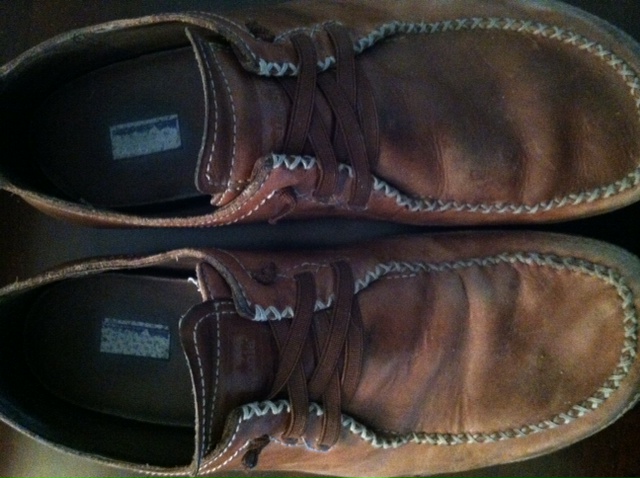
Patagonia is a socially responsible company that I have supported religiously — long before I started writing in the area.  You can see my worn out Patagonia shoes below.  While Patagonia’s products may be expensive, their value proposition is strong.  Those shoes cost me less per day worn than any other shoes I have ever purchased. (My wife has been trying to get rid of these shoes for years and is probably going to be mortified that I posted a picture of them, if she ever finds this post). 

More recently, I have made purchases from Method, Better World Books, Plum Organics, Ben & Jerry’s, and other socially responsible businesses (or at least companies that market themselves as socially responsible) with varying levels of satisfaction.  In Nashville, we frequent a number of restaurants that attempt to buy fair trade and from local sources. 

When we moved into our new home a little over a week ago, we used The Green Truck Moving Company.  (They gave us a small discount for tweeting about the service, but had no involvment in or knowledge of this post).  The Green Truck Moving Company plants two trees for each move, has trucks that run on biodiesel, recycles your boxes, and had the friendliest movers I have ever encounteredI have moved over a dozen times in my life, and they did a great job, but, frankly, I probably would not have used them if they were not competitive on price with their more profit-focused peers. 

One of the reasons that more consumers are not willing to pay significantly more for socially responsible products may be that they do not trust the claims put forward by the companies.  For example, Professor Alicia Plerhoples (Georgetown) recently profiled a for-profit college with a seemingly poor track record that took advantage of one of the new social enterprise legal forms.

My students (and many other people around their age), however, seem to have a strong and growing interest in socially responsible products and businesses.  The law is evolving quickly in that area and will hopefully address the accountability issues. 

For those who are interested in further reading regarding consumer willingness to purchase from socially responsible companies, here is information on a recent Nielsen survey and a link to an article entitled Are People Willing to Pay More for Socially Responsible Products: A Meta – Analysis.  (Thanks to Professors Cass Brewer (Georgia State) and Peter Roberts (Emory) for the links).

Shoes

As I have mentioned before, there appears to be no official “meat market” for legal studies positions in business schools.  I found my current job through Higher Ed Jobs, and thought Higher Ed Jobs was the best source during my search.  Also, the Chronicle of Higher Education’s Vitae recently launched (though they have had a jobs board for quite some time) and is likely worth frequenting.

For those still on the market, I wanted to highlight two recent business law postings: Southeast Missouri State University and University of Alaska (Fairbanks).  Both positions appear to be tenure-track legal studies positions in business schools.  Also, both schools are AACSB-accredited.  (There are multiple accrediting bodies for business schools, and AACSB is the gold standard). 

I maintain that being a professor is the best job in the world (especially given that my childhood dream of becoming an NFL quarterback is looking less glamorous in light of all the talk about concussions and chronic traumatic encephalopathy (CTE)). 

Wishing success for our readers who are on the professor market. 

Professor Caroline Mala Corbin from University of Miami has written an interesting article on the Hobby Lobby and Conestoga Wood Specialites Corp. cases before the Supreme Court. Her abstract is below:

Do for-profit corporations have a right to religious liberty? This question is front and center in two cases before the Supreme Court challenging the Affordable Care Act’s “contraception mandate.” Whether for-profit corporations are entitled to religious exemptions is a question of first impression. Most scholars writing on this issue argue that for-profit corporations do have the right to religious liberty, especially after the Supreme Court recognized that for-profit corporations have the right to free speech in Citizens United. 

This essay argues that for-profit corporations should not – and do not – have religious liberty rights. First, there is no principled basis for granting religious liberty exemptions to for-profit corporations. For-profit corporations do not possess the inherently human characteristics that justify religious exemptions for individuals. For-profit corporations also lack the unique qualities that justify exemptions for churches. Citizens United fails to provide a justification as its protection for corporate speech is based on the rights of audiences and not the rights of corporate speakers. Second, as a matter of current law, neither the Free Exercise Clause nor the Religious Freedom Restoration Act recognizes the religious rights of for-profit corporations. Finally, corporate religious liberty risks trampling on the employment rights and religious liberty of individual employees.


I recently discovered that YouTube hosts a collection of content related to contracts. If you teach this first year course, it is at least worth browsing through the options to see if you can include something in class, a follow-up email to students, or linking through your course website.  These videos are silly and hard to believe that one could devote so much time to a task like “contracts” songs, but bless those who do.  

Collection of Contracts Songs #1: 

Collection of Contracts Songs #2

If you use other content in your first year contracts course, please leave a comment or send me an email. I will update the post with your suggestions.

-AT

Last week, after a post here, I received a call from a Charleston (WV) reporter seeking some background on veil piercing as it relates to the company (Freedom Industries) linked to a chemical spill that left 300,000 people without clean drinking water.  That conversation led to a rather long article, as newspapers go, on the concepts of veil piercing in West Virginia.  The article did a rather good job of relaying the basics (with a few nits), and I hope it at least informs people a little bit about the process to follow on that front. 

The article does reflect a little confusion over what I was trying to communicate about personal liability for the president of Freedom Industries. West Virginia law provides: (b)“Unless otherwise provided in the articles of incorporation, a shareholder of a corporation is not personally liable for the acts or debts of the corporation except that he may become personally liable by reason of his own acts or conduct.W. Va. Code, § 31D-6-622 (emphasis added). I was trying (and I take responsibility for any lack of clarity) to reflect my view that it was conceptually possible that the company president could be found personally liable for the harm if there were activities undertaken in his personal (and not corporate) capacity, but that based on the facts currently available, that seemed unlikely to me. 

West Virginia courts have long reinforced the separate nature of the corporation and the shareholder. Consistent with prevailing views, the state recognizes each corporation as a distinct, individual entity that is separate and distinct from other corporations and from their respective shareholders. “The law presumes that two separately incorporated businesses are separate entities and that corporations are separate from their shareholders.” S. Elec. Supply Co. v. Raleigh County Nat. Bank., 173 W. Va. 780, 788, 320 S.E.2d 515, 523 (1984). In a proper case, courts will disregard the entity form—pierce the limited liability veil—where necessary to prevent injustice; however, courts take seriously this separate nature of corporations and shareholders, and “the corporate form will never be disregarded lightly.” Laya v. Erin Homes, Inc., 177 W. Va. 343, 347, 352 S.E.2d 93, 97 (1986) (quoting S. States Coop., Inc. v. Dailey, 167 W.Va. 920, 930, 280 S.E.2d 821, 827 (1981)); see also S. Elec. Supply Co. v. Raleigh County Nat. Bank., 173 W. Va. 780, 787, 320 S.E.2d 515, 522 (1984) (“The [veil piercing] doctrine is complicated, and it is applied gingerly.”).  Thus, while veil piercing is not impossible, it is a significant hurdle. 

I mentioned in a prior post that I thought enterprise liability (essentially collapsing various limited liability entities into one) was a more likely possible remedy for unpaid losses, though again it is by no means a given.  Much more information about how the various entities involved in the whole situation operated and interacted with one another will need to be discovered before the real likelihood of such an outcome can be reasonably predicted.  

Regardless of how that turns out, though, there is another issue worth noting, and that is the lack of government oversight.  The classic case on veil piercing and enterprise liability, Walkovszky v. Carlton, explained that complaints about the inadequacy of corporate insurance and others assets are not a problem for the courts to solve.  That court explained: 

if the insurance coverage required by statute “is inadequate for the protection of the public, the remedy lies not with the courts but with the Legislature.” It may very well be sound policy to require that certain corporations must take out liability insurance which will afford adequate compensation to their potential tort victims. However, the responsibility for imposing conditions on the privilege of incorporation has been committed by the Constitution to the Legislature (N. Y. Const., art. X, §1) and it may not be fairly implied, from any statute, that the Legislature intended, without the slightest discussion or debate, to require of . . . [such] corporations that they carry . . . liability insurance over and above that mandated by [law].”  Walkovszky v. Carlton, 18 N.Y.2d 414, 419-420(N.Y. 1966) (citations omitted).

I don’t know if a court will pierce the veil or apply an enterprise liability theory to expand the available assets for victims of the chemical spill. There is a lot to be determined before we’ll see an outcome. Still, it needs to be clear that where a company acts within the parameters of its grant of limited liability, seeking additional compensation from others after the fact is improper. (Again, whether the companies involved acted appropriately is an open question.) 

If we’re uncomfortable with the cap on recovery for harms such as this, then randomly, haphazardly, and retroactively eliminating a state grant of limited liability protection is not the proper response.  There are other ways to help protect the public, such as proper permitting, oversight and enforcement at chemical storage sites, and increased insurance and/or bonding requirements.  State and federal legislatures should be discussing such options right now, and at least some discussions are occuring.  It is, though, disheartening to read that even while discussing stronger standards for chemical storage tank operators, the West Virginia Senate Natural Resources Committee also voted to reduce water quality standards for aluminum in state water.

The following call for papers comes to us from Janine Hiller (Virginia Tech):

I am pleased to announce a Call for Papers for a research colloquium focused on “Legal and Ethical Issues in Predictive Data Analytics.” The colloquium is co-organized and the resulting publication will be co-edited by Tonia Hap Murphy of  the University of Notre Dame. The colloquium of 8-10 scholars will be held at Virginia Tech, Blacksburg, Va. on June 19-20, 2014. Virginia Tech and the Center for Business Intelligence and Analytics are sponsoring the research meeting, and will pay for meals and lodging during the colloquium dates.


Predictive data analytics are used in a variety of settings and applications,  including personalized marketing, crime prevention, insurance, health care, and increasingly in the legal profession itself. Within the next few years, the sale of predictive analytics business software alone is forecast to reach billions of dollars and to be utilized in a wide variety of industries. In contrast to the growth of data analytics and predictive modeling, legal and ethical considerations have not been widely identified or discussed in academic literature. The goal of the colloquium is to provide leadership for research about these issues and to provide a vehicle for researchers to discuss their ideas, or to launch new ideas, about the intersection of law, ethics, and predictive data analytics.


To be considered, please submit an abstract of up to 750 words to Janine Hiller at jhiller@vt.edu, and copied to tmurphy1@nd.edu by March 3, 2014.  Abstracts will be evaluated based upon the quality of the abstract and the topic’s fit with other presentations.  Questions and a request for a copy of the full Call for Papers may be directed to Janine Hiller at jhiller@vt.edu or Tonia Hap Murphy at tmurphy1@nd.edu.