Vice Chancellor Laster has issued his opinion in the TripAdvisor case.  I’m still digesting it, but the overall framework does not surprise me.  As I can’t improve on the opinion’s recitation of the basic factual situation, here it is:

A Delaware corporation has two classes of stock. The CEO/Chair owns highvote shares carrying a majority of the outstanding voting power, giving him hard majority control. The board decides to convert the Delaware corporation into a Nevada corporation, and the CEO/Chair delivers the necessary stockholder vote. The board does not establish any protections to simulate arm’s length bargaining. The conversion is not conditioned on either special committee approval or a majority-ofthe-minority vote.

A stockholder plaintiff challenges the conversion.1 The plaintiff argues that Nevada law offers fewer litigation rights to stockholders and provides greater litigation protections to fiduciaries like the directors and the CEO/Chair. The plaintiff alleges that the directors and the CEO/Chair approved the conversion to secure the litigation protections for themselves. In support of those assertions, the plaintiff cites the materials the board considered, disclosures in the company’s proxy statement, the work of distinguished legal scholars about the content of Nevada law, and public statements by Nevada policy makers about the direction Nevada law has taken.

I appreciate that the opinion gives a neutral framework under Delaware law for how to assess liability for changes in governance and litigation rights.  Although it’s Nevada today, Tesla might be jumping to Texas tomorrow.  This decision provides guidance for how to think about that problem.  This passage does a good job presenting the issue:

Holding that the plaintiffs have stated a claim on which relief can be granted does not discriminate against Nevada entities. The same reasoning would apply if a Delaware corporation converted into another Delaware entity in a transaction with comparable implications. Using the contractual freedom conferred by the Delaware Limited Liability Company Act, entity planners can implement a wide array of governance schemes that provide fewer rights to investors than what stockholders in a Delaware corporation enjoy. If a Delaware corporation converted into a Delaware LLC where the governing agreement had eliminated all fiduciary duties, then the same reasoning would hold. Entity planners could even design a Delaware LLC that mirrors the internal governance structure of a Nevada corporation. If a Delaware corporation converted into that LLC, the outcome would be the same.

After deciding that the entire fairness standard will apply, the decision also clearly charts a path to leave Delaware without any liability:

Nor does this decision mean that a corporation can never leave Delaware without litigation risk. If a board proposed a similar conversion for a corporation without a stockholder controller, and if the fiduciaries fully disclosed the consequences of the change in legal regimes, including the effect on stockholder litigation rights, then the stockholders’ approval of the conversion would be dispositive, triggering an irrebuttable version of the business judgment rule. If directors proposed a similar conversion for a corporation with a stockholder controller, and if they properly conditioned the transaction on the twin MFW protections, then the dual approvals would be dispositive, again triggering an irrebuttable version of the business judgment rule.

For some public companies, Nevada may be a better fit than Delaware simply because of the cost issue.  Controlled corporations can exit with a two-step process and corporations without a controlling stockholder can make the move with a simple shareholder vote.

Going forward, a real challenge will be deciding how to value the change in litigation rights.  The opinion sketches out a possible market method:

The standard legal remedy is money damages. It seems quite likely that the court can craft a monetary remedy in this case that would be adequate. The remedial challenge will be to quantify the extent of the harm, if any, that moving from Delaware to Nevada imposes on the unaffiliated stockholders.

One way to determine the quantum of harm would be to value the Company pre-conversion as a Delaware corporation, then value the Company post-conversion as Nevada corporation, subtract the Nevada value from the Delaware value, and calculate a per share amount. That would be hard.

But there is another way to get at the delta. The Company’s stock has a trading price. In the conversion, nothing will change except the Company’s corporate domicile. Maffei’s control will remain constant. The Company’s business will remain constant. The only independent variable is the law governing its internal affairs.

Given that set-up, the change in the Company’s trading price should help quantify the harm, if any, caused by the conversion. As long as the market for the Company’s common stock is semi-strong-form efficient, then the price reaction should be indicative. Note that the stock price need not fairly approximate a pro rata share of the Company’s intrinsic value for the price reaction to matter. As long as any pricing disconnects remains consistent across variables other than the governing law, the price impact should provide insight.

From a Nevada perspective, the state will hope that companies trade up after these moves.  I previously proposed using markets to evaluate governance changes.  Although this method might shed some light on the valuation question, it’s going to be a challenge.  Of course, this may also open the door to some disclosure gamesmanship.  It seems possible that a corporation announcing or completing this kind of move to Nevada might also selectively reveal some positive information at the same time.  That would increase the likelihood the stock would trade up and perhaps cloud or mask any impact from investors selling on the loss of their governance rights. 

It’s probably worth also taking a look at other corporations that have made this move and what happens with their stock price.  If Delaware law and Nevada law are somewhat constant, you could likely get a better sense of the effect these moves have on valuation by getting a bigger dataset together.

If we’re looking at changes in litigation rights and using this framework here when a company shifts from Delaware to Nevada or from a Delaware Corp. to a Delaware LLC, would we also use it for other governance changes?  What about a move to amend the bylaws in some way that affects litigation rights or a move to add a 102(b)(7) provision to a corporate charter?  My first thought is that the same framework should apply.  

In any event, this is going to be fun to watch.
Dear BLPB Readers:

For those of you who might be interested in strengthening your knowledge of empirical methods, Northwestern Law School is offering two summer workshops on Research Design for Causal Inference.  An overview of the main workshop and its target audience is below.  The complete details of the main and advanced workshops are here.

“Main Workshop Overview

We will cover the design of true randomized experiments and contrast them to natural or quasi experiments and to pure observational studies, where part of the sample is treated, the remainder is a control group, but the researcher controls neither which units are treated vs. control, nor administration of the treatment. We will assess the causal inferences one can draw from specific “causal” research designs, threats to valid causal inference, and research designs that can mitigate those threats.

Most empirical methods courses survey a variety of methods. We will begin instead with the goal of causal inference, and how to design a research plan to come closer to that goal, using messy, real-world datasets with limited sample sizes. The methods are often adapted to a particular study.

Target Audience

Quantitative empirical researchers (faculty and graduate students) in social science, including law, political science, economics, many business-school areas (finance, accounting, management, marketing, etc.), medicine, sociology, education, psychology, etc. –  anywhere that causal inference is important.

We will assume knowledge, at the level of an upper-level undergraduate econometrics or similar course, of multivariate regression, including OLS, logit, and probit; basic probability and statistics including confidence intervals, t-statistics, and standard errors; and some understanding of instrumental variables. This course should be suitable both for researchers with recent PhD-level training in econometrics and for empirical scholars with reasonable but more limited training.”

From friend-of-the-BLPB Jessica Erickson:

The University of Richmond School of Law is looking for a visitor next spring (2025) in the business law area.  Specifically, we are looking for coverage for our Mergers & Acquisitions course, as well as either Securities Regulation or Business Associations. If you might be interested, please reach out to Kristen Osenga, our Associate Dean for Academic Affairs, at kosenga@richmond.edu.  I am also happy to answer any questions about the school and our fabulous students and faculty.

WayneLawLogo(2)

I have the privilege and honor to be in Detroit today to present the second annual Baiardi lecture at Wayne State University Law School.  Wayne Law is a bit of a second home for me (a status it enjoys with several other law schools).  I have presented at two symposia here (publishing twice, as a result, with the Wayne Law Review).  Also, Wayne Law was the academic pied à terre of Peter Henning, who was a trusted and dear mentor (and an accomplice in reasoning through insider trading and applied corporate governance questions) until his untimely death.

My lecture addresses aspects of a joint project I previewed at the National Business Law Scholars Conference at Tennessee Law last June.  The project is the brainchild of my Tennessee Law colleague Tomer Stein and involves taking a new approach to the ongoing debate about federalizing corporate law.  The talk offers some practical applied thoughts on the project and is entitled “Visioning (Not Advocating or Discounting) Federal Corporate Law.” I undoubtedly will have more to say on this topic as our work on the project progresses.  But if you think of or come across anything you deem relevant to the cause and have time to contact me or Tomer, I know we would be grateful for your insights and suggestions.

Screen Shot 2024-02-18 at 6.11.29 PM

[Please note that, although the notice above says the day of the week is a Thursday, I am speaking today–Monday.]

POSITION OVERVIEW

Position title: Executive Director of the Lowell Milken Institute for Business Law and Policy

Salary range: A reasonable estimate for this position is $200,000 to $250,000

APPLICATION WINDOW

Open date: October 30, 2023

Most recent review date: Sunday, Jan 7, 2024 at 11:59pm (Pacific Time)
Applications received after this date will be reviewed by the search committee if the position has not yet been filled.

Final date: Sunday, Mar 31, 2024 at 11:59pm (Pacific Time)
Applications will continue to be accepted until this date, but those received after the review date will only be considered if the position has not yet been filled.

POSITION DESCRIPTION

The Lowell Milken Institute for Business Law and Policy (“Institute”) is seeking an Executive Director with substantial practical experience in business law and policy to plan, oversee and execute the work of the Institute. The Institute is, by design, a dynamic one and the Executive Director will have significant opportunity to creatively shape the Institute’s mission and initiatives together with key faculty and leaders at UCLA School of Law. The Institute supports and expands educational opportunities, job-search support, academic scholarship, and policy analysis in business law and tax law. The goals of the Institute are to train the next generation of leaders in business law and to be an important resource for both scholars and practitioners in analyzing current issues in business law and tax law and developing policy solutions in response to those issues. The Executive Director will lead a talented team, and will oversee the Institute’s core programs, fundraising, and operation.

The full position description can be found here. Hat tip to friend-0f-the-BLPB Andrew Verstein.

The University of Cincinnati College of Law is currently undertaking a search for a new director of our Corporate Law Center. A description is below.  Hat tip to Kate Jackson.

About the Center

The Corporate Law Center at the University of Cincinnati College of Law was founded in 1987.  Its mission is to carry out  programs related to the education and training of students and others in the field of corporate law.  The Center has historically fulfilled its mission in a variety of ways, including the following: Awarding CLC fellowships to incoming law students, hosting an annual symposium devoted to trending topics in business law, supporting research, coursework, and other academic activities related to corporate law, sponsoring the student-led Business Law Society at the College of Law, supporting the Entrepreneurship and Community Development Clinic, which provides transactional legal services to start-ups, small businesses, and non-profit organizations; supporting the Patent & Trademark Clinic, which provides intellectual property legal services to individuals and businesses throughout the Cincinnati entrepreneurial ecosystem, and administering the Business Law Concentration for current law students.

Many of these activities continue to be enormously valuable. As part of the creation of a vision and strategic plan, the new Director will undertake a full programmatic review of the CLC and determine what kind of restructuring and reimagining is necessary to bring the CLC to the next level, as the leading national center of its kind.  Additional activities in this regard may include the creation of additional educational opportunities for students, a mentoring program, the establishment of an advisory board, and roundtables and seminars for members of the bar.

Job Overview

The College of Law seeks an innovative and dynamic leader to reinvigorate and reimagine its storied Corporate Law Center (“CLC”).  Reporting directly to the Dean and working closely with its Academic Director, the new Director of the CLC will be responsible for defining a vision for the CLC, developing the resources to carry the vision out, and raising the profile of the CLC so that it is properly recognized as one of the premier centers of the College of Law. 

The ideal candidate will be collaborative and visionary, with experience in transactional law and a passion for the educational mission of the College of Law.  The candidate’s background will reflect the potential to build strong and lasting partnerships with various constituencies both within and outside the institution to advance the mission of the Corporate Law Center.  The ideal candidate will also demonstrate the capacity to tailor academic and nonacademic programming to meet the unique needs of law students interested in transactional law.  Finally, the candidate will have a demonstrated track record of bringing a vision from its original conception through to full implementation.  

The position is structured as a two-year term, with the potential for extensions if the CLC is successful in obtaining funding to support the position for a longer period. 

Standard Days Worked: M-F
Type of Appointment: Full-Time (12 Months)
Work Location:  In-person.  The office location is University of Cincinnati College of Law, 2925 Campus Green Drive, Cincinnati, Ohio 45221.

Essential Functions

  • Undertake a full programmatic review of the CLC’s current activities.
  • Create a vision and a long-term strategic plan for the CLC.
  • Develop the resources necessary to carry out the plan. 
  • Build partnerships across campus and to the Cincinnati business community.
  • Research, design, and implement high quality programming in the area of corporate law.
  • Provide educational outreach to the transactional legal community through events, workshops, and collaboration with applicable partners.
  • Collaborate with College of Law leadership, faculty, and staff, as well as campus and community members.
  • Maintain data and provide reports on Center activities, as well as assessment of outreach and other efforts.
  • May provide direct and/or indirect supervision to exempt and non-exempt staff (i.e., hiring/firing, performance evaluations, disciplinary action, approve time off, etc.).
  • Perform related duties based on the needs of the Corporate Law Center.

Minimum Requirements

  • Demonstrated capacity for developing a vision and creating and carrying out a strategic plan.
  • Substantial capacity for fundraising.
  • Commitment to working collaboratively and building partnerships to advance the mission of the CLC and the College.
  • Strong communication skills.
  • Deep commitment to creating a culture of inclusive excellence and belonging.
  • Five years post-J.D. work experience in corporate legal practice or a related field.
  • Juris Doctor.

Additional Qualifications Considered

  • Experience with law teaching.
  • A record of published scholarship in corporate law and related fields.

Application Information

  • Interested and qualified applicants must apply online and include (i) a cover letter of interest, and (ii) a resume.  
  • Applications without a cover letter and resume will not be considered for the position. Please use the additional documents feature as needed for these items.

Fights over advance notice bylaws are becoming more common; I previously posted about Paragon Technologies v. Cryan, and right after that, VC Will decided Kellner v. AIM Immunotech.  In both situations, boards were found to have been overly aggressive in drafting and enforcing their bylaws, and VC Will went case by case to determine which actions were permissible and which were not.  And since the dissidents had not fully complied with even the permissible bylaws, VC Will would not order that their nominees be permitted to stand for election.

This strikes me as such a difficult problem.  On the one hand, there are good reasons for these bylaws, as both the Paragon and AIM disputes make clear.  In Paragon, the dissident really was playing games about providing information regarding its plans; in AIM, the contest was a continuation of one spearheaded a year earlier by a convicted felon who tried to conceal his involvement.  So yeah, boards have really legitimate interests in ensuring that shareholders have full information.

On the other hand, the blue pencil approach – where the noncompliant bylaws are severed and the legitimate ones remain standing – strikes me as having the same problem that’s been identified in the context of noncompetition agreements.  In the employment context, Chancery does not blue pencil, because:

To blue-pencil the provision creates a no-lose situation for employers, because the business can draft the covenant as broadly as possible, confident that the scope of the restriction will chill some individuals from departing. If someone does challenge the provision, then the worst case is that the court will blue-pencil its scope so that it is acceptable. It also enables employers to extract benefits at the expense of employees by including unenforceable restrictions in their agreements. The logical result of such a system is sprawling restrictive covenants.  Accordingly, “[w]hile, in some circumstances, a court may use its discretion to blue pencil an overly broad non[1]compete to make its restrictions more reasonable, this court has also exercised its discretion in equity not to allow an employer to back away from an overly broad covenant by proposing to enforce it to a lesser extent than written.”

Obviously, the employment context is not the same as an advance notice bylaw – dissidents are not nearly as vulnerable as employees – but there is, I think, a similar set of concerns.  If Delaware courts blue pencil the bylaws back to what – ex post – is determined to be reasonable, then boards have no incentive not to draft the most lengthy and unreasonable bylaws they can.  The dissident then has to guess at which ones are and are not permissible, and comply with the right set of bylaws – reveal too much and make themselves vulnerable, too little and disqualify themselves – while mounting an expensive court challenge that won’t necessarily create useful precedent for the next set of creative bylaws.

One aspect of the AIM case highlights the problem.  In 2016, the board had adopted a bylaw requiring disclosure of “all arrangements or understandings between such stockholder and each proposed nominee and any other person or persons (including their names) pursuant to which the nomination(s) are to be made.”  In 2023, after having dealt with the convicted felon’s earlier contest, the board amended the bylaw to broaden that provision and capture associates and family members in a manner that VC Will found was unreasonable.  When the dissidents challenged the amended bylaw, rather than strike it entirely, Will decided to restore it to the narrower, 2016 version, and measured the dissidents’ compliance against that bylaw – the one that did not exist anymore.  The dissidents had not complied with the bylaw that did not exist, and that was one of the reasons why VC Will affirmed the board’s decision not to permit them to advance their nominees. 

Now, given the peculiar facts of this case, I’m not troubled by that result, but notice the bind this would have placed on a good-faith dissident slate.  They would have found it nearly impossible to guess what information was actually required of them.

I wonder, then, if the solution is to set some kind of blanket rule that certain types of bylaws are almost always going to be permissible.  If the board adopts bylaws that go beyond that floor, it does so at its own risk – if any additions are deemed unreasonable, all are struck, but the floor (to the extent adopted by the board) remains intact.  That way, dissidents know what the floor is for compliance, and there is no risk that, say, a felon gets through without any disclosure just because the board was overzealous.  Meanwhile, if the board has genuine need for information beyond the floor, it has an incentive to be judicious in crafting its additional requirements.

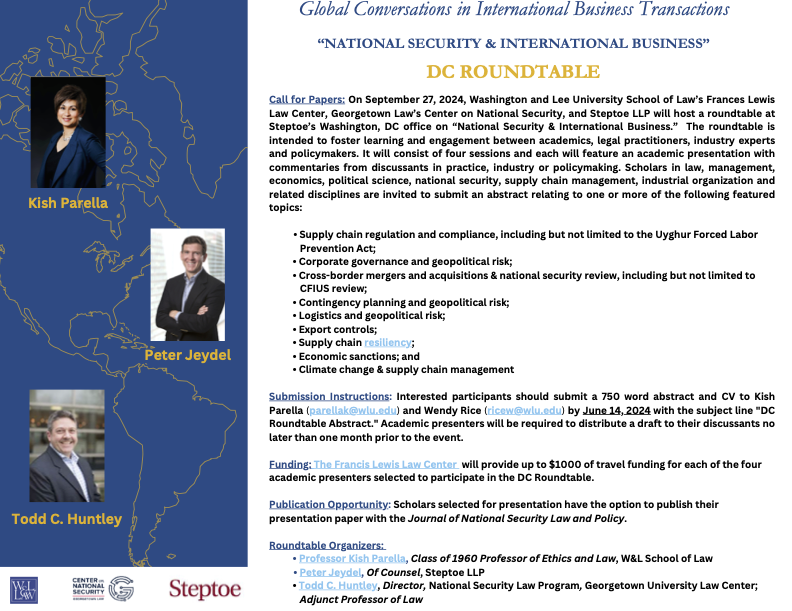
National Business Law Scholars Conference (NBLSC) 

June 24-25, 2024 

Call for Papers 

The National Business Law Scholars Conference (NBLSC) will be held on Monday and Tuesday, June 24-25, 2024, at The University of California, Davis School of Law. 

This is the fifteenth meeting of the NBLSC, an annual conference that draws legal scholars from across the United States and around the world. We welcome all scholarly submissions relating to business law. Junior scholars and those considering entering the academy are especially encouraged to participate. If you are thinking about entering the academy and would like to receive informal mentoring and learn more about job market dynamics, please let us know when you make your submission. 

Submission Guidelines: 

Please fill out this form to register and submit an abstract by Friday, March 15, 2024. Please be prepared to include in your submission the following information about you and your work: 

Name 

E-mail address 
Institutional Affiliation & Title 
Paper title 
Paper description/abstract 
Keywords (3-5 words) 
Dietary restrictions 
Mobility restrictions 

If you have any questions, concerns, or special requests regarding the schedule, please email Professor Eric C. Chaffee at eric.chaffee@case.edu. We will respond to submissions with notifications of acceptance a few weeks after the submission deadline. We anticipate the conference schedule will be circulated in late April. 

Conference Organizers: 

Afra Afsharipour (University of California, Davis, School of Law) 
Tony Casey (The University of Chicago Law School) 
Eric C. Chaffee (Case Western Reserve University School of Law) 
Steven Davidoff Solomon (University of California, Berkeley School of Law) 
Benjamin Edwards (University of Nevada, Las Vegas Boyd School of Law) 
Joan MacLeod Heminway (The University of Tennessee College of Law) 
Nicole Iannarone (Drexel University Thomas R. Kline School of Law) 
Kristin N. Johnson (Emory University School of Law) 
Elizabeth Pollman (University of Pennsylvania Carey Law School) 
Jeff Schwartz (University of Utah S.J. Quinney College of Law) 
Megan Wischmeier Shaner (University of Oklahoma College of Law) 

Look, it’s not like I want to post about Elon Musk every week, it’s just that he keeps doing things that result in interesting corporate governance conundrums.  So this week’s post covers several things, only one of which is a Musk thing.

The Musk Thing

After Chancellor McCormick struck down his Musk’s 2018 pay package, one bit of speculation that floated about was whether Musk could sue Tesla to recover the package, on some kind of restitution/quantum meruit theory.  My suspicion is that such a claim would be unlikely to succeed because Musk’s own fiduciary breaches are what led to the original forfeiture, and he who comes into equity must do so with clean hands.  Or, as the famous jurist Leo Rosten put it, it would be like “a man who, having killed his mother and father, throws himself on the mercy of the court because he is an orphan.”

But despite the dubious merit such a claim would have, given the close ties McCormick identified between Tesla’s board and Elon Musk, there would be a risk that the board would take a dive and settle unnecessarily.

(More under the cut)

Continue Reading This Post is Not (Just) About Elon Musk