
A recent study, Who Owns West Virginia? (full report pdf), gives a glimpse into the land ownership in the state.  The report finds that much of the state’s private land is “owned by large, mainly absentee corporations, [but] the list of top owners – once dominated by energy, land holding and paper companies – now includes major timber management concerns.”  

As reported by Ken Ward Jr. in the Charleston Gazette, the report finds that “[n]one of the state’s top 10 private landowners is headquartered in West Virginia.”  Although it is accurate that the top ten owners are not indivdual owners,  I will note that not all of the top ten owners are “corporations.”  There is at least one master limited partnership and one limited liability company (LLC).  That may not mean much in the sense of absentee ownership, but it is a doctrinal distinction I maintain is still important.  

It’s not shocking that these entity owners would be out of state, especially because that was true back in 1974, too, when the last study was done.  There are relatively few large entities chartered or headquartered in West Virginia, and it appears that many of the state chartered companies that were around in 1974 have since been acquired by larger, out-of-state entities. Absentee ownership is hardly a new, or even modern, phenomenon in the state. The report notes: “By 1810, as much as 93 percent of land in present day West Virginia was held by absentee owners, more than any other state in the region and likely any other state in the Union.”  Much of the ownership is still based in the region, though, as many of the large companies holding West Virginia land are based in Virginia. 

Other highlights:

Although the purchase of West Virginia’s land by timber management companies is perhaps the most interesting finding by investigators for this report, researchers also found:

  • The top 25 private owners own 17.6 percent of the state’s approximately 13 million private acres.

  • In six counties, the top ten landowners own at least 50 percent of private land. Of the six, five are located in the southern coalfields – Wyoming, McDowell, Logan, Mingo and Boone. Wyoming County has the highest concentration of ownership of any county.

  • Not one of the state’s top ten private landowners is headquartered in West Virginia.

  • Many of the counties – including Harrison, Barbour, Mineral, Lincoln, and Putnam – that had high concentrations of absentee corporate ownership (over 50%) in Miller’s 1974 study did not in this analysis. 

  • Only three corporations that were among the state’s top ten landowners in 1974 remained on that list in 2011. If the sale of MeadWestvaco properties to Plum Creek Timber is completed, only two of the 1974 top owners will still be on the list.

  • Nationally timberland management concerns control about half of the nation’s timberlands that had been managed by industrial timber companies until the 1980s.


Finally, another potentially important finding is different level of entity ownership by region as related to the minerals beneath the land — coal and natural gas. The study found:

There are also large geographical disparities in the share of large private landowners in the state. All but one of the counties where the top ten landowners owned at least 50 percent of the private land is in the southern coalfield coalfields – Wyoming, McDowell, Logan, Mingo and Boone. In the Marcellus gas field counties of the northeast and north-central part of the state, the private land ownership is less concentrated and tends to be owned more by individuals than large out-of-state corporations. 

The study looked only at surface ownership, and not mineral rights ownership, so it’s hard to tell if this gives an accurate look at the level of entity ownership in the Marcellus Shale. Moreover, mineral estates may be owned by private individuals who have leased their rights to entities, so it may be that even more of the state’s  property rights are effectively controlled by entities.  The report indicates more study would be useful here, and I concur.

The takeaway:  This report has the potential to be a good starting point for considering how to move the state forward in trying times.  As the study notes:  “[S]tudying patterns of land ownership in West Virginia through the lens of the 2011 tax data can help us understand our history, make wise policies in the present and better map the future of the state.”  

I think that’s right.  To me, a big cavaet is to ensure that the report be used to react to what is and to plan for what could be, rather then getting bogged down in what was or could have been.  If people spend their time lamenting that outside corporations own land in the state, they will be missing the opportunity to do something positive for the future, like figuring out what can be done to promote sustainable development in the state by working with the current landowners.  I hope the focus is primarily on the latter.  There have already been enough missed opportunities. 
Thanks to Professor Brian Quinn (Boston College) for passing along the video posted below on “Material Adverse Change” in the M&A Context (Part 1) from law firm Weil Gotshal.  Weil Gotshal has posted a number of similar clips, which I have found useful in the past. 


This past Sunday, Robert B. Schumer (Paul Weiss) authored a related post over at the Harvard Law School Forum on Corporate Governance and Financial Regulation.  His post is entitled “Delaware Court: Missed Sales Forecasts Could be ‘Material Adverse Effect”‘ and opens with the following paragraph:

In Osram Sylvania Inc. v. Townsend Ventures, LLC, the Delaware Court of Chancery (VC Parsons) declined to dismiss claims by Osram Sylvania Inc. that, in connection with OSI’s purchase of stock of Encelium Holdings, Inc. from the company’s other stockholders (the “Sellers”), Encelium’s failure to meet sales forecasts and manipulation of financial results by the Sellers amounted to a material adverse effect (“MAE”). The decision was issued in the context of post-closing indemnity claims asserted by OSI against the Sellers and not a disputed closing condition.

Few, if any, Delaware cases have found a triggering of a MAC/MAE clause, but such cases obviously depend on the wording of the agreement and the relevant facts.  Read the entire post here

If you have an interest in entrepreneurship and innovation, or if you just want to know more about the company whose boxes are currently appearing on porches across the nation, read Brad Stone’s new book, The Everything Store: Jeff Bezos and the Age of Amazon.

Stone is not a corporate shill; his portrait of Bezos is not always flattering. But the book is well written and entertaining, and a good study of what made Amazon successful. Budding entrepreneurs could derive a number of important lessons from Jeff Bezos.

The Goal of a Business is to Serve Customers

Entrepreneurs often chase the wrong rabbit. The goal of a business is not to create the fanciest technology. The goal of a business is not to get ready to make a public offering. The goal of a business, and the way it makes money, is to serve customers—to fulfill some customer need more effectively than any other company.

It’s clear that customers have been Bezos’ top priority from the beginning, and that’s what has made Amazon successful. The most obvious example of that philosophy? Putting both positive and negative customer reviews on the Amazon web site. We take that for granted now—many online retailers do it—but it was business heresy at one time. I have foregone some purchases because of those negative reviews, but those reviews are also one of the main reasons I keep going back.

Innovation: You Have to Break Eggs to Make an Omelet

Forgive the cliché, but innovation depends on risk-taking. For every success, there are many, many failures. Jeff Bezos has wasted a lot of money going down blind alleys, but once in a while, those ideas have paid off in a major way. Amazon is successful because of its willingness to fail.

“Good Enough” is Not Good Enough

It is clear from The Everything Store that Bezos is driven to succeed. He demands results and he doesn’t tolerate failure. I don’t think I would want to work for Bezos. If Stone’s portrayal is accurate, Bezos can sometimes be an unpleasant person; ridicule is one of his tools. But that drive, that demand for results, is one of the reasons Amazon has become such a giant.

Costs Matter Too

Profitability depends on two things, revenues and expenses. You have to be willing to spend money to make money (Cliché No. 2). But that doesn’t mean you should spend as much money as possible. I read a lot of business history and the level of extravagance at some start-up companies amazes me.
Bezos is, to put it bluntly, cheap. He doesn’t waste money. He may take the idea so far as to make it a fetish, but that’s better than the alternative.

The “Everything” Store

I highly recommend Stone’s book. It’s an entertaining look at how one company went from start-up to behemoth.

Richard Schragger & Micah Schwartzman have posted “Some Realism about Corporate Rights” on SSRN.  Here is the abstract:

Can we meaningfully speak of a church’s right to conscience or a corporation’s right to religious liberty? One way to approach this question is by inquiring into the nature of churches and corporations, asking whether these are the kinds of entities that can or should have rights. We have recently seen this kind of reasoning in public debates over whether corporations have free speech rights, and, relatedly, in arguments about the religious free exercise rights of churches, non-profits, and for-profit corporations. Those in favor of such rights sometimes argue that corporations and churches are moral agents, capable of exercising rights separate and apart from the rights and interests of their members; whereas, those opposed tend to argue that churches, corporations or groups are mere aggregations of individuals, or else artificial persons created or recognized by the state to advance the interests of those who compose them.

In this paper, we argue that this form of argument is mistaken and that debates about the ontological status of group or corporate entities are largely irrelevant. One does not need a particular theory of a corporation, organization, or group’s metaphysical status in order to determine its legal rights. To defend this claim, we first consider and reject H.L.A. Hart’s semantic critique of corporate personality theories. Instead we follow John Dewey’s realist argument against corporate metaphysics. We develop that argument and apply it to current litigation over whether for-profit corporations can assert rights of religious free exercise against the requirement that they provide health insurance coverage for contraception.

Eric Chiappinelli has posted “The Underappreciated Importance of Personal Jurisdiction in Delaware’s Success” on SSRN.  Here is the abstract:

The judges of the Delaware Court of Chancery are aggressively trying to stop stockholder/plaintiffs from filing corporate law cases outside of Delaware. Delaware believes that its position as the center of corporate litigation is in danger because cases are no longer filed exclusively there. If litigation continues to flow away from Delaware, it would jeopardize Delaware’s prominence in corporate law and the large revenues Delaware receives from out of state businesses that are incorporated there.

I argue that scholars and the Delaware judges underappreciate the vital importance of personal jurisdiction over corporate directors in Delaware’s quest to become and remain the center of corporate litigation. I show that Delaware’s dominance in litigation in large part stemmed from, and is now dependent upon, its unique system of personal jurisdiction.

None of Delaware’s attempts to stop cases from flowing out of Delaware will be enduringly successful without addressing the weaknesses in its current personal jurisdiction statute. I argue that Delaware should adopt a new statute that both will remedy the current flaws and will be effective in encouraging stockholder/plaintiffs to litigate in Delaware.

There’s an interesting slide show available on Forbes, 10 Terms You Must Know Before Raising Venture Capital.

It’s interesting, but it overlooks the most important thing entrepreneurs should know before raising venture capital: the need to hire an experienced lawyer. Learning the terminology won’t substitute for representation by someone who knows what he or she is doing.


Behavioral economist Dan Ariely (Duke) spoke on Belmont’s campus yesterday on his book Predictably Irrational.  His talk was similar to his TED talk from a few years ago (with a few additions), and I thought some of our readers might find it interesting.  At the very least, he is an entertaining speaker, and I do think his underlying research (mentioned in more detail in the book) might be useful for those of us interested in business law.  Predictably Irrational is an easy read; I read all 325 pages last night and this morning.  The book was published the same year as Nudge and is similar in many respects.  A colleague of mine prefers Professor Ariely’s more recent book, The (Honest) Truth About Dishonesty, which I have not read yet.    


Yesterday was the last day of a fantastic three-day conference at the UN in Geneva on business and human rights, and I will blog about it next week after I fully absorb all that I have heard. As I type this (Wednesday), I am sitting in a session on corporate governance and the UN Guiding Principles on Business and Human Rights moderated by a representative from Rio Tinto. The multi-stakeholder panel consists of representatives from Caux Roundtable Japan  (focused on moral capitalism), the Norwegian National Contact Point (the governmental entity responsible for responding to claims between aggrieved parties and companies), Aviva Public Limited (insurance, pensions UK), Cividep (a civil society organization in India), and Petrobas (energy company in Brazil).

If you want to learn more about the conference, I have been tweeting for the past two days at @mlnarine, and you can follow the others who have been posting at #UNForumWatch #unforumwatch or #businessforum. 1700 businesspeople, lawyers, academics, NGOs, state delegates and members of civil society are here.  Economist Joseph Stiglitz presented a fiery keynote address. Some of the biggest names in business such as Microsoft, Unilever, Total, Vale and others have represented corporate interests.  

Depending on where you are, by the time you read this, I will be in Oslo attending a conference on climate change and global company law and will be speaking on the US perspective on Friday. I will blog on that conference on my Thursday spot in two weeks.  

On a completely unrelated note, with Bitcoin appreciating over 5000% in the past year (see here) and reaching $1000 last week, I thought readers would be interested in this article,  “Whack-A-Mole: Why Prosecuting Digital Currency Exchanges Won’t Stop Online Money Laundering”by Catherine Martin Christopher.  Au revoir from Geneva. Hallo from Norway. 

The abstract is below. 

Law enforcement efforts to combat money laundering are increasingly misplaced. As money laundering and other underlying crimes shift into cyberspace, U.S. law enforcement focuses on prosecuting financial institutions’ regulatory violations to prevent crime, rather than going after criminals themselves. This article will describe current U.S. anti-money laundering laws, with particular criticism of how attenuated prosecution has become from crime. The article will then describe the use of Bitcoin as a money-laundering vehicle, and analyze the difficulties for law enforcement officials who attempt to choke off Bitcoin transactions in lieu of prosecuting underlying criminal activity. The article concludes with recommendations that law enforcement should look to digital currency exchangers not as criminals, but instead as partners in the effort to eradicate money laundering and — more importantly — the crimes underlying the laundering.


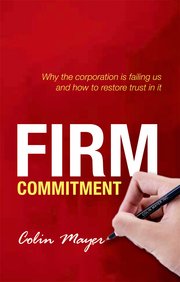
After meeting Colin Mayer (Oxford) and hearing him present at Vanderbilt’s 2013 Law and Business Conference, I purchased and read his recent book, Firm Commitment: Why the Corporation is Failing Us and How to Restore Trust in it.  The book is organized in three parts: (1) how the corporation is failing us; (2) why it is happening; (3) what we should do about it.  While the first two parts contain some helpful background and interesting case studies, I found the third part the most useful.  In the third part, Professor Mayer suggests:

These three straightforward adaptations of current arrangements – establishing corporate values, permitting the creation of a board of trustees to act as their custodians, and allowing for time dependent shares – together solve the fundamental problems of breaches of trust in relation to current and future generations. (pg. 247) 

In discussing corporate values, Professor Mayer writes:

Corporate social responsibility was rightly dismissed as empty rhetoric and jettisoned when recession forced a return to more traditional shareholder value.  Why should I trust an organization that is owned and controlled by anonymous, opportunistic, self-interested wealth seekers?  Without commitment, there is no reason why there should be any trust in the corporation, however much its fine promotional material suggests otherwise.  Values need value.  They need to be valuable to those upholding them and costly to those who do not.  They need to inflict pain on those who abuse them and gain on those who do not. (pg. 244)

While Professor Mayer was writing about corporations generally, and not benefit corporations specifically, the same commitment concern is present with these new corporate forms (called benefit corporations or public benefit corporations) that claim to be focused on society and the environment.    

As one possible solution to the commitment problem, Professor Mayer suggests time dependent shares.  Time dependent shares would provide greater voting power to shareholders who commit to hold shares for a longer period of time.  This feature, Professor Mayer argues, would focus the managers on long term value, which could benefit all stakeholders.  Professor Mayer does not favor requiring time dependent shares for all corporations, but suggests that time dependent shares might be useful for those firms that need or desire long-term investment and commitment.  I am still thinking through all the possible implications of time dependent shares, especially in the M&A context, but appreciate the effort to fight short-termism and focus management on longer term goals for the corporation. 

Interested readers can find Firm Commitment through Oxford University Press.

Cross-posted at SocEntLaw.

FC

Earlier this week the SEC released its 2014 rulemaking agenda and excluded from the list is a proposal for public companies to disclose political spending.  In 2011, the Committee on Disclosure of Corporate Political Spending, comprised of 10 leading corporate and securities academics, petitioned the SEC to adopt a political spending disclosure rule.  This petition has received a historic number of comments—over 640,000—which can be found here.

The Washington Post reported that after the petition was filed,

A groundswell of support followed, with retail investors, union pension funds and elected officials at the state and federal levels writing to the agency in favor of such a requirement. The idea attracted more than 600,000 mostly favorable written comments from the public — a record response for the agency.

Omitting corporate political spending from the 2014 agenda has received steep criticism from the NYT editorial board in an opinion piece written yesterday declaring the decision unwise “even though the case for disclosure is undeniable.” Proponents of corporate political spending disclosure like Public Citizen are “appalled” and “shocked” by the SEC’s decision, while the Chamber of Commerce declares the SEC’s omission a coup that appropriately avoids campaign finance reform.

Included in the 2014 agenda are Dodd-Frank and JOBS Act measures, as well as a proposal to enhance the fiduciary duties owed by broker-dealers.  More on the agenda in future posts….

-Anne Tucker