
“Man grows used to everything, the scoundrel!” 
― Fyodor DostoyevskyCrime and Punishment

This week two articles caught my eye.  The New York Times’ Room for Debate feature presented conflicting views on the need to “prosecute executives for Wall Street crime.” My former colleague at UMKC Law School, Bill Black, has been a vocal critic of the Obama administration’s failure to prosecute executives for their actions during the most recent financial crisis, and recommended bolstering regulators to build cases that they can win. Professor Ellen Podgor argued that the laws have overcriminalized behavior in a business context, and that the “line between criminal activities and acceptable business judgments can be fuzzy.” She cited the thousands of criminal statutes and regulations and compared them to what she deems to be overbroad statutes such as RICO, mail and wire fraud, and penalties for making false statements. She worried about the potential for prosecutors to abuse their powers when individuals may not understand when they are breaking the law.

Charles Ferguson, director of the film “Inside Job,” likened the activity of some major financial executives to that of mobsters and argued that they have actually done more damage to the economy. He questioned why the government hadn’t used RICO to pursue more criminal cases.  Former prosecutor and now private lawyer Allen Goelman pointed out rather bluntly that prosecutors aren’t cozy with Wall Street—they just won’t bring a case when the evidence won’t allow them to win. He also reminded us that greed and stupidity, which he claimed was the cause of the “overwhelming majority of the risky and irresponsible behavior by Wall Street,” are not crimes.  Professor Lawrence Friedman wrote that  the law “announces the community’s conceptions of right and wrong,” and if we now treat corporations like people under Citizens United then we should likewise make the executives who run them the objects of the community’s condemnation of wrongdoing.

Finally, Senator Elizabeth Warren concluded that if corporations know that they can break the law, pay a large settlement, and not admit any guilt or have any individual prosecuted, they won’t have any incentive to follow the law. She also argued for public disclosure of these settlements including whether there were tax deductions or releases of liability.

This brings me to the second interesting article. Former SEC enforcement chief and now Kirkland & Ellis partner Robert Khuzami recently said, “I didn’t think there was much doubt in most cases that a defendant engaged in wrongdoing when you had a 20-page complaint, you had them writing a big check, you may well have prosecuted an individual in the wrongdoing.” While not endorsing or rejecting current SEC Chair Mary Jo White’s position to require certain companies to admit wrongdoing in settlements, he raised a concern about whether this change in policy would place undue strain on the agency’s limited resources by forcing more cases to go to trial.  He also raised a valid point about the legitimate fear that firms should have in that admitting guilt could expose them to lawsuits, criminal prosecution, and potential business losses.  Chair White did not set out specific guidelines for the new protocol, but so far this year 22 companies have benefitted from the no admit/no deny policy and have paid $14 million in sanctions. But we don’t know how many executives from these companies lost their jobs. On the other hand, would these same companies have settled if they had to admit liability or would they have demanded their day in court?

Should the desire to preserve agency resources trump the need to protect the investing public—the stated purpose of the SEC? If neither the company nor the executive faces true accountability, what will be the incentive to change? In a post-Citizens United world, will Congressmen strengthen the laws or bolster the power and resources of the regulators to go after the corporations that help fund their campaigns? Have we, as Dostoyevsky asserted, become “used” to the current state of affairs where drug dealers and murderers go to jail, but there aren’t enough resources to pursue financial miscreants?

What will make companies and executives “do the right thing”? Dostoyevksy also wrote “intelligence alone is not nearly enough when it comes to acting wisely,” and he was right. Perhaps the fear of the punishment for clearly enumerated and understood crimes, and the fear of the admission of wrongdoing with the attendant collateral damage that causes will lead to a change in individual and corporate behavior.  I agree with Professor Podgor that there is clearly room for prosecutorial abuse of power and that the myriad of laws can lead to a no-mans land for the unwary executive forced to increase margins and earnings per share (while possibly getting a healthy bonus).  While I have argued in the past for an affirmative defense for certain kinds of corporate crimial liability, I also agree with Professor Black and Senator Warren.  At some point, people and the corporations (made up of people) need more than “intelligence” to act “wisely.” They need the punishment to fit the crime.


Last week, I attended and presented at my first legal studies in business school conference, the Southeastern Academy of Legal Studies in Business (“SEALSB”) annual conference.  On this recent trip, I was able to meet a number of other professors who hold positions similar to mine at other business schools.  Most of the professors were from the southeast, but we also had professors from California, Michigan, Minnesota, and New York.

One of the new pieces of information I learned was that, while I was correct in my previous post stating that there is no “meat market” equivalent for legal studies in business school positions, the Academy of Legal Studies in Business (“ALSB”) does send out job postings, on occasion, to its members.  Also, more than one professor in attendance claimed to have obtained his/her current position by attending the ALSB annual meeting and networking.

In this post, I will discuss some of the differences I see between my current job as a professor teaching law in a business school and my previous job as a law professor in a law school.  I draw on my own experiences and conversations I have had with many professors across the country, at both types of schools.  That said, this is just anecdotal evidence, and I imagine experiences differ. 

Scholarship

  • Business school deans and colleagues usually require education on legal scholarship and law journals. Business schools are used to traditional peer reviewed journals (generally double blind) that are listed on Cabell’s.  That said, most business schools I know of, are accepting (at least some) law reviews as acceptable placements from their tenure track legal studies professors 
  • Business schools also tend to encourage, or at least not penalize, co-authored work, whereas it seems many law schools apply a significant discount to co-authored articles. 
  • Legal studies professors in business schools may have to struggle to obtain WestLaw access and legal research support.  Everyone I talked to at SEALSB had obtained access, though it seemed to require a bit more effort than at a law school. 

Teaching.

  • In law schools, very roughly speaking, the average teaching load seems to be 2/1 at research schools and 2/2 at the teaching schools.  In business schools, the normal teaching load seems to be either 2/1 or 2/2 at the research schools (with 2/2 appearing to be the norm), and 3/3 (or in some limited cases 3/4 or 4/4) at teaching business schools. Teaching loads seem to be a bit lighter at law schools, though this may be changing at some law schools given the financial challenges many are facing.   
  • Business school professors tend to give many more assessments than law school professors.  In law schools the norm still seems to be one major assessment per semester, though plenty of professors do more.  Most of the legal studies professors in business schools claimed to give at least three major assessments a semester, and sometimes as many as six or seven. 
  • The business school professors I spoke to tended to have smaller classes (20-50), at least smaller than the large section law classes (70-150).  That said, some of the professors from large state universities reported undergraduate classes as large (or sometimes much larger) than the average large section law school class.
  • Many legal studies professors I have met teach both undergraduate and graduate business law courses, though some only teach undergraduate.  Obviously, law professors only teach graduate students.  That said, the average MBA student likely has more work experience than the average law student. 

Service. 

  • As far as I can tell, service requirements seem similar at law and business schools.

Compensation. 

  • Compensation of law professors and legal studies in business school professors seems relatively close, at least if the business school has an MBA program, in addition to its undergraduate program.  The compensation seems a bit less uniform across business schools than across law schools, with a few business professors who would be outliers, on the low end, of current law school compensation. 

These are all obviously generalizations, and I am sure there are many exceptions, but I thought the rough sketch of the differences might be useful for those who are trying to choose between teaching law at a business school or at a law school. 

We live in a world where most working individuals have some retirement savings invested in the stock market.  The stock market funds, in part, college educations, and serve as the primary wealth accumulator for post-baby boom generations.  My parents—an elementary school teacher and a furniture salesman—lived in Midwestern frugality and invested their savings from the mid-80’s until 2006 when they pulled out of the market.  They retired early, comfortably (so I believe), and largely because of consistent gains in the stock market over a 30 year period.  The question is whether this story is repeatable as a viable outcome for working investors now. 

The Wall Street Journal ran a story on Monday “Stocks Regain Appeal” documenting the number of dollars flowing into markets from retail investors as well as the anecdotal confidence of investors.  The WSJ reports that:

“U.S. stock mutual funds have attracted more cash this year than they have in any year since 2004, according to fund-tracker Lipper. Investors have sent $76 billion into U.S. stock funds in 2013. From 2006 through 2012, they withdrew $451 billion.” 

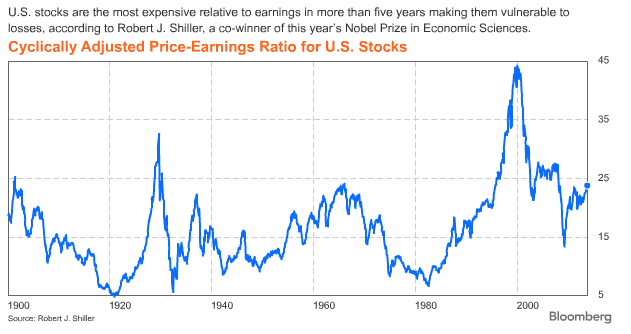
This seems indisputably good right?  Maybe.  The real question for me is why is more money flowing into the markets and confidence high?  Is this behavior driven by information, emotion, or herd mentality?  Robert Shiller, recent Nobel Prize winner and author of Irrational Exuberance, wrote in March in a column for the NYT that investors were confident, but who knows why.  Shiller’s conclusions were based on data from the cyclically adjusted price-earnings ratio, CAPE, of 23 suggesting that the market was priced high, which is interesting when compared with his data that 74% of individual investors did not think that the market was overpriced.  Shiller strengthened his cautionary stance on the market last month when the CAPE held at 23.7, and Shiller warned that stocks were the “most expensive relative to earnings in more than five years.”

This is business law blog, not a market blog, yet the role of the market interests me greatly.  As corporate law scholars, we teach students and write about the legal limits, obligations and assumptions that establish the market and dictate how individuals and institutions interact with the market and corresponding corporate-level controls.  In 2007 the market collapsed (self-corrected if we want to use the economists’ terms) and what was the result?  Dodd-Frank and a series of legislation aimed at policing the market.  If we are interested in the laws that govern the market, surely some attention must be paid to how and why the market works the way that it does.

Shiller stock CAPE

 -Anne Tucker

Today is November 12, 2013, or 11/12/13.   (It also happens to be my 43rd birthday.  Yay me.) 

In honor of the unique date, I decided to take a look at some business cases from the most recent prior 11/12/13.  I found a couple of  interesting passages.  One case, Cotten v. Tyson, 89 A. 113, 116 (Md. Nov. 12, 1913),  provides a good overview of some basic corporate principals: 

[1] The principle is elementary that a stockholder, as such,
is not an owner of any portion of the property of the corporation and, apart
from his stock, has no interest in its assets which is capable of being
assigned. [citing cases] 

[2] Where one person is the owner of all the capital stock
of a corporation, it has been held bound by his acts in reference to its
property. [citing cases]

[3] But it is entirely clear upon reason and authority that
a stockholder of a corporation, while retaining his stock ownership, cannot
assign the interest represented by his stock in any particular class of the
corporate assets. Such an attempted alienation would not only be incompatible
with the retention of title to the stock in the assignor but its enforcement
would be altogether impracticable. The stockholder himself could not require
the corporation to segregate and distribute a specific portion of its property,
and certainly he could not create and confer such a right by assignment.

[4] . . .Even if a stockholder could
effectively assign an interest in the choses in action of his corporation, such
a result could obviously not be accomplished by a mere assignment of his
interest in the assets of its debtors.

Another, and in contrast, Smith v. Pullum, 63 So. 965 (Ala. Nov. 12, 1913),  provides a  sound example of terrible legal jargon: 

The bill  . . . alleges that it was agreed between the
three parties, viz., G.W. Smith, William Pullum, and W.K. Pullum, that upon the
purchase of the property for the above sum a corporation was to be
formed, with a paid in capital of $4,500; that $1,650 of the said capital stock
was to be the property of W.K. Pullum, $600 of said capital stock was to be the
property of said Wm. Pullum, and $2,250 of said capital stock was to be the
property of said G.W. Smith. 

The case uses the term “said” seventy-five times. It’s a four-page case.  

Here’s hoping we can dispense with said practice posthaste.  

The SEC’s crowdfunding proposal offers small, startup
businesses a new way to raise capital without triggering the expensive
registration requirements of the Securities Act of 1933. But the capital needs
of small businesses are often uncertain. They may need to raise money again
shortly after an exempted offering. Or they may want to sell securities pursuant
to another exemption at the same time they’re using the crowdfunding exemption.
How do other offerings affect the crowdfunding exemption? The proposed crowdfunding
rules are unexpectedly generous with respect to other offerings, but they still
contain pitfalls.

Other Securities Do Not Count
Against the $1 Million Crowdfunding Limit

The proposed rules make it clear that the crowdfunding
exemption’s $1 million limit is unaffected by securities sold outside the crowdfunding
exemption. As I explained in an earlier post, only securities sold pursuant to
the section 4(a)(6) crowdfunding exemption count against the limit.

Crowdfunding and the Integration Doctrine

But the integration doctrine, the curse of every securities
lawyer, poses problems beyond determining the offering amount.

Briefly, the integration doctrine defines what constitutes a
single offering for purposes of the exemptions from registration. The Securities
Act exemptions are transactional; to avoid registration, the issuer must fit
its entire offering within a single exemption. It cannot separate what is
actually a single offering into two or more parts and fit each part into
different exemptions.

Unfortunately, the application of the integration doctrine
is notoriously uncertain and unpredictable, making it difficult for issuers who
do two offerings of securities at or about the same time to know whether or not
those offerings qualify for an exemption. (For a critical review of the
integration doctrine, see my article here.)

The SEC’s crowdfunding proposal begins with what appears to
be absolute protection from integration. The proposal says (p. 18) that “an
offering made in reliance on Section 4(a)(6) should not be integrated with another
exempt offering made by the issuer, provided that each offering complies with
the requirements of the applicable exemption that is being relied on for the
particular offering.”

However, the SEC giveth and the SEC taketh away. First, this
isn’t really a rule, just a pledge by the SEC. The anti-integration language
does not appear anywhere in the rules themselves; it’s only in the release
discussing the rules. Other integration safe harbors, such as Rule 251(c) of
Regulation A and Rule 502(a) of Regulation D, appear in the rules.
It’s not clear why the SEC was unwilling to write an integration provision into
the crowdfunding rules, but an actual rule would provide much more comfort to
issuers than the SEC’s bare promise.

And, unfortunately, the SEC doesn’t stop with the broad
anti-integration pledge. It adds (pp. 18-19) that

An issuer conducting a concurrent exempt offering for which
general solicitation is not permitted, however, would need to be satisfied that
purchasers in that offering were not solicited by means of the offering made in
reliance on Section 4(a)(6). Similarly, any concurrent exempt offering for
which general solicitation is permitted could not include an advertisement of
the terms of the offering made in reliance on Section 4(a)(6) that would not be
permitted under Section 4(a)(6) and the proposed rules.

These qualifications may prove particularly mischievous.
Assume, for example, that an issuer is offering securities pursuant to section
4(a)(6) and, around the same time, offering securities pursuant to Rule 506(b),
which prohibits general solicitation. The issuer would have to verify that none
of the accredited investors in the Rule 506(b) offering saw the offering on the
crowdfunding platform. Since crowdfunding platforms are open to the general public,
that might be difficult.

As a result of the second sentence quoted above, there’s
also a potential problem in the other direction. Assume that an issuer is
simultaneously offering the same securities pursuant to both section 4(a)(6)
and Rule 506(c). Rule 506(c) allows unlimited general solicitation, but the
crowdfunding rules severely limit what an issuer and others may say about the
offering outside the crowdfunding platform. The SEC seems to be saying that a
public solicitation under Rule 506(c) would bar the issuer from using the
crowdfunding exemption to sell the same securities. Since the same securities
are involved in both offerings, the 506(c) solicitation would arguably “include
an advertisement of the terms of the offering made in reliance on Section
4(a)(6).”

Double-Door Offerings Redux

Before the SEC released the crowdfunding rules, I questioned
whether “double-door” offerings using the crowdfunding exemption and the new
Rule 506(c) exemption were viable
. I posited a single web site that sold the
same securities (1) to accredited investors pursuant to Rule 506(c) and (2) to the
general public pursuant to the crowdfunding exemption. I concluded that,
because of the integration doctrine, such offerings were impossible. The SEC
anti-integration promise may change that result, if the SEC really means what
it says.

The anti-integration promise doesn’t exclude simultaneous
offerings, even if those offerings involve the same securities. And I don’t see
anything in the rules governing crowdfunding intermediaries that would prevent
both 506(c) and crowdfunding offerings on a single web platform, with
accredited investors funneled to a separate closing under Rule 506(c).
Funding portals could not host such a double-door platform, because they’re
limited to crowdfunded offerings, but brokers could.

However, both the issuer and the broker would have to be
careful about off-platform communications. Ordinarily, an issuer in a Rule
506(c) offering may engage in any general solicitation or advertising it
wishes, on or off the Internet. But the SEC crowdfunding release, as we saw,
warns that “any concurrent exempt offering for which general solicitation is
permitted could not include an advertisement of the terms of the offering made
in reliance on Section 4(a)(6) that would not be permitted under Section 4(a)(6)
and the proposed rules.” To avoid ruining the crowdfunding exemption, any
off-platform communications would have to be limited to what the crowdfunding
rules allow, and that isn’t much.

Martin Gelter & Geneviève Helleringer posted “Constituency
Directors and Corporate Fiduciary Duties
” on SSRN a few weeks ago, and I’m
finally getting around to passing on the abstract:

In this chapter, we identify a fundamental contradiction in
the law of fiduciary duty of corporate directors across jurisdictions, namely
the tension between the uniformity of directors’ duties and the heterogeneity
of directors themselves. Directors are often formally or informally selected by
specific shareholders (such as a venture capitalist or an important
shareholder) or other stakeholders of the corporation (such as creditors or
employees), or they are elected to represent specific types of shareholders
(e.g. minority investors). In many jurisdictions, the law thus requires or
facilitates the nomination of what has been called “constituency” directors.
Legal rules tend nevertheless to treat directors as a homogeneous group that is
expected to pursue a uniform goal. We explore this tension and suggest that it
almost seems to rise to the level of hypocrisy: Why do some jurisdictions
require employee representatives that are then seemingly not allowed to
strongly advocate employee interests? Looking at US, UK, German and French law,
our chapter explores this tension from the perspective of economic and
behavioral theory.

As Marc O. DeGirolami notes here: “In an extensive
decision, a divided panel of the U.S. Court of Appeals for the Seventh Circuit
has enjoined the enforcement of the HHS contraception mandate against several
for-profit corporations as well as the individual owners of those corporations.”  I have not had a chance to read the entire
decision (which you can find here), but I did do a quick search for “corporation” and pass on the
following excerpts I found interesting.

The plaintiffs are two Catholic families and their closely
held corporations—one a construction company in Illinois and the other a
manufacturing firm in Indiana. The businesses are secular and for profit, but
they operate in conformity with the faith commitments of the families that own
and manage them…. These cases—two among many currently pending in courts around
the country—raise important questions about whether business owners and their
closely held corporations may assert a religious objection to the contraception
mandate and whether forcing them to provide this coverage substantially burdens
their religious-exercise rights. We hold that the plaintiffs—the business
owners and their companies—may challenge the mandate. We further hold that
compelling them to cover these services substantially burdens their religious
exercise rights…. Nothing in RFRA [the Religious Freedom Restoration Act]
suggests that the Dictionary Act’s definition of “person” is a “poor fit” with
the statutory scheme. To use the Supreme Court’s colloquialism, including
corporations in the universe of “persons” with rights under RFRA is not like
“forcing a square peg into a round hole.” [Rowland, 506 US 194, 200 (1993).] A
corporation is just a special form of organizational association. No one doubts
that organizational associations can engage in religious practice…. It’s common
ground that nonprofit religious corporations exercise religion in the sense
that their activities are religiously motivated. So unless there is something
disabling about mixing profit-seeking and religious practice, it follows that a
faith-based, for-profit corporation can claim free-exercise protection to the
extent that an aspect of its conduct is religiously motivated.

The quote I focus on above is: “A corporation is just a
special form of organizational association.” 
I have argued previously that when courts render decisions like the
Seventh Circuit did here, they seem to be giving mere lip service to the word “special”
in that sentence.  For more on that, you
can go here.

UPDATE: Josh Blackman notes how many religion-clause scholars are cited in the opinion here.  Here is my Twitter follow-up:


The Economist has an interesting piece on how “[a] mutation in the way companies are financed and managed will change the distribution of the wealth they create.”  You can read the entire article here.  A brief excerpt follows.

The new popularity of the [Master Limited Partnership] is part of a larger shift in the way businesses structure themselves that is changing how American capitalism works…. Collectively, distorporations such as the MLPs have a valuation on American markets in excess of $1 trillion. They represent 9% of the number of listed companies and in 2012 they paid out 10% of the dividends; but they took in 28% of the equity raised…. [The] beneficiaries, though, are a select class. Quirks in various investment and tax laws block or limit investing in pass-through structures by ordinary mutual funds, including the benchmark broad index funds, and by many institutions. The result is confusion and the exclusion of a large swathe of Americans from owning the companies hungriest for the capital the markets can provide, and thus from getting the best returns on offer….

Another booming pass-through structure is that of the “business development company” (BDC). These firms raise public equity and debt much like a leveraged fund.… What they all share is an ability to do bank-like business—lending to companies which need money—without bank-like regulatory compliance costs….

Andrew Morriss, of the University of Alabama law school, sees the shift as an entrepreneurial response to a century’s worth of governmental distortions made through taxation and regulation. At the heart of those actions were the ideas set down in “The Modern Corporation and Private Property”, a landmark 1932 study by Adolf Berle and Gardiner Means. As Berle, a member of Franklin Roosevelt’s “brain trust”, would later write, the shift of “two-thirds of the industrial wealth of the country from individual ownership to ownership by the large, publicly financed corporations vitally changes the lives of property owners, the lives of workers and …almost necessarily involves a new form of economic organisation of society.” … Several minor retreats notwithstanding, the government’s role in the publicly listed company has expanded relentlessly ever since.

In 2011, I met with members of the SEC and Congressional staffers as part of a coalition of business people and lawyers raising concerns about the proposed Dodd-Frank whistleblower provision. Ten days after leaving my compliance officer position and prior to joining academia, I testified before a Congressional committee about the potential unintended consequences of the law. The so-called “bounty-hunter” law establishes that whistleblowers who provide original information to the SEC related to securities fraud or violations of the Foreign Corrupt Practices Act are eligible for ten to thirty percent of the amount of the recovery in any action in which the SEC levies sanctions in excess of $1 million dollars. The legislation also contains an anti-retaliation clause that expands the reach of Sarbanes-Oxley. Congress enacted the legislation to respond to the Bernard Madoff scandal. The SEC recently awarded $14 million dollars to one whistleblower. To learn more about the program, click here.

I argued, among other things, that the legislation assumed that all companies operate at the lowest levels of ethical behavior and instead provided incentives to bypass existing compliance programs when there are effective incentive structures within the existing Federal Sentencing Guidelines for Organizations.  Although they are no longer binding, judges use the Guidelines to sentence corporations that plead guilty or are so adjudicated after trial. Prosecutors use them as guideposts when making deals with companies that enter into nonprosecution and deferred prosecution agreements. I recommended: (1) that there be a presumption that whistleblowers report internally first unless there is no viable, credible internal option; (2) that the SEC inform the company that an anonymous report has been made unless there is legitimate reason not to do so and (3) that those with a fiduciary duty to report be excluded from the bounty provisions of the bill and be required to report upward internally before reporting externally.

Fortunately, the final legislation does make it more difficult for certain people to report externally without first trying to use the compliance program, if one exists.  Nonetheless, the Wall Street Journal reported yesterday that a growing number of compliance personnel are blowing the whistle on their own companies, notwithstanding the fact that they must wait 120 days under the rules after reporting internally to go to the SEC.  One of the attorneys interviewed in the WSJ article, Gregory Keating, is a shareholder Littler Mendelsohn, a firm that exclusively represents management in labor matters. His firm and others are seeing more claims brought by compliance officers.

This development leads to a number of questions. What about compliance officers who are also lawyers, as I was? NY state has answered the question by excluding lawyers from the awards, and I am sure that many other states are considering it or will now start after reading yesterday’s article. What does this mean for those forward thinking law schools that are training law students to consider careers in compliance? I believe that this is a viable career choice in an oversaturated legal market because the compliance field is exploding, while the world of BigLaw is contracting. Do we advise students considering the compliance field to forego their bar licenses after graduation because one day they could be a whistleblower and face a conflict of interest? I think that’s unwise.  What about compliance personnel in foreign countries? Courts have already provided conflicting rulings about their eligibility for whistleblower status under the law.

Most significantly, in many companies compliance officers make at least an annual report to the board on the activities of the compliance program in part to ensure that the board fulfills its Caremark responsibilities.  These reports generally do and should involve detailed, frank discussions about current and future risks. Will and should board members become less candid if they worry that their compliance officer may blow the whistle?

Could the Sentencing Commission have avoided the need for compliance officers to blow the whistle externally by recommending that compliance officers report directly to the board as the heads of internal audit typically do? This option was considered and rejected during the last round of revisions to the Sentencing Guidelines in 2010. Compliance officers who do not report to general counsels or others in the C-Suite but have direct access to board members might feel less of a need to report to external agencies. This is why, perhaps, in almost every corporate integrity agreement or deferred prosecution agreement, the government requires the chief compliance officer to report to the board or at least to someone outside of the legal department.

To be clear, I am not opposed to the legislation in principle. And for a compliance officer to report on his or her own organization, the situation internally was probably pretty dire. Gregory Keating and I sit on the Department of Labor’s Whistleblower Protection Advisory Committee, which will examine almost two dozen anti-retaliation laws in  the airline, commercial motor carrier, consumer product, environmental, financial reform, food safety, health care reform, nuclear, pipeline, public transportation agency, railroad, maritime and securities fields.  During our two-year term we will work with academics, lawyers, government officials, organized labor and members of the public to make the whistleblower laws more effective for both labor and management.

State bars, government agencies, boards, general counsels, plaintiffs’ lawyers and defense lawyers need to watch these developments  of the compliance officer as whistleblower closely. I will be watching as well, both as a former compliance officer and for material for a future article.


Yesterday was election
day
!  Elections hold a special place
in my heart, and I remain interested in the interplay of corporations and campaigns,
especially in a post-Citizens United
world.  The races, candidates, and
results, however, received significantly less attention without a federal
election (mid-term or general) to garner the spotlight.  The 2014 election season, which officially
begins today, has several unknowns. While Citizens
United
facilitated unlimited independent expenditures (distinguishable from
direct campaign contributions) for individuals and corporations alike,
corporations remain unable to donate directly to campaigns.  Individual campaign contributions are
currently capped at $2,500 per candidate/election and are subject to aggregate
caps as well.  McCutcheon
v. FEC
, which was argued
before the US Supreme Court on October 8, 2013, challenges the individual
campaign contribution cap.  If McCutcheon removes individual caps, the foundation
will be laid to challenge corporate campaign contribution bans as well.  See this pre-mortem
on McCutcheon
by Columbia University law professor Richard Briffault.  As for current corporate/campaign finance
issues, the focus remains on corporate disclosures of campaign expenditures in
the form of shareholder
resolutions
(118 have been successful) and company-initiated
disclosure policies
, possible
SEC disclosure requirements
for corporate political expenditures, and the
threat of legislation augmenting corporate disclosure requirements for
political expenditures (see, for example the latest bill introduced:  the Corporate
Politics Transparency Act
(H.R. 2214)).

As an aside, brief treatment of the questions regarding the
rights of corporations to participate in elections, and the role of corporations
in our democracy elicit some of the best (and most heated) student discussions
in my Corporations class.  If you have
the stomach for it, I highly recommend that you try it!

-Anne Tucker