
Last week, I posted (here) about an important new article on the Fed and I’m doing that again this week.  Wharton Professor Christina Parajon Skinner’s Central Bank Digital Currency as New Public Money (forthcoming, University of Pennsylvania Law Review) is also a critical piece.  As the Introduction explains: “nearly every central bank around the world” is considering whether to create a central bank digital currency (CBDC).  Most payments are already digital.  Hence, it is important to realize that the impact of a central bank digital currency would be more than just payment digitization. 

Skinner states that “At least in the case of a U.S.-dollar CBDC, issued by the Federal Reserve, not only is a CBDC a fundamentally new monetary instrument, it also fundamentally alters – by weakening – the bundle of rights that State-issued money has heretofore conveyed to individuals holding public money.” (p. 9-10) And that “In many ways, as this Article will suggest, the nature of money implicates the very relationship between people and the State. In that sense, each nation’s decision about whether to pursue a CBDC will be highly dependent on its legal framework but also its political-economy values. Some States may well proceed with a CBDC while others might find it inconsistent with their political and legal mores and traditions. But in that case, the question of how to preserve a well-functioning monetary order will need to be addressed within the framework of international monetary law.” (p.11)  

Even more than with the question of who has access to a master account at the Fed (see here, here and here), widespread understanding of and debate about the potential adoption of a U.S.-dollar CBDC is tremendously important.  Such conversations are also incredibly timely. 

In fall 2022, the Federal Reserve Bank of New York (FRBNY) released its Phase One Report on “Project Cedar.”  As the FRBNY explains: “Project Cedar is the inaugural project of the New York Innovation Center (NYIC). It is a multiphase research effort to develop a technical framework for a theoretical wholesale central bank digital currency (wCBDC) in the Federal Reserve context.”  The Report “aims to contribute to a broad and transparent public dialogue about CBDC from a technical perspective. The report is not intended to advance any specific policy outcome, nor to signal that the Federal Reserve will make any imminent decisions about the appropriateness of issuing a retail or wholesale CBDC, nor to offer an indication of how one would necessarily be designed.” (p.3-4)

Here’s the abstract for Skinner’s article:

Today, nearly every central bank around the world is considering whether to create a new form of digital public money, referred to as central bank digital currency, “CBDC.” Although CBDC is often discussed as a way to make payments more efficient, enhance financial inclusion, or reduce the risk of financial instability posed by stablecoins, the legal rights attached to CBDC remain poorly understood. This Article theorizes American public money as a bundle of distinct economic rights—namely, rights to popular monetary sovereignty; to property in value; and to qualified privacy. It then measures CBDC against the legal and conventional status quo to discern where CBDC adds to the monetary bundle-of-rights or takes a stick away. The Article argues that CBDC transfers significant monetary power to the State by weakening the individual right of issuance, conditioning the individual right to monetary property, and rendering monetary privacy rights scarce. It also, in so doing, empowers the central bank while weakening its independence.”    
The DePaul Law Review will devote the third issue of its 73rd volume (slated for publication in Spring 2024) to a symposium addressing the Emmy-winning scripted drama Succession from a legal and pedagogical point of view. The aim of this special issue is to collect in one place the insights of a variety of faculty members with different legal subject-matter expertise, as a resource for all who are interested in the use of this award-winning work for the teaching, practice, and study of law. The DePaul Law Review has already secured the participation of a number of distinguished scholars.

The DePaul Law Review invites proposals from others for two to four additional contributions to be included in this special issue. Proposals for a contribution of between 5,000 and 10,000 words are welcome from all who teach any area of law. (The print symposium will be accompanied by simultaneous online publication with live hyperlinks, allowing readers to access video links if the author desires.)

Potential contributions to the special issue might take a variety of forms. For example, these essays might:

• explore the legal implications of various plotlines through a variety of doctrinal lenses (e.g., mergers and acquisitions, wills and trusts, corporate law, employment law, criminal law);

• share classroom techniques for using Succession, and its scenarios or characters, in law teaching;

• consider how matters such as race, gender, sexual orientation, age, disability, and class are represented on Succession, or how the show depicts law, law enforcement, and lawyers; or

• draw on literary techniques to illuminate (or critique) Succession‘s approach to the myriad legal issues it presents.

Interested individuals should send an abstract outlining the topic and substance of their proposed contribution to the DePaul Law Review by email to Lizzie Carroll, Managing Editor of Lead Articles, at lawreviewdepaul@yahoo.com, or to Prof. Susan Bandes, sbandes@depaul.edu, or Visiting Professor Diane Kemker, dklein14@depaul.edu. Abstracts (of 250 words at most) should be submitted by April 30, 2023. Proposals will be reviewed and invitations issued by June 1, 2023. Initial drafts will be due August 15, 2023, with final drafts due by October 1, 2023.

For those of you interested in watching or listening to the inaugural Peter J. Henning lecture (the subject of my blog post last Monday), you can find the recording here.  Friend-of-the-BLPB Chris Lund was kind enough to send the link along.  As you’ll note, Judge Rakoff’s remarks (which were introduced by Chris) begin with comments about Peter, his contributions to our field, and his service to the general public.  Judge Rakoff’s thoughts in that regard are so well taken.  The whole presentation was such a fitting tribute.

I hope you all enjoy the lecture as much as I did!

From America First Legal (here) on April 5, 2023:

Today, as part of its initiative under the Center for Legal Equality, America First Legal (AFL) asked the U.S. Equal Employment Opportunity Commission (EEOC) to open a civil rights investigation into McDonald’s Corporation for engaging in unlawful, discriminatory hiring practices. Federal law forbids discrimination based on race, color, religion, sex, or national origin by an employer against an employee or potential employee. Yet, McDonald’s publicly admits to intentionally violating this law. McDonald’s even created a “Diversity Snapshot” that breaks down its staffing goals by race …. As part of its “Allyship through Accountability” program, McDonald’s actively uses hiring practices focusing on immutable characteristics rather than skillsets…. The odious and illegal practice of hiring based on immutable characteristics like race is a flagrant attack on civil rights that harms all Americans. Under the guise of “equity,” companies like McDonald’s openly discriminate against individuals without facing any repercussions or pushback. America First Legal is determined to stop the destructive hiring practices of woke companies across the country and will continue to fight for equal opportunity for all Americans.

Gene Hamilton, America First Legal Vice President and General Counsel, added the following:

So many of America’s biggest and most celebrated corporations have abandoned the very systems, values, and laws that made this country great. Now, even McDonald’s, with its iconic golden arches and international recognition as a standard-bearer for American success, has caved to a woke mob of activists and has committed to violating the law to achieve their desired social outcomes–even aiming for racial quotas. Their actions are un-American, bad for business, and patently unlawful. As McDonald’s prepares for widely anticipated corporate layoffs–an unfortunate development that will hurt real American families–our hope is that it abides by federal law and refuses to use these anticipated layoffs with an eye towards achieving its racial diversity goals.

I blogged a few times about 10(b) cases raising the question of when shareholders of a publicly traded parent company can sue its wholly-owned subsidiary for the subsidiary’s false statements.  The latest, In re CarLotz Inc. Securities Litigation, 2023 WL 2744064 (S.D.N.Y. Mar. 31, 2023), denied such claims by shareholders of a pre-merger SPAC seeking to hold the pre-merger target liable for misleading investor presentations about its business.  The case was the natural result of the Second Circuit’s decision in Menora Mivtachim Insurance Ltd. v. Frutarom Industries Ltd., 54 F.4th 82 (2d Cir. 2022), which I blogged about here.

CarLotz was in the business of facilitating used car sales from their original owners to retail customers.  Acamar, a SPAC, went public in February 2019, and struck a deal to merge with CarLotz in October 2020.  A prospectus and registration statement were filed in December 2020 to register the new Acamar shares that would be issued as merger consideration, and Acamar shareholders approved the deal in January 2021.

After the announcement of the deal but before the merger, CarLotz’s officers were alleged to have made a false statements about CarLotz’s business.  The truth was revealed after the merger, when CarLotz admitted, among other things, a backlog of inventory that it had to sell at unfavorable prices, and the loss of a critical corporate partner and source of vehicles.

Shareholders of both pre-merger Acamar and post-merger CarLotz sued CarLotz’s officers under Rule 10b-5, as well as Section 11 and Section 12, purporting to represent Acamar/post-merger traders in the period beginning October 2020 through May 2021.

The court held that Frutarom “forecloses Plaintiffs’ challenge to any statements made by Pre-Merger CarLotz about Pre-Merger CarLotz.  As in Frutarom, neither of the named Plaintiffs purchased shares of Pre-Merger CarLotz—a privately held entity. The only pre-merger shares purchased by a named plaintiff in this case were those of Acamar. All of the challenged pre-merger statements, however, were made by Pre-Merger CarLotz about itself, not Acamar.”  Though the court explicitly noted the “policy concerns” of permitting SPAC transactions to escape 10b-5 liability in this manner, the court considered itself bound by the Second Circuit’s holding, even noting that the Second Circuit had explicitly considered – and rejected – arguments about Frutarom’s application to SPACs when the Frutarom plaintiffs petitioned for rehearing.

As for the Section 11 and Section 12 claims, the court held that plaintiffs had not shown they’d purchased shares traceable to the false registration statement or – with respect to Section 12 – in the offering itself (which, in the latter case, would not seem to be possible by anyone except the former CarLotz shareholders).  The court rejected arguments that Section 11 and 12 requirements should be modified for the SPAC context.

Anyhoo, as I previously blogged, at least one court outside the Second Circuit has rejected Frutarom, so … stay tuned.

Imagine a group of state university faculty sitting around a table discussing their upcoming five-year plan. They decide that one of their priorities will be to promote some or all of the following eight concepts in their classes (the hypo also works if you imagine a board of directors contemplating priorities for mandatory employee training):

  1. Black people are morally superior to White people.
  2. White people are inherently racist.
  3. All White people are privileged, and all Black people are oppressed.
  4. Assertions of color-blindness are racist.
  5. White people should be discriminated against because of actions committed in the past by other White people.
  6. White people should be discriminated against to achieve diversity, equity, and inclusion.
  7. All White people bear personal responsibility for and must feel guilt, anguish, or other forms of psychological distress because of actions committed in the past by other White people.
  8. Such virtues as merit, excellence, hard work, fairness, neutrality, and objectivity are racist and were created by White people to oppress Black people.

If you think that should be illegal (or if you think that would be the best of all possible worlds), then you might be interested in a recent Federalist Society litigation update on the Stop WOKE Act cases (available here) in which Ryan Newman, General Counsel to Florida Governor Ron DeSantis, discusses recent cases such as Pernell v. Florida Board of Governors, Novoa v. Diaz, and Honeyfund.com Inc. v. DeSantis. The following remarks from Newman provide some background on the legislation.

In our view, woke ideology poses a direct and irreconcilable challenge to a fundamental principle of the American political community — not always faithfully observed of course, but nevertheless stretching back to the Declaration of Independence – and that is the equality of all persons, that we are all created equal. The question raised by these cases is whether the people, acting through their elected representatives, have the authority to take limited measures to prevent the forced indoctrination of people in the workplace and in our public educational institutions in concepts that amount to rank discrimination on the basis of race and sex and that if accepted by most Americans would effectively destroy our country as we know it. The Stop WOKE Act does not ban the eight concepts that it identifies. These ideas, as pernicious and repugnant as they are, will continue to exist in the marketplace of ideas but they cannot be foisted upon employees in the workplace or imposed on impressionable students in public schools. We don’t believe that the Constitution requires the people to surrender this small degree of self-protection from an ideology that would itself destroy our political community. The Constitution is not, after all, a suicide pact.

This just in from Mary Fan at the University of Washington School of Law:

The University of Washington School of Law invites applications for a visiting lecturer to teach courses in business law and entrepreneurship.  The University of Washington is a major research university in the dynamic hub of Seattle with numerous connections to innovative business and entrepreneurial activity.  Courses that the lecturer may teach include Business Organizations, Entrepreneurial Law, Law and Technology, Intellectual Property Survey, and Nonprofit Organizations. The successful candidate will have a track record of teaching and practical experience in these areas.  Please apply soon because applications are reviewed on a rolling basis.

More information and the application upload site is here:

https://apply.interfolio.com/122716.

Thanks to Mary for sharing this opportunity.

I’ve often blogged (for example, here and here) about the monumental importance of a seemingly mundane topic: access to a master account at the Federal Reserve.  So, I was delighted to read Professor Julie Anderson Hill’s new article, From Cannabis to Crypto: Federal Reserve Discretion in Payments (forthcoming, Iowa Law Review).  It’s an important piece about a critical issue.  Here’s the abstract:

“From its inception, the Federal Reserve has operated payment systems that let banks move money for their customers. Checks, wire transfers, and electronic consumer payments all happen thanks to the Federal Reserve. Congress by statute specified which banks get access to the Fed’s payment services. For more than a century, the Federal Reserve provided services to all legally eligible banks. But when the Federal Reserve received requests for payments access from a cannabis-focused credit union and a cryptocurrency custody bank (both of whom are legally eligible), it denied them. The Fed also issued sweeping guidelines claiming discretion to conduct risk-vetting and deny bank requests. These guidelines apply to all banks and reverberate far beyond cannabis and crypto.

This Article examines whether the Federal Reserve’s payments discretion is as great as it now claims—a question that has been raised in three recent cases, but never answered. It concludes the Fed has overstepped. The language and structure of the Federal Reserve Act require that the Federal Reserve provide payment services to all eligible banks. In support of this statutory interpretation, the Article excavates long forgotten legislative history and more than a century of sometimes hidden Federal Reserve payments practices. It shows that while the Federal Reserve has some discretion over the payments it processes and terms under which it offers it payments services, the Fed’s discretion is not so broad as to allow it to reject access requests from legally eligible banks. If the Fed wants to exclude banks, it should ask Congress to change the law.”

Henning(Rakoff)

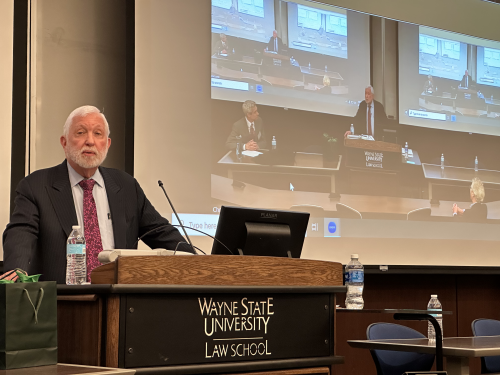
As I wrote last week, I attended the inaugural Petter J. Henning lecture today at Wayne State University Law School.  The Honorable Jed S. Rakoff offered insightful remarks on the sustainability of fraud: why fraud continues to occur unabated and why fraudsters get away with it.  In short, after citing to data on decreasing rates of crime of other kinds, Judge Rakoff noted that fraud rates have been holding steady.  He posited a number of reasons why fraud persists, as set forth below:

  • Deterrence requires speed and certainty of punishment, and fraud enforcement actions are slow and uncertain.
  • The Anglo-American common law of fraud makes it hard to prosecute.
  • Public enforcement is underfunded.
  • Pressure to generate short-term profits is strong.

Judge Rakoff also offered–relevant to some of the work that I have done and am doing on friends-and-family insider trading cases–that based on his personal experience, fraud and other white collar criminal misconduct may be motivated by greed, a desire for power or status, psychological issues, etc.  But he noted overall that those who commit business fraud have a well-founded belief that they can get away with their misconduct–and they actually do.  These fraudsters get off the hook, he says, in part because of a prosecutorial double standard that jails some and not others and also because of an enforcement shift from a large number of individual white collar prosecutions in the early part of the new millennium to legal actions taken against the business entities that employ the actors committing the fraudulent activity.

It was a fitting lecture–an appropriate celebration of Peter’s many contributions to business and white collar crime law.  I was pleased to be able to be there to honor Peter and spend time with some of his family, colleagues, and friends.  I look forward to the next lecture in the series.  

On March 13, 2023, Magistrate Judge Wicks dismissed a claim for disgorgement of short-swing profits against a 10% beneficial owner of 1-800 Flowers, on the grounds that the plaintiffs lacked Article III standing.  See Packer on Behalf of 1-800 Flowers.com v. Raging Capital Mgmt LLC, 2023 WL 2484442 (E.D.N.Y. Mar. 13, 2023).  The decision is currently on appeal.

Section 16(b) of the Exchange Act provides:

For the purpose of preventing the unfair use of information which may have been obtained by [a] beneficial owner, director, or officer by reason of his relationship to the issuer, any profit realized by him from any purchase and sale, or any sale and purchase, of any equity security of such issuer … within any period of less than six months, … shall inure to and be recoverable by the issuer, irrespective of any intention on the part of such beneficial owner, director, or officer in entering into such transaction …

The statute was enacted in 1934 to prevent insider trading; Congress believed that corporate insiders regularly misused information they obtained in their capacity as fiduciaries, and that the only feasible way to prevent such misuse was to bar insiders from earning profits (or avoiding losses) via short swing trading.  See, e.g., Kern Cnty. Land Co. v. Occidental Petroleum Corp., 411 U.S. 582 (1973); Reliance Elec. Co. v. Emerson Elec. Co., 404 U.S. 418 (1972); Smolowe v. Delendo Corp., 136 F.2d 231 (2d. Cir. 1943).  Rather than being enforced by the SEC, the statute is enforced by the issuing company or, more commonly, derivatively by its shareholders.

It is well established that in order to have standing to bring a case in federal court, a private plaintiff must demonstrate that he or she experienced a concrete injury.  In TransUnion LLC v. Ramirez, 141 S. Ct. 2190 (2021), the Supreme Court held that Congress cannot create such an injury merely by granting the plaintiff a statutory right of action.  Instead, any statutorily-created rights and injuries must have a “close historical or common-law analogue” to satisfy Article III of the Constitution.  141 S. Ct. at 2204.

In 1-800 Flowers, Judge Wicks relied on TransUnion to hold that the mere fact that an insider earns short-swing profits does not itself demonstrate that there was an injury to the corporation, and therefore no Section 16(b) action may be maintained, either by the issuer itself or, in this case, derivatively by its shareholders.  The court allowed for the possibility that some kind of injury might be associated with such profits in a particular case, but held that such an injury must be alleged and proven in order for plaintiffs to maintain an action; the fact of trading alone would be insufficient.

Now, a lot could be – and has been – written about the TransUnion decision, but taking it at face value, it raises the question what kind of “historical or common-law analogue” is sufficient.  Let’s start with some basics: First, it’s blackletter common law that fiduciaries may not make personal use of their principal’s property and confidential information. See, e.g., Restatement (First) of Agency § 395 (1933).  Second, it’s blackletter common law that the principal may disgorge any profits associated with such use without showing any injury; or, to put it another way, the injury is the principal’s loss of exclusive control over his property.  See, e.g., Restatement (First) of Agency § 404 (1933).  The rule is partially prophylactic in nature; it serves to ensure that the agent acts solely to benefit the principal, and does not abandon or alter his performance for personal gain. 

Those axioms map very well to the notion that insider trading is a violation of a fiduciary’s duty to the corporate principal, see Brophy v. Cities Service Co., 70 A.2d 5 (Del. Ch. 1949), and were apparently among the concerns that animated the 1934 Congress.  Now, my understanding is, at the time of the statute’s enactment, there were few common law prohibitions on insider trading, but then, many of the cases seemed to be brought by stockholders in their individual capacities rather than on the corporate principal’s behalf.  See Kenneth L. Yourd, Trading in Securities by Directors, Officers and Stockholders: Section 16 of the Securities Exchange Act, 38 Mich. L. Rev. 133 (1939).  So the real question should be whether Section 16(b) is similar enough to the common law agency principles (and even TransUnion does not hold that there needs to be an exact match) to satisfy Article III.  I think there’s a pretty close family resemblance; the bright line prohibition against short swing profits was established merely to avoid difficulties of proof.  We can call it an irrebuttable evidentiary presumption that such trades were predicated on inside information. 

To be sure, there is more distance from agency law when the trader is a 10% owner than when the trader is an officer or director, because 10% owners do not usually have fiduciary duties to the company, but the statute is rooted in a presumption that 10% owners have either the influence of a fiduciary or access to information that comes from fiduciaries, and that kind of relationship to the corporation would be covered even under the common law rule.  So, in my view, under TransUnion, the cause of action should survive without any additional showing of injury.  I guess we’ll see if the Second Circuit sees it the same way.