
|
The following opportunities come to us from Patricia Wilson at Baylor Law. The first two positions are directly related to business law. The last two are more litigation-oriented but may be of interest to business litigation folks. * * * Baylor Law is currently recruiting to fill multiple faculty positions, as described below. The starting date for each position is no later than August 1, 2023. If you know of someone who may be interested in these positions, please encourage them to visit the Baylor Law employment opportunities webpage. Interested individuals are also welcome to contact Associate Dean Patricia Wilson by email or phone for more information. We are particularly interested in expressions of interest from individuals who would add to the diversity of our faculty. Please note that three of the listings are for full-time positions. However, if you or someone you know is interested in teaching as an adjunct, we regularly have adjunct positions available and are currently seeking adjunct instructors to teach transactional drafting and persuasive writing/litigation drafting. We are flexible in scheduling adjunct-taught classes, including developing a schedule that allows an adjunct to teach most classes remotely on Zoom. Assistant Professor of Business/Transactional Law Baylor Law seeks an instructor who will have responsibility for electives in the areas of transactional, commercial, or business areas based upon Baylor Law’s curricular needs and the applicant’s experience. Such courses could include real estate finance, construction, oil and gas/alternative energy, debt financing, business succession planning, individual or entity income taxation, nonprofit organizations, digital/cybersecurity, elder law/special needs, retirement, international business transactions, international trade, consumer protection, bankruptcy, creditors remedies, negotiable instruments/payment systems, franchising, sports law, healthcare. Full-time Lecturer Baylor Law seeks a lecturer who will have responsibility for teaching in the Legal Analysis, Research & Communications (LARC) program. Responsibilities include working collaboratively with other faculty members of the Baylor Law Writing Program to create, teach and grade assignments for the LARC 4 course (Transactional Drafting) and coordinating all of the writing efforts across all three years of the curriculum to ensure consistency and best management of resources. The ideal candidate will have at least three years of transactional legal writing experience, including drafting and analyzing a variety of different contracts and business entity governing documents. Full-time Lecturer Baylor Law seeks a lecturer with substantial experience in persuasive writing and litigation drafting, including drafting appellate briefs and a variety of different pleadings, trial motions, and similar work product. The selected individual will have responsibility for teaching in the Legal Analysis, Research & Communications (LARC) program, specifically LARC 3 (persuasive writing) and LARC 5 (litigation drafting). He or she will teach several sections of both courses each year and will be one of several LARC 3 instructors. With respect to the LARC 5 course, the candidate will be expected to collaborate and coordinate project planning with instructors for the LARC 4 course (transactional drafting). Thus, the ideal candidate will also have experience in analyzing and drafting a variety of contracts. The candidate will share additional responsibilities as well, such as periodically serving as a judge in the Practice Court program and collaborating with other legal writing faculty members to create problems for writing competitions. Part-time Temporary Adjunct Baylor Law seeks a temporary adjunct to teach a section of the LARC 3 course, a course on persuasive writing, and LARC 5 course, a course that focuses on litigation drafting. The candidate should have experience in drafting appellate briefs or producing similar work product, or litigation drafting, including drafting a variety of different pleadings, trial motions, and similar work product. Prospective applicants can direct questions to Associate Dean Patricia Wilson at 254.710.6591 or 254.722.2564, or Patricia_Wilson@baylor.edu. |
There’s no joking in securities law
I’ve previously blogged about confusion regarding Section 10(b)’s requirement that a false statement be made “in connection with” a securities trade, when the speaker is a subsidiary of the securities’ issuer. We have a new entry in the genre in In re Volkswagen AG Sec. Litig., 2023 U.S. Dist. LEXIS 43031 (E.D. Va. Mar. 14, 2023).
This case concerns Volkswagen’s stupid joke from two years ago where it announced that it was changing its name to “Voltswagen,” which roiled the stock for a couple of days until the company admitted that it was just kidding. An equally stupid securities fraud lawsuit naturally followed, resulting in what is actually a fairly baffling dismissal. Because whatever one thinks of the claim or its merits, the legal reasoning matters, not just for this case but for future cases.
The setup:
Volkswagen is a German company, and its stock is not listed on a U.S. exchange. Its “unsponsored” ADRs trade in the U.S.
VWGoA is Volkswagen’s American subsidiary. It is wholly owned by Volkswagen.
The original press release announcing the name change came from VWGoA and its officers, who posted it to the VWGoA website on March 29, 2021. The press release was taken down, but news media got wind of it, and it popped back up again on March 30, 2021, including quotes from VWGoA’s CEO. A Volkswagen twitter account – apparently controlled by VWGoA – also announced the change. VWGoA’s Head of Technology confirmed the story to the Associated Press. By the close of business on March 30, though, the press release was gone again, and the WSJ was reporting that it was all a joke.
The price of ADRs fell in response, and investors filed a Section 10(b) lawsuit against Volkswagen, VWGoA, VWGoA’s CEO, and VWGoA’s Head of Technology.
In dismissing the complaint, the court actually took the claims seriously, and conducted a thorough analysis of some of the knotty issues concerning Morrison v. Nat’l Australia Bank Ltd., 561 U.S. 247 (2010), but I think its reasoning faltered when it came to the ultimate holding.
The first issue: did plaintiffs allege a “domestic transaction” for Morrison purposes? In Stoyas v. Toshiba Corp., 896 F.3d 933 (9th Cir. 2018), the Ninth Circuit held that if the ADRs are traded in the U.S., transactions in them are domestic for Morrison purposes. If they are unsponsored – the subject company truly had no involvement in their creation – there might be a question whether the subject company’s false statements are made in connection with a domestic transaction, but the transaction itself remains domestic and subject to U.S. law.
The Volkswagen court followed this reasoning, and concluded that the plaintiffs’ ADR purchases were domestic. (Recently, the district court in Toshiba held that even a domestic ADR purchase might be treated as “foreign” if it involved the creation of a new ADR via an overseas purchase of the underlying shares, Stoyas v. Toshiba Corp., 2022 WL 220920 (C.D. Cal. Jan. 25, 2022), but the Volkswagen court questioned that reasoning, see op. at *32 n.8, and in any event, found that such determinations were inappropriate on a motion to dismiss).
So. Domestic purchase.
Next, the court turned to the potential liability of the Volkswagen parent. And here, the court employed Janus Capital Grp., Inc. v. First Derivative Traders, 564 U.S. 135 (2011) to hold that the plaintiffs had not alleged sufficient facts to show that Volkswagen had exercised “ultimate authority” over the statements issued by VWGoA; therefore, Volkswagen had not “made” a statement for Janus purposes.
I mean, I could go on a riff about the artificiality of treating Volkswagen as distinct from its wholly-owned subsidiary, which the court recognized as being completely under the control of its parent, but the court gave the plaintiffs leave to replead on this and I’ll skip it.
That left the liability of VWGoA and its officers. The court agreed that the officers had acted at least recklessly when issuing the press release, their scienter could be attributed to VWGoA, and that plaintiffs had established materiality and loss causation.
So, the court turned to the defendants’ arguments that, because the ADRs were unsponsored, any statements by VWGoA were not made “in connection with” ADR transactions.
The court first held that, given the relationship between the subsidiary and the parent, the statements by VWGoA were not so attenuated from securities of Volkswagen as to eliminate 10(b) liability. Op. at *67.
The court next held that, while it was possible that statements about underlying securities may not be made “in connection with” unsponsored ADRs, in this case, plaintiffs had sufficiently alleged that Volkswagen had had some approval power/involvement with the creation of the ADRs, such that statements about Volkswagen stock would also be “in connection with” its ADRs. The court thus concluded, “because Plaintiffs have implicated a specific depositary institution, which has publicly confirmed it requires the approval of the foreign issuer prior to launching an unsponsored ADR program, Plaintiffs’ allegations provide a plausible basis that the alleged misstatement ‘touches’ or ‘coincides’ with ‘the purchase or sale of any other security in the United States.’” Op. at *70-71.
Finally, the court held that the statements themselves were distributed in a medium on which investors would rely: “Plaintiffs have adequately averred that VWGoA publicly disseminated a press release on multiple occasions and that such announcement was material. Not only did the announcement itself detail an upcoming significant rebranding effort by the Company across North America, but it also generated a widespread public response. Given the alleged seriousness with which the market perceived the name change, it is entirely reasonable that investors would have relied upon the press release.” Op. at *71.
But did the claims against the VWGoA defendants survive?
They did not. The court concluded:
This Court will not contravene Janus by holding that the statements of a non-publicly traded wholly-owned subsidiary and its employees may be actionable upon the parent issuer when the Amended Complaint fails to adequately plead that the alleged material misstatements may be attributed to the parent issuer. Without a plausible theory of liability ascribed to the issuer, Plaintiffs’ purchase or sale of Volkswagen ADRs cannot be said to “touch[]” or “coincide” with the alleged false statements of the Individual Defendants and VWGoA.
In sum, Plaintiffs have sufficiently alleged that Volkswagen continues to play an active role in the unsponsored ADR program and that it was reasonable for investors to rely upon those alleged false statements. But they have not sufficiently pleaded that the alleged false statements by the Individual Defendants and VWGoA “coincide” with or “touch[]” the ADRs purchased by Plaintiffs because the issuer of the underlying securities has not been shown to be liable under § 10(b).
Op. at *72-73.
I … do not follow. The court seems to be hung up on Volkswagen’s liability, when the question of the liability of VWGoA and its officers is distinct. Why should VWGoA’s liability for false public statements turn on whether Volkswagen parent is liable? We have three actors: VWGoA, its CEO, and its head of tech, all of whom, with scienter, made false statements about Volkswagen’s business – about, the court found, Volkswagen’s securities – in a medium on which investors would (and did) rely. It’s now well-established – the court even says in its opinion, at *65-66 – that actors other than issuers can be liable for issuing fraudulent statements in connection with the issuers’ securities. Analysts, auditors, brokers, all might lie about a company’s securities; the company may be entirely innocent, but that does not absolve the speaker. If I adopt some kind of pseudonymous identity and go online and make false statements about a publicly traded security, I would surely expect the SEC to come after me, even if the issuer had nothing to do with it.
Nonetheless, the court seemed to hold, that logic only extends to actors who are independent of the issuer. It does not extend to actors who are related to the issuer, such as wholly owned subsidiaries. Those speakers, uniquely, get a free pass.
In other words, VWGoA and its officers escape liability because there is both too much control by Volkswagen – it would contravene Janus to hold a controlled subsidiary liable for statements it actually made about its parent – and too little, because there was not enough control by Volkswagen to make Volkswagen the legal “maker” of the statements.
Notably, the court’s holding would seem to create an open season for subsidiaries to make false statements about parent companies – which is particularly bizarre because, earlier in its opinion, that’s exactly what the court wanted to avoid:
For purposes of standing, Plaintiffs’ fulsome allegations demonstrate the appropriateness of extending Rule 10b-5’s reach to securities of a parent company, when that parent company exercises substantial involvement over the day-to-day operations of a wholly-owned subsidiary alleged to have violated federal securities laws. If this were not so, issuers exercising such concrete control over their subsidiaries would never be legally responsible for the statements of their non-publicly traded wholly-owned subsidiaries. That would reward issuers with a scapegoat mechanism through their unlisted subsidiaries to avoid§ 10(b)’s remedial scheme.
Op. at *66-67.
Yes! I agree! But still, the court says there’s no liability even for the subsidiary that made the statements, with scienter.
In any event, the plaintiffs have leave to replead (including to replead Volkswagen’s involvement in the whole thing), so we’ll see what happens.
A Review of Some of Larry Fink’s Recent Letters
Some word counts that may be of interest to BLPB readers (please check my work and let me know if I’ve gotten any of these wrong):
|
Letter |
“ESG” |
“stakeholder” |
“stakeholder capitalism” |
|
0 |
3 |
0 |
|
|
0 |
7 |
0 |
|
|
1 |
18 |
5 |
|
|
4 |
13 |
0 |
Compare word counts for “Wachtell Lipton Discusses Larry Fink’s [2023] Annual Letters to Investors“: “ESG” = 0; “stakeholder” = 6; “stakeholder capitalism” = 2.
Addendum: The Wachtell post notes that “[f]or more than ten years, Larry Fink, Chairman and CEO of BlackRock, the world’s largest asset manager, has published separate annual letters — one to CEOs and another to BlackRock’s shareholders. This year, Fink combined the two letters into one.”
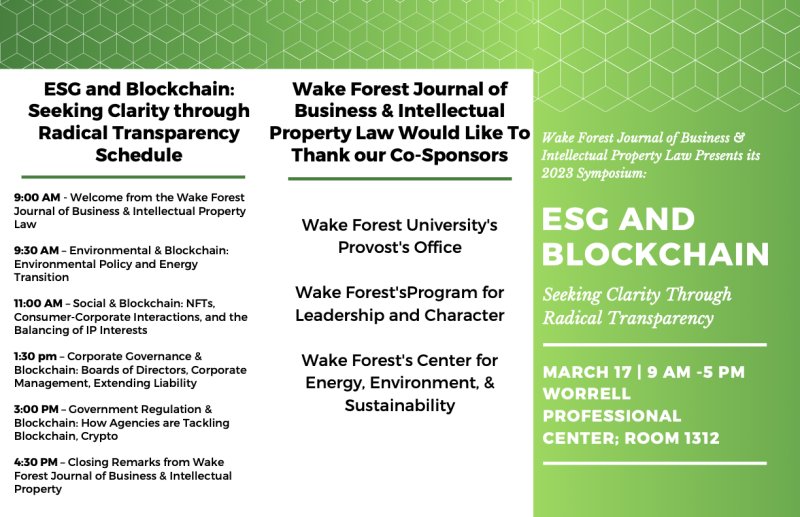
Wake Forest Law – ESG and Blockchain
I am honored to be speaking later today on ESG, blockchains, and corporate governance at this symposium at Wake Forest University School of Law. This practitioner-centered symposium promises to offer significant information useful to my teaching and scholarship. My fellow speakers hail from law firms and other organizations across the United States. I am excited to share and learn!
Yale Law Clinical Fellowships
I just heard about this a few days ago, but I do not think anyone has posted on it yet. Sadly, it looks like the formal application deadline has passed. But they may still be accepting applications. Those considering applying may want to inquire . . . .
* * *
YALE LAW SCHOOL CLINICAL FELLOWSHIPS
in the Veterans Legal Services Clinic
and Housing and Community & Economic Development Clinics
Yale Law School seeks applicants for two clinical fellowships in the Jerome N. Frank Legal Services Organization, within Yale Law School’s clinical program. These Fellowships are two-year positions with a third-year option, beginning on or about July 1, 2023, and are designed for lawyers with at least three years of practice who are considering a career in law school teaching. Each fellow will work with a different clinic. Responsibilities include representing clients, supervising students, assisting in teaching classes, and pursuing a scholarship agenda. Fellows also have an option to co-teach a section of a six-week fall program for first-year students, Introduction to Legal Analysis and Writing, for additional compensation. Candidates must be prepared to apply for admission to the Connecticut bar (candidates may qualify for admission without examination). All work will be conducted with the support of the clinical faculty and will focus on providing legal assistance to low-income and civil rights clients and organizations.
The Jerome N. Frank Legal Services Organization is committed to building a culturally diverse and pluralistic faculty and staff to teach and work in a multicultural environment. Candidates must be able to work both independently and as part of a team, and must possess strong written and oral communication skills. Experience in creative and community-driven advocacy is a strong plus. Annual salary is $75,000-80,000. In addition, Fellows will receive health benefits and access to university facilities.
Email a resume, cover letter, writing sample, and names, addresses and telephone numbers of three references to Osikhena Awudu, Program Manager, The Jerome N. Frank Legal Services Organization, osikhena.awudu@yale.edu. Please indicate the clinic or clinics to which you are applying. Applications will be accepted until March 15, 2023 but will be reviewed on a rolling basis (early applications encouraged).
More details about each fellowship follow below.
Veterans Legal Services Clinic (VLSC)
VLSC is a semester-long, in-house clinic whose students represent veterans and their organizations in VA benefits, record correction, and civil rights litigation in administrative, state, and federal courts, and in state and federal policy advocacy.
Illustrative cases include representation of individual veterans seeking disability compensation benefits for injuries incurred during military service, in initial applications, administrative appeals, and judicial review in federal court; former service members in applications to upgrade a less-than-honorable discharge before Defense Department boards and on judicial review in federal court; plaintiffs in federal civil rights cases, such as a woman raped while a cadet at the U.S. Military Academy at West Point and Black veterans seeking reparations for historic discrimination in VA benefits programs; three nation-wide classes of Iraq and Afghanistan Era veterans who received less-than-fully-honorable discharges, despite having PTSD or related conditions attributable to their military service; a nation-wide class of U.S. Air Force veterans exposed to radiation after cleaning up two hydrogen bombs accidentally dropped on Spain in 1966, in the first appeals class action certified in the history of the U.S. Court of Appeals for Veterans Claims; and local and national veterans’ organizations in campaigns to address gender discrimination in congressional nominations to the military service academies; curb retaliation against servicemembers who report sexual harassment or assault; and make veterans with bad paper eligible for state veterans’ benefits.
The principal supervisor for the position will be Professor Michael Wishnie.
Housing and Community & Economic Development Clinics
The Community & Economic Development (CED) is a semester-long, in-house clinic that provides transactional legal services to clients seeking to promote economic opportunity and mobility. CED’s clients include affordable housing developers, community development financial institutions, farms and farmer’s markets, fair housing advocates, and neighborhood associations. CED’s legal services help our clients to expand access to financial services, bring arts institutions and grocery stores to chronically under-resourced communities, break down barriers to affordable housing development in high-opportunity communities, promote access to healthy foods, and facilitate entrepreneurship among low-income people.
The Housing Clinic is a semester-long, in-house clinic that represents tenants facing evictions and substandard housing conditions; homeowners facing foreclosures and seeking affirmative relief for illegal behavior by mortgage lenders and servicers; and individuals and advocates in affirmative fair housing litigation.
On behalf of our clients, our students represent clients in federal and state courts; negotiate and draft contracts; provide advice on the tax consequences of deal structures and entity choices; structure and carry out real estate transactions; represent borrowers and lenders in financings; engage in legislative and regulatory advocacy; form for-profit and not-for-profit entities; and resolve land use and environmental issues. In addition to representing clients, students in their first semester of the clinic take a seminar which covers federal, state and local policies affecting urban and suburban places; substantive law in tax, real estate development, and corporate governance; and transactional and regulatory lawyering skills, such as negotiation and drafting contracts.
The principal supervisor for the position will be Professor Anika Singh Lemar.
Yale University considers applicants for employment without regard to, and does not discriminate on the basis of, an individual’s sex, race, color, religion, age, disability, status as a veteran, or national or ethnic origin; nor does Yale discriminate on the basis of sexual orientation or gender identity or expression. Title IX of the Education Amendments of 1972 protects people from sex discrimination in educational programs and activities at institutions that receive federal financial assistance. Questions regarding Title IX may be referred to the University’s Title IX Coordinator, at TitleIX@yale.edu, or to the U.S. Department of Education, Office for Civil Rights, 8th Floor, Five Post Office Square, Boston MA 02109-3921. Telephone: 617.289.0111, Fax: 617.289.0150, TDD: 800.877.8339, or Email: ocr.boston@ed.gov.
Michigan Law – Entrepreneurial Teaching Fellowship
The University of Michigan Law School is seeking a clinical teaching fellow in its Zell Entrepreneurship Clinic (ZEC). Law students in the ZEC provide transactional legal services to early-stage startups and play a significant role in the entrepreneurial ecosystem of Ann Arbor. Typical matters include business entity formation, intellectual property, contract drafting, and other common early-stage legal issues. This is a two-year appointment with the possibility of extension for a third year, beginning in the summer of 2023.
You can find more info about the clinic here: www.law.umich.edu/clinical/ec, and the job posting here: careers.umich.edu/job_detail/231796/…
Professor Sitaraman on Deplatforming
This week, I read Professor Ganesh Sitaraman’s fascinating article, Deplatforming (forthcoming, Yale Law Journal). As he states in the introduction, “Deplatforming has also not been limited to individuals and content on social media.” My research isn’t focused on tech platforms or social media. However, it does encompass banking, financial market infrastructures, and other evolving financial market platforms where this issue either has arisen or might arise in the future. I’m grateful that this article will help me in thinking about such questions. Here’s the abstract:
“Deplatforming in the tech sector is hotly debated, and at times, it might even seem unprecedented. In recent years, scholars, commentators, jurists, and lawmakers have focused on the possibility of treating social media platforms as common carriers or public utilities, with the implication that imposing a duty to serve the public would restrict them from deplatforming individuals and content.
But in American law, the duty to serve all comers was never absolute. In fact, the question of whether and how to deplatform—to exclude content, individuals, or businesses from critical services—has been utterly common and regularly debated throughout American history. In the common law and the major infrastructural and utility sectors—transportation, communications, energy, and banking—American law has long provided rules and procedures for when and how to deplatform.
This Article offers a history and theory of the law of deplatforming across networks, platforms, and utilities. Historically, the American tradition has not been one of either an absolute duty to serve or an absolute right to exclude. Rather, it has been one of reasonable deplatforming—of balancing the du-ties to serve and the need to, in limited and justifiable cases, exclude. Theoretically, deplatforming raises common questions across sectors: Who deplatforms? What is deplatformed? When does deplatforming occur? What are permissible reasons for deplatforming? How to deplatform? The Article uses the history of deplatforming to identify these and other questions, and to show how American law has answered them.
The history and theory of deplatforming shows that the tension between service and exclusion is an endemic issue for common carriers, utilities, and other infrastructural services—including contemporary tech platforms. The Article considers ways in which past deplatforming practices can inform current debates over the public and private governance of tech platforms.”
Tomorrow!! Virtual Teach-In: The Failure of Silicon Valley Bank
Dear BLPB Readers,
Professor Nadav Orian Peer at the University of Colorado Boulder Law School shared that tomorrow, Wednesday March 15th at 2pm ET (noon MT), there will be a “virtual teach-in at Colorado Law about SVB and its significance.” Interested readers can join the event at: www.cu.law/svb
LSU Law is Seeking a Visitor or Adjunct for Business Associations Courses
This just in from friend-of-the-BLPB Christina Sautter:
The Louisiana State University Paul M. Hebert Law Center seeks visiting or adjunct professors for the 2023-2024 academic year to teach Business Associations I (fall and spring) and Business Associations II (spring). Additional courses, such as Mergers & Acquisitions or Securities Regulation will also be considered. Interested individuals should email Pamela Hancock at phancock@lsu.edu for more information, as well as to obtain a link and instructions for uploading a CV and cover letter.
LSU is committed to providing equal opportunity for all qualified persons in admission to, participation in, or employment in the programs and activities which the University operates without regard to race, creed, color, marital status, sexual orientation, gender identity, gender expression, religion, sex, national origin, age, mental or physical disability, or veteran’s status. LSU is committed to diversity and is an equal opportunity/ equal access employer. LSU believes diversity, equity, and inclusion enrich the educational experience of our students, faculty, and staff, and are necessary to prepare all people to thrive personally and professionally in a global society.
Everything is a Security
This week, NYAG Letitia James filed a complaint against KuoCoin, a crypto exchange, for various violations of NY law, including running an unregistered commodities and securities exchange, and acting as an unregistered securities broker.
The allegations focus on three different crypto assets: Luna, TerraUSD, and Ether. In particular, James claims that Ether is both a commodity and a security – the latter allegation necessary to support the claim that Kuo should have registered as a securities broker.
Now, as we all know, the SEC and the CFTC have generally taken the view that Ether is a commodity, not a security, but Ether’s shift to a proof-of-stake model has raised questions about whether Ether’s status should change under federal law. James highlights the proof-of-stake model in her briefing in support of a petition for a permanent injunction against KuoCoin. But more interestingly, she argues in the alternative that Ether is a security under New York State’s prehistoric Waldstein test, articulated in In re Waldstein, 160 Misc. 763 (Sup. Ct, Albany Cnty. 1936). That test says a security is “any form of instrument used for the purpose of financing and promoting enterprises, and which is designed for investment.”
Waldstein has, according to Westlaw, been cited in a total of 32 cases since it was articulated in 1936, and in many of those cases, it’s mentioned but not really applied. When it is applied, it seems to have been used in conjunction with Howey and/or Reves, and it seems courts often conclude that the instrument under consideration comes out the same way under all tests. See, e.g., People v. Van Zandt, 981 N.Y.S.2d 275 (Sup Ct., Bronx Cnty. 2014); Xerox Corp v. New York State Tax Appeals Tribunal, 973 N.Y.S.2d 458 (App. Div. Third Dep’t 2013); People v. First Meridian Planning, 614 N.Y.S.2d 811 (App. Div. Third Dep’t 1994); All Seasons Resorts v. Abrams, 68 N.Y. 2d 81 (1986). But this time, James is using Waldstein in a manner that (might) diverge from how at least federal agencies have interpreted Howey, which begs the question whether New York courts will hold that Waldstein and Howey are different, and/or that Waldstein is still good law. Mostly, though, this is a lesson for my students that though we focus on Howey and Reves in class, states can have entirely different definitions of what counts as a security for the purposes of state regulation.