
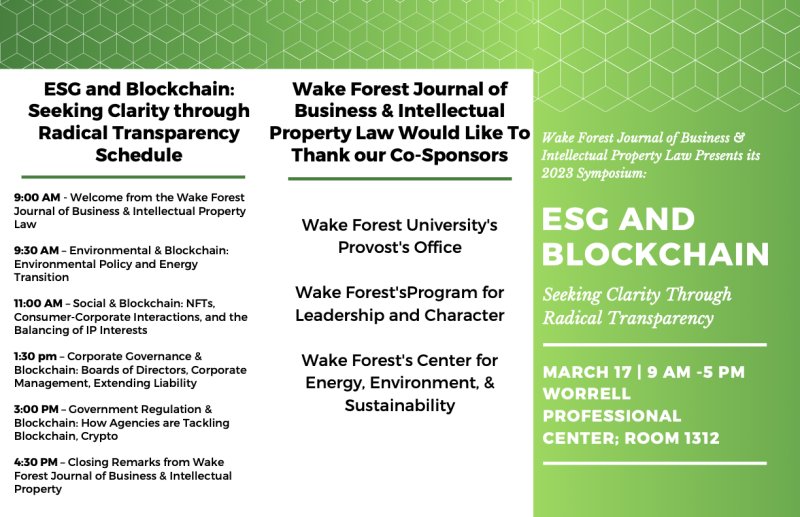
I am honored to be speaking later today on ESG, blockchains, and corporate governance at this symposium at Wake Forest University School of Law. This practitioner-centered symposium promises to offer significant information useful to my teaching and scholarship. My fellow speakers hail from law firms and other organizations across the United States. I am excited to share and learn!
Yale Law Clinical Fellowships
By Colleen Baker on
I just heard about this a few days ago, but I do not think anyone has posted on it yet. Sadly, it looks like the formal application deadline has passed. But they may still be accepting applications. Those considering applying may want to inquire . . . .
* * *
YALE LAW SCHOOL CLINICAL FELLOWSHIPS
in the Veterans Legal Services Clinic
and Housing and Community & Economic Development Clinics
Yale Law School seeks applicants for two clinical fellowships in the Jerome N. Frank Legal Services Organization, within Yale Law School’s clinical program. These Fellowships are two-year positions with a third-year option, beginning on or about July 1, 2023, and are designed for lawyers with at least three years of practice who are considering a career in law school teaching. Each fellow will work with a different clinic. Responsibilities include representing clients, supervising students, assisting in teaching classes, and pursuing a scholarship agenda. Fellows also have an option to co-teach a section of a six-week fall program for first-year students, Introduction to Legal Analysis and Writing, for additional compensation. Candidates must be prepared to apply for admission to the Connecticut bar (candidates may qualify for admission without examination). All work will be conducted with the support of the clinical faculty and will focus on providing legal assistance to low-income and civil rights clients and organizations.
The Jerome N. Frank Legal Services Organization is committed to building a culturally diverse and pluralistic faculty and staff to teach and work in a multicultural environment. Candidates must be able to work both independently and as part of a team, and must possess strong written and oral communication skills. Experience in creative and community-driven advocacy is a strong plus. Annual salary is $75,000-80,000. In addition, Fellows will receive health benefits and access to university facilities.
Email a resume, cover letter, writing sample, and names, addresses and telephone numbers of three references to Osikhena Awudu, Program Manager, The Jerome N. Frank Legal Services Organization, osikhena.awudu@yale.edu. Please indicate the clinic or clinics to which you are applying. Applications will be accepted until March 15, 2023 but will be reviewed on a rolling basis (early applications encouraged).
More details about each fellowship follow below.
Veterans Legal Services Clinic (VLSC)
VLSC is a semester-long, in-house clinic whose students represent veterans and their organizations in VA benefits, record correction, and civil rights litigation in administrative, state, and federal courts, and in state and federal policy advocacy.
Illustrative cases include representation of individual veterans seeking disability compensation benefits for injuries incurred during military service, in initial applications, administrative appeals, and judicial review in federal court; former service members in applications to upgrade a less-than-honorable discharge before Defense Department boards and on judicial review in federal court; plaintiffs in federal civil rights cases, such as a woman raped while a cadet at the U.S. Military Academy at West Point and Black veterans seeking reparations for historic discrimination in VA benefits programs; three nation-wide classes of Iraq and Afghanistan Era veterans who received less-than-fully-honorable discharges, despite having PTSD or related conditions attributable to their military service; a nation-wide class of U.S. Air Force veterans exposed to radiation after cleaning up two hydrogen bombs accidentally dropped on Spain in 1966, in the first appeals class action certified in the history of the U.S. Court of Appeals for Veterans Claims; and local and national veterans’ organizations in campaigns to address gender discrimination in congressional nominations to the military service academies; curb retaliation against servicemembers who report sexual harassment or assault; and make veterans with bad paper eligible for state veterans’ benefits.
The principal supervisor for the position will be Professor Michael Wishnie.
Housing and Community & Economic Development Clinics
The Community & Economic Development (CED) is a semester-long, in-house clinic that provides transactional legal services to clients seeking to promote economic opportunity and mobility. CED’s clients include affordable housing developers, community development financial institutions, farms and farmer’s markets, fair housing advocates, and neighborhood associations. CED’s legal services help our clients to expand access to financial services, bring arts institutions and grocery stores to chronically under-resourced communities, break down barriers to affordable housing development in high-opportunity communities, promote access to healthy foods, and facilitate entrepreneurship among low-income people.
The Housing Clinic is a semester-long, in-house clinic that represents tenants facing evictions and substandard housing conditions; homeowners facing foreclosures and seeking affirmative relief for illegal behavior by mortgage lenders and servicers; and individuals and advocates in affirmative fair housing litigation.
On behalf of our clients, our students represent clients in federal and state courts; negotiate and draft contracts; provide advice on the tax consequences of deal structures and entity choices; structure and carry out real estate transactions; represent borrowers and lenders in financings; engage in legislative and regulatory advocacy; form for-profit and not-for-profit entities; and resolve land use and environmental issues. In addition to representing clients, students in their first semester of the clinic take a seminar which covers federal, state and local policies affecting urban and suburban places; substantive law in tax, real estate development, and corporate governance; and transactional and regulatory lawyering skills, such as negotiation and drafting contracts.
The principal supervisor for the position will be Professor Anika Singh Lemar.
Yale University considers applicants for employment without regard to, and does not discriminate on the basis of, an individual’s sex, race, color, religion, age, disability, status as a veteran, or national or ethnic origin; nor does Yale discriminate on the basis of sexual orientation or gender identity or expression. Title IX of the Education Amendments of 1972 protects people from sex discrimination in educational programs and activities at institutions that receive federal financial assistance. Questions regarding Title IX may be referred to the University’s Title IX Coordinator, at TitleIX@yale.edu, or to the U.S. Department of Education, Office for Civil Rights, 8th Floor, Five Post Office Square, Boston MA 02109-3921. Telephone: 617.289.0111, Fax: 617.289.0150, TDD: 800.877.8339, or Email: ocr.boston@ed.gov.
Michigan Law – Entrepreneurial Teaching Fellowship
By Colleen Baker on
The University of Michigan Law School is seeking a clinical teaching fellow in its Zell Entrepreneurship Clinic (ZEC). Law students in the ZEC provide transactional legal services to early-stage startups and play a significant role in the entrepreneurial ecosystem of Ann Arbor. Typical matters include business entity formation, intellectual property, contract drafting, and other common early-stage legal issues. This is a two-year appointment with the possibility of extension for a third year, beginning in the summer of 2023.
You can find more info about the clinic here: www.law.umich.edu/clinical/ec, and the job posting here: careers.umich.edu/job_detail/231796/…
Professor Sitaraman on Deplatforming
By Haskell Murray on
This week, I read Professor Ganesh Sitaraman’s fascinating article, Deplatforming (forthcoming, Yale Law Journal). As he states in the introduction, “Deplatforming has also not been limited to individuals and content on social media.” My research isn’t focused on tech platforms or social media. However, it does encompass banking, financial market infrastructures, and other evolving financial market platforms where this issue either has arisen or might arise in the future. I’m grateful that this article will help me in thinking about such questions. Here’s the abstract:
“Deplatforming in the tech sector is hotly debated, and at times, it might even seem unprecedented. In recent years, scholars, commentators, jurists, and lawmakers have focused on the possibility of treating social media platforms as common carriers or public utilities, with the implication that imposing a duty to serve the public would restrict them from deplatforming individuals and content.
But in American law, the duty to serve all comers was never absolute. In fact, the question of whether and how to deplatform—to exclude content, individuals, or businesses from critical services—has been utterly common and regularly debated throughout American history. In the common law and the major infrastructural and utility sectors—transportation, communications, energy, and banking—American law has long provided rules and procedures for when and how to deplatform.
This Article offers a history and theory of the law of deplatforming across networks, platforms, and utilities. Historically, the American tradition has not been one of either an absolute duty to serve or an absolute right to exclude. Rather, it has been one of reasonable deplatforming—of balancing the du-ties to serve and the need to, in limited and justifiable cases, exclude. Theoretically, deplatforming raises common questions across sectors: Who deplatforms? What is deplatformed? When does deplatforming occur? What are permissible reasons for deplatforming? How to deplatform? The Article uses the history of deplatforming to identify these and other questions, and to show how American law has answered them.
The history and theory of deplatforming shows that the tension between service and exclusion is an endemic issue for common carriers, utilities, and other infrastructural services—including contemporary tech platforms. The Article considers ways in which past deplatforming practices can inform current debates over the public and private governance of tech platforms.”
Tomorrow!! Virtual Teach-In: The Failure of Silicon Valley Bank
By Haskell Murray on
Dear BLPB Readers,
Professor Nadav Orian Peer at the University of Colorado Boulder Law School shared that tomorrow, Wednesday March 15th at 2pm ET (noon MT), there will be a “virtual teach-in at Colorado Law about SVB and its significance.” Interested readers can join the event at: www.cu.law/svb
LSU Law is Seeking a Visitor or Adjunct for Business Associations Courses
By Colleen Baker on
This just in from friend-of-the-BLPB Christina Sautter:
The Louisiana State University Paul M. Hebert Law Center seeks visiting or adjunct professors for the 2023-2024 academic year to teach Business Associations I (fall and spring) and Business Associations II (spring). Additional courses, such as Mergers & Acquisitions or Securities Regulation will also be considered. Interested individuals should email Pamela Hancock at phancock@lsu.edu for more information, as well as to obtain a link and instructions for uploading a CV and cover letter.
LSU is committed to providing equal opportunity for all qualified persons in admission to, participation in, or employment in the programs and activities which the University operates without regard to race, creed, color, marital status, sexual orientation, gender identity, gender expression, religion, sex, national origin, age, mental or physical disability, or veteran’s status. LSU is committed to diversity and is an equal opportunity/ equal access employer. LSU believes diversity, equity, and inclusion enrich the educational experience of our students, faculty, and staff, and are necessary to prepare all people to thrive personally and professionally in a global society.
Everything is a Security
By Ann Lipton on
This week, NYAG Letitia James filed a complaint against KuoCoin, a crypto exchange, for various violations of NY law, including running an unregistered commodities and securities exchange, and acting as an unregistered securities broker.
The allegations focus on three different crypto assets: Luna, TerraUSD, and Ether. In particular, James claims that Ether is both a commodity and a security – the latter allegation necessary to support the claim that Kuo should have registered as a securities broker.
Now, as we all know, the SEC and the CFTC have generally taken the view that Ether is a commodity, not a security, but Ether’s shift to a proof-of-stake model has raised questions about whether Ether’s status should change under federal law. James highlights the proof-of-stake model in her briefing in support of a petition for a permanent injunction against KuoCoin. But more interestingly, she argues in the alternative that Ether is a security under New York State’s prehistoric Waldstein test, articulated in In re Waldstein, 160 Misc. 763 (Sup. Ct, Albany Cnty. 1936). That test says a security is “any form of instrument used for the purpose of financing and promoting enterprises, and which is designed for investment.”
Waldstein has, according to Westlaw, been cited in a total of 32 cases since it was articulated in 1936, and in many of those cases, it’s mentioned but not really applied. When it is applied, it seems to have been used in conjunction with Howey and/or Reves, and it seems courts often conclude that the instrument under consideration comes out the same way under all tests. See, e.g., People v. Van Zandt, 981 N.Y.S.2d 275 (Sup Ct., Bronx Cnty. 2014); Xerox Corp v. New York State Tax Appeals Tribunal, 973 N.Y.S.2d 458 (App. Div. Third Dep’t 2013); People v. First Meridian Planning, 614 N.Y.S.2d 811 (App. Div. Third Dep’t 1994); All Seasons Resorts v. Abrams, 68 N.Y. 2d 81 (1986). But this time, James is using Waldstein in a manner that (might) diverge from how at least federal agencies have interpreted Howey, which begs the question whether New York courts will hold that Waldstein and Howey are different, and/or that Waldstein is still good law. Mostly, though, this is a lesson for my students that though we focus on Howey and Reves in class, states can have entirely different definitions of what counts as a security for the purposes of state regulation.
Recommended: “A Roundtable on Recent Developments at the FTC”
By Stefan J. Padfield on
On March 6, the Federalist Society hosted “A Roundtable on Recent Developments at the FTC.” Yesterday, I had the chance to listen to a podcast of the event and I think it may be of interest to BLPB readers. All the relevant links can be found here. Below is a brief description of the event.
Recent months have seen a flurry of notable developments at the Federal Trade Commission, including oral arguments in the high-profile Axon v. FTC and SEC v. Cochran Supreme Court cases, administrative complaints challenging deals between Altria and JUUL and Illumina and GRAIL, and FTC Commissioner Christine Wilson’s announced resignation. Please join us for an in-person luncheon featuring a panel of antitrust law experts examining these developments and debating what might come next at the FTC.
Central Michigan University Seeking Tenure-Track Entrepreneurship Faculty
By Colleen Baker on
Position Summary
The College of Business Administration at Central Michigan University invites applications for one or more entrepreneurship faculty members to begin service at the rank of assistant professor, associate professor, or full professor on August 21, 2023.
CMU anticipates the successful applicant will take a leadership role in the department. This could include serving as the Department Chairperson, serving as the Director of the Master in Entrepreneurial Ventures (MEV) program, or service in another administrative capacity. A reduced teaching load is available for successful applicants serving in one of these roles.
Tenure-track faculty are generally expected to teach three courses per semester, maintain an active research agenda, and actively participate in service activities. Courses may be face-to-face or online and at the undergraduate or graduate level. Faculty may also: advise students; engage in assessment of learning activities; help develop and promote CMU’s entrepreneurship offerings; support CMU’s New Venture Competition (NVC) and other extra-curricular initiatives; and strengthen partnerships on and off campus. Candidates must have the ability to perform the essential functions of the job with or without reasonable accommodations.
Required Qualifications
Candidates must have a terminal degree: (i) a Ph.D. or D.B.A in entrepreneurship or a related business field (from an AACSB accredited institution); or, (ii) a J.D. (from an ABA accredited institution) with significant entrepreneurship-related experience; or, (iii) other relevant terminal degree (from a major national university) with significant entrepreneurship-related experience. For those pursuing a Ph.D. or D.B.A., ABD applicants will be considered if it is clear that the applicant’s degree will be conferred at the time of appointment.
Message to Applicants
CMU encourages applicants from diverse academic backgrounds to apply. You must submit an online application to be considered an applicant for this position. To apply, please visit our website at https://www.jobs.cmich.edu/. Inquiries about the position may be directed to the Entrepreneurship Chairperson David Nows at David.Nows@cmich.edu; however, the applicant must apply directly through the online Central Michigan University applicant portal.
CMU, an AA/EO institution, strongly and actively strives to increase diversity and provide equal opportunity within its community. CMU does not discriminate against persons based on age, color, disability, ethnicity, familial status, gender, gender expression, gender identity, genetic information, height, marital status, national origin, political persuasion, pregnancy, childbirth or related medical conditions, race, religion, sex, sex-based stereotypes, sexual orientation, transgender status, veteran status, or weight (see http://www.cmich.edu/ocrie).
Professor Packin on Financial Inclusion Gone Wrong: Securities and Crypto Assets Trading for Children
By Haskell Murray on
Today, a LexisNexis alert shared the great news that Professor Nizan Geslevich Packin’s article, Financial Inclusion Gone Wrong: Securities and Crypto Assets Trading for Children, has now been published in the Hastings Law Journal. It’s a fascinating work that I had the privilege of seeing presented at last year’s National Business Law Scholars Conference (NBLSC) at OU Law. I’m excited to see it’s now published, and I can’t wait to learn about more exceptional work like this at this year’s NBLSC in Knoxville, Tennessee. Hope to see many of you there!
Article citation: Nizan Geslevich Packin, Financial Inclusion Gone Wrong: Securities and Cypto Assets Trading for Children, 74 Hastings L. J. 349 (2023).
Here’s the abstract posted on SSRN:
“According to studies, for most Americans, money is a major source of anxiety. Looking for ways to help Americans address this source of anxiety, some believe that increasing children’s financial orientation could help lower their money-related anxiety levels as adults. Identifying this market as a business opportunity, and reassured by research that shows that by age six, children are already veteran consumers of mobile apps, financial technology (FinTech), decentralized finance (DeFi) and even traditional financial entities have started offering services and products to children. These services and products include a broad array of financial-related products and services – from enabling children to earn money for doing their chores, to trade stocks and crypto assets, and even earn digital assets and currencies while playing video games.
The potential of this new market’s clientele is valuable for two reasons. First, having more customers is always a good thing. Second, children will eventually mature into adult customers and presumably will continue using the services and products they like and with which they are familiar. And although some legal challenges are associated with children, who are minors, not only entering into financial-based contracts but also doing so online, this business trend will continue to grow as offering financial services to children is becoming socially acceptable. Society’s newly adopted paradigms for describing, understanding, and shaping children’s rights, domestic relationships, custodial status, and even digital purchasing power are all supportive of this trend. Moreover, FinTech and DeFi financial apps and games can help teach children about the value of money, the importance of investing, and the risks involved in trading.
Yet, FinTech and DeFi apps and games could also have a developmentally and behaviorally disruptive effect on children, similarly to other consumed digital content. Moreover, they should be a source of concern to anyone focused on investor and consumer protection, including regulatory agencies such as the SEC and FINRA, which have already expressed concerns about gamification and digital engagement practices. Given “the financialization of everything,” using legal and ethical reasoning, and behavioral economics tools, this Article calls for the search for effective financial literacy education for children to be replaced by a search for policies more conducive to good consumer and investor protection outcomes, which should guide lawmakers in regulating FinTech and DeFi apps and games offered to children in light of: (i) the addictiveness of digital gaming; (ii) how gamifying finance makes it feel less serious; (iii) the connection between gamification and gambling; (iv) how children’s financial choices are more susceptible to the influence of outside parties than are those of adults; (v) the FinTech and DeFi apps and games’ failure to teach children the importance of concepts such as debt, credit, and financial commitments; and (vi) the unrealistic burden on young parents who already struggle with the need to constantly supervise their children’s online activities, in our digital era, by expecting them to monitor their children’s online financial activities.”