Dear BLPB Readers:

The below is from the Call for Panel and Independent Paper Proposals for the upcoming conference, Money as a Democratic Medium 2.0.

We are delighted to announce Money as a Democratic Medium 2.0. The Conference will be held at two sites in order to maximize participation while minimizing carbon impacts: Cambridge, MA (Harvard Law School, June 15-17, 2023) and Hamburg, Germany (the Hamburg Institute for Social Research and THE NEW INSTITUTE,  June 15-16, 2023).  The Conference is open to all students of money, credit, and finance, the monetary system, and the modern economy, including members of the public. We will offer robust online access and we encourage distant participants to join us virtually.

The full call is here.  The deadline for submissions is February 1, 2023.
Posting something light tonight . . . .

I have found myself fascinated listening to Jax’s recent hit “Victoria’s Secret,” a clever pop ballad about female body image concerns and intimates retailer Victoria’s Secret.  The refrain is catchy and, itself, tells a story–a business story.

I know Victoria’s secret
And, girl, you wouldn’t believe
She’s an old man who lives in Ohio
Making money off of girls like me”
Cashin’ in on body issues
Sellin’ skin and bones with big boobs
I know Victoria’s secret
She was made up by a dude (dude)
Victoria was made up by a dude (dude)
Victoria was made up by a dude

Because I knew some of the history of the Victoria’s Secret business, I understood that the allusion to the “old man who lives in Ohio”–the “dude”–is a reference to Leslie Wexner, the founder of L Brands (earlier famous for owning major brands like The Limited, Express, and Abercrombie & Fitch, as well as Victoria’s Secret).  Victoria’s Secret became an independent publicly traded firm, Victoria’s Secret & Co., last year through a tax-free spin-off from L Brands (now known as Bath & Body Works, Inc.).  From the Victoria’s Secret & Co. website:

On August 3, 2021, L Brands (NYSE: LB) completed the separation of the Victoria’s Secret business into an independent, public company through a tax-free spin-off to L Brands shareholders. The new company, named Victoria’s Secret & Co., includes Victoria’s Secret Lingerie, PINK and Victoria’s Secret Beauty. Victoria’s Secret & Co. is a NYSE listed company trading under the ticker symbol VSCO.

In conjunction with this announcement, L Brands changed its name to Bath & Body Works, Inc. and now trades under the ticker symbol BBWI.

According to (among other sources) a Newsweek piece from last summer, Wexner did not found Victoria’s Secret.  He bought it in 1982 from the founder.  However, he did elevate the brand to cult status and financial success.  So, one might say that he did “make up” Victoria (as she is conceptualized in the song’s lyrics). 

Having said that, it also seems fair to note that Ed Razek, long-time L Brands chief marketing officer, is credited (in that same Newsweek article) with overseeing the iconic Victoria’s Secret fashion shows that ran from 1995 to 2018.  In the minds of many, these fashion shows created–or at least popularized–the image of the Victoria in Jax’s lyrics (“skin and bones with big boobs”).

Victoria’s Secret & Co. has been working to change its image.  Its website includes value statements consistent with greater inclusion and features some photos of nontraditional intimates models–models that are not reflective of the Victoria described in the “Victoria’s Secret” song lyrics.  Moreover, the Victoria’s Secret & Co. CEO reportedly reached out to Jax to thank her for highlighting body image issues through her song.

With the craziness of current business stories, grading, and the holiday season, this post is designed to offer some amusement (if not educational value).  I have endeavored to ensure that BLPB readers now know Victoria’s Secret–the company–a bit better.  I also hope you enjoy the Jax song and appreciate its encouragement of positive body image.

My classroom teaching for the semester is over.  I am in “grading mode”–not my favorite way of being.  But final assessments must be completed!  (Wishing you well in completing yours.)

Before I left the classroom, however–specifically, in the last class meeting for my corporate finance students–I did have some fun.  I saved my last class session in the course to address what my students wanted me to cover.  I asked for the topics in advance.  They covered a range of corporate finance topics, from litigation issues (Theranos, FTX, and current hot legal claims) through common mistakes to avoid in a corporate finance practice to survival tips for first-year law firm associates.  Weaving all of that together in a 75-minute class period was a tall task.

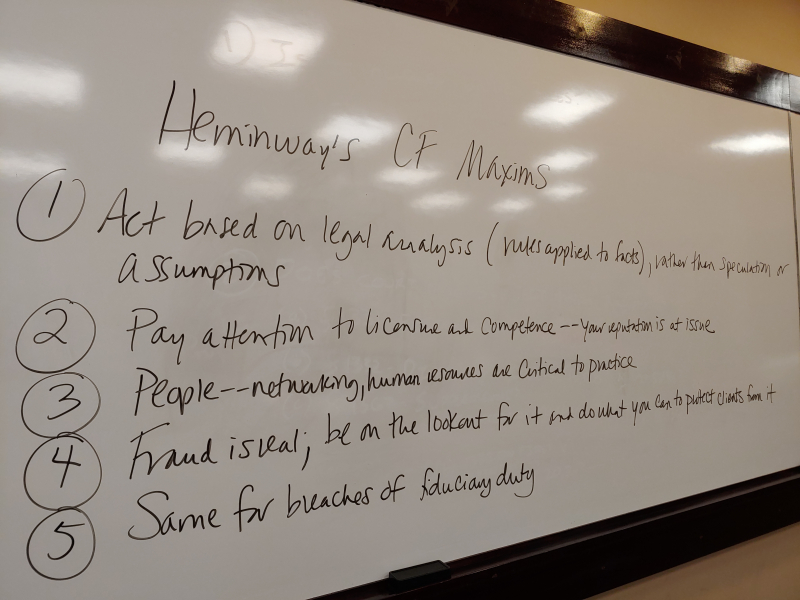
My ultimate vehicle was to come up with a list of maxims–short-form guidance statements–that would allow me to address all of what my students had asked me to cover.  I came into class with just a few maxims to get us started and cover the basics.  But the conversation was very engaged and got rich relatively quickly.  As we riffed off each other’s questions and comments, my little list grew to a robust thirteen maxims!  

Before I erased the white board and left the classroom, I took a picture of each of the two white board panels generated from our conversation.  Those pictures are included below.  Despite my handwriting, I am hoping you can see what we came up with real-time.  If not, set forth below is our jointly created list of principles (edited slightly), many of which apply equally outside a corporate finance practice.

  1. Act based on legal analysis (rules applied to facts), rather than speculation or assumptions.
  2. Pay attention to licensure and competence–your reputation is at issue.
  3. People–networking, human resources–are critical to practice.
  4. Fraud is real; be on the lookout for it, and do what you can to protect clients from it.
  5. The same is true for for breaches of fiduciary duty.
  6. Take an issue as far as you can before consulting.
  7. Learn when to decide and when to consult.
  8. Keep abreast of changes in law, business, etc. relevant to your practice.
  9. Don’t check your common sense at the door (with a hat tip to GWK–George W. Kuney, one of my colleagues).
  10. Time is important–show up on time, meet deadlines, etc.
  11. Manage your time away from the office; don’t forget personal care/wellness.  (Drugs–including caffeine–are not the answer.)
  12. Hand colleagues and clients your best work (within the allotted time).
  13. Take time to enjoy your colleagues, clients, and work–there is great joy in this practice.

Which of these maxims resonate most with you?  Which of them would you amend by adjustment or addition? What maxims do you share with your students?  Leave thoughts in the comments!

1130220944


1130220945

I’m a huge football fan. I mean real football– what people in the US call soccer. I went to Brazil for the World Cup in 2014 twice and have watched as many matches on TV as I could during the last tournament and this one. In some countries, over half of the residents watch the matches when their team plays even though most matches happen during work hours or the middle of the night in some countries. NBC estimates that 5 billion people across the world will watch this World Cup with an average of 227 million people a day. For perspective, roughly 208 million people, 2/3 of the population, watched Superbowl LVI in the US, which occurs on a Sunday.

Football is big business for FIFA and for many of its sponsors. Working with companies such as Adidas, Coca-Cola, Hyundai / KIA, Visa, McDonald’s, and Budweiser has earned nonprofit FIFA a record 7.5 billion in revenue for this Cup. Fortunately for Budweiser, which paid 75 million to sponsor the World Cup, Qatar does not ban alcohol. But in a plot twist, the company had to deal with a last-minute stadium ban. FIFA was more effective in Brazil, which has banned beer in stadiums since 2003 to curb violence. The ban was temporarily lifted during the 2014 Cup. I imagine this made Budweiser very happy. I know the fans were. 

This big business is a big part of the reason that FIFA has been accused of rampant corruption in the award of the Cup to Russia and Qatar, two countries with terrible human rights records. The Justice Department investigated and awarded FIFA hundreds of millions as a victim of its past leadership’s actions related to the 2018 and 2022 selections. Amnesty International has called these games the “World Cup of Shame” because of the use of forced labor, exorbitant recruitment fees, seizure of passports, racism, delayed payments of $220 per month, and deaths. Raising even more awareness, more than 40 million people have watched comedian John Oliver’s 2014 , 2015, and 2022 takedowns of FIFA. 

The real victims of FIFA’s corruption are the millions of migrant workers operating under Qatar’s kafala system. I remember sitting at a meeting at the UN Forum on Business and Human Rights in Geneva when an NGO accused the Qatar government of using slaves to build World Cup Stadiums. I also remember both FIFA and the International Olympic Committee pledging to consider human rights when selecting sites in the future. Indeed, FIFA claims that human rights were a “key factor” when choosing the Americas to host the 2026 Cup. 

With all of the talk about ESG including human rights and anti-discrimination from FIFA, Coca Cola, Budweiser and others related to the World Cup, how do those pronouncements square with FIFA’s ban on team captains wearing the One Love Rainbow Arm Band?  Qatar has banned same sex relations  so seven EU team captains had planned to wear the arm bands as a gesture to “send a message against discrimination of any kind as the eyes of the world fall on the global game.”  This was on brand with FIFA ‘s own  strong and repeated statements against racism after several African players suffered from taunts and chants from fans in stadiums. FIFA reiterated its stance after the death of George Floyd. Just today, FIFA issued another statement against discrimination, noting that over 55% of players received some kind of discriminatory online abuse during the Euro 2020 Final and AFCON 2022 Final.

It’s curious then that despite FIFA’s and the EU team’s pledges about anti-discrimination, just three hours before a match, the teams confirmed that they would not wear the arm bands after all.  Apparently, they learned that players could face yellow card sanctions if they wore them. Qatar also bans advocacy and protests about same sex relationships. Unlike the stadium beer ban, this wasn’t new.

And the human rights abuse allegations against FIFA aren’t new. I’ve blogged about FIFA and the issues I encountered when meeting human rights activists in Brazil several times including here. So I will end with the questions I asked years ago about FIFA and its sponsors and add the answers as I know them today. 

1)   Is FIFA, the nonprofit corporation, really acting as a quasi-government and if so, what are its responsibilities to protect and respect local communities under UN Guiding Principles on Business and Human Rights? Answer: FIFA has pledged to comport with the UN Guiding Principles on Business and Human Rights, but its arm band ban shows otherwise. 

2)   Does FIFA have more power than the host country and will it use that power when it requires voters to consider a bidding country’s human rights record in the future? Answer: See the answer to #3. Also, it will be interesting to see what FIFA demands of 2026 host Florida, a state which is divesting of funds with a focus on ESG and which has proposed anti-ESG legislation.  

3)   If Qatar remains the site of the 2022 Cup after the various bribery and human rights abuse investigations, will FIFA force that country to make concessions about alcohol and gender roles to appease corporate sponsors? Answer: Nope

4)   Will/should corporate sponsors feel comfortable supporting the Cup in Russia in 2018 and Qatar in 2022 given those countries’ records and the sponsors’ own CSR priorities? Answer: Yep, despite public statements to the contrary. It’s just too lucrative

5)   Does FIFA’s antidiscrimination campaign extend beyond racism to human rights or are its own actions antithetical to these rights? Answer: Yes the campaign does but again, the arm band ban shows otherwise. 

6)   Are the sponsors commenting publicly on the protests and human right violations? Should they and what could they say that has an impact? Should they have asked for or conducted a social impact analysis or is their involvement as sponsors too attenuated for that? Answer: Amnesty International is seeking corporate support for compensation reform, but hasn’t been very successful.

7)   Should socially responsible investors ask questions about whether companies could have done more for local communities by donating to relevant causes as part of their CSR programs? Answer: In my view, yes. The UN has guidance on this as well. 

8)   Are corporations acting as “bystanders”, a term coined by Professor Jena Martin?  Answer: Yes. 

9)   Is the International Olympic Committee, a nonprofit, nongovernmental organization, taking notes? Answer: Yes. Despite or perhaps because of the outrage over selecting China for the Olympics, the IOC has recently approved a Strategic Framework on Human Rights.

10)  Do consumers, the targets of creative corporate commercials and  viral YouTube videos, care about any of this? Answer: It depends on the demographics, but I would say no. How do I know this? Because I teach and write about business and human rights and I have still scheduled my grading of exams and meetings around the World Cup. Advertisers can’t miss out on having 25% of the world’s eyeballs on their products.  And FIFA knows that the human rights noise will all go away for most fans as soon as the referee blows the whistle to start the match.

In any event, my business and human rights students will enjoy grappling with the ugly side of the beautiful game next semester as we work on proposals for the city of Miami to live up to its 2021 commitments to human rights whether FIFA does or not.

A former shareholder of Anaplan recently filed a lawsuit against several of its former officers and directors, alleging a variety of fiduciary breaches in connection with the company sale to Thoma Bravo (“TB”).

As you may recall from news reports at the time – or Matt Levine’s column – Anaplan signed a deal to sell itself to TB at $66 per share.  Then, the bottom fell out of the market, and suddenly that looked like a very generous price.  TB was stuck, though, until Anaplan screwed up by approving a bunch of new bonus payments to executives that violated the merger agreement’s ordinary course covenant.  That gave TB an excuse to threaten to walk away unless Anaplan agreed to a lower deal price, and the merger ultimately closed at $63.75 – a reduction of $400 million.

Pentwater Capital, a hedge fund with a substantial stake in Anaplan, is now suing, alleging that compensation committee directors, and the officers involved with the awards, breached their duties of loyalty and committed waste, and that the officers – including the company CEO, who was also Chair – acted with gross negligence. 

(Side note: to distinguish the CEO’s behavior in his capacity as officer, where he was not exculpated for negligence, from his behavior in his capacity as Chair, where he was, the complaint points out that he participated in Compensation Committee meetings, though he could not legally have been a member of that committee since NYSE requires that Compensation Committee members be independent).

And what leaps out to me from this suit is how Delaware law has taken some wrong turns.

First and most obviously, as I previously blogged, Delaware now permits officers, as well as directors, to be exculpated for negligence in connection with direct claims.  Though the Anaplan complaint tries to make out a claim for conscious wrongdoing, which would violate the duty of loyalty via bad faith action, that seems like a tall ask; there’s no argument that the excess compensation awards were self-dealing, only that they were obviously barred by the merger agreement, and that the defendants forged ahead heedlessly nonetheless.  Pentwater doesn’t even claim that the excess awards were actually material to TB or the merger agreement.  Instead, it admits that their significance was that they handed TB the excuse it needed to escape the deal, and claims that the defendants should have anticipated that TB would make use of any leverage it could.

So this, to me, is a scenario where negligence liability would help remedy a tangible harm inflicted on the shareholders.  But in future years, it’s likely that any officers who behave similarly will be entirely in the clear.  I’ll note that Pentwater makes much of the CEO’s golden parachute and other payments he received in connection with the merger – to the tune of over $250 million – but this is not like those cases where the CEO negotiates a bad deal to get his severance; here, the CEO already had a great deal on the table and no reason to blow it, especially since a lot of his payments were equity.  Still, the payments do suggest that there would be some justice in forcing him personally to make up a lot of what shareholders lost.

Second, this case highlights the fallacy of Corwin.  Because the biggest stumbling block for Pentwater is that shareholders approved the merger.  Of course they did!  The bottom fell out of the market; they weren’t going to get a better deal, even at the revised price.  That hardly means they wanted to cleanse the fiduciary breaches that cost them $400 million.  But Corwin requires that these two actions – approval of the substance of the deal, and ratification of the managers’ conduct – be bundled into a single vote.  Which is precisely the objection several commenters have raised with respect to Corwin, see, e.g., James D. Cox, Tomas J. Mondino, & Randall S. Thomas, Understanding the (Ir)relevance of Shareholder Votes on M&A Deals, 69 Duke L.J. 503 (2019).  In fact, as I previously blogged, VC Glasscock recently had the exact same intuition outside the Corwin context.  In Manti Holdings v. The Carlyle Group, 2022 WL 444272 (Del. Ch. Feb. 14, 2022), he held that shareholders did not waive their rights to bring fiduciary duty claims in connection with a merger merely because they signed a contract agreeing not to challenge the merger itself.  Because challenging a merger, and alleging fiduciary breaches in connection with a merger, are different things, as the Anaplan case highlights, but as Corwin conflates.

That said, Pentwater knows all this and has seeded its complaint with potential end-runs around Corwin.  Starting with, it argues that the vote was coerced: “stockholders had a metaphorical gun to their head,” Pentwater alleges.  And, that’s not wrong, but defendants presumably will argue, not without force, that the “coercion” was simply that the shareholders liked the deal on the table and didn’t expect a better one would be forthcoming.  The facts may be extreme, but they’re the same as every other merger that Corwin deems cleansed; what this situation really highlights is just how unsatisfying Corwin is for that reason.

Pentwater also argues that the proxy materials were misleading because they didn’t make clear exactly how egregious the defendants’ conduct was, and how aware they were that they were in breach.  Which may be true – I have no idea – but the whole point of the coercion argument is that shareholders were forced to vote in favor anyway, which kind of suggests that those details were immaterial. 

Finally, Pentwater argues waste.  Pentwater makes the not unreasonable point that when a company is on the verge of being sold for cash, new retention awards add zero value to current shareholders.  Waste, of course, can only be approved with a unanimous shareholder vote, see Harbor Fin. Partners v. Huizenga, 751 A.2d 879 (Del. Ch. 1999), and while the vote in favor of the deal was nearly 99%, it wasn’t actually unanimous.

I actually can see this one having legs, especially if Pentwater can make the case that the defendants knew they violated the agreement or acted without heed of it.  Not only is the waste argument persuasive, but waste is useful from Delaware’s perspective because it would allow justice to be done in this particular case without forcing a confrontation with the paradoxes created by Corwin.  But that doesn’t mean the problems have gone away.

Back in October, I posted a blog asking “Should Antitrust Regulators Come for the ESG Cartel?” Yesterday, The Federalist reported (here) that Republicans are launching an investigation into the “Climate-Obsessed Corporate ‘Cartel.’” Some key points from the article:

  • In a June op-ed published in the Wall Street Journal and cited by lawmakers, Sean Fieler, the president of Equinox Partners, a Manhattan-based investment firm, outlined how “The ESG Movement Is a Ripe Target for Antitrust Action.”
  • Republican Arizona Attorney General Mark Brnovich launched a separate antitrust investigation into the Climate Action 100+ network in November last year.
  • House Republicans launched an investigation Tuesday probing whether major climate groups that spearhead the “environmental, social, and governance” (ESG) movement are violating antitrust laws.

The article notes that: 

In a letter sent to executives of the Steering Committee for Climate Action 100+, Republicans led by Ohio Rep. Jim Jordan are demanding a treasure trove of documents that illustrate the coalition’s network of influence…. “Woke corporations are collectively adopting and imposing progressive policy goals that American consumers do not want or do not need. An individual company’s use of corporate resources for progressive aims might violate fiduciary duties or other laws, harming its viability and alienating consumers,” Republicans warned. “But when companies agree to work together to punish disfavored views or industries, or to otherwise advance environmental, social, and governance (ESG) goals, this coordinated behavior may violate the antitrust laws and harm American consumers.”

A Pacific Legal Foundation press release from Nov. 16 (here) reports the following, which may be of interest to #corpgov types overseeing DEI initiatives.

Today, Joshua Diemert, a former City of Seattle employee, filed a federal lawsuit against the City and Mayor Bruce Harrell for subjecting him to a racially hostile work environment…. Diemert endured years of harassment and racial discrimination in the workplace. Some incidents officially sanctioned by the city were so severe that they created a racially hostile working environment. For example:

  • He was pressured to resign from a position rather than take FMLA leave because he was told that taking FMLA leave would be an exercise of his “white privilege” and would deny a “person of color” an opportunity for promotion.
  • On multiple occasions, upper-level managers verbally told him and other department employees that new positions should be filled with people of color, particularly senior roles.
  • He was forced to attend training that demanded he acknowledge his complicity in racism, not based on his personal actions or beliefs but because he is white.
  • When he spoke up against egregiously racist messaging at a required workshop, his coworkers labeled him a white supremacist. And belligerent colleagues continuously berated him about his race.

“Instead of supporting its employees and providing them with opportunities, the City of Seattle is encouraging racial discrimination and harassment through its Race and Social Justice Initiative,” said Laura D’Agostino, an attorney at Pacific Legal Foundation. “Seattle employees should be treated as individuals with dignity and evaluated by the content of their character, not the color of their skin.”… The case is Joshua Diemert v. City of Seattle, filed in the United States District Court for the Western District of Washington.

When it comes to FTX, I’ll let the crypto people talk about the implications for that space generally, and I’m sure we all have our opinions on Samuel Bankman-Fried’s conduct – both before the collapse, and his endless apology tour afterwards – but what will live on for me is not any of that, but the 14,000 word hagiography that Sequoia had published on its website until very recently; they took it down after the bankruptcy declaration, though of course you can’t erase anything from the internet.

Sequoia has gotten a lot of flak for it not only for the fawning coverage, but because it revealed that Bankman-Fried actually was playing a video game during his pitch meeting.  More than that, after FTX raised $1 billion in its B round, it apparently held a “meme round” of financing, and raised $420.69 million from 69 investors.

Such revelations have inspired a lot of criticisms of the due diligence process today, not only by Sequoia but also by other FTX investors like Ontario Teachers’ Pension Plan.

But what really stood out to me not just was the evidence of due diligence failure, but the fact that Sequoia intentionally, by their own volition, put this article on its own website.  It wanted you to know that this was who they were funding, and this was the process they used.  They believed this would give them credibility, perhaps with founders, perhaps with their own investors – and they may very well have been right.

I’ve previously blogged (twice!), and written an essay about, about how the changes to the securities laws create these situations (though, of course, macroeconomic changes are responsible as well, as this Financial Times article explains).

In particular, my point is that the securities laws cultivate investors with particular preferences, and that leads to particular corporate outcomes.  As relevant here, in 1996, Congress gave the green light for private funds to raise unlimited amounts of capital, without becoming subject to registration under either the Securities Act or the Investment Company Act, so long as their own investors consist solely of persons with $5 million in assets.   At the same time, Congress and the SEC also made it easier for operating companies to raise capital while remaining private, so long as they mostly limit their investor base to these newly supercharged private funds.  The illiquid nature of the funding vehicles (necessitated by their private, non-tradeable status) encourages a short-termist orientation in search of a quick payout.  Due to the high-risk nature of these investments, private funds invest in multiple firms in the expectation that most will fail but a few will become outsized hits.  The result has been that one category of investor – wealthy, institutional, private, illiquid, risk-seeking, and with limited ability to express negative sentiment – has come to dominate the private markets.   And that’s how you end up with Sequoia bragging about funding being based on obscene numbers rather than DCF models. 

The securities laws are ultimately supposed to facilitate the efficient allocation of capital, but unfortunately, too much weight is being put on “let sophisticated investors make their own choices” and not enough on how these rules shape these sophisticated investors themselves and their preferences, which may not up end up aligning with society’s preferences.

In a press release issued today (here), “Florida Chief Financial Officer (CFO) Jimmy Patronis announced that the Florida Treasury will begin divesting $2 billion worth of assets currently under management by BlackRock.”  Stated Patronis:

Using our cash … to fund BlackRock’s social-engineering project isn’t something Florida ever signed up for. It’s got nothing to do with maximizing returns and is the opposite of what an asset manager is paid to do. Florida’s Treasury Division is divesting from BlackRock because they have openly stated they’ve got other goals than producing returns. As Larry Fink stated to CEOs “[A]ccess to capital is not a right. It is a privilege.” As Florida’s CFO I agree wholeheartedly, so we’ll be taking Larry up on his offer. There’s no lack of companies who will invest on our behalf, so the Florida Treasury will be taking its business elsewhere.

At some point, these millions/billions being divested from Blackrock are going to add up to real money.

Dear BLPB Readers:

The World Federation of Exchanges is organising its 40th Annual Clearing and Derivatives Conference, WFEClear, hosted by the Johannesburg Stock Exchange (JSE) and its CCP, JSE Clear. 

We invite the submission of theoretical, empirical, and policy research papers on issues related to the conference topics. Accepted papers will be presented at the conference and posted as part of the Conference Proceedings on the Financial Economic Network (SSRN).

Note that the submission deadline of December 13, 2022, is fast approaching!  The complete call for papers is here.