
Are the following two items related?
Ghosts of Christmas Past: WeWork Litigation
Everyone remember the WeWork debacle? One interesting aspect is that although Adam Neumann is often mentioned in the same breath as Elizabeth Holmes and – these days – Samuel Bankman-Fried, Neumann was never charged with fraud, despite ballyhooed announcements of investigations. If anything, that’s one of the more amazing things about the story: Neumann was able to incinerate billions of dollars while apparently explaining exactly what he planned to do and how he would do it.
Well, not exactly. As I blogged in March 2021, one set of WeWork investors brought fraud claims against Neumann and other WeWork officers, namely former shareholders of a company called Prolific Interactive, which WeWork acquired for a combination of cash and WeWork stock. The former Prolific shareholders claim that they were misled about the value of WeWork stock and sold their company too cheaply. And, when they filed their complaint, I blogged that I didn’t understand why they had chosen to bring claims solely under Section 10(b) of the federal Exchange Act. Section 10(b) is a very plaintiff-unfriendly statute. Among other things, 10(b) claims are subject to the heightened pleading requirements of the PSLRA, and the scope of prohibited behavior is actually quite narrow (aiding and abetting claims, for example, are unavailable, and the definition of a primary violation can be something of a moving target). Section 10(b) is only preferred by plaintiffs because it allows fraud-on-the-market liability, which most states’ common law does not. The former Prolific shareholders, however, were not bringing a fraud-on-the-market case, so I didn’t understand why they were advancing claims under 10(b).
Well, on December 23, 2022, the District of Delaware finally dismissed the complaint (with leave to replead), see Emamian v. Neumann, No. 1:21-cv-00414, and from that opinion (as well as by reading some of the briefing), I got my answer. (Sadly, the opinion is not available on Westlaw or Lexis as of this posting; you have to pull it from the docket).
When the plaintiffs signed the deal to receive WeWork stock in exchange for Prolific stock, the agreement contained a clause that disclaimed reliance on any representations outside of the agreement itself. That disclaimer of reliance is enforceable under common law (or at least, under Delaware’s common law, see Abry Partners V, L.P. v. F & W Acquisition, 891 A.2d 1032 (Del. Ch. 2006), which likely applies here). But some federal courts have held that anti-reliance clauses are not enforceable under Section 10(b), as they are too similar to a prohibited waiver of Exchange Act protection. See AES Corp. v. Dow Chemical Co., 325 F.3d 174 (3d Cir. 2003). But see Cornielsen v. Infinium Capital Management, LLC, 916 F.3d 589 (7th Cir. 2019).
Sidebar: As I’ve previously blogged (here and here and here), the Ninth Circuit is right now considering whether a forum selection bylaw that shunts Exchange Act claims into a forum that has no jurisdiction to hear them is also the equivalent of a prohibited Exchange Act waiver.
In the Emamian case, though the contract disclaimed reliance on external representations, and the plaintiffs based their claims entirely on those. Since the reliance waiver would have foreclosed claims under common law, they instead brought them under 10(b).
But!
Although some federal courts have been reluctant to give automatic effect to nonreliance clauses in 10(b) cases, they may hold that 10(b) requires plaintiffs to show that their reliance was justifiable, and a nonreliance clause may be evidence – though not dispositive – that any reliance on the disclaimed statements was not justifiable. See O’Connor v. Cory, 2018 WL 5117197 (N.D. Tex. Oct. 19, 2018) (exploring the caselaw). Beyond the issue of nonreliance clauses, the caselaw on what counts as “justifiable” reliance is somewhat mixed, especially since doctrines like “puffery” already serve the same function by eliminating any facially unreliable statements. As a result, some courts have held that, since 10(b) is a fraud statute, plaintiffs have no affirmative duty to investigate defendants’ representations, Teamsters Local 282 Pension Fund v. Angelos, 762 F.2d 522 (7th Cir. 1985).
The Third Circuit, however, requires some degree of diligence by the plaintiff, and so the Emamian court dismissed plaintiffs’ claims for failure to plead that they conducted a reasonable investigation – especially in light of the nonreliance clause and the length of the negotiations – but gave plaintiffs leave to replead on that issue.
That said, I’ll note something else: Although the court gave lip service to PSLRA pleading standards, it quite demonstrably did not require the same level of detail you’d expect in a fraud-on-the-market case by public company shareholders. Though the court rejected plaintiffs’ claim that WeWork’s $110-per-share valuation was itself fraudulent for (for failure to plead scienter), the court did hold that plaintiffs had properly alleged that Neumann made false statements, with scienter, about WeWork’s “operations and business prospects.” Yet the most that plaintiffs alleged along these lines was:
During these meetings [held from December 2018 to March 2019], Neumann discussed how valuable WeWork will be after its IPO as well as WeWork’s purported profitability, cash flow, and supposedly strong balance sheet at the time….
During the meetings and discussions leading up to WeWork’s acquisition of Prolific, Neumann and the other Defendants failed to disclose WeWork’s cash flow problems, massive operating losses, the unsustainable nature of the Company’s business model, Neumann’s self-dealing and erratic behavior, or that Neumann sold or was selling large blocks of his WeWork shares privately.
And, though it’s unclear whether the court considered these to be part of the fraud, Plaintiffs also made general allegations about WeWork’s public statements, such as:
Despite its growth, and the message it was presenting to the investing community that it was a tech start-up that was revolutionizing the workplace by bettering humanity and promoting community “wellness” and “kindness,” as it was later revealed, WeWork was nothing more than a subleasing company that captured the spread between long-term rental costs and short-term subleasing revenues for commercial office space. WeWork claimed to be selling a membership “experience” that was “powered by technology designed to enable [WeWork’s] members to manage their own space, make connections among each other and access products and services.” But the reality is that WeWork simply offered a trendy desk and chair for monthly rent.
These allegations would never support a Section 10(b) class action against a public company – indeed, reading the complaint, it seems that the plaintiffs’ main claim is that they were defrauded by the $47 billion company valuation (which allegations, again, the court rejected on scienter – not falsity – grounds). Which is probably why we haven’t seen the kinds of government actions surrounding WeWork as we’ve seen for other high-profile startup collapses; statements of valuation – with nothing more – are extremely hard to prove false, let alone intentionally so.
Which means, we can say that 10(b) cases may formally have tougher pleading standards than common law cases, but judges may be loathe to impose them outside the class action context.
Recordings of Debt Market Complexity: Shadowed Practices and Financial Injustice
Earlier this year, co-blogger Joan Heminway posted about the University of Pennsylvania Law Review’s October 2022 Symposium, Debt Market Complexity: Shadowed Practices and Financial Injustice. It was a fantastic program! For interested BLPB readers who were unable to attend, I wanted to share that recordings of the program were available online.
Holiday Happiness and the Business Law Professor
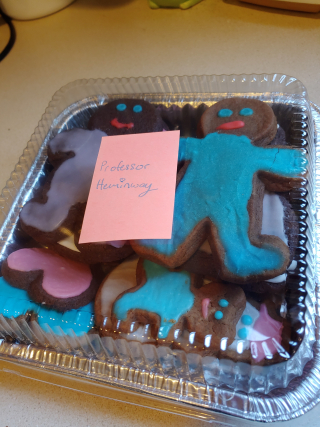
As a law professor, I find December a very confusing month. On the one hand, exams are given and papers are in, and grading them and determining course grades loom large. These activities consume inordinate amounts of time and are stressful, adding to the stress of holiday preparations (a real thing some of us do not acknowledge). And then there always is the need to work in medical appointments that did not make it into one’s schedule during the fall semester. The negative energy can be overwhelming.
Yet, on the other hand, class preparation is done. Scheduling things gets a bit easier since class meetings are no longer happening. The many hours of grading even have some bright moments–moments in which you are confident someone really “gets it” (whatever “it” is) There is some joy in the gift-buying and wrapping, menu-planning and cooking, and certainly in gift-giving. And there is gratitude that those medical appointments are finally happening, and that any necessary follow-ups can be organized and implemented.
The little happy surprises are, however, the best–like the wonderful homemade gingerbread pictured above, a gift from a young woman I met almost four years ago because of a talk I gave to honors undergraduates on crowdfunding. She had this cool idea for a nonprofit, and I introduced her to one of our law clinic faculty members. (He got cookies, too!)
I try to focus on the little joys. They make a difference in my sense of fulfillment and productivity. I do not fully understand why. But I continue to pursue answers.
Along those lines, I recently had the privilege of participating in a campus leadership event that offered me some food for thought. I reflect on it in this blog post for Leading as Lawyers, the blog hosted by the Institute for Professional Leadership at UT Law (of which I am the Interim Director). The post is about lawyer leadership. Each of us as law professors is a leader. We are leaders in the classroom in our law schools, in the communities in which we live and work, and in our family and personal lives more generally. According to the research cited by the speaker at that event, choosing to be happy by focusing on enjoyment, satisfaction, and purpose, even in stressful times, is important. It can change the course of one’s leadership and life (and the lives of others) in positive ways.
The cookies from my nonprofit entrepreneur friend (and those pictured below–with some of hers–that were made by one of my fellow Tuesday-night yogis in a special semi-private class I take at a local yoga studio) are symbolic. I enjoy cookies. They are meaningful representations that put a smile on my face. The represent the fulfillment of some of my current limited “wants”–sustained and deep relationships among them. And they are evidence that I understand and am pursuing my recognized purpose, which includes using my “corporate law powers” to help others. Yay for all that (and for cookies generally)!
I wish all much happiness and good fortune in 2023. Pursue enjoyment, satisfaction, and purpose. Take pleasure in the many fruits of your labors, including your relationships with students. Happy New Year!
[Editorial note: I have been trying to publish this on and off for the past day or so. Ultimately, I had to create this post on my phone, since my computer and TypePad do not want to play ball with each other right now. I hope this will resolve itself soon, since the photo editing function is not as nuanced on a handheld (or maybe I am just inept. Lol. Please forgive!]

Video of the Seventh Annual Berkeley Fall Forum on Corporate Governance
In early November, Berkeley held a 2-day forum on corporate governance, featuring a variety of A-list speakers including Chancellor McCormick and Vice Chancellor Glasscock. I also participated on a panel with Adam Badawi to talk about everyone’s favorite subject, Elon Musk’s takeover of Twitter. The videos from the event were just posted online, so for those of you who couldn’t watch it live – here’s the link (also available here)!
Happy holidays, everyone. Stay warm!
Give Yourself the Gift of Understanding Contract Drafting and Negotiation In Miami or Virtually February 2023
It’s the holidays and it’s time to treat yourself and members of your team to practical training and fantastic networking in sunny Miami in February. We don’t have bomb cyclones down here. The Transactional Skills Program at the University of Miami School of Law couldn’t be more excited to host the How to Contract Conference from February 15-17, 2023.
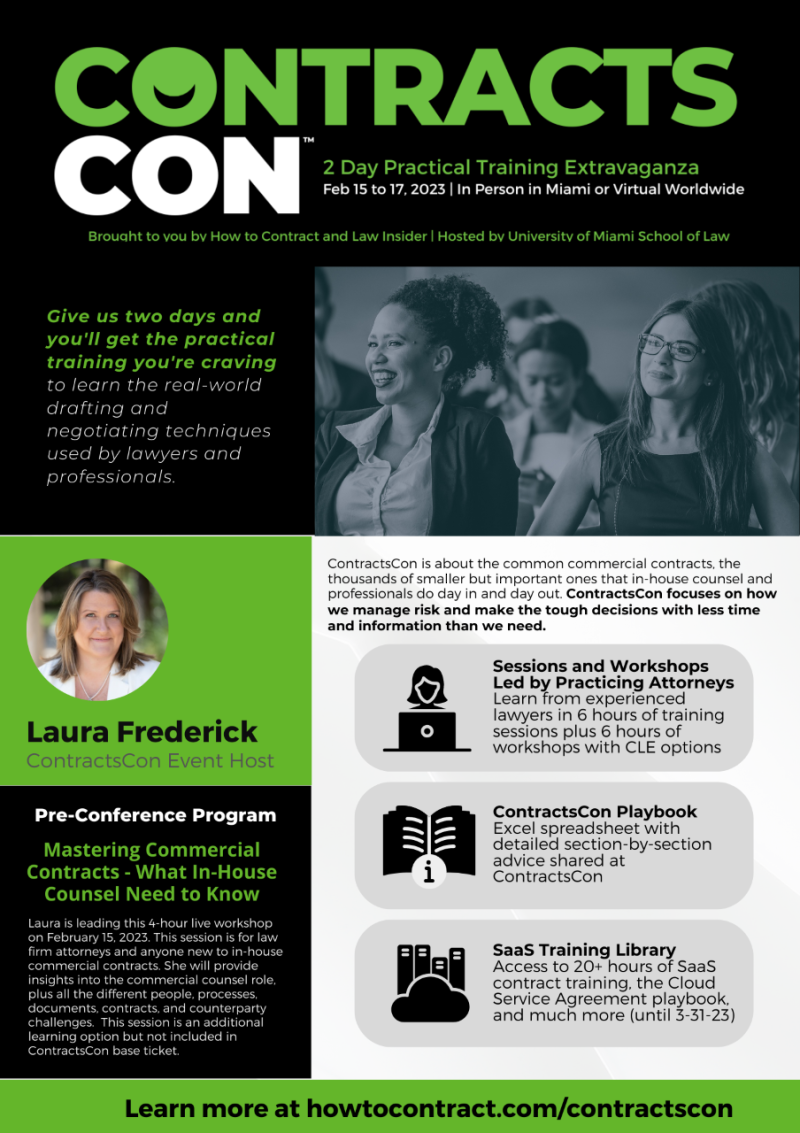
- ContractsCon is a training and networking EXTRAVAGANZA focused on the practical contract drafting and negotiating skills that in-house counsel and contracts professionals need to know.
- This event is a zero-fluff, to-the-point training on the nitty-gritty details. ContractsCon includes:
- speakers who get the in-house experience and can explain why we draft the way we do
- training centered around provision-level playbooks for you and your company to use when you return to work
- workshops that provide a deeper dive into more nuanced topics and include interactive group activities
- ContractsCon Playbook, featuring the advice and drafting approaches discussed at ContractsCon
- access to How to Contract’s SaaS Contracts Training Library, with 20+ hours of training videos, the Cloud Services Agreement Playbook, and lots more (through March 31, 2023)
- CLE pending in 26 states for up to 7 hours for virtual ticket holders and up to 13 hours for in-person attendees
- ContractsCon is an annual training and networking event for in-house counsel and contract professionals presented by How to Contract and Law Insider and hosted by University of Miami School of Law. This 2-day event will feature over 20 live training sessions with some of the most well-known contract experts.
- Our promise is to share with you the core skills and expertise you need to work in-house on commercial contracts. All you have to do is show up ready to learn.
- ContractsCon is designed for in-house lawyers and professionals who want to learn:
- the insights and techniques needed to handle the commercial contracts filling their inbox every day,
- how experienced lawyers manage risk, work efficiently, and make the hard decisions in challenging circumstances,
- WHAT to say, WHY to say it that way, and HOW to reach the best-negotiated deal you can with your contract counterparties.
- Give us two days of your time and you’ll walk away with enhanced skills that enable you to better protect your company and clients. You’ll gain more confidence. You’ll finally leave those “I don’t know” and “I’m not sure” frustrations behind you. You’ll also be able to network with other lawyers and professionals who share your desire to improve your skills and overcome any traces of imposter syndrome.
Click here to get your ticket. And I’ll see you in Miami, mojito in hand (after I do my session, of course).
Call for Submissions: Akron Law Review Sports and Entertainment Law Symposium
The Akron Law Review seeks articles and essays of any length, speakers, and panel participants for a symposium on issues related to sports and entertainment law. The Symposium, “Game Changers: Rewriting the Playbook” A Sports and Entertainment Law Symposium will take place at the University of Akron School of Law, Akron, OH, on Friday, April 14, 2023.
The editors seek articles, essays, and speakers that address one or more of the following topics, or other related topics:
- Contract Negotiations
- Diversity in Sports Leadership
- The Interplay of Ethics and Sports Agency
The editors seek articles, essays, and speakers for panel discussions on the following topics:
- Name, Image, and Likeness (NIL) – With this panel, we seek discussion of NIL policy and how athletes do, can, and/or should navigate new and evolving guidelines.
- Equality in Pay – With this panel, we seek discussion of the differences in pay between women and men in team and individual sports, such as soccer and golf.
The Akron Law Review has been highly ranked in the Washington and Lee Law Review Rankings for several years. In five recent years (2015-2019), the Akron Law Review ranked in the top 100 for student-edited, general journals in the Washington and Lee Law Library law journal rankings for “combined score” and in the top 107 for student-edited, general journals in the category of “impact factor.”
The Call for Papers will remain open until Saturday, December 31, 2022. Article proposals should be around 300 words. Submit proposals to the Editor-in-Chief, Jennifer Cranmer, and Managing Editor of the Symposium Edition, Demetria Kimble, at ualawrev@gmail.com.
Selected participants and writers will be notified by January 7, 2023. Finished articles will be due by February 3, 2023. Our editors will work with you to prepare your work for the symposium and/or publication. Articles will be published in the 2023 Symposium edition of the Akron Law Review.
The Meaning of FTX, Part Deux
A couple of weeks ago, I blogged about how the most striking aspect of the FTX saga was the lack of due diligence by FTX’s equity backers – and how proud they were of that fact, before everything came crashing down.
This week, we got a little more color on that, in the form of the SEC’s complaint against Samuel Bankman-Fried (like everyone else, for ease of reference, I’ll call him “SBF”). The least surprising thing about the case is that the SEC focused not on the fraud perpetuated on crypto asset traders, but on the fraud perpetuated by SBF on investors in FTX. That’s because the SEC only has jurisdiction over fraud committed in connection with securities trading, and it’s not always clear whether a particular crypto asset is, or is not, a security. To sue SBF over fraud perpetuated on FTX customers, the SEC would have to perform the Howey test on an asset-by-asset basis for everything the customers traded – not exactly a feasible undertaking. So, the SEC took the low-hanging fruit and sued to vindicate the rights of the stockholders in FTX.
Just one teensy problem. Here are examples of the fraud, taken from the SEC’s complaint:
For the entire span of the Relevant Period, while raising money from equity investors, Bankman-Fried, and those speaking at his direction and on his behalf, claimed in widely distributed public forums and directly to investors that: FTX was a safe crypto asset trading platform; FTX had a comparative advantage due to its automated risk mitigation procedures….
FTX’s Terms of Service, which were publicly available on FTX’s website and accessible to investors, assured FTX customers that their assets were secure…
Similarly, FTX posted on its website a document entitled, “FTX’s Key Principles for Ensuring Investor Protections on Digital-Asset Platforms,” in which FTX represented that it “segregates customer assets from its own assets across our platforms.”…
Throughout the Relevant Period, Bankman-Fried made public statements assuring that customer assets were safe at FTX. For example, he stated in a tweet on or about June 27, 2022: “Backstopping customer assets should always be primary. Everything else is secondary.” He likewise tweeted on or about August 9, 2021: “As always, our users’ funds and safety comes first. We will always allow withdrawals (except in cases of suspected money laundering/theft/etc.).”
Bankman-Fried also told investors, and directed other FTX and Alameda employees to tell investors, that Alameda received no preferential treatment from FTX. For example, Bankman-Fried told the Wall Street Journal in or around July 2022: “There are no parties that have privileged access.” Likewise, in a Bloomberg article published in or about September 2022, Bankman-Fried claimed that “Alameda is a wholly separate entity” than FTX. In the same article, Ellison is quoted as stating about Alameda: “We’re at arm’s length and don’t get any different treatment from other market makers.” Bankman-Fried made similar statements directly to investors…..
FTX invested significant resources to develop and promote its brand as a trustworthy company. For example, in materials provided to one investor in or around June 2022, FTX cultivated and promoted its reputation:
FTX has an industry-leading brand, endorsed by some of the most trustworthy public figures, including Tom Brady, MLB, Gisele Bundchen, Steph Curry, and the Miami Heat, and backed by an industry-leading set of investors. FTX has the cleanest brand in crypto…
Bankman-Fried repeatedly touted FTX’s automated risk mitigation protocols—which he called FTX’s “risk engine”—to the public, and prospective investors, as a safe and reliable way for crypto asset trading platforms to manage risk. Bankman-Fried promoted the concept of “24/7” automated risk monitoring as an innovative benefit of cryptocurrency markets, including at a hearing on or about December 8, 2021, to the U.S. House of Representatives Committee on Financial Services….
In a submission to the Commodity Futures Trading Commission, FTX touted its automated system, claiming that it calculated a customer’s margin level every 30 seconds; and that if the collateral on deposit fell below the required margin level, FTX’s automated system would sell the customer’s portfolio assets until the collateral on deposit exceeded the required margin level….
Bankman-Fried thus misled FTX’s investors by representing that its risk engine would protect FTX customer funds and would limit FTX’s exposure to any single customer….
Get it? The majority of what the SEC alleges are not statements to investors; they were statements to the general public, to FTX customers, to Congress. There are a couple of stray allegations about direct communications with investors – among other things, SBF at one point handed investors a printout of what the FTX website said, and there were some audited financials (mentioned briefly in paragraph 51; the SEC’s reticence over them suggests it’s not comfortable resting its entire case on those) – but there’s really not much direct investor communication at all, at least not before the collapse and SBF began looking for bailouts.
Compare, for example, to the SEC’s complaint against Elizabeth Holmes. Investors got media releases, sure, but they also got binders about purported relationships with big pharma, they got lab tours, they got information on clinical trials. But there’s nothing like that in the case against SBF.
Now, that may be because everyone’s operating on a condensed timeline. Maybe these are the statements the SEC could get at quickly, and it intends to supplement its complaint later (in which case, this blog post will quickly become irrelevant). But at least for now, the overwhelming suggestion is that the SEC based its case on false public statements because SBF didn’t actually make any false private ones – investors bought FTX stock without demanding so much as an offering memorandum.
From a legal perspective, that may not be a problem, exactly. In the context of private plaintiffs and fraud on the market, it’s well established that a statement may be “in connection with” a securities transaction so long as market analysts relied on it, even if the communication was not specifically directed to investors. See In re Carter- Wallace Sec. Litig., 150 F.3d 153 (2d Cir. 1998). As a result, private class action plaintiffs frequently base claims on advertisements targeted to customers, mainstream news appearances, and so forth. So, in this case, even if SBF were to argue that he wasn’t talking to investors, he was talking to other audiences, the obvious rejoinder is that the whole reason investors were willing to invest on a song was because of FTX’s public reputation, carefully cultivated by SBF.
That said, if you already had the impression that the VC/private investment space is based more on “vibes” than financial models, the SEC’s complaint only provides more evidence.
Open Legal Studies Faculty Positions – Georgia State University College of Business
Dear BLPB Readers:
“GEORGIA STATE UNIVERSITY invites applications for full-time tenure-track and non-tenure-track faculty positions in Legal Studies in the Department of Risk Management and Insurance at the J. Mack Robinson College of Business, effective for Fall 2023. The salary level, benefits, and course-load for these positions are competitive. Candidates must have a J.D. (or a PhD) from an accredited institution. For additional information, please access the tenure-track position posting here (https://academicjobsonline.org/ajo/jobs/23860) and the non-tenure-track position posting here (https://academicjobsonline.org/ajo/jobs/23859).”
Call for Panel and Independent Paper Proposals – Money as a Democratic Medium 2.0
Dear BLPB Readers:
The below is from the Call for Panel and Independent Paper Proposals for the upcoming conference, Money as a Democratic Medium 2.0.
“We are delighted to announce Money as a Democratic Medium 2.0. The Conference will be held at two sites in order to maximize participation while minimizing carbon impacts: Cambridge, MA (Harvard Law School, June 15-17, 2023) and Hamburg, Germany (the Hamburg Institute for Social Research and THE NEW INSTITUTE, June 15-16, 2023). The Conference is open to all students of money, credit, and finance, the monetary system, and the modern economy, including members of the public. We will offer robust online access and we encourage distant participants to join us virtually.“
The full call is here. The deadline for submissions is February 1, 2023.