The world seems to be fascinated with Musk’s antics in connection with the Twitter acquisition (I have to pay attention; it’s my job), and in particular, a question that seems to be coming up a lot is, “Why isn’t the SEC doing anything?”  The answer, of course, is that none of this has anything to do with the SEC.  Yes, sure, Elon Musk didn’t file a form on time, and, now that we have the preliminary proxy, it seems the forms he did file were false in that they claimed he had no designs on a merger when in fact he absolutely did have designs on a merger, but delayed 13D/13G filings have never been a high priority for the SEC and in most cases have been met with a small fine.  The rest of it – Musk’s arguable violation of the merger agreement by tweeting confi info and disparaging everyone in sight, and his fairly transparent attempt to back out of his obligations with pretextual excuses about spambots – simply are not the SEC’s bailiwick.  That’s Delaware’s problem, which dictates the fiduciary duties of Twitter board members, and whose law governs the merger agreement.  And Delaware doesn’t act sua sponte, like a regulatory agency; it responds only when someone brings a lawsuit.  Which Twitter may or may not ultimately do.  (Its shareholders certainly will; one suit’s brewing, more will likely be forthcoming).

But there’s a deeper issue here, which is that the complete failure of anyone to rein Musk in really undermines the perception that there is a general rule of law that applies to everyone.  That’s why everyone’s asking why the SEC isn’t acting, even though this isn’t really the SEC’s responsibility to address.

I mean, sure, you kind of know in a cynical way that rich people play by their own rules, but there’s a difference between believing that intellectually and viscerally experiencing it, day by day, as it plays out in Twitter.

And maybe that perception is misguided in this case – as I just said, there really isn’t a basis for any regulatory authority to get involved here, though the SEC could create headaches by demanding more disclosures in the proxy – but Musk’s brazen disregard of his contractual obligations almost certainly flows from his history of ignoring rules and experiencing no meaningful consequences.  And of course, the more he does it, the more he develops an army of admirers who become less likely to hold him to account in the next iteration of the game.

Uninformed observers may be misunderstanding the specifics, but they’re right on the general principle.  Like, I don’t think it’s entirely coincidental that Musk is publicly defying obligations under Delaware law right after a Delaware court said – in practical effect – that he is a business genius who is largely entitled to skip all the niceties of Delaware procedure.

And that’s the danger of each individual player – a Delaware court, a particular regulatory agency, a merger partner – each deciding that Musk is too irascible, too smart, too wealthy, too talented, to rein in.  It collectively communicates a very specific lesson about who has to comply with the law, and who doesn’t.  That harms everyone, but no one actor has an incentive or even the jurisdiction to address it.

That said, on a long enough timeline, well….
It’s a lovely Friday night for grading papers for my Business and Human Rights course where we focused on ESG, the Sustainable Development Goals (SDGs), and the UN Guiding Principles on Business and Human Rights. My students met with in-house counsel, academics, and a consultant to institutional investors; held mock board meetings; heard directly from people who influenced the official drafts of EU’s mandatory human rights and environmental due diligence directive  and the ABA’s Model Contract Clauses for Human Rights; and conducted simulations (including acting as former Congolese rebels and staffers for Mitch McConnell during a conflict minerals exercise). Although I don’t expect them all to specialize in this area of the law, I’m thrilled that they took the course so seriously, especially now with the Biden Administration rewriting its National Action Plan on Responsible Business Conduct with public comments due at the end of this month.

The papers at the top of my stack right now:

  1. Apple: The Latest Iphone’s Camera Fails to Zoom Into the Company’s Labor Exploitation
  2. TikTok Knows More About Your Child Than You Do: TikTok’s Violations of Children’s Human Right to Privacy in their Data and Personal Information
  3. Redraft of the Nestle v. Doe Supreme Court opinion
  4. Pornhub or Torthub? When “Commitment to Trust and Safety” Equals Safeguarding of Human Rights: A Case Study of Pornhub Through The Lens of Felites v. MindGeek 
  5. Principle Violations and Normative Breaches: the Dakota Access Pipeline – Human rights implications beyond the land and beyond the State
  6. FIFA’s Human Rights Commitments and Controversies: The Ugly Side of the Beautiful Game
  7. The Duty to Respect: An Analysis of Business, Climate Change, and Human Rights
  8. Just Wash It: How Nike uses woke-washing to cover up its workplace abuses
  9. Colombia’s armed conflict, business, and human rights
  10. Artificial Intelligence & Human Rights Implications: The Project Maven in the ‘Business of war.’
  11. A Human Rights Approach to “With Great Power Comes Great Responsibility”: Corporate Accountability and Regulation
  12. Don’t Talk to Strangers” and Other Antiquated Childhood Rules Because The Proverbial Stranger Now Lives in Your Phone
  13. Case studies on SnapChat, Nestle Bottling Company, Lush Cosmetics, YouTube Kidfluencers, and others 

Business and human rights touches more areas than most people expect including fast fashion, megasporting events, due diligence disclosures,  climate change and just transitions, AI and surveillance, infrastructure and project finance, the use of slave labor in supply chains, and socially responsible investing. If you’re interested in learning more, check out the Business and Human Rights Resources Center, which tracks 10,000 companies around the world. 

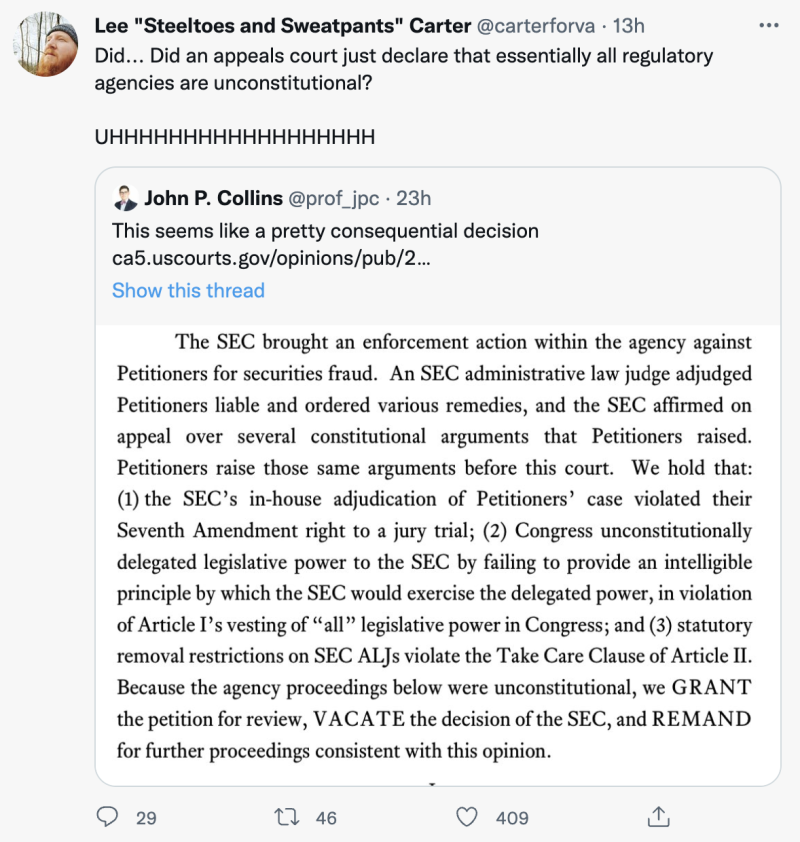
The Fifth Circuit recently decided Jarkesy v. Sec. & Exch. Comm’n, No. 20-61007, 2022 WL 1563613, at *1 (5th Cir. May 18, 2022).  The case has significant implications for the SEC’s use of administrative law judges (ALJs).  The majority opinion was written by Judge Elrod and joined by Judge Oldham. Judge Davis penned a dissent.  The majority issued three holdings:

We hold that: (1) the SEC’s in-house adjudication of Petitioners’ case violated their Seventh Amendment right to a jury trial; (2) Congress unconstitutionally delegated legislative power to the SEC by failing to provide an intelligible principle by which the SEC would exercise the delegated power, in violation of Article I’s vesting of “all” legislative power in Congress; and (3) statutory removal restrictions on SEC ALJs violate the Take Care Clause of Article II.

The case involved two hedge funds founded by Jaresky, an investor, businessman, and conservative radio host.  The SEC alleged that Jaresky: (i) misrepresented the identity of the prime broker and auditor; (ii) misrepresented the funds’ investment parameters and safeguards; and (iii) overvalued the funds’ assets to increase the fees collected.  After an evidentiary hearing, an SEC ALJ found that the funds had committed securities fraud.  Jaresky’s defended by raising constitutional challenges to administrative adjudication, among other things.
 
Although his arguments were rejected by the Commission, the Fifth Circuit embraced them.  I’ll overview them briefly in turn before turning to broader context and the long term perspective.  
 
7th Amendment Right to a Jury Trial
 The Fifth Circuit concluded administrative adjudication was unconstitutional “because the SEC’s enforcement action is akin to traditional actions at law to which the jury-trial right attaches. And Congress, or an agency acting pursuant to congressional authorization, cannot assign the adjudication of such claims to an agency because such claims do not concern public rights alone.”  As I read the opinion, the Fifth Circuit’s  seems to find that a right to a jury trial attaches to statutory and administrative claims which significantly overlap with common law claims. This may not be the only reading and I welcome any thoughts in the comments about the scope of this reasoning.
 
There are some immediate implications from this.  If applied more broadly, this reasoning might gut much administrative adjudication outside the SEC as well. This holding does not turn on anything unique to the SEC.  This would also likely significantly shift enforcement actions to federal court.
 
Unconstitutional Delegation
The SEC has long enjoyed the discretion to decide whether to proceed administratively or in an Article III court. The Fifth Circuit concluded that Congress unconstitutionally delegated this discretion because Congress did not specify a specific intelligible principle for this decision.  
 
The SEC had argued that the decision about where to bring its enforcement action was an executive one akin to prosecutorial discretion–not a legislative decision.  The Fifth Circuit disagreed finding that the decision about whether to consign matters to administrative adjudication or Article III courts was a legislative one.  It reasoned that different procedures apply in administrative adjudication and the ability to elect between administrative adjudication and Article III courts allows the SEC to pick the rules under which it would play on a case-by-case basis.
 
The opinion marks another advance for nondelegation doctrine within the federal courts.  As the doctrine expands, the risk to administrative agencies grows significantly.
 
Unconstitutional Removal Restrictions
As a final holding, the Fifth Circuit invalidated the ALJ structure as improperly insulated from presidential control because ALJs enjoy two layers of for-cause removal protections.   It found that: 
 
SEC ALJs perform substantial executive functions. The President therefore must have sufficient control over the performance of their functions, and, by implication, he must be able to choose who holds the positions. Two layers of for-cause protection impede that control; Supreme Court precedent forbids such impediment.
 Whether two layers of for-cause removal protection actually exists remains uncertain.  The Fifth Circuit repeats an error made by the Supreme Court in describing SEC Commissioners as protected by for-cause removal protections.  The SEC’s statute does not address it. See Gary Lawson, Stipulating the Law, 109 Mich. L. Rev. 1191, 1194 (2011) (explaining that despite the widespread assumption that for-cause removal protections protect SEC Commissioners, “is certainly not obvious that the SEC Commissioners enjoy ‘for cause’ protection”); Peter L. Strauss, On the Difficulties of Generalization -Pcaobi N the Footsteps of Myers, Humphrey’s Executor, Morrison, and Freytag, 32 Cardozo L. Rev. 2255, 2276–77 (2011) (explaining that the ability of the President to remove SEC Commissioners remains unclear because there is no statutory provision granting SEC Commissioners for-cause removal protection).
 
The Broader Picture
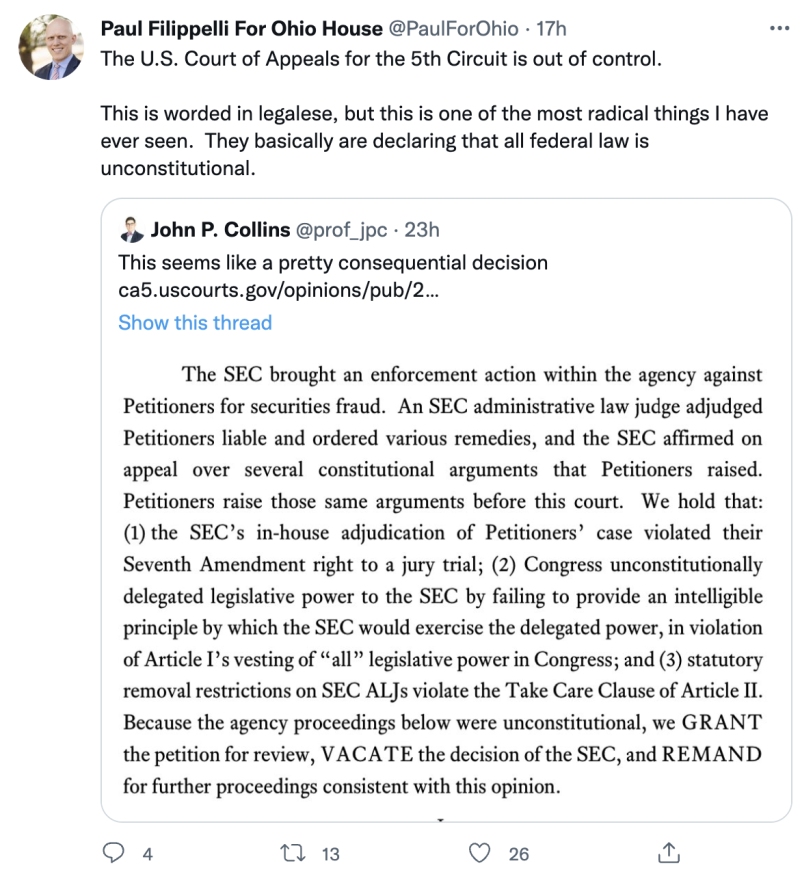
Many social media reactions to the decision mischaracterize it.  The decision does not declare the SEC unconstitutional or say that administrative agencies are unconstitutional.  Here are two examples:
Filippelli
Filippelli
 
As Bloomberg’s Matt Levine has explained, this particular holding only addressed a small part of what the SEC does.  He explained that we should pay attention, but that it’s not as though the SEC is suddenly shutting its doors:
 
This may not be a particularly big deal. Two judges on one panel of one appeals court found that one small part of what the SEC does is an unconstitutional delegation of power. It is possible that this decision is fairly narrow: Congress did delegate this decision — about whether to bring cases in federal courts or its own forums — to the SEC, fairly recently, without any guidance at all, which is unusual. Perhaps the “intelligible principle” standard allows the SEC to do all of its other rulemaking (because Congress has mostly given it some broad guidance about protecting investors in the public interest, and because SEC rules do help to fill in a fairly detailed statutory system), but not to make this particular decision. Still. I think the Fifth Circuit went out of its way to find a nondelegation problem because the Supreme Court has changed and now there will be a lot more courts finding a lot more nondelegation problems. I think this might be a sign of where things are going.
Others have had similar takes.  Professor Wurman thought the Fifth Circuit didn’t need to reach many issues, but did not see a need to panic. 
Professor Verret welcomed the decision.
Mark Cuban celebrated the result.
Professor Jackson disagreed with the Fifth Circuit’s reasoning with a thread.
 
A Worrying Trendline
I’ve written about the risks that the lines of judicial thought here pose.  Although this decision creates new risks for administrative agencies, financial regulators should pay particularly close attention.  That the Fifth Circuit would declare SEC ALJs unconstitutional wasn’t on my immediate radar, but it didn’t surprise me.  The bigger risk I’m worried about is that a court will suddenly take out some systemically important financial regulator leading to a market collapse and a financial crisis.  One way to think about this risk is that the courts have begun to play a game of Jenga™.   The Fifth Circuit just pulled away a bit of the SEC’s enforcement discretion and use of ALJs within the Fifth Circuit.  Nothing has come tumbling down yet.  What happens when some brief before it raises constitutional challenges to FINRA, the Exchanges, or other SROs?  It’s all fun and games until you pull the wrong block and crash the bond markets.

I was excited to see that Professor Jeremy Kress‘ excellent new article, Banking’s Climate Conundrum, is forthcoming in the American Business Law Journal!  Kress presented this article during The Changing Faces of Business Law and Sustainability Symposium at the end of February (post here).  As with all his pieces, it’s highly-readable, understandable, and enjoyable.  I’m a bit less sanguine than he is regarding relying on external credit rating agencies in calculations of bank capital requirements.  I encourage BLPB to read and decide what they think!  Here’s the abstract:

Over the past decade, a consensus has emerged among academics and policymakers that climate change could threaten the stability of banks, insurers, and the broader financial system. In response, regulators from around the world have begun implementing policies to mitigate emerging climate risks in the financial sector. The United States, however, lags significantly behind other countries in addressing such risks. This Article argues that the United States’ sluggishness in responding to climate-related financial risk is problematic because the U.S. banking system is uniquely susceptible to climate change. The United States’ vulnerability stems, in part, from a little-known statutory provision that prohibits U.S. regulators from relying on external credit ratings in bank capital requirements. Because of this deviation from internationally-accepted capital standards, when a credit rating agency downgrades a “brown” company, U.S. banks that lend to that company need not compensate by maintaining a bigger capital cushion. Over time, this dynamic will likely incentivize “brown” companies to borrow more from U.S. banks, intensifying the U.S. banking system’s exposure to climate risks. This Article contends that the United States must act quickly to overcome this unusual weakness by taking bold steps to safeguard the domestic financial system from the climate crisis.”

Over at the University of Chicago’s ProMarket site, Bernard Sharfman has posted: Will “Portfolio Primacy” Throw a Monkey Wrench in Elon Musk’s Plans to Acquire Twitter? In the piece, Sharfman argues that even if one assumes Musk’s offer for Twitter maximizes the value of that firm, “investment advisers to index funds, such as BlackRock, Vanguard, and State Street (the Big Three)” may vote against the deal on the basis of portfolio primacy because:

[A]n investment adviser who manages a stock fund should be managing the fund based on an approach that attempts to maximize the financial value of the entire stock portfolio at any point in time, not just the value of any individual stock investment. This approach is referred to as “portfolio primacy.”… [L]et’s say that the investment adviser to the S&P 500 fund comes to the conclusion that a Musk takeover of Twitter will so distract Musk from his duties at Tesla that it will lead to a significant reduction in the market value of Telsa’s stock. Because the S&P 500 fund has so much more in terms of dollar holdings of Tesla than Twitter, this expected reduction in the market value of Tesla stock could easily outweigh whatever positive value the fund derives from Musk purchasing Twitter.


Dear Section Members —

On behalf of the Executive Committee for the AALS section on Business Associations, I’m writing with details of our two sessions at the 2023 AALS Annual Meeting, which will be held in San Diego, CA from January 4-7, 2023.

First, our main program is entitled, “Corporate Governance in a Time of Global Uncertainty.” We anticipate selecting up to two papers from this call for papers. To submit, please submit an abstract or a draft of an unpublished paper to Professor Mira Ganor, mganor@law.utexas.edu, on or before Friday, August 19, 2022. Authors should include their name and contact information in their submission email but remove all identifying information from their submission. Please include the words “AALS – BA- Paper Submission” in the subject line of your submission email.

Second, we are excited to announce that we will again hold a “New Voices in Business Law” program, which will bring together junior and senior scholars in the field of business law for the purpose of providing junior scholars with feedback and guidance on their draft articles. Junior scholars who are interested in participating in the program should send a draft or summary of at least five pages to Professor Summer Kim at skim@law.uci.edu on or before Friday, August 19, 2022. The cover email should state the junior scholar’s institution, tenure status, number of years in his or her current position, whether the paper has been accepted for publication, and, if not, when the scholar anticipates submitting the article to law reviews. The subject line of the email should read: “Submission—Business Associations WIP Program.”

For further details on both sessions, please see the attached calls for papers. [Ed. Note: the calls for papers are included below.]

Thank you,

James Park
Chair, AALS Business Associations Section

+++++

Call for Papers for the
Section on Business Associations Program on
Corporate Governance in a Time of Global Uncertainty
January 4-7, 2023, AALS Annual Meeting

The AALS Section on Business Associations is pleased to announce a Call for Papers for its program at the 2023 AALS Annual Meeting in San Diego, CA. The topic is Corporate Governance in a Time of Global Uncertainty. Up to two presenters will be selected for the section’s program.

Businesses are operating at an exceptional level of global uncertainty.  Mounting pressures from myriad fronts leave boards of directors to navigate new frontiers while maneuvering lingering challenges.  In addition to adjusting to uncertain economic and financial implications of geopolitical events and the global pandemic, businesses are asked to assume a distinct social role.  Proliferation of calls for corporate disengagement from certain states comes amidst continued disruption in supply chains and mounting diversity, inequality, climate, and cybersecurity challenges, as well as increased disclosure requirements.  This panel will explore the implications of global uncertainty on corporate governance and the role of corporations and their boards in these changing times.

Submission Information:

Please submit an abstract or a draft of an unpublished paper to Mira Ganor, mganor@law.utexas.edu, on or before Friday, August 19, 2022.  Authors should include their name and contact information in their submission email but remove all identifying information from their submission.  Please include the words “AALS – BA- Paper Submission” in the subject line of your submission email.  Papers will be selected after review by members of the Executive Committee of the Section.  Presenters will be responsible for paying their registration fee, hotel, and travel expenses.

We recognize that the past couple of years have been incredibly challenging and that these challenges have not fallen equally across the academy.  We encourage scholars to err on the side of submission, including by submitting early stage or incomplete drafts.  Scholars whose papers are selected will have until December to finalize their papers.   

Please direct any questions to Mira Ganor, the University of Texas School of Law, at mganor@law.utexas.edu.

+++++

Call for Papers
AALS Section on Business Association
New Voices in Business Law
January 4-7, 2023, AALS Annual Meeting

The AALS Section on Business Associations is pleased to announce a “New Voices in Business Law” program during the 2023 AALS Annual Meeting in San Diego, CA. This works-in-progress program will bring together junior and senior scholars in the field of business law for the purpose of providing junior scholars with feedback and guidance on their draft articles.  To complement its other session at the Meeting, this Section is especially interested in papers relating to corporate governance in a time of global uncertainty, but it welcomes submissions on all business-related topics.

PROGRAM FORMAT:  Scholars whose papers are selected will provide a brief overview of their paper, and participants will then break into simultaneous roundtables dedicated to the individual papers.  Two senior scholars will provide commentary and lead the discussion about each paper.

SUBMISSION PROCEDURE:  Junior scholars who are interested in participating in the program should send a draft or summary of at least five pages to Professor Summer Kim at skim@law.uci.edu on or before Friday, August 19, 2022.  The cover email should state the junior scholar’s institution, tenure status, number of years in his or her current position, whether the paper has been accepted for publication, and, if not, when the scholar anticipates submitting the article to law reviews.  The subject line of the email should read: “Submission—Business Associations WIP Program.”

Junior scholars whose papers are selected for the program will need to submit a draft to the senior scholar commentators by Friday, December 9, 2022.

ELIGIBILITY:  Junior scholars at AALS member law schools are eligible to submit papers.  “Junior scholars” includes untenured faculty who have been teaching full-time at a law school for ten or fewer years.  The Committee will give priority to papers that have not yet been accepted for publication or submitted to law reviews. 

Pursuant to AALS rules, faculty at fee-paid non-member law schools, foreign faculty, adjunct and visiting faculty (without a full-time position at an AALS member law school), graduate students, fellows, and non-law school faculty are not eligible to submit.  Please note that all presenters at the program are responsible for paying their own annual meeting registration fees and travel expenses.

So of course, after I drafted this post about Chancellor McCormick’s decision in Coster v. UIP Companies, the Ninth Circuit came down with a decision affirming the district court opinion in Lee v. Fisher.  I blogged about that case here; the short version is, the district court enforced a forum selection bylaw that required derivative 14(a) claims to be litigated in Delaware Chancery, despite the fact that Delaware Chancery has no jurisdiction to hear 14(a) claims.  Based on Ninth Circuit precedent, the district court held that the Exchange Act’s antiwaiver provision was not a clear enough statement of a federal public policy against forum selection to prohibit enforcement of the bylaw.   The Ninth Circuit, on appeal, agreed (you know the drill by now; no one engaged the question whether the bylaw is the equivalent of a contractual agreement, naturally).  By affirming the district court’s decision, the Ninth Circuit sort of – but not exactly – created a split with the Seventh Circuit’s decision in Seafarer’s Pension Plan v. Bradway; I say “sort of” because – as I explained in my post about the Bradway decision, here – most of the Seventh Circuit’s logic refusing to enforce such a bylaw was rooted in its interpretation of Delaware law, rather than federal law. The Ninth Circuit largely refused to engage with the Delaware law analysis, and instead focused on federal law, because it concluded that the Lee v. Fisher plaintiff had waived arguments about Delaware law.

Upshot: In the Ninth Circuit, it is now possible for a company to completely opt out of Exchange Act liability by unilaterally adopting a bylaw saying so, as long as the bylaw doesn’t use the word “waiver” and instead uses the words “forum selection” and “Delaware Chancery.”

That’s probably all I have to say about that for now, despite my general creeping horror, unless I change my mind (saving it for a ranting article that one day will go up on SSRN), so back to what I originally intended to post about….

Recently, Chancellor McCormick issued her opinion in on remand in Coster v. UIP CompaniesCoster is a somewhat unusual case for Delaware, in that it involves a closely-held corporation governed via longstanding personal ties, rather than a public entity, or at least one sponsored by arm’s length VC/PE capital.  Two founding members of UIP each held 50% of its stock; when one died, his widow, Marion Coster, received his share.  The remaining founder and UIP employees tried to negotiate with Coster to buy her out, but they could not reach a deal; the parties deadlocked and could not agree on board members; and finally, Coster sought the appointment of a custodian.  In response, the remaining founder caused UIP to sell a chunk of stock to a longtime employee/holdover director.  Once the sale was complete, the founder and the employee together had majority voting control, breaking the deadlock and diluting Coster’s stake.

Coster challenged the sale and, after a trial, McCormick concluded that though the defendants were interested in the sale, and had effectuated it to break the deadlock and thwart Coster’s move for a custodian, the transaction had nonetheless been “entirely fair” to Coster and the company because the board ran a reasonable process and the employee had paid a fair price.

On appeal, the Delaware Supreme Court seemed to leave undisturbed McCormick’s conclusion that the transaction had been “entirely fair,” but nonetheless held that, given the board’s entrenching motives, McCormick should additionally have evaluated whether the defendants had engineered the sale in order to entrench themselves and thwart Coster’s voting rights, in violation of Blasius Industries, Inc. v. Atlas Corp, 564 A.2d 651 (Del. Ch. 1988) – adding an interesting footnote acknowledging that while some have questioned the relationship of Blasius to Unocal, none of the parties had made that argument and so the court would not engage it, see Op. at n.66.

That in and of itself highlights a very odd aspect of the doctrine: the Delaware Supreme Court’s decision may be read to mean that a transaction can both be “entirely fair” and represent an inequitable interference with voting rights.  If that’s right, and since “entire fairness” is usually described as the most rigorous standard of review, the Supreme Court decision may mean that Blasius exists on something like a different scale, independent of the financial aspects of corporate action.  Or maybe the Delaware Supreme Court, recognizing that conceptual oddity, left the relationship of Blasius to “entire fairness” somewhat vague.  In the Court’s words:

the Court of Chancery fully supported its factual findings and legal conclusion that the board sold UIP stock to Bonnell at a price and through a process that was entirely fair. Thus, we will not disturb this aspect of the court’s decision. But the court also held that its entire fairness analysis was the end of the road for judicial review. …In our view, the court bypassed a different and necessary judicial review where, as here, an interested board issues stock to interfere with corporate democracy and that stock issuance entrenches the existing board. As explained below, the court should have considered Coster’s alternative arguments that the board approved the Stock Sale for inequitable reasons, or in good faith but for the primary purpose of interfering with Coster’s voting rights and leverage as an equal stockholder without a compelling reason to do so….

And later in the opinion

under Blasius, even if the court finds that the board acted in good faith when it approved the Stock Sale, if it approved the sale for the primary purpose of interfering with Coster’s statutory or voting rights, the Stock Sale will survive judicial scrutiny only if the board can demonstrate a compelling justification for the sale.  That the court found the Stock Sale was at an entirely fair price did not substitute for further equitable review when Coster alleged that an interested board approved the Stock Sale to interfere with her voting rights and leverage as an equal stockholder.

So I suppose this could be read to mean that Blasius is, in fact, part of the entire fairness analysis, and McCormick erred by stopping with process/price.  I’m not really sure, and I’m not sure the Supreme Court wanted me to be sure.

In any event, on remand, Chancellor McCormick elaborated on her factual findings.  In particular, she highlighted that the board’s actions were defensive moves intended to thwart the damaging actions of Coster, who was the aggressor.  Specifically, after insisting on a buyout at an unreasonable price, Coster sought to have unqualified nominees seated on UIP’s board.  When the board refused, she sought a custodian who would have had significant powers to upend UIP’s entire business model and damage its revenue streams.  Along the way, she refused meaningful negotiation with board members who tried in good faith to accommodate her.  At the same time, the stock sale to the employee had been in the works for a while, so by going ahead with it, the board managed to both address the Coster problem and reward someone who had long been a critical asset to the company.  Under these circumstances, McCormick felt that the board had shown it had a compelling justification for its actions under Blasius.

So, this is interesting because it speaks to a hypothesized but – as far as I can tell – never before seen set of circumstances in Delaware law.  Namely, when is it okay to issue stock to dilute someone’s existing voting power because they threaten to use that power in a damaging way?  Note that this is not the same as a poison pill; the pill gives advance warning to investors that if they acquire more shares, they may be diluted.  Here, by contrast, the dilution was to an existing interest, with no warning, based solely on the inequitable actions they sought to take.

The possibility that a board might be justified in taking such action has been raised before.  Specifically – as I blogged when discussing CBS’s proposal to take similar action with respect to Shari Redstone – in Mendel v. Carroll, 651 A.2d 297 (Del. Ch. 1994), the court held that maybe a board might under some circumstances be justified in taking such an action against a threatening controller.  The Mendel dicta has been repeated over the years, but this is, to my knowledge, the first time that a Delaware court has actually approved a board in fact taking such action.  Though, as I highlighted in that earlier blog post, a New York court interpreting Delaware law approved a dilutive issuance intended to force the sale of Bear Stearns to JP Morgan at the height of the financial crisis – which, among other things, demonstrated that Delaware was happy to pass that hot potato to New York in order to avoid taking responsibility for throwing America’s markets into chaos by blocking the action.

But until now, no Delaware court (I think) has actually given the go-ahead in a particular set of facts; the court in CBS itself held that it was not necessary for the board to dilute Shari Redstone’s interest because any fiduciary breaches on her part could be remedied on a case-by-case basis.

Which means the lesson here is not simply that there are some corporate actions that survive Blasius review, but also that there is at least one set of facts that permits the issuance of new shares for the explicit purpose of diluting an existing holder who represents a threat to the company’s future.

Earlier this month, I came across a fun Wall Street Journal article, “Great Novels About Business: How Much Do You Know?” The article got me thinking about business-themed novels more generally. What are the greatest all-time novels about business? I came across another, related article from Inc.com that offers the following list of the 10 best classic novels about business:

  1. The Financier by Theodore Dreiser
  2. The Rise of David Levinsky by Abraham Cahan
  3. The Magnificent Ambersons by Both Tarkington
  4. The Old Wives’ Tale by Arnold Bennett
  5. The Buddenbrooks by Thomas Mann
  6. North and South by Elizabeth Gaskell
  7. Atlas Shrugged by Ayn Rand
  8. JR by William Gaddis
  9. American Pastoral by Philip Roth
  10. Nice Work by David Lodge

I have to admit that I’ve yet to read a few of these books, and I plan to add them to my summer reading list. But I’m also surprised to find at least one book missing, A Christmas Carol by Charles Dickens.  How could we leave Scrooge, Marley, and old Fezziwig off the list….. 

“But you were always a good man of business, Jacob,” faultered Scrooge, who now began to apply this to himself.

“Business!” cried the Ghost, wringing its hands again. “Mankind was my business. The common welfare was my business; charity, mercy, forebearance, and benevolence, were, all, my business. The dealings of my trade were but a drop of water in the comprehensive ocean of my business!”

Can you think of other novels that should be added–or some that should be removed from the list above? Please share your thoughts in the comments–and share some lines from your favorite business-themed novels!

After the end-of-semester crunch and a bout with Covid, I’m back to reading Hilary Allen’s Driverless Finance.  Chapter three, focused on Fintech and Capital intermediation seems prophetic today.  In it, she explains how stablecoins could lead to fiat currency runs and fluctuations.  She also explains how concerns about a particular cryptoasset could trigger panics affecting other cryptoassets.

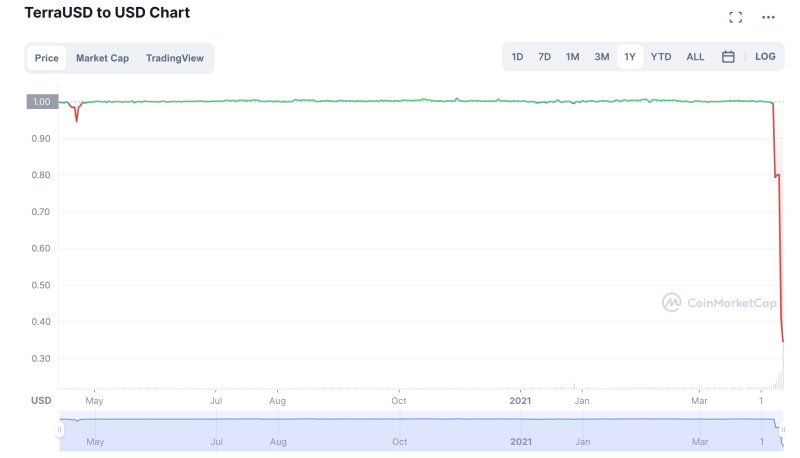
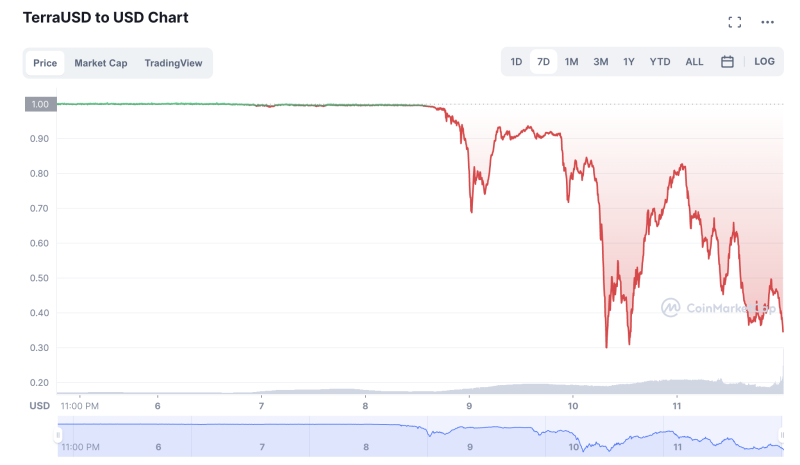
This brings me to our world today.  TerraUSD, a stablecoin, has become unstable.  It aimed to hold its value at $1 per coin to allow crypto enthusiasts to park cryptoassets in TerraUSD, avoiding market fluctuations.  For most of the past year, TerraUSD largely achieved this goal.  But then it didn’t.  As of Wednesday, TerraUSD traded at $0.23.  To help readers see the carnage, check out these charts, first the year and then the last seven days.

TerraUSD 1Y

TerraUSD 7d

Allen predicted that these sorts of things could happen.  The Wall Street Journal described the panic briefly spreading to another stablecoin, explaining that the “collapse saddled investors with billions of dollars in losses. It ricocheted back into other cryptocurrencies, helping drive down the price of bitcoin. Another stablecoin, tether, edged down to as low as 96 cents on Thursday before regaining its peg to the dollar.”

Allen also warned about the dangers to the financial system if cryptoassets served as collateral for institutional borrowing.  We can see some of the risks today with cryptoasset declines potentially causing retail investors to sell out of traditional equity securities.  Some retail traders already access margin loans with cryptocollateral. We’re also seeing significant declines in crytocurrencies now.   This may drive significant selling activity.  

Ultimately, the events strengthen Allen’s argument that we must manage financial stability risks arising from these new financial assets.

As I have heard many other educators state, this was the toughest semester in my dozen years as a teacher. In my case, it was a mix of difficulties – teaching an overload, representing my colleagues in a heated faculty senate term, and balancing family responsibilities.

Among the most difficult parts was working with students who were struggling more than I have ever seen. To be clear, I was quite proud of my students this semester. Even with a Zoom option, most students showed up in person, engaged with the material, and worked hard. But several students communicated true hardships, and all students seemed to drag more than usual. Typically, I am a stickler for deadlines, but I pushed deadlines back in every class this semester, and I graded with more grace.

It has been a while since Colleen or I had a running post, but today’s track workout felt a bit like this semester. My plan for this morning was 1 mile at tempo pace followed by 8x400m at goal mile race pace. I haven’t been getting great sleep this week so the run started sluggishly. The warm-up and the tempo mile went fine, but I could tell they required more effort than normal. Starting the 400s, I refocused mentally, dug deeper, and came through faster than expected on the first one. On the second 400, however, my legs felt like logs, and I stepped off the track halfway through that rep. I knew 8×400 simply was not going to happen at the planned pace, and I reconfigured the workout on the fly to 800@3K pace, 2×200@800m race pace, 800@3K pace, 2×200@800m race pace. This maintained roughly the same amount of hard running, but in a format that I could actually complete.

Younger versions of myself would have seen this “busted workout” as weakness. And the line between strength building and destruction is a fine one. At times, you want to “go to the well” and “see God” in a workout. Training yourself to be mentally tough and push through pain can be a valuable part of the process. You do have to tear down somewhat in order to build. But an effort that is “too difficult” will hamper progress either through injury or through extreme fatigue that ruins other planned runs. Disgraced Nike Coach Alberto Salazar seemed to miscalculate in his training of Mary Cain and squandered her immense talent with too much intensity.

Obviously, both as a teacher and as an athlete, finding the right balance is difficult. Frankly, I may have been a bit too easy on my students and myself this past semester, but it did seem like we were moving into territory where holding strictly to plan would have been more destructive than stengthening.