March 2015

Yesterday, Prof. Bainbridge annotated my “creed” on corporate governance, and I appreciated his take. In fact, many of his chosen sources would have been mine.

In a later footnote, he noted that he was not sure what I meant by my statement: “I believe that public companies should be able to plan like private companies . . . .” I thought I’d try to explain. 

My intent there was to address my perception that there is a prevailing view that private companies and public companies must be run differently.  Although there are different disclosure laws and other regulations for such entities that can impact operations, I’m speaking here about the relationship between shareholders and directors when I’m referencing how public and private companies plan. 

Public companies generally have far more shareholders than private companies, so the goals and expectations of those shareholders will likely be more diverse than in a private entity. Therefore, a public entity may need to keep multiple constituencies happy in a way many private companies do not.  However, that is still about shareholder wishes, and not the public or private nature of the entity itself.  A private company with twenty shareholders could crate similar
Over the past few weeks I have posted extensively on how gambling laws treat commercial NCAA Tournament pools.  However, March Madness pools are not the only form of online sports gaming proliferating on the Internet.  Indeed, play-for-cash “daily fantasy sports” contests have recently become big business.  Even the National Basketball Association is now a shareholder in one of these ventures (FanDuel).

With the legal status of “daily fantasy sports” still relatively unsettled, it is my pleasure to announce the online publication of sections 1-4 of my newest law review article “Navigating the Legal Risks of Daily Fantasy Sports: A Detailed Primer in Federal and State Gambling Law.”   This article explores the legal status of “daily fantasy sports” in light of both federal and state gambling laws, and explains why the legal status of such contests likely varies based on both contest format and states of operation.

The full version of this article will be published in the January 2016 edition of University of Illinois Law Review.  In the interim, I welcome any thoughts or comments.

When I write a law review article, I usually include in the author’s footnote a brief note of thanks to the student research assistants who helped me on that article. When I write a book, I thank my research assistants in the preface.

My research assistant also helps me from time to time with research related to this blog. (Yes, I actually research some of the things I write on this blog. Hard to believe, isn’t it?) Blogs don’t have prefaces or author’s footnotes, so there’s no convenient way to acknowledge his help. I decided to give him his own blog post.

My thanks to Stephen Knudsen, University of Nebraska College of Law Class of 2015, for the assistance his has given me over the past year on this blog. (He is, of course, totally responsible for anything I wrote that you found objectionable or wrong.) The two or three people who read what I write here are now aware of his contribution and he can provide the link to his parents, almost doubling my usual readership.

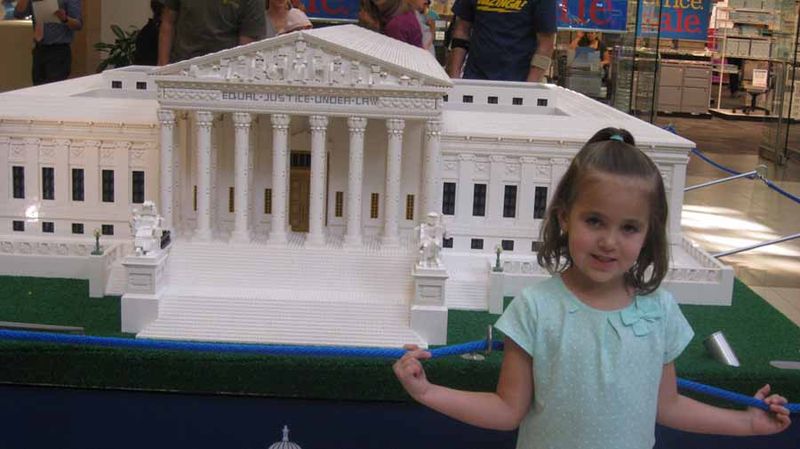
I saw this in Utah over spring break and I just had to share it with our readers: the Supreme Court building made out of Legos.

Supreme Court Lego Edited

This was part of an extensive Lego exhibit that also included the White House, the Capitol, and the Washington Monument, among other familiar D.C. monuments. If you have a child that likes Legos, a lot of time, and a lot of money for the Legos, feel free to try this at home. What better way for a lawyer or law student to teach a child about the Supreme Court?

The darling model next to the building is my five-year-old granddaughter Payton, something of a Lego expert herself. Thanks to Sandy Placzek for the photography. (Grandpa has too much fun playing with the grandchildren to spend time taking pictures.)

On Tuesday, the Supreme Court finally issued its decision in Omnicare, Inc. v. Laborers District Council Construction Industry Pension Fund (.pdf), concerning the definition of “opinion falsity” in the context of a lawsuit under Section 11 of the Securities Act.

Joan described the case in more detail here, but the basic issue was, what does it mean for a statement of opinion to be false?  Or, to ground it more in the facts of Omnicare, if the company files a registration statement – as Omnicare did – that claims that the company “believes” its contracts are in compliance with the law, is that statement false when the DoJ sues for Medicaid fraud?

The defendants argued that opinion statements – such as a “belief” in legal compliance – can only be false if they falsely represent the speaker’s belief, i.e., if the speaker did not really believe that Omnicare was in compliance.  If the speaker did believe in such compliance, then even if that belief was unfounded or turned out to be false, the statement itself would be literally true.  

The plaintiffs agreed that statements of opinion may be false if the speaker misrepresents his or her own opinion, but also argued that opinions may be false for other reasons.  For example, according to the plaintiffs, an opinion statement is false if the statement has no reasonable basis, regardless of the subjective beliefs of the speaker.  So in Omnicare’s case, its statement about legal compliance would be false if it did not bother to investigate whether its contracts were in compliance with the law, or if it ignored information that suggested the contracts were not in compliance.

In general, the case was pitched as a dispute about the continuing viability of Section 11 as a strict liability statute.  Section 11, 15 U.S.C. §77k, provides that issuers are strictly liable for false statements in registration statements, and signatories of the registration statement are liable unless they demonstrate that they conducted a reasonable investigation of those statements.  So, if Omnicare prevailed in its argument that belief statements are only false if the speaker misstates his own belief, it would, as a practical matter, require the plaintiffs to demonstrate that the speaker intentionally misled investors, thus importing a scienter requirement into Section 11.  The effect would be particularly pronounced because there is a great deal of slipperiness regarding what counts as an opinion statement in the first place.

Ultimately, the Supreme Court adopted a standard that fit within the framework advocated by the plaintiffs, although the Court used a narrower formulation.  The Court agreed with the defendants that statements of opinion can only be false if disbelieved by the speaker – if the speaker misstates his or her own belief – but then went on to hold that such statements may be misleading if they omit material information.  Such as, if they omit the fact that the speaker had no basis for the belief he or she purported to hold and failed to conduct any investigation into the matter.  It depends on context and delicate inferences yadda yadda yadda, but a registration statement is a formal document and investors are likely to assume that statements of belief contained therein are the product of a reasonable investigation, etc.

But none of this is what the case was really about.

[More under the cut]

Plenty of valuable information was shared today at Vanderbilt’s 17th annual law & business conference, including remarks from Elisse Walter (former-SEC Chairman), Jim Cox (Duke), Bob Thompson (Georgetown)Amanda Rose (Vanderbilt), and others.

The most immediately useful information, however, might be the fact that SEC Commissioner Dan Gallagher, our luncheon speaker, is on Twitter. In academic and other circles, Commissioner Gallagher garnered a great deal of attention due to his controversial article co-authored with Joseph Grundfest (Stanford) entitled “Did Harvard Violate Federal Securities Law? The Campaign Against Classified Boards of Directors.”

Below is a recent Tweet from Commissioner Gallagher for those who would like to follow him.

Vanderbilt

After teaching my early morning classes, I will spend the rest of the day at Vanderbilt Law School for their Developing Areas of Capital Market and Federal Securities Regulation Conference.

This is Vanderbilt’s 17th Annual Law and Business Conference and they have quite the impressive lineup, including Commissioner Daniel Gallagher, Jr. of the U.S. Securities and Exchange Commission. 

I am grateful to the Vanderbilt faculty members who invited me to this event and others like it. Vanderbilt is only about 1 mile from Belmont and I have truly enjoyed getting to know some of the Vanderbilt faculty members and their guest speakers.

Below is a call for papers and description of a weeklong project on business and human rights. If you are interested, please contact one of the organizers below. I plan to participate and may also be able to answer some questions.

Lat Crit Study Space Project in Guatemala

Corporations, the State, and the Rule of Law

We are excited to invite you to participate in an exciting Study Space Project in Guatemala. Study Space, a LatCrit, Inc. initiative, is a series of intensive workshops, held at diverse locations around the world. This 2015 Study Space project involves a 7 working day field visit to Guatemala between Saturday June 27 (arrival date) and Saturday July 4, 2015 (departure date).  We are reaching out to you because we believe that your interests, scholarship, and service record align well with the proposed focus of our trip.

This call for papers proposes a trip to Guatemala to study more closely the phenomena of failed nations viewed from the perspective of the relationship of the state of Guatemala with corporations. With the recent surge of Central American unaccompanied minors and children fleeing with their mothers, the United States has had to confront the human face

Last week, NCAA lawyers went into court seeking to reverse the U.S. District Court for the Northern District of California’s ruling in O’Bannon v. National Collegiate Athletic Association.  In that case, the district court had held that the NCAA member colleges illegally restrained trade under Section 1 of the Sherman Act when they colluded among other things, to keep college athlete compensation below the full cost of college attendance. 

Among the NCAA’s many legal arguments in seeking reversal was their claim that college athletics is exempt from the Sherman Act because amateurism, according to the NCAA, is driven by economic motives and not commercialism.  Although previous court decisions from the Third and Sixth Circuit seem to side with the NCAA’s argument on that point, other circuits have long rejected this contention and analyzed NCAA conduct in labor markets under the traditional Sherman Act.

Nevertheless, even to the extent there exists a split in the circuits on this important issue, it seems extraordinarily disingenuous for the NCAA lawyers to even make the argument that it prioritizes education over economics when considering the economic realities of the ongoing NCAA men’s basketball tournament.  In the past ten days alone, the NCAA has