August 2017

Call for Papers (DEADLINE: August 24, 2017)

AALS Section on Business Associations

Institutional Investors and Corporate Governance

AALS Annual Meeting, January 5, 2018

The AALS Section on Business Associations is pleased to announce a Call for Papers for a joint program to be held on Friday, January 5, 2018 at the 2018 AALS Annual Meeting in San Diego, California.  The topic of the program is “Institutional Investors and Corporate Governance.”

In thinking through the difficulty of agency costs within the public corporation, corporate law academics have turned repeatedly to institutional investors as a potential solution.  The agglomeration of shares within a large investing firm, together with ongoing cooperation amongst a large set of such investors, could overcome the rational apathy the average shareholder has towards participation in corporate governance.  Alternatively, activist investors could exert specific pressure on isolated companies that have been singled out—like the weakest animals in the herd—for extended scrutiny and pressure.  In these examples, the institutionalization of investing offers a counterbalance to the power of management and arguably provides a systematized way of reorienting corporate governance.  These institutional-investor archetypes have, in fact, come to life since the 1970s and have disrupted the stereotype of the passive investor.  But

TaxProf Blog has been passing along the news of law schools choosing to allow applicants to substitute the GRE in place of the LSAT. The most recent post: Georgetown Is Fourth Law School To Accept GRE For Admissions, Finds It Is Just As Accurate As LSAT In Predicting 1L Grades; LSAC Disagrees, Says ‘The Rest Of The Top 14 Will Go Like Lemmings Off The Cliff’.

As to the substance of the matter, I don’t feel too strongly.  It is my suspicion that combining grade point average with any standardized test (including GMAT and MCAT, along with GRE and LSAT) would do a reasonably good job of predicting success in law school. Sure, the MCAT  would likely be less on target, but probably not that much, especially when we’re talking about highly selective schools like Georgetown and Northwestern.  

The value of competition in the testing marketplace does seem valuable to me in a few ways..  For one thing, the LSAT is still administered like it is 1989 (as Christine Hurt noted a while back). There would be value in making the LSAT more accessible, and it is is at least plausible that the highly limited access to the

Yesterday, on the last morning of the 2017 Southeastern Association of Law Schools (SEALS) conference, Matt Lyon, the Associate Dean at Lincoln Memorial University – Duncan School of Law (UT Law’s Knoxville neighbor) convened a discussion group on “Corporate and Financial Reform in the Trump Administration.” I was grateful to be asked to participate.  In addition to me, BLPB co-bloggers Josh Fershee and Marcia Narine Weldon, my UT Law coworker Brian Krumm, Securities Law Prof Blog editor Eric Chaffee, and University of Houston Law Center colleague Darren Bush were among the discussants.

SEALS2017(RegReformDiscGrp-1)

Each of us came with issues and questions for discussion.  Each of us offered reflections.  Recently made, currently proposed, and possible future changes to business regulation were all on the table.  I wish this session had been held earlier in the program, since many had left before the Sunday morning sessions (and we were competing with, among other enticing alternatives, a discussion session on marijuana regulation). However, we honestly had more than enough to discuss as among the seven of us, in any case.

I had to leave the session early to attend the SEALS board meeting.  But before I left, I took some notes on topics relating to my interest in and potential future work on regulatory reform.  I continue, for example, to be interested in the best approaches to reducing and streamlining regulation.  (See my posts here and here.)  A few additional outtakes follow.

The following comes from the University of Akron School of Law:

The University of Akron School of Law anticipates hiring a tenure-track or tenured faculty member with a focus in the area of international and comparative law to begin teaching in Fall 2018.  We seek a candidate demonstrating general international law expertise with a preference for private international law, including but not limited to international business transactions, international trade, and/or international commercial arbitration.  Both entry-level and lateral candidates are encouraged to apply.  The appointment may include opportunities for administrative leadership overseeing study abroad programs, programs for foreign lawyers, and other international programs.  The committee is interested in candidates with scholarly distinction or great promise as demonstrated by strong early scholarship and a thoughtful agenda for future work, as well as a commitment to excellence in teaching.

The University of Akron School of Law is a public, mid-size law school of approximately 500 students located in the Akron/Cleveland metropolitan area.  With a new building, a new dean, and strong enrollments, Akron Law provides an energized community and faculty environment.  The School of Law has a strong tradition of teaching and offers students low tuition, a commitment to student success, strong job placement, award-winning clinical programs, a national trial team program, and unique mentorship with the local and regional bars.  It has research centers in Intellectual Property, Constitutional Law, and Professional Responsibility.  Akron Law has recently enhanced its international initiatives including new collaborative relationships with universities in Asia, an accelerated juris doctor program for international students, visiting international scholars, and a four-week, three-city, two-country study abroad program in Japan and South Korea.  In addition, the larger University has been expanding international initiatives and programming.  The University of Akron is a public research university of 25,000 students, with a national reputation in polymer science, engineering, and business in addition to law.  It is centered in Akron, Ohio, a city with a population of 200,000, known for its low cost of living and high quality of life, its surrounding natural beauty including the Cuyahoga Valley National Park, its history of industrial innovation, and its multitude of cultural, artistic, athletic, and recreational opportunities.

My latest paper, The Inclusive Capitalism Shareholder Proposal, 17 U.C. Davis Bus. L.J. 147 (2017), is now available on Westlaw. Here is the abstract:

When it comes to the long-term well being of our society, it is difficult to overstate the importance of addressing poverty and economic inequality. In Capital in the Twenty-First Century, Thomas Piketty famously argued that growing economic inequality is inherent in capitalist systems because the return to capital inevitably exceeds the national growth rate. Proponents of “Inclusive Capitalism” can be understood to respond to this issue by advocating for broadening the distribution of the acquisition of capital with the earnings of capital. This paper advances the relevant discussion by explaining how shareholder proposals may be used to increase understanding of Inclusive Capitalism, and thereby further the likelihood that Inclusive Capitalism will be implemented. In addition, even if the suggested proposals are rejected, the shareholder proposal process can be expected to facilitate a better understanding of the strengths and weaknesses of Inclusive Capitalism, as well as foster useful new lines of communication for addressing both poverty and economic inequality.

I have been at the Southeastern Association of Law Schools (SEALS) conference all week.  As usual, there have been too many program offerings important to my scholarship and teaching.  I have participated in and attended so many things.  I am exhausted.

But I know that all of this activity also energizes me.  Once I am back at home tomorrow night and get a good night’s sleep, I will be ready to rock and roll into the new academic year (which starts for us at UT Law in a few weeks).  I use the SEALS conference as this bridge to the new year every summer.

One of my favorite discussion groups at the conference was the White Collar Crime discussion group that John Anderson and I organized.  A number of us focused on insider trading law this year.  John, for example, shared his preliminary draft of an insider trading statute.  I asked folks to ponder the result under U.S. insider trading law of a tipping case with the following general facts:

  • A person with a fiduciary duty of trust and confidence to a principal conveys material nonpublic information obtained through the fiduciary relationship to a third person;
  • The recipient of the

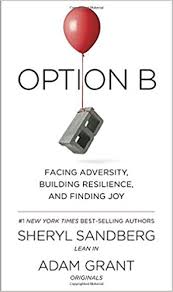
OptionB

Shortly after hearing Sheryl Sandberg and Adam Grant speak on a Harvard Business Review podcast, I purchased Option B.

After listening to the podcast, I expected the book to contain more references to the research on resilience than it ultimately did. While I knew the book was popular press, I expected Penn Professor Adam Grant to add a more scholarly flavor. As it was, the book was a relatively short memoir focused on the death of Sheryl Sandberg’s husband Dave. Had I started the book expecting a window into Sandberg’s grieving process rather than an accessible integration of the resilience research, I think I would have appreciated the book more.  

On the positive side, the book is an extremely easy read and is written with a punchy, engaging style. Sandberg is quite honest, and is blunt in sharing with the readers what is and isn’t helpful in interacting with those who have experienced great personal loss. In Sanberg’s opinion, you should address the elephant in the room, and should not worry about reminding them of their loss, as they are already thinking about it all the time. Vague offers like “let me know if I can do anything to help”

Good morning from gorgeous Belize. I hope to see some of you this weekend at SEALS. A couple of weeks ago, I posted about the compliance course I recently taught. I received quite a few emails asking for my syllabus and teaching materials. I am still in the middle of grading but I thought I would provide some general advice for those who are considering teaching a similar course. I taught thinking about the priorities of current employers and the skills our students need.

1) Picking materials is hard– It’s actually harder if you have actually worked in compliance, as I have, and still consult, as I do from time to time. I have all of the current compliance textbooks but didn’t find any that suited my needs. Shameless plug- I’m co-authoring a compliance textbook to help fill the gap. I wanted my students to have the experience they would have if they were working in-house and had to work with real documents.  I found myself either using or getting ideas from many primary source materials from the Society of Corporate Compliance and Ethics, the  Institute of Privacy ProfessionalsDLA Piper, the Federal Sentencing Guidelines for

Today, the Delaware Supreme Court issued its much-awaited decision in DFC Global Corp. v. Muirfield Value Partners, LP, et al., regarding the proper role of the deal price when determining fair value in a corporate appraisal action.  In an opinion by Chief Justice Strine, the court rejected calls for a bright-line rule deferring to the price, but emphasized that market pricing is generally the best evidence of value.  In one passage that struck me as curious, the court held that the purpose of an appraisal action is not to award dissenters the very highest price their shares could command, but to “make sure that they receive fair compensation for their shares in the sense that it reflects what they deserve to receive based on what would fairly be given to them in an arm’s-length transaction.”  Which, you know, sounds an awful lot like deal price.  And not a whole lot like valuing a company “as a going concern, rather than its value to a third party as an acquisition,” In re Petsmart, 2017 WL 2303599 (Del. Ch. May 26, 2017), which is how appraisal has previously been described.

I will leave it to others to analyze the implications