
September 2024

The Contest
The Public Investors Advocate Bar Association (PIABA) sponsors this contest for papers touching on securities law and securities arbitration and will pay over $3,000 in awards to law students with prizes at $1,500, $1,000, and $750 for the top three entrants.  The PIABA Bar Journal will publish the first place paper and, in years past, has also made offers to publish other papers from the contest.  Papers must be submitted by Friday, March 28, 2025.

Eligibility
The competition is open to all students attending a law school in the United States.[1]  PIABA employees and externs (except for students working less than 20 hours per week) are not eligible to enter the competition. 

Criteria and Judging
All entries will be judged anonymously by the Competition Judges, who will select the winning submission(s). PIABA will notify the award winner(s) in early April.

Entries will be judged based on the following criteria: quality of research and authority provided; accuracy and clarity of the analysis; compliance with legal writing standards and technical quality of writing, including organization, grammar, syntax, and form. Strong preference will be given to articles that advocate pro-investor positions, provide updates on or surveys of securities or

  • prison sentences (althoigh not those with significantly long terms and no opportunity for parole) and wide publicity of the same in the news media, citing to 1980s insider trading enforcement efforts and the new millennium Enron era accounting fraud enforcement efforts as examples;
  • multiple enforcement cases of the same kind brought close in time–creating what she referred to as “industry-changing deterrence”; and 
  • whistleblower programs, which she praised for their capacity to permit broad and quick enforcement against serious frauds.

I didn’t really think it through. I actually thought that teaching Business Associations (BA) online, would mean that I would have fewer students. I’m teaching online because I have two immunocompromised parents and I don’t want to take any risks. But alas, I have 90 students this semester.

Not to brag, but I’m pretty good at teaching online. I haves some students who have taken three or four classes with me online and none of them are required. But I have never taught ninety online. That number is completely contrary to best practices for online teaching and learning. 

I even tried to scare some students away. Before every semester, I ask all students to complete a Google form that helps me understand them a bit better. This lets me know how to pronounce their names, what experience they have in business, where they have worked, what classes they are taking, and what they are most interested in learning about. This survey helped me understand how many of them were taking BA and Evidence at the same time. Some masochists are taking BA, Evidence, and our Transactional Skills I course, which is incredibly time consuming. But alas, only two dropped.

Well, Hurricane Francine passed through New Orleans, and left me with power (yay!) but no internet (boo!), which means I’m relatively helpless.

Still, I’ll take this opportunity to announce that I’ve started a podcast, Shareholder Primacy, with Mike Levin (The Activist Investor).  We’re still working out what it wants to be, but our first episode is up (here on Apple, here on Spotify, here on YouTube) addressing the status of the Tesla compensation case, and the implications of the universal proxy.

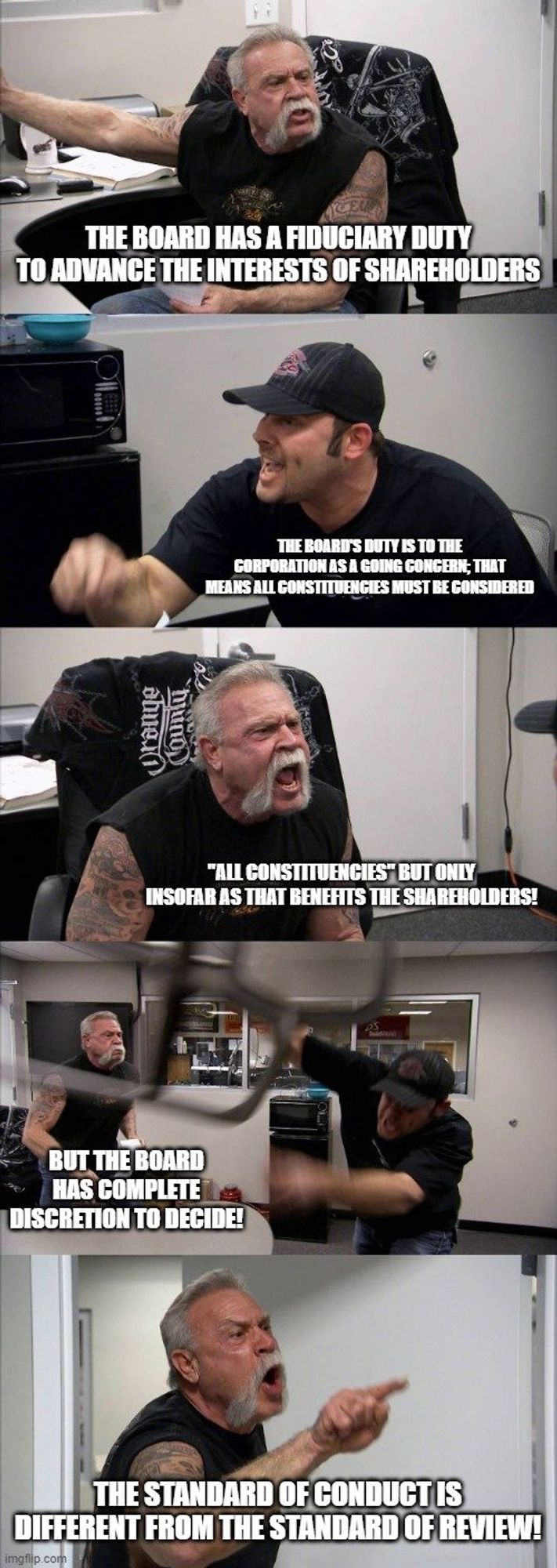
Also, I’m very proud of this meme I made:

E8831d72-6284-44d5-b15c-0e87ffc7551e

Touro University Jacob D. Fuchsberg Law Center Seeking to Fill
Four Tenure Track Positions in Property, Business Organizations, Trusts and Estates, Tax, and Evidence

The Touro University Jacob D. Fuchsberg Law Center is pleased to announce that it is currently seeking outstanding applicants for four tenure-track appointments to its full-time faculty starting in August 2025. The law school welcomes applications from candidates interested in teaching Property, Business Organizations, Trusts and Estates, Tax, and Evidence.

Ideal candidates must have a J.D. degree from an ABA accredited law school and a commitment to teaching in an environment dedicated to excellence in teaching and mentoring of students. We look for innovative faculty with a preference for both practice and teaching experience. Applicants must demonstrate a commitment to service to legal education and to the wider community as well as a desire to engage in the intellectual life of the Law Center. With one of the most diverse student bodies in the country, Touro Law Center is dedicated to the aims of diversity and strongly encourages applications from women and minorities.  Applicants are expected to be willing and capable of teaching in-person and remotely and familiar with best practices in both modalities. 

Touro Law

The University of Maine School of Law, in the thriving and increasingly diverse coastal community of Portland, Maine, invites applications for four full-time faculty positions to begin in 2025 – two doctrinal and two clinical.  The Law School is particularly interested in doctrinal candidates whose focus includes criminal law and related subjects (including criminal procedure); and property law and related subjects (including land use and environmental law).  The Law School is interested in clinical faculty to direct its Youth Justice Clinic and direct its new Business Law Clinic.

Applicants must possess a J.D. degree, an excellent academic record, a record or promise of high scholarly achievement (particularly for doctrinal positions), and a record or promise of successful teaching and mentoring students. Both lateral and entry level candidates will be considered. Rank and salary will be competitive and commensurate with qualifications and experience. Members of minority groups, women, and others whose background would contribute to the diversity of the Law School are encouraged to apply.

Application materials should include a cover letter, C.V., and research agenda. Please direct application materials and questions to the chair of the Appointments Committee, Professor Anthony Moffa, at the following email address: mainelawsearch@maine.edu.

Review of

The Southeastern Association of Law Schools (SEALS) 2025 annual meeting is scheduled for July 26-Aug. 2 at the Omni Resort in Amelia Island, Florida.I am committed to conjure up ideas for business law panels and discussion groups at the conference.  But before I approach that task, I want to follow up on Haskell’s recent post, SEALS Conference Reflection — Mind, Soul, and Body?, from August 28th.

In that post, Haskell made the following observations:

Traditionally, legal academics do an excellent job sharpening the mind. “Think like a lawyer” is a phrase even my colleagues across campus know. The soul gets much less attention at most schools, but that seems to be changing a bit, especially with increasing concerns for lawyer well-being.

The body, however, seems almost entirely neglected both at the SEALS Conference and at law schools nationwide. Yes, there were tennis and pickleball tournaments, but I don’t think there was a single panel related to the physical health of our students, faculty, and staff.

I know he’s right.  So, in the comments to his post, I suggested a SEALS discussion session on physical wellness.  I want to start the process of putting together that session through this post.

Dear BLPB Readers:

“The American Business Law Journal (ABLJ) is currently accepting submissions for Volume 62 (2025).  

The ABLJ is a faculty-edited, double blind peer-reviewed journal, continuously published since 1963. The journal is ranked is ranked #2 in the 2023 Washington & Lee Law Journal Rankings for journals in Business, Corporations and Securities Law. It is ranked as an “A” journal by the Australian Business Deans Council.

Our mission is to publish only top quality law review articles and essays that make a scholarly contribution to all areas of law that impact business theory and practice, either U.S. or comparative in scope. We search for those articles that articulate a novel research question and make a meaningful contribution directly relevant to scholars and practitioners of business law. The blind peer-review process means legal scholars well-versed in the relevant specialty area have determined selected articles are original, thorough, important, and timely, and peer editors provide expert feedback and support throughout the editorial process. 

The ABLJ is published quarterly. Articles should be between 16,000 and 20,000 words (inclusive of footnotes). Essays should be between 7,000 and 10,000 words (inclusive of footnotes). 
 
Authors may submit their manuscripts and CVs/resumes through Scholastica or

This time, it’s Brazil.

If you’re not following the saga, the story is apparently that ex-Twitter, now controlled by Elon Musk (not the CEO, though; you can’t even really say he’s the owner without qualifying about the interests of other investors and – don’t forget – the debtholders), ignored the order of Brazilian Supreme Court Justice Alexandre de Moraes to remove certain accounts associated with hate speech and misinformation.  Apparently out of fear that Twitter’s Brazilian employees would be arrested, Twitter shut down its Brazilian offices.  At that point, Twitter was out of compliance with a Brazilian requirement that a legal representative be present in the country.  So, Justice de Moraes ordered that access to Twitter be blocked throughout Brazil.  (Legal challenges to that order continue)

That’s not great for Twitter, but it turns out, it was even worse for Starlink, a wholly-owned subsidiary of Musk-controlled SpaceX, because the Justice ordered that Starlink’s financial accounts be frozen in order to force payment of fines owed by Twitter.  Musk at first insisted that he would not block access to Twitter via Brazilian Starlink, then – on that point – relented.  Shortly thereafter, it was reported SpaceX was evacuating its personnel from the country.  As the Wall Street Journal put it, “Starlink’s entanglement in a dispute originally about X is a stark illustration of how some government officials around the world may draw few distinctions between enterprises that Musk runs.”

So, all of this has the makings of a great introductory classroom discussion of corporate separateness, enterprise liability, and veil-piercing.  I have no idea what the law on this is in Brazil, but let’s talk about how we’d analyze this under American law.

(more under the jump)

The AALS Section on Transactional Law & Skills is pleased to announce a session at the 2025 AALS Annual Meeting in San Francisco, C.A.

Pedagogy Panel on Experiential Exercises in Business Law

We invite submissions for a panel that highlights experiential exercises in business law. Exercises might include, for example, contract drafting, transactional research, mock negotiations, or other exercises that would fit into a law school course. We invite speakers to share exercises with the panel, to discuss how they facilitate and/or grade the exercises, and/or to teach a short mock version of their exercise during the panel.

Please submit a short proposal and/or a draft of the exercise you would like to present to Professor Benjamin Edwards (Benjamin.Edwards@unlv.edu) on or before Friday, September 20th.  Authors should include their name and contact information in their submission email but remove all identifying information from their submission.  Please include the words “AALS – Transactional Pedagogy” in the subject line of your submission email. Papers will be selected after review by members of the Executive Committee of the Transactional Law & Skills Section. Presenters will be responsible for paying their registration fee, hotel, and travel expenses.

Please direct any questions