Photo of Haskell Murray

Professor Murray teaches business law, business ethics, and alternative dispute resolution courses to undergraduate and graduate students. Currently, his research focuses on corporate governance, mergers & acquisitions, sports law, and social entrepreneurship law issues.

Professor Murray is the 2018-19 President of the Southeastern Academy of Legal Studies in Business (“SEALSB”) and is a co-editor of the Business Law Professor Blog. His articles have been published in a variety of journals, including the American Business Law Journal, the Delaware Journal of Corporate Law, the Harvard Business Law Review, and the Maryland Law Review. Read More

Although a bit behind on getting it up, I wanted to flag this article from Ron Lieber about his experience showing up for a “complimentary gourmet meal” with an annuity salesman.  By doing a few record checks, he soon discovered some interesting facts about the annuity salesman:

And the host? An insurance salesman, Arif M. Halaby, who I quickly discovered had been the subject of a state cease-and-refrain order earlier in the decade because of certain financial products that an administrative law judge determined that he had sold. The state found that Mr. Halaby was offering “unqualified” securities after an ailing older client pulled equity from his home to invest in a real estate development in Costa Rica.

At this point, alarm bells should be going off.  This is the sort of high-risk move that could easily prove disastrous.  

The SEC has long warned about these seminars.  When it held its “senior summit” about a decade ago, it issued warnings that the seminars may involve misleading presentations that are just designed to sell products.

When Lieber attended this one, he discovered the presenter using a graphic depicting the annuity product significantly outperforming the S&P 500.  The fine print disclosed that

In Hexion Specialty Chemicals, Inc. v. Huntsman Corp., 965 A.2d 715, 730 (Del. Ch. 2008) – a case I worked on as a judicial clerk – the court wrote, “[m]any commentators have noted that Delaware courts have never found a material adverse effect to have occurred in the context of a merger agreement.”

That statement is no longer true.

Today–in a 3 page opinion–the Delaware Supreme Court affirmed the 240+ page opinion by Vice Chancellor Travis Laster in Akorn, Inc. v. Fresenius Kabi, AG, et al., which held that Akorn triggered the Material Adverse Effect (“MAE”) clause of the merger agreement at issue.

As the Chancery Daily reports, and as is clear looking at the recent opinions, the Delaware Supreme Court opinion does not provide much reasoning for its decision to affirm, but the Court of Chancery opinion does provide plenty of guidance. In the first few pages, the Court of Chancery notes that Akorn experienced a “dramatic, unexpected, and company-specific downturn in…business that began in the quarter after signing.” The Court of Chancery also notes the importance of whistleblower letters and issues with Akron and the FDA. 

Also of interest, the court notes that this

I posted about my summer reading here, and I have decided to write this sort of post each semester, at least for a few semesters. 

This semester was incredibly busy, and I didn’t read as much as I would have liked, but I am glad I finished at least a few books. Nearly all of these books were pretty light

Always looking for interesting books to read – and I am open to reading in most areas – so feel free to leave a comment with suggestions or e-mail me

The Honest Truth About Dishonesty – Dan Ariely (Non-Fiction – Ethics/Behavioral Economics, 2013). Duke University behavioral economist examines the environs/structures that encourage or discourage honesty.

Hannah Coulter – Wendell Berry (Fiction-Novel, 2005). Elderly lady, twice widowed, reflects on her life and the lives of her family members as the world changes after World War II, and as the modern world diverts from rural, farming communities like Port William, KY. Berry’s first novel with a female narrator.

The Most Important Year – Suzanne Bouffard (Non-Fiction – Education, 2017). Discusses the importance of the year before kindergarten. (My oldest child starts kindergarten this coming fall). Biggest takeaway was to engage

Colleen Baker

Colleen Baker is joining us as a guest blogger at Business Law Prof Blog for the next month. Colleen Baker is an Assistant Professor at the Price College of Business at the University of Oklahoma. She is also affiliate faculty at the University of Oklahoma College of Law. Her research interests primarily lie in the banking and financial institutions law and regulation space. Additional information about her education, practice, and publications can be found at her bio, linked to above. We are looking forward to Professor Colleen Baker’s posts and hope our readers will engage with her work.

Facing looming retirement crises, some states have begun to do more.  Notably, Nevada recently passed a state fiduciary statute.  I cheered the legislation’s passage because it mostly puts in place the legal protections that most savers now mistakenly believe that they already have.  New Jersey also recently began to solicit comments on the issue as well.  For the New Jersey process, written comments are due on December 14th.

As it moves forward, New Jersey will likely have to contend with the financial services industry doggedly lobbying to protect a stockbroker’s right to sell clients the wrong products.  Much of the campaign will likely be led by the Securities Industry and Financial Markets Association (SIFMA).  SIFMA touts itself as “the voice of the nation’s securities industry.”  It came up with some creative concerns about the Nevada fiduciary statute and will likely raise similar concerns with New Jersey. 

One SIFMA argument struck me as particularly interesting in its implications:

We remain concerned that any new fiduciary duties under the Nevada law would impose additional recordkeeping requirements that would violate the National Securities Markets Improvement Act of 1996 (“NSMIA). As you well know, NSMIA precludes states from enacting regulations relating to the making and

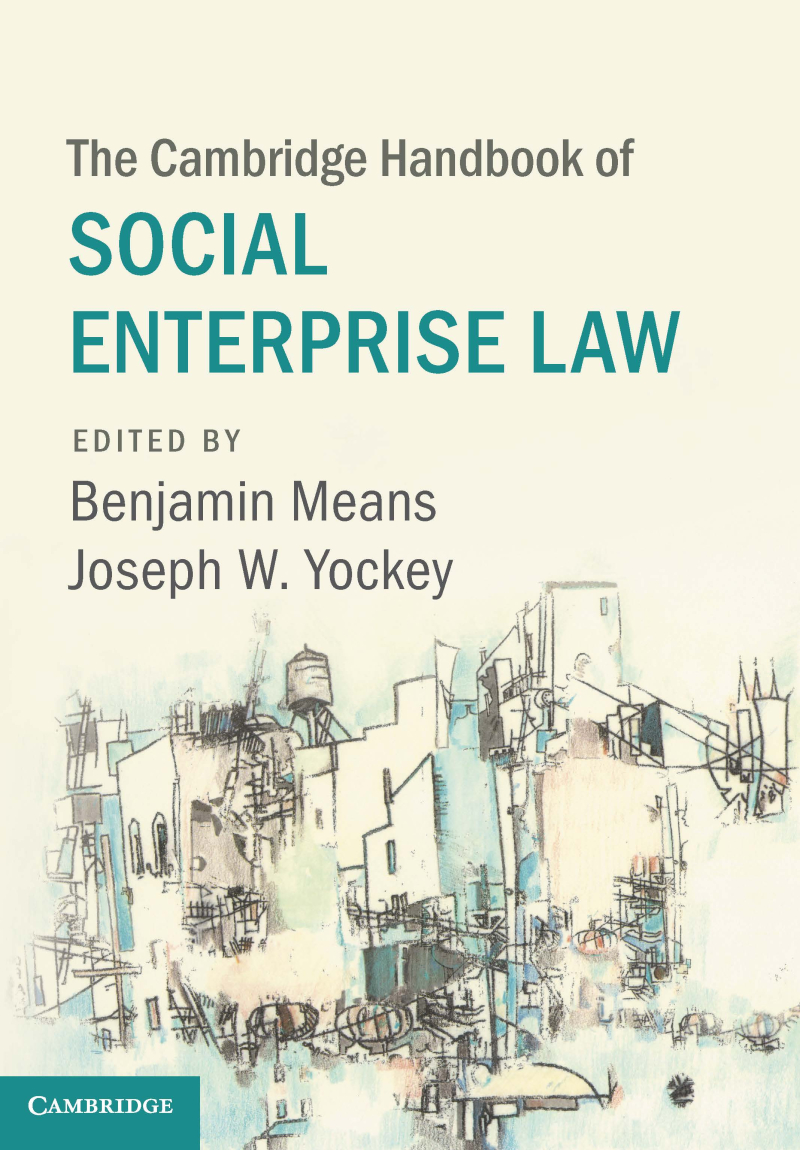
The Cambridge Handbook of Social Enterprise Law, edited by Ben Means (South Carolina) and Joe Yockey (Iowa) is at the printers and should be ready for orders in early 2019. 

My fellow BLPB editor Joan Heminway and I both have chapters in the book, along with many others. 

The introduction is posted on SSRN, for those who are interested. Also, editor Ben Means has many talents, as he did the cover artwork below as well.

The Cambridge Handbook of Social Enterprise Law_Cover

The Theranos collapse and Elizabeth Holmes’ indictment makes me wonder about what investor biases may have played a role in allowing Theranos to operate as long as it did.  In an op-ed in The Hill, Ann McGinley and I point out that it might have been her seemingly deliberate projection of an idealized masculinity:  

Presenting the right identity may unlock millions in funding and bypass close, critical reviews. Consider Elizabeth Holmes, the recently indicted founder of Theranos. Flanked by a board sporting retired military officers, she presented herself as a masculinized take on the Steve Jobsian ideal — aping his wardrobe choices with a black turtleneck sweater.

Her costume was often complimented by a blazer’s broad shoulders, and she spoke with a startlingly deep voice.  The presentation exuded a hard-charging masculinity, allowing backers to see her as a Jungian fantasy of Jobs’ second coming. 

The op-ed ties back to the bigger law review article discussing the ways in which a bias toward favored identities causes founders to perform their and their entities’ identities to please sources of capital. 

Gender bias (and other forms of implicit bias) likely does more than just raise capital costs for founders.  It also seems to saddle

The SEC’s influential Investor Advisory Committee has just released new recommendations for the SEC as it continues to move forward with its effort to raise the standard for investment advice given to retail customers.  Although the entire recommendation is worth reading, it highlights the special importance of making sure that account-type recommendations fall within the rule.  As it currently stands, the proposed regulation does not apply to initial recommendations about what kind of account a customer should select.

The Committee described the issue’s critical importance:

Some of the most important decisions investors make arise at the outset of the relationship, before they receive recommendations regarding specific transactions. These include decisions about whether to roll money out of a retirement account and into an IRA, what type of account to open (where the firm has more than one account type available), and the scope of services to be provided. Those central decisions, generally made at the beginning of a brokerage or advisory relationship, set up the contours of the relationship. They will often have a far greater impact on the investor than subsequent recommendations regarding which specific securities to invest in.

Rollover recommendations, for example, are frequently provided at a critical

Next Friday, the George Washington Law Review will host a symposium on Women and Corporate Governance. Co-sponsored by Lisa Fairfax, the symposium features an impressive lineup–three former SEC Commissioners, regulators, professors, partners at leading law firms, and the BLPB’s own Joan Heminway.  The panels include discussions about women and corporate boards, women as regulators, women in the C-Suite, and women as gatekeepers.  This is the quick overview:

The Symposium will explore the role of women in a changing corporate environment, particularly in light of the 2008 financial crisis and its aftermath. Recent social, political, and economic events have brought renewed attention to the ways in which the corporate environment is impacted by, and responsive to, women. It is especially vital to further this discussion today, as corporations grapple with the under-representation of women on their boards, in their C-suites, and in a host of other managerial positions.

In place of the traditional individual keynote, we have the privilege of hosting a fireside chat featuring the three women who have served as Chair of the U.S. Securities and Exchange Commission – Mary Schapiro, Elisse Walter, and Mary Jo White, moderated by Professor Lisa Fairfax.

Congratulations to Professor Fairfax and the George Washington Law Review for getting so many

5th Conference of the French Academy of Legal Studies in Business (Association Française Droit et Management)

June 20 and 21, 2019 – emlyon – Paris Campus

CALL FOR PAPERS 2019 Social Issues in Firms

Social issues and fundamental rights occupy an increasingly important space in the governance of today’s companies. Private enterprises assume an increasingly active role not only in a given economy but also in society as a whole. Firms become themselves citizens. They recognize and support civic engagement by the men and women who work for them. Historically, the role of the modern firm that resulted from the Industrial Revolution has been torn between two opposing viewpoints.

[More information under the break.]