Photo of Marcia Narine Weldon

Professor Narine Weldon is the director of the Transactional Skills Program, Faculty Coordinator of the Business Compliance & Sustainability Concentration, Transactional Law Concentration, and a Lecturer in Law.

She earned her law degree, cum laude, from Harvard Law School, and her undergraduate degree, cum laude, in political science and psychology from Columbia University. After graduating, she worked as a law clerk to former Justice Marie Garibaldi of the Supreme Court of New Jersey, a commercial litigator with Cleary, Gottlieb, Steen and Hamilton in New York, an employment lawyer with Morgan, Lewis and Bockius in Miami, and as a Deputy General Counsel, VP of Global Compliance and Business Standards, and Chief Privacy Officer of Ryder, a Fortune 500 Company. In addition to her academic position, she serves as the general counsel of a startup and a nonprofit.  Read More

BLPB(PaceLawLogo)

Elisabeth Haub School of Law Faculty Hiring Announcement

The Elisabeth Haub School of Law at Pace University invites applications to fill up to two full-time, academic tenure-track/tenured faculty positions at the rank of assistant professor, associate professor, or professor. The positions will begin in August 2021. Applicants must be committed to providing excellent legal training both in person and online, engaging in meaningful service within the law school and in the broader community, and producing excellent scholarship. Applicants should have teaching and research interests in any of the following areas: environmental law, natural resources law, sustainable business law, energy and climate law, public health law, contracts law, business law, and tax law. Applicants whose interests cover multiple of these areas are particularly encouraged to apply. We welcome applications from candidates interested in doctrinal, experiential, and/or clinical teaching.

Applicants seeking the rank of assistant professor should hold a J.D. from an accredited law school or an equivalent degree from a non-U.S. law school. A successful candidate will have an excellent academic record and demonstrated potential for accomplishment in teaching, scholarship and research, and service.

Applications are encouraged from people of color, individuals of varied sexual and affectional orientations, individuals who are
BA(MasonJones-1)

I wanted to get there first, but friend, co-blogger, and Nova Southeastern Law colleague Jim Levy beat me to it.  In a blog post for Legal Skills Prof Blog, Jim wrote about the incredible similarities between the game show Hollywood Squares and Zoom teaching.  As I teach my last classes of the semester today–all online (thanks to our dean’s promotion of online teaching for the last two class days of the semester)–I continue to be stuck on  and struck by this similarity.  We are not the only ones to note this comparison, of course.  See, e.g., here and here and here.

I have called the Zoom squares the Hollywood Squares more than once during my class sessions this semester.   Unlike Jim, however, I have not yet endeavored to “play host” in a way that mimics the show.  He recalls (as do I) Peter Marshall’s lengthy stint as the show’s host.  But it does turn out there were others.

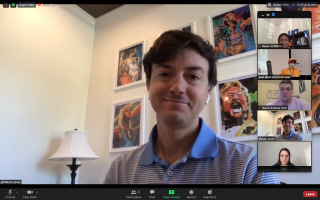
As I bid goodbye to the Fall 2020 semester, I leave you with a picture (above) of one of my class meetings earlier this fall.  UT Law alum and entrepreneur Mason Jones (founder of Volunteer Traditions, Inc.) visited

The University of Alabama School of Law seeks to fill as many as two tenure-track positions for the 2021-22 academic year. Candidates must have outstanding academic credentials, including a J.D. from an accredited law school or an equivalent degree (such as a Ph.D. in a related field). Entry-level candidates should demonstrate potential for strong teaching and scholarship. The primary focus of these positions is in Contracts and Torts; however, qualified applicants in other areas may be considered. Among our secondary interests are Family Law and Business Law. We welcome applications from candidates who approach scholarship from a variety of perspectives and methods. The University embraces diversity in its faculty, students, and staff, and we welcome applications from those who would add to the diversity of our academic community.

Interested candidates should apply online at https://facultyjobs.ua.edu/postings/47619. Salary, benefits, and research support will be nationally competitive. All applications are confidential to the extent permitted by state and federal law; the positions remain open until filled. Questions should be directed to Professor Fred Vars, Chair of the Faculty Appointments Committee (facappts@law.ua.edu).

The University of Alabama is an Equal Employment/Equal Educational Opportunity Institution. All qualified applicants will receive consideration for employment

Voting-1

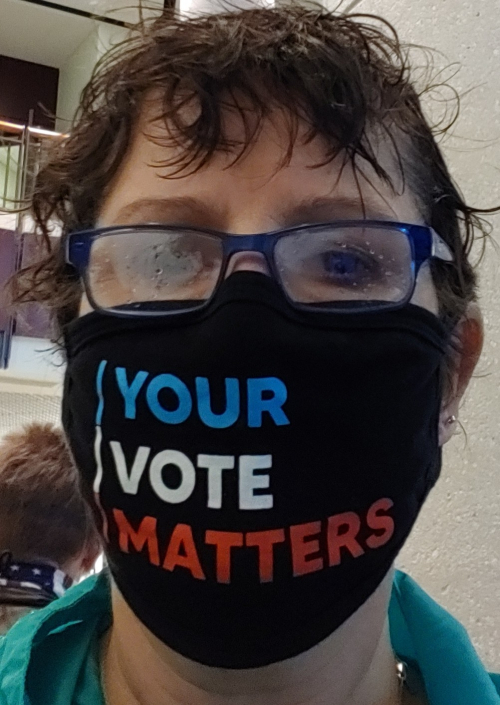
Since almost all of us are thinking about Election Day 2020 (tomorrow!), I am taking a moment here to reflect on conversations I recently have had with my students about parallels in political and corporate governance.  Although current conversations center around the fiduciary duties of those charged with governance (a topic that I will leave for another day), just a few weeks ago, we were focused on voting (both shareholder and director voting).  The above photo shows me–sporting wet hair and rain-spotted, fogged-up glasses–waiting in line to vote early last week.  I admit that while I routinely vote in political elections, I have only been to a shareholder meeting once, and then as an advisor to the corporation, not to actually vote any shares held.  Having said that, in my fifteen years of law practice, I did draft proxy materials, structure shareholder meetings, and address concerns associated with shareholder voting.

My students are always curious about shareholder voting and most intrigued by proxy voting.  Corporate governance activities are, of course, not very transparent in daily life for most folks.  A course covering corporate law introduces both new terms to a student’s lexicon and new concepts to a student’s base of

ABALogo(2020)
I have written about the American Bar Association Limited Liability Institute in this space before.  See, e.g., here, here, here, here, and here.  The 2020 LLC Institute is being hosted virtually and begins next Friday–something to look forward to at the end of election week!  This ABA program is always a premier event, and it is the only national annual program that focuses in exclusively on LLCs and unincorporated business associations.

Importantly, this year’s institute is free to law students.  I have recommended registration and attendance to mine.  Click here for more information, including the agenda, list of speakers (including yours truly!), and registration.

Image1

The NYU Pollack Center for Law & Business, Indiana University Maurer School of Law, and Securities and Exchange Commission Historical Society invite you to a virtual program entitled “Insider Trading: Honoring the Past|A Program Commemorating the 40th Anniversary of Chiarella v. United States,” which will take place on Thursday, November 5th from 10am-noon Eastern Time.

The program will explore the fascinating backstories of the Chiarella prosecution and the Supreme Court argument as well as the SEC’s and DOJ’s insider trading enforcement strategies in the wake of the Court’s ruling. The Chiarella case is also the subject of Donna Nagy’s recent essay, Chiarella v. United States and its Indelible Impact on Insider Trading Law.

A webinar link will be circulated to all those who RSVP, which you can do here. Conference details and schedule are below.

Conference Organizers:

Stephen Choi, Murray and Kathleen Bring Professor of Law, NYU School of Law, Co-Director Pollack Center for Law and Business
Donna M. Nagy, C. Ben Dutton Professor of Law, Indiana University Maurer School of Law
Jane Cobb, Executive Director, SEC Historical Society

Schedule:

10:00am Welcome by Stephen Choi, Murray and Kathleen Bring Professor of Law, NYU School of

Although my UT Law colleague Greg Stein is perhaps most well known for his work in the area of real estate law (development, finance, land use, etc.–see his SSRN page here), of late, he has been focusing increased attention on issues at the intersection of technological innovation and economic enterprise.  I have been interested in and engaged by this new twist to his research, thinking, and writing.  This post promotes two works he has completed that occupy this scholarly space, the first of which was recently published in the Brooklyn Law Review and the second of which is forthcoming in the Florida State University Law Review.

The Brooklyn Law Review piece is entitled “Inequality in the Sharing Economy.”  The SSRN abstract follows.

The rise of the sharing economy benefits consumers and providers alike. Consumers can access a wider range of goods and services on an as-needed basis and no longer need to own a smaller number of costly assets that sit unused most of the time. Providers can engage in profitable short-term ventures, working on their own schedule and enjoying many new opportunities to supplement their income.

Sharing economy platforms often employ dynamic pricing, which means

On Friday night, I finished five days of group oral midterm exam appointments with my Business Associations students.  (I wrote a law review article on these group oral midterms five years ago, in case you are interested in background and general information.)  It is an exhausting week: twenty-one 90-minute meetings with groups of three students based on a specific set of facts.  And this year, of course, the examinations were hosted on Zoom, like everything else.  Especially given social distancing, mask-wearing, and the overall hybrid instructional method for the course (about which I wrote here), I admit that I headed into the week a bit concerned about how it all would go . . . .

The examination is conducted as a simulated meeting of lawyers in the same law office–three junior lawyers assisting in preparing a senior colleague for a meeting with a new client.  The student teams are graded on their identification and use of the applicable substantive law. I was pleased to find that the teams scored at least as well overall and individually as they typically do.  That was a major relief.  I had truly wondered whether students would be less well prepared in

ConnectingThreadsIV-1024x683

The fourth annual Business Law Prof Blog symposium, Connecting the Threads, is happening, despite the pandemic.  We are proceeding in a virtual format, hosted on Zoom on Friday, October 16.  More information is available here.

The line-up includes an impressive majority of our bloggers speaking on a wide range of topics from shareholder proposals to social enterprise, opting out of partnership, and much more.  Most papers will have a faculty and student discussant.  My submission, “Business Law and Lawyering in the Wake of COVID-19,” is coauthored with two students and carries one hour of Tennessee ethics credit.  While I wish we could host everyone in person in Knoxville, it always is an amazing day when we all get together.  I look forward to learning more about what everyone is working on and hearing what everyone has to say.

No. You didn’t miss Part 1. I wrote about Weinstein clauses last July. Last Wednesday, I spoke with a reporter who had read that blog post.  Acquirors use these #MeToo/Weinstein clauses to require target companies to represent that there have been no allegations of, or settlement related to, sexual misconduct or harassment. I look at these clauses through the lens of a management-side employment lawyer/compliance officer/transactional drafting professor. It’s almost impossible to write these in a way that’s precise enough to provide the assurances that the acquiror wants or needs.

Specifically, the reporter wanted to know whether it was unusual that Chevron had added this clause into its merger documents with Noble Energy. As per the Prospectus:

Since January 1, 2018, to the knowledge of the Company, (i), no allegations of sexual harassment or other sexual misconduct have been made against any employee of the Company with the title of director, vice president or above through the Company’s anonymous employee hotline or any formal human resources communication channels at the Company, and (ii) there are no actions, suits, investigations or proceedings pending or, to the Company’s knowledge, threatened related to any allegations of sexual harassment or other sexual misconduct by any