Friend-of-the-BLPB Tom Rutledge alerted me earlier today to a Thomson Reuters piece on the TripAdvisor reincorporation litigation that quotes not one but two of our blogger colleagues: Ann Lipton and Ben Edwards (in that order).  Ann is quoted (after a mention and quotation of one of her recent, more entertaining tweets) on the Delaware judicial aspects of the case.  Ben is quoted on the Nevada corporate law piece.  So great to see these two offering their legal wisdom on this interesting claim.

Ann’s tweet (perhaps predictably) offers a different “take” on Nevada law than Ben’s press statements.

Ann: “I tell my students, Nevada is where you incorporate if you want to do frauds . . . .” 

Ben: “The folks here are people acting in good faith, trying to do what’s right – not cynically racing to the bottom . . . .”

And then Ben gets the last word: “Nevada . . . has become a home for billionaires leaving Delaware in a huff.”

Beautiful.

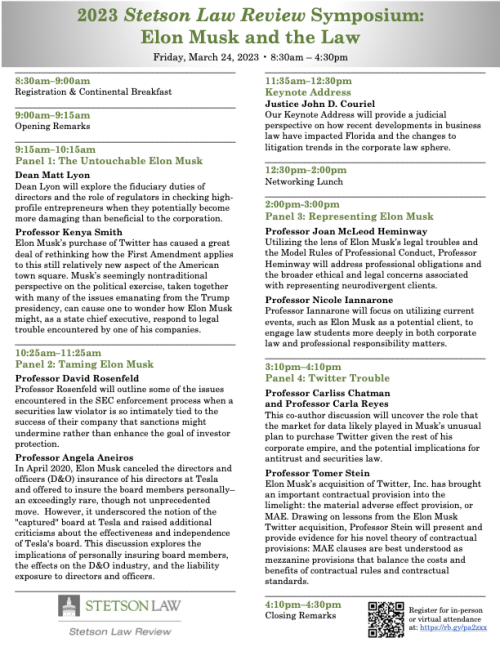
Last Friday, I had the privilege of speaking, with other colleagues, at the 2023 Stetson Law Review Symposium on “Elon Musk and the Law.”  (See the flyer on the program, below.)  This symposium grew out of a discussion group I organized at the 2022 Southeastern Association of Law Schools Conference.  I posted about it here back in May of last year.

I could not have been happier with the way the symposium worked out.  The Stetson Law students, faculty, and administration were well organized, kind, and fun–a total pleasure to work with.  And I got excellent questions and feedback on my early draft paper, Representing Elon Musk, which focuses attention on the lawyer-client relationship under the American Bar Association’s Model Rules of Professional Conduct.  I look forward to seeing the final published proceedings in two forthcoming books of the Stetson Law Review.

*               *               *

Stetson2023(flyer)

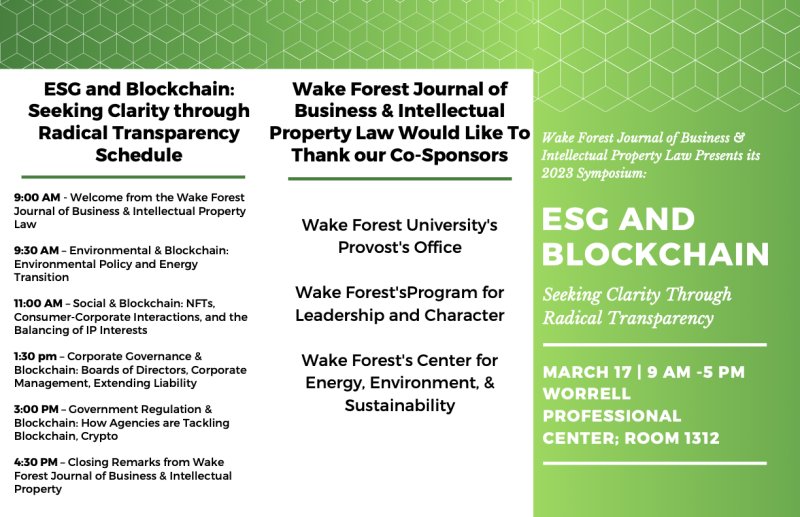
I am honored to be speaking later today on ESG, blockchains, and corporate governance at this symposium at Wake Forest University School of Law.  This practitioner-centered symposium promises to offer significant information useful to my teaching and scholarship.  My fellow speakers hail from law firms and other organizations across the United States.  I am excited to share and learn!

WakeForest2023(Flyer)

Friend-of-the-BLPB Walter Effross recently informed me of his blog, Keeping Your Own Counsel (subtitled “Simple Strategies and Secrets for Success in Law School”). The blog is a companion piece to Walter’s new book designed for pre-law and law students, also entitled Keeping Your Own Counsel. Walter let me know that one can check out the book’s table of contents, preface, and first two chapters through Amazon’s “Look inside” feature and that a summary of six of the book’s themes is in his most recent blog post.

He also noted that his February 25th blog post provides links to his conversations with leading in-house and outside counsel about the definition and goals of, career opportunities in, and ways to remain current on, the increasingly relevant practice of Environmental, Social, and Governance (ESG) law.  He specifically recommends one of those conversations–the one with Fox Rothschild LLP partner David Colvin–even to law students who are not specifically interested in ESG because it addresses practical ethical issues.  He indicated (and I agree) that the overall post may be of particular interest to our readers.  So many of us are focused on ESG and related regulation in our work at the moment .

Warning: this post addresses suicide.

I was supposed to post yesterday about a different topic but I’m posting today and not next week because someone needs to read this today.

Maybe it’s you. Maybe it’s your “strong” friend or colleague.

I found out yesterday that I lost a former student to suicide. She lit up every room she walked into and inspired me, her classmates, and everyone she met. I had no idea she was living in such darkness. Lawyers, law students, compliance professionals, and others in high stress roles are conditioned to be on top of everything. We are the strong ones that clients and colleagues rely on. We worry so much about the stigma of not being completely in control at all times, that we don’t get help. We worry that clients won’t trust us with sensitive or important matters. We worry that we won’t pass the character and fitness assessments to get admitted to the bar. 

The CDC released a report this week showing an alarming rise in depression, suicidal thoughts, and anxiety among our youth. The report noted that:

  • Female students and LGBQ+ students are experiencing alarming rates of violence, poor mental health, and suicidal thoughts

My mind is still reeling from my trip to Lisbon last week to keynote at the Building The Future tech conference sponsored by Microsoft.

My premise was that those in the tech industry are arguably the most powerful people in the world and with great power comes great responsibility and a duty to protect human rights (which is not the global state of the law).

I challenged the audience to consider the financial price of implementing human rights by design and the societal cost of doing business as usual.

In 20 minutes, I covered  AI bias and new EU regulations; the benefits and dangers of ChatGPT; the surveillance economy; the UNGPs and UN Global Compact; a new suit by Seattle’s school board against social media companies alleging harmful mental health impacts on students; potential corporate complicity with rogue governments; the upcoming Supreme Court case on Section 230 and content moderator responsibility for “radicalizing” users; and made recommendations for the governmental, business, civil society, and consumer members in the audience.

Thank goodness I talk quickly.

Here are some non-substantive observations and lessons. In a future post, I’ll go in more depth about my substantive remarks. 

1. Your network

I have given several talks on ESG (environmental, social, and governance) matters in the past few months.  And, of course, it is a subject discussed in the classroom.  As we celebrate the birthday of Dr. Martin Luther King Jr. today (and this week), I could not help but feel that his work provided a foundation for—somehow embraced—current ESG discussions and actions.  So, I went poking around on the Internet.

I guess I am not the only one who noticed this connection.

On the environmental part of ESG, Los Padres ForestWatch offers that:

Dr. King’s actions and teachings led to many important acts being passed in congress including the Civil Rights Act of 1964 and the Voting Rights Act of 1965. It’s through this work that Dr. King created a movement that was meant for us to understand how we are mutually tied together and that all life is interrelated. It’s this structure of thinking that has led many to believe that his work was the early structure for the Environmental Justice Movement. We see after Dr. King’s passing that environmentalists were able to pass the Clean Air Act of 1970, the Clean Water Act of 1972 and the Endangered Species

An ambitious question, yes, but it was the title of the presentation I gave at the Society for Socio-Economists Annual Meeting, which closed yesterday. Thanks to Stefan Padfield for inviting me.

In addition to teaching Business Associations to 1Ls this semester and running our Transactional Skills program, I’m also teaching Business and Human Rights. I had originally planned the class for 25 students, but now have 60 students enrolled, which is a testament to the interest in the topic. My pre-course surveys show that the students fall into two distinct camps. Most are interested in corporate law but didn’t know even know there was a connection to human rights. The minority are human rights die hards who haven’t even taken business associations (and may only learn about it for bar prep), but are curious about the combination of the two topics. I fell in love with this relatively new legal  field twelve years ago and it’s my mission to ensure that future transactional lawyers have some exposure to it.

It’s not just a feel-good way of looking at the world. Whether you love or hate ESG, business and human rights shows up in every factor and many firms have built

It’s the holidays and it’s time to treat yourself and members of your team to practical training and fantastic networking in sunny Miami in February. We don’t have bomb cyclones down here. The Transactional Skills Program at the University of Miami School of Law couldn’t be more excited to host the How to Contract Conference from February 15-17, 2023. 

Thumbnail_ContractsCon Flyer - 1 page (12-23-2022)

  • ContractsCon is a training and networking EXTRAVAGANZA focused on the practical contract drafting and negotiating skills that in-house counsel and contracts professionals need to know. 
  • This event is a zero-fluff, to-the-point training on the nitty-gritty details. ContractsCon includes:
    • speakers who get the in-house experience and can explain why we draft the way we do
    • training centered around provision-level playbooks for you and your company to use when you return to work
    • workshops that provide a deeper dive into more nuanced topics and include interactive group activities
    • ContractsCon Playbook, featuring the advice and drafting approaches discussed at ContractsCon
    • access to How to Contract’s SaaS Contracts Training Library, with 20+ hours of training videos, the Cloud Services Agreement Playbook, and lots more (through March 31, 2023)
    • CLE pending in 26 states for up to 7 hours for virtual ticket holders and up to 13 hours for in-person attendees
  • ContractsCon is an annual

Posting something light tonight . . . .

I have found myself fascinated listening to Jax’s recent hit “Victoria’s Secret,” a clever pop ballad about female body image concerns and intimates retailer Victoria’s Secret.  The refrain is catchy and, itself, tells a story–a business story.

I know Victoria’s secret
And, girl, you wouldn’t believe
She’s an old man who lives in Ohio
Making money off of girls like me”
Cashin’ in on body issues
Sellin’ skin and bones with big boobs
I know Victoria’s secret
She was made up by a dude (dude)
Victoria was made up by a dude (dude)
Victoria was made up by a dude

Because I knew some of the history of the Victoria’s Secret business, I understood that the allusion to the “old man who lives in Ohio”–the “dude”–is a reference to Leslie Wexner, the founder of L Brands (earlier famous for owning major brands like The Limited, Express, and Abercrombie & Fitch, as well as Victoria’s Secret).  Victoria’s Secret became an independent publicly traded firm, Victoria’s Secret & Co., last year through a tax-free spin-off from L Brands (now known as Bath & Body Works, Inc.).  From the Victoria’s Secret & Co.