
Job posting from an e-mail I recently received:

——————–

The UNIVERSITY OF NEBRASKA COLLEGE OF LAW invites applications for

lateral candidates for a tenured faculty position to hold the Clayton K. Yeutter Chair at

the College of Law. This chaired faculty position will be one of four faculty members to

form the core of the newly-formed, interdisciplinary Clayton K. Yeutter Institute for

International Trade and Finance. The Institute also will include the Duane Acklie Chair at

the College of Business Associations, the Michael Yanney Chair at the College of

Agricultural Sciences, and the Haggart/Works Professorship for International Trade at the

College of Law. The Yeutter Chair, along with the other three professors, will be

expected to support the work and objectives and ensure the success of the Yeutter

Institute. The Yeutter Chair will teach courses at the College of Law, including

International Finance. Other courses may include Corporate Finance and/or other related

classes pertaining to issues arising in international business and finance. More on the

Yeutter Institute can be found at http://news.unl.edu/newsrooms/today/article/giftsestablish-

endowed-chairs-for-yeutter-institute/ .


Minimum Required Qualifications: J.D Degree or Equivalent; Superior Academic

Record; Outstanding Record of Scholarship in International Finance and/or other areas

related to international business; and
The Wells Fargo headlines–fresh from a congressional testimony, a spiraling stock price, and a CEO with $41M less dollars to his name— raise the question of whether this is a case study of corporate governance effectiveness or inefficiency. That the wrong doing (opening an estimated 2M unauthorized customer accounts to manipulate sales figures) was eventually unearthed, employees fired and bonus pay revoked may give some folks confidence in the oversight and accountability structures set up by corporate governance. Michael Hiltzit at the LA Times writes a scathing review of the CEO and the Board of Directors failed oversight on this issue.  

The implicit defense raised by Stumpf’s defenders is that the consumer ripoff at the center of the scandal was, in context, trivial — look at how much Wells Fargo has grown under this management. But that’s a reductionist argument. One reason that the scandal looks trivial is that no major executive has been disciplined; so how big could it be? This only underscores the downside of letting executives off scot-free — it makes major failings look minor. The answer is to start threatening the bosses with losing their jobs, or going to jail, and they’ll start to

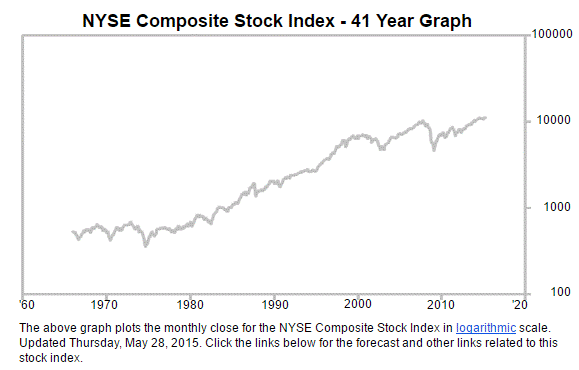
Stock pricing in the securities market responds to supply and demand.  This is intuitive with regard to individual securities.  We understand that if more people want to buy a stock (demand) than sell it (supply), then the price moves up. Conversely, the price decreases if more want to sell than buy.  I wonder to what extent regulators have examined the role of retirement saving plans in flooding the market with demand to buy new securities and which can drive up stock prices overall.  Consider this historical graph of the NYSE trading average.  Observe the sharp rise beginning in the late 1980’s with the introduction of individual retirement savings plan and the beginning of the defined contribution society. 

Nyse-composite-may

chart source: Forecast Chart

New Department of Labor regulations open the door for state governments to sponsor retirement savings plans for non-government workers.  See for example, California’s proposed plans.  The rules, proposed in 2015, became final on August 30, 2016.  You can read a summary of the proposed plans published by The Brookings Institute and a DOL interpretive bulletin.  Also being considered are proposed rules authorizing high-population cities to sponsor similar plans in states that don’t create the non-government worker retirement savings plans.  Collectively, these regulations

House Representative Carolyn B. Maloney, Democrat of New York, sent a formal request to a slew of federal agencies to share trading data collected in connection with the Volcker Rule. The Volcker Rule prohibits U.S. banks from engaging in proprietary trading (effective July 21, 2015), while permitting legitimate market-making and hedging activities.  The Volcker Rule restricts commercial banks (and affiliates) from investing investing in certain hedge funds and private equity, and imposes enhanced prudential requirements on systemically identified non-bank institutions engaged in such activities.

Representative Maloney requested  the Federal Reserve, Federal Deposit Insurance Corporation, Commodity Futures Trading Commission, Office of the Comptroller of the Currency, and the Securities and Exchange Commission to analyze seven quantitative trading metrics that regulators have been collecting since 2014 including: (1) risk and position limits and usage; (2) risk factor sensitivities; (3) value-at-risk (VaR) and stress VaR; (4) comprehensive profit and loss attribution; (5) inventory turnover; (6) inventory aging; and (7) customer facing trade ratios.

Representative Maloney requested the agencies analyze the data and respond to the following questions:

  • The extent to which the data showed significant changes in banks’ trading activities leading up to the July 21, 2015 effective date for the prohibition on

We are now more than three months into the Title III crowdfunding experiment.  I have been wanting to get back to posting on Title III crowdfunding since my “LIVE” post back in May, but so much other fun stuff has been going on!  So, to make me feel a bit better on that point, I will share some current crowdfunding data with you all in this post based on publicly available information obtained from a Westlaw search performed yesterday (Sunday, August 21, 2016).  [Note to the powers that be at the SEC:  EDGAR makes it hard to find the aggregated set of Form C filings unless you are collecting data on an ongoing basis.  I hope that changes as EDGAR continues to improve . . . .]  

At the outset, I will note that others have offered their own reports on Title III crowdfunding since I last posted (including here, here, and here).  These reports offer some nice summaries.  This post offers a less comprehensive data dump focusing in on completed offerings and withdrawn offerings.  At the end, I offer some limited observations from the information provided here about crowdfunding as a small-business capital-raising alternative, the need for EDGAR adjustments, inferences about the success of Title III crowdfunded offerings, and platform disclosure about withdrawn offerings.

First, however, the top-level Westlaw-based summary:

Total Form C filings: 85 (275 filings show on Westlaw, but only 85 are non-exhibit filings representing distinct offerings)
Total Form C/A filings (amendments, including exhibit filings): 153
Total Form C-U filings (updates): 4
Total Form C-W filings (withdrawals): 2

The remainder of this post takes a shallow dive into the updates and withdrawals.  Filings in each case are presented in reverse chronological order by filing date.  All referenced dates are in 2016.  Issuer names are copied from filings and may not be the actual legal names of the entities.

If it is true that “a good thing cannot last forever,” the recent turn of events concerning appraisal arbitrage in Delaware may be a proof point. A line of cases coming out of the Delaware Court of Chancery, namely In re Appraisal of Transkaryotic Therapies, Inc., No. CIV.A. 1554-CC (Del. Ch. May 2, 2007), In re Ancestry.Com, Inc., No. CV 8173-VCG (Del. Ch. Jan. 5, 2015), and Merion Capital LP v. BMC Software, Inc., No. CV 8900-VCG (Del. Ch. Jan. 5, 2015), have made one point clear: courts impose no affirmative evidence that each specific share of stock was not voted in favor of the merger—a “share-tracing” requirement. Despite this “green light” for hedge funds engaging in appraisal arbitrage, the latest case law and legislation identify some new limitations.

What Is Appraisal Arbitrage?

Under § 262 of the Delaware General Corporation Law (DGCL), a shareholder in a corporation (usually privately-held) that disagrees with a proposed plan of merger can seek appraisal from the Court of Chancery for the fair value of their shares after approval of the merger by a majority of shareholders. The appraisal-seeking shareholder, however, must not have voted in favor of the merger. Section 262, nevertheless, has been used mainly by hedge funds in a popular practice called appraisal arbitrage, the purchasing of shares in a corporation after announcement of a merger for the sole purpose of bringing an appraisal suit against the corporation. Investors do this in hopes that the court determines a fair value of the shares that is a higher price than the merger price for shares.

In Using the Absurdity Principle & Other Strategies Against Appraisal Arbitrage by Hedge Funds, I outline how this practice is problematic for merging corporations. Not only can appraisal demands lead to 200–300% premiums for investors, assets in leveraged buyouts already tied up in financing the merger create an even heavier strain on liquidating assets for cash to fund appraisal demands. Additionally, if such restraints are too burdensome due to an unusually high demand of appraisal by arbitrageurs seeking investment returns, the merger can be completely terminated under “appraisal conditions”—a contractual countermeasure giving potential buyers a way out of the merger if a threshold percentage of shares seeking appraisal rights is exceeded. The article also identifies some creative solutions that can be effected by the judiciary or parties to and affected by a merger in absence of judicial and legislative action, and it evaluates the consequences of unobstructed appraisal arbitrage.

The Issue Is the “Fungible Bulk” of Modern Trading Practices

In the leading case, Transkaryotic, counsel for a defending corporation argued that compliance with § 262 required shareholders seeking appraisal prove that each of its specific shares was not voted in favor of the merger. The court pushed back against this share-tracing requirement and held that a plain language interpretation of § 262 requires no showing that specific shares were not voted in favor of the merger, but only requires that the current holder did not vote the shares in favor of the merger. The court noted that even if it imposed such a requirement, neither party could meet it because of the way modern trading practices occur.

The Federal Reserve Board announced its enforcement actions against Goldman Sachs from 2012-2014 events where a Goldman Sachs banker, a former NY Fed employee, received confidential documents from a NY Fed employee.  The individuals involved plead guilty to the resulting charges and Goldman Sachs paid fines in New York.  The Federal Reserve Board took separate actions this week based upon evidence that the banker “repeatedly obtained, used and disseminated [confidential supervisory information or CSI] … including CSI concerning financial institutions’ confidential CAMELS ratings, non-public enforcement actions, and confidential documents prepared by banking regulators.”  Even though Goldman Sachs terminated the banker involved and reported the matter to authorities, apparently the misconduct was sustained over a long-enough period of time and used to “solicit business” in a way that compelled Federal Reserve Board Action.

The Fed’s release and copies of the orders are available here.  The sanctions against Goldman Sachs include the monetary fine as well a requirement to ‘Within 90 days of this Order, …submit to the Board of Governors an acceptable written plan, and timeline for implementation, to enhance the effectiveness of the internal controls and compliance functions regarding the identification, monitoring, and control of confidential supervisory information.”

Financial press coverage

Jamie Dimon (JP Morgan Chase), Warren Buffet (Berkshire Hathaway), Mary Barra (General Motors), Jeff Immet (GE), Larry Fink (Blackrock) and other executives think so and have published a set of “Commonsense Principles of Corporate Governance” for public companies. There are more specifics in the Principles, but the key points cribbed from the front page of the new website are as follows:

Truly independent corporate boards are vital to effective governance, so no board should be beholden to the CEO or management. Every board should meet regularly without the CEO present, and every board should have active and direct engagement with executives below the CEO level;

■ Diverse boards make better decisions, so every board should have members with complementary and diverse skills, backgrounds and experiences. It’s also important to balance wisdom and judgment that accompany experience and tenure with the need for fresh thinking and perspectives of new board members;

■ Every board needs a strong leader who is independent of management. The board’s independent directors usually are in the best position to evaluate whether the roles of chairman and CEO should be separate or combined; and if the board decides on a combined role, it is essential that the

Last week on the blog I featured the smart book Empire of the Fund by sharing excerpts from a conversation with author, Professor William Birdthistle.  In discussing the book, he shared with me some insights on writing a book:  its process, genesis and use in the classroom.  I am fascinated by other’s people writing process in the continual effort to improve my own.

writing a book…

[W]riting a book was more of a challenge than I expected, even though I told myself it was simply a collection of law review articles.  It turns out that the blinking cursor on an empty screen is more taunting when you’re obliged to fill hundreds of pages.  Brief stints of productivity need to be repeated again and again and, until it all exists, nothing really exists.  I developed a convoluted system of drafting notes, then sitting down with a research assistant to record a chat about those notes, then working that recording into an outline.  That process still left me with plenty of writing to do, but I found it much easier to expand, polish, and revise those outlines than to fight the demon blank page.

Talking through your ideas forces you to synthesize the materials. It also

Professor William Birdthistle at Chicago-Kent College of Law is publishing his new book, Empire of the Fund with Oxford University Press.  A brief introductory video for the book (available here) demonstrates both Professor Birdthistle’s charming accent and talent for video productions (this is obviously not his first video rodeo). Professor Birdthistle has generously provided our readers with a window into the book’s thesis and highlights some of its lessons.  I’ll run a second feature next week focusing on the process of writing a book—an aspiration/current project for many of us.

Empire of the Fund is segmented into four digestible parts:  anatomy of a fund describing the history and function of mutual funds, diseases & disorders addressing fees, trading practices and disclosures, alternative remedies introducing readers to ETFs, target date funds and other savings vehicles, and cures where Birdthistle highlights his proposals. For the discussion of the Jones v. Harris case alone, I think I will assign this book to my corporate law seminar class for our “book club”.  As other reviewers have noted, the book is funny and highly readable, especially as it sneaks in financial literacy.  And now, from Professor Birdthistle:

Things that the audience might learn:

The SEC does practically zero enforcement on fees.  [pp. 215-216]  Even though every expert understands the importance of fees on mutual fund investing, the SEC has brought just one or only two cases in its entire history against advisors charging excessive fees.  Section 36(b) gives the SEC and private plaintiffs a cause of action, but the SEC has basically ignored it; even prompting Justice Scalia to ask why during oral arguments in Jones v. Harris?  Private plaintiffs, on the other hand, bring cases against the wrong defendants (big funds with deep pockets but relatively reasonable fees).  So I urge the SEC to bring one of these cases to police the outer bounds of stratospheric fund fees.

The only justification for 12b-1 fees has been debunked.  [pp. 81-83]  Most investors don’t know much about 12b-1 fees and are surprised by the notion that they should be paying to advertise funds in which they already invest to future possible investors.  The industry’s response is that spending 12b-1 fees will bring in more investors and thus lead to greater savings for all investors via economies of scale.  The SEC’s own financial economist, however, studied these claims and found (surprisingly unequivocally for a government official) that, yes, 12b-1 fees certainly are effective at bringing in new investment but, no, funds do not then pass along any savings to the funds’ investors.  I sketch this out in a dialogue on page 81 between a pair of imaginary nightclub denizens.

Target-date funds are more dangerous than most people realize.  [pp. 172-174]  Target-date funds are embraced by many as a panacea to our investing problem and have been extremely successful as such.  But I point out some serious drawbacks with them.  First, they are in large part an end-of-days solution in which we essentially give up on trying to educate investors and encourage them simply to set and forget their investments; that’s a path to lowering financial literacy, not raising it (which may be a particularly acute issue if my second objection materializes).  Second, TDFs rely entirely on the assumption that the bond market is the safety to which all investors should move as they age; but if we’re heading for a historic bear market on bonds (as several intelligent and serious analysts have posited), we’ll be in very large danger with a somnolent investing population