We do not often talk or write about the scholarship our students produce.  A number of my students have won prizes for their work; more have seen their work published (in one case I know of, three times!).  I wish I had said more about all of that as it was happening.

Today, I want to promote the work of a rising 3L that I am working with on a project.  He is the Editor-in-Chief of the Tennessee Journal of Law and Policy.  His name is Caleb Atkins.

Caleb recently completed work on an article in the area of healthcare regulation, a big topic in the State of Tennessee, as you may know.  Healthcare is a big business in Tennessee.  Many of our students get jobs in that field. 

I became interested in Caleb’s research while he was working on it because of my knowledge of the merger that underlies and inspired his inquiries.  The consolidation of healthcare facilities in various parts of the United States can have alarming effects on people.  His article provides illustrations.  I just love that Caleb has taken on this work as a student.  Months ago, I asked if I could share his work

IPL(Symposium2024-SaveDate)

I have written in the past about the intersections of leadership and law, including business law.  See, for example,  here, here, here, here, and here.  And I was privileged to be the Interim Director, for over three years, of the institute for Professional Leadership at The University of Tennessee College of Law.  I find there is such a strong connection between leadership and business law teaching and practice . . . .

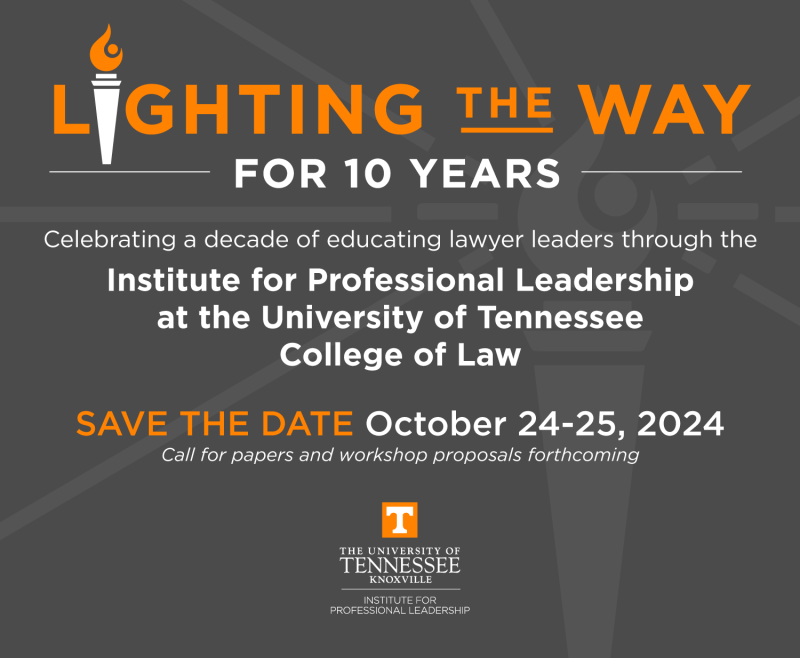
We are celebrating the tenth anniversary of the Institute for Professional Leadership this fall.  The celebration, which will take place on Thursday, October 24 and Friday, October 25, will include a gala dinner and a symposium featuring workshops, a call-for-papers panel, and a series of expert panels.  The “save the date” notice is included above.  I hope you will consider responding to the forthcoming call for proposals and papers.  But regardless, I hope you will consider attending. Feel free to reach out to me with any questions.

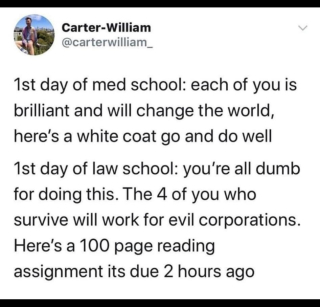
The meme below has been going around about the different framing for medical school and law school. I get why it is kind of amusing, but it is mostly rather upsetting because it resonates too readily with too many people.

IMG_4694

Although that has never been the institutional approach anywhere I have been, I will concede that there are at least some faculty members (and plenty members of the bench and bar) who think this way about law school and the legal profession. 

When I became a dean, I decided to do it, in part, because of how much I believe in the legal profession and what we are charged to do.  I believed, and I continue to believe, that lawyers are there to help people in what is often their worst of times.  Even when it is not bad, it is still usually a very significant time.  At the risk of being cliché, that means our jobs come with great power and responsibility. 

Despite what you may hear, our law students today are capable, smart, and caring.  They may not view the world the way we did, but we didn’t view the world the same as our predecessors, either.  There

If you happen to be in Miami or think it’s worth it to fly there next week, this is for you. I’ll be moderating the panel on regulatory considerations for promoters and influencers and we have student teams competing from all over the country. 

February 29 – March 1
University of Miami

Content is king. We live in the golden age where content creators, artists, and influencers wield power and can shift culture. Brands want to collaborate. Creators need to be sophisticated, understand deal points and protect their brand and intellectual property. Miami Law will be the first law school in the country to pull together law students with leading lawyers, influencers, artists, creatives and trendsetters for a negotiation competition and conference.  

Negotiation Competition – Thursday, February 29 

Where

Shalala Student Center, 1330 Miller Drive, Coral Gables, FL 33146

Who Should Participate

This competition is ideal for law and business students. THE. TEAMS ARE FINALIZED ALREADY.

What to Expect

Participants will have the chance to represent influencers, brands, artists, fashion companies and other creators in the first ever Counseling Creators: Influencers, Artists and Trendsetters Negotiation Competition

  • Register a team of law students (can include business school students)
    1. Team of

We just finished our second week of the semester and I’m already exhausted, partly because I just submitted the first draft of a law review article that’s 123 pages with over 600 footnotes on a future-proof framework for AI regulation to the University of Tennessee Journal of Business Law. I should have stuck with my original topic of legal ethics and AI.

But alas, who knew so much would happen in 2023? I certainly didn’t even though I spent the entire year speaking on AI to lawyers, businesspeople, and government officials. So, I decided to change my topic in late November as it became clearer that the EU would finally take action on the EU AI Act and that the Brussels effect would likely take hold requiring other governments and all the big players in the tech space to take notice and sharpen their own agendas.

But I’m one of the lucky ones because although I’m not a techie, I’m a former chief privacy officer, and spend a lot of time thinking about things like data protection and cybersecurity, especially as it relates to AI. And I recently assumed the role of GC of an AI startup. So

I’m a law professor, the general counsel of a medtech company, a podcaster, and I design and deliver courses on a variety of topics as a consultant. I think about and use generative AI daily and it’s really helped boost my productivity. Apparently, I’m unusual among lawyers. According to a Wolter’s Kluwers Future Ready Lawyer report that surveyed 700 legal professionals in the  US and EU, only 15% of lawyers are using generative AI right now but 73% expect to use it next year. 43% of those surveyed see it as an opportunity, 25% see it as a threat, and 26% see it as both.

If you’re planning to be part of the 73% and you practice in the US, here are some ethical implications with citations to select model rules. A few weeks ago, I posted here about business implications that you and your clients should consider.

  • How can you stay up-to-date with the latest advancements in AI technology and best practices, ensuring that you continue to adapt and evolve as a legal professional in an increasingly technology-driven world? Rule 1.1 (Competence)
  • How can AI tools be used effectively and ethically to enhance your practice, whether in legal research,

Greetings from SEALS, where I’ve just left a packed room of law professors grappling with some thorny issues related to ChatGPT4, Claude 2, Copilot, and other forms of generative AI. I don’t have answers to the questions below and some are well above my pay grade, but I am taking them into account as I prepare to teach courses in transactional skills; compliance, corporate governance, and sustainability; and ethics and technology this Fall.

In no particular order, here are some of the questions/points raised during the three-hour session. I’ll have more thoughts on using AI in the classroom in a future post.

  1. AI detectors that schools rely on have high false positives for nonnative speakers and neurodivergent students and they are easy to evade. How can you reliably ensure that students aren’t using AI tools such as ChatGPT if you’ve prohibited it?
  2. If we allow the use of AI in classrooms, how do we change how we assess students?
  3. If our goal is to teach the mastery of legal skills, what are the legal skills we should teach related to the use of AI? How will our students learn critical thinking skills if they can

Earlier tonight, I had the opportunity of a lifetime: a chance to–in some small way–let a teacher-mentor know how much she means to me and has meant to my career.  Specifically, I had the privilege of presenting an award to the amazing woman who taught me in the foundational law courses that I have needed most in my careers as a practitioner and an instructor.  That amazing woman is NYU’s Professor Helen Scott.  The award was a surprise, making things all the more fun.

I know some BLPB readers also are Helen’s former students.  Others are fans of hers for other reasons.  For all, I am copying in below the tribute I offered in conveying the award to Helen at the 2023 Impact Investment Legal Working Group & Grunin Center Annual Conference hosted at my alma mater, NYU Law.  Feel free to add your tributes in the comments.  I promise to pass them on.

*          *          *

Commitment; sustained commitment.

Sometimes, there is someone who impacts your life deeply by merely “being there” in important ways at key times. Helen Scott is one of those people in my life. I do

If you follow me on LinkedIn, you know that I posted almost every day in May for Mental Health Awareness Month.
 
Last week,  I had the opportunity to discuss mental health and well being for an AmLaw 20 firm (one of my coaching clients) that opened the presentation up to all of its legal professionals. Hundreds registered. Too often, firms or companies focus on those with the highest salaries. As a former paralegal, I know how stressful that job can be. And I know I could never have done my job as a lawyer without the talented legal professionals who supported me.

Here are some scary statistics that I shared from the most recent ALM Mental Health and Substance Abuse Survey.

If you’re a law firm leader or work with legal professionals in any capacity, please read the report and take action. If you can’t get rid of the billable hour (which would solve a lot of issues), think about how you allocate work, respond to unreasonable client demands, and reward toxic perfectionism and overwork. 

✅ 71% of the nearly 3,000 lawyers surveyed said they had anxiety

✅ 45% said their morale has not changed since the pandemic

✅ 38%

I’m excited to announce this new position. It’s particularly timely as just this morning, I had breakfast with venture capitalists, founders, and others in the tech ecosystem nurtured and propelled by the founders of Emerge Americas. This is a great time to be in Miami. Here are the details.

The University of Miami School of Law seeks to appoint an Inaugural Law & Technology Resident Fellow.  

This will be an exciting opportunity as the Fellow will join a vibrant community of scholars and practitioners working at the intersection of law and technology. Miami-Dade County and the surrounding Tech Hub is enjoying a dramatic expansion in technology-related startups and finance.  MiamiLaw has an established J.D. degree concentration in Business of Innovation, Law, and Technology (BILT). Faculty have set up numerous technology-related programs including Law Without Walls (LWOW) and the We Robot conference.

MiamiLaw currently offers courses in: AI and Robot Law; Blockchain Technology and Business Strategies; Digital Asset and Blockchain Regulation; Digital Transformation Services: Business & Legal Considerations; Dispute Resolution; Technology and The Digital Economy; E-Sports; Electronic Discovery; Genomic Medicine, Ethics and the Law; Intellectual Property in Digital Media; Introduction to Programming For Lawyers; NFTs: Legal and Business Considerations