If you follow me on LinkedIn, you know that I posted almost every day in May for Mental Health Awareness Month.
 
Last week,  I had the opportunity to discuss mental health and well being for an AmLaw 20 firm (one of my coaching clients) that opened the presentation up to all of its legal professionals. Hundreds registered. Too often, firms or companies focus on those with the highest salaries. As a former paralegal, I know how stressful that job can be. And I know I could never have done my job as a lawyer without the talented legal professionals who supported me.

Here are some scary statistics that I shared from the most recent ALM Mental Health and Substance Abuse Survey.

If you’re a law firm leader or work with legal professionals in any capacity, please read the report and take action. If you can’t get rid of the billable hour (which would solve a lot of issues), think about how you allocate work, respond to unreasonable client demands, and reward toxic perfectionism and overwork. 

✅ 71% of the nearly 3,000 lawyers surveyed said they had anxiety

✅ 45% said their morale has not changed since the pandemic

✅ 38%

I’m excited to announce this new position. It’s particularly timely as just this morning, I had breakfast with venture capitalists, founders, and others in the tech ecosystem nurtured and propelled by the founders of Emerge Americas. This is a great time to be in Miami. Here are the details.

The University of Miami School of Law seeks to appoint an Inaugural Law & Technology Resident Fellow.  

This will be an exciting opportunity as the Fellow will join a vibrant community of scholars and practitioners working at the intersection of law and technology. Miami-Dade County and the surrounding Tech Hub is enjoying a dramatic expansion in technology-related startups and finance.  MiamiLaw has an established J.D. degree concentration in Business of Innovation, Law, and Technology (BILT). Faculty have set up numerous technology-related programs including Law Without Walls (LWOW) and the We Robot conference.

MiamiLaw currently offers courses in: AI and Robot Law; Blockchain Technology and Business Strategies; Digital Asset and Blockchain Regulation; Digital Transformation Services: Business & Legal Considerations; Dispute Resolution; Technology and The Digital Economy; E-Sports; Electronic Discovery; Genomic Medicine, Ethics and the Law; Intellectual Property in Digital Media; Introduction to Programming For Lawyers; NFTs: Legal and Business Considerations

In 2021 and again in 2022, I blogged about Well-Being Week in Law.  The first week in May bears this title, offering a chance for all of us to focus on how to best ensure that those involved in legal service work can flourish in our work and in the rest of our lives.  As the website notes:

When our professional and organizational cultures support our well-being, we are better able to make good choices that allow us to thrive and be our best for our clients, colleagues, organizations, families, and communities. It is up to all of us to cultivate new professional norms and cultures that enable and encourage well-being.

I agree with all of that.  And as an instructor and researcher and public servant who dedicates significant time to lawyer leadership, I focus a lot of attention on the legal profession and developing the whole lawyer.  So, count me in as a fan.

But this year, I did not post on Well-Being Week in Law, which was last week.  I carry a small amount of guilt for that (and for not getting this post up yesterday, too, when I had originally planned to publish it), since

I am pleased to share with you that the inaugural Peter J. Henning Lecture at Wayne State University Law School will be held next Monday, April 3rd, at 6:00 pm.  The speaker is the Honorable Jed S. Rakoff (United States District Court for the Southern District of New York) who knew Peter and valued his work.  See the flyer below.  Come if you are able.

As readers may recall, Peter was a mentor and friend.  His work and my work in insider trading law and practice intersected.  I offered some comments on my relationship with him here on the BLPB shortly after his untimely passing last year.  I also shared some thoughts at the 2022 National Business Law Scholars Conference and wrote a short related tribute to Peter forthcoming in the Wayne Law Review.  I will be at the lecture on Monday. 

I know many of you also have been touched by Peter or his work.  He was a special man who made great contributions in many spheres.  Please note in the flyer below that financial support for the lecture series is being solicited.  I hope that some of you will take advantage of this opportunity to honor Peter

Friend-of-the-BLPB Walter Effross recently informed me of his blog, Keeping Your Own Counsel (subtitled “Simple Strategies and Secrets for Success in Law School”). The blog is a companion piece to Walter’s new book designed for pre-law and law students, also entitled Keeping Your Own Counsel. Walter let me know that one can check out the book’s table of contents, preface, and first two chapters through Amazon’s “Look inside” feature and that a summary of six of the book’s themes is in his most recent blog post.

He also noted that his February 25th blog post provides links to his conversations with leading in-house and outside counsel about the definition and goals of, career opportunities in, and ways to remain current on, the increasingly relevant practice of Environmental, Social, and Governance (ESG) law.  He specifically recommends one of those conversations–the one with Fox Rothschild LLP partner David Colvin–even to law students who are not specifically interested in ESG because it addresses practical ethical issues.  He indicated (and I agree) that the overall post may be of particular interest to our readers.  So many of us are focused on ESG and related regulation in our work at the moment .

I teach business law courses that involve planning and drafting in connection with business transactions. I know many of you do, too.  My question is, how do you teach your students to find drafting precedents (if that is part of your teaching) for transactional business law projects/tasks?  Do you advise students to use forms or to walk back provisions in fully negotiated agreements?

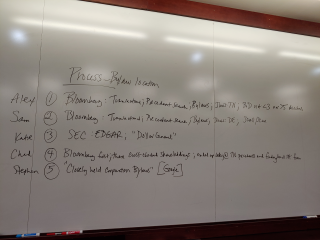
In our capstone 3L planning and drafting course at UT Law, Representing Enterprises, I let students take their own path in finding drafting precedents and ask them to report out their process to the class.   We talk through the pros and cons of their individual approaches, which I capture on the whiteboard.  My board notes from a recent class (during which we talked through how students located precedent bylaws for a closely held–preferably Tennessee–corporation) are included below.

RE(LocatingBylaws2023)

Although Bloomberg Law was a popular resource for students who shared their process in this particular class meeting, the Securities and Exchange Commission’s website and Google also got some love.  In the ensuing discussions, a student also mentioned Westlaw’s Practical Law as a resource, although that’s not reflected in this picture.

In other advanced business law planning/drafting courses, I

Warning: this post addresses suicide.

I was supposed to post yesterday about a different topic but I’m posting today and not next week because someone needs to read this today.

Maybe it’s you. Maybe it’s your “strong” friend or colleague.

I found out yesterday that I lost a former student to suicide. She lit up every room she walked into and inspired me, her classmates, and everyone she met. I had no idea she was living in such darkness. Lawyers, law students, compliance professionals, and others in high stress roles are conditioned to be on top of everything. We are the strong ones that clients and colleagues rely on. We worry so much about the stigma of not being completely in control at all times, that we don’t get help. We worry that clients won’t trust us with sensitive or important matters. We worry that we won’t pass the character and fitness assessments to get admitted to the bar. 

The CDC released a report this week showing an alarming rise in depression, suicidal thoughts, and anxiety among our youth. The report noted that:

  • Female students and LGBQ+ students are experiencing alarming rates of violence, poor mental health, and suicidal thoughts

An ambitious question, yes, but it was the title of the presentation I gave at the Society for Socio-Economists Annual Meeting, which closed yesterday. Thanks to Stefan Padfield for inviting me.

In addition to teaching Business Associations to 1Ls this semester and running our Transactional Skills program, I’m also teaching Business and Human Rights. I had originally planned the class for 25 students, but now have 60 students enrolled, which is a testament to the interest in the topic. My pre-course surveys show that the students fall into two distinct camps. Most are interested in corporate law but didn’t know even know there was a connection to human rights. The minority are human rights die hards who haven’t even taken business associations (and may only learn about it for bar prep), but are curious about the combination of the two topics. I fell in love with this relatively new legal  field twelve years ago and it’s my mission to ensure that future transactional lawyers have some exposure to it.

It’s not just a feel-good way of looking at the world. Whether you love or hate ESG, business and human rights shows up in every factor and many firms have built

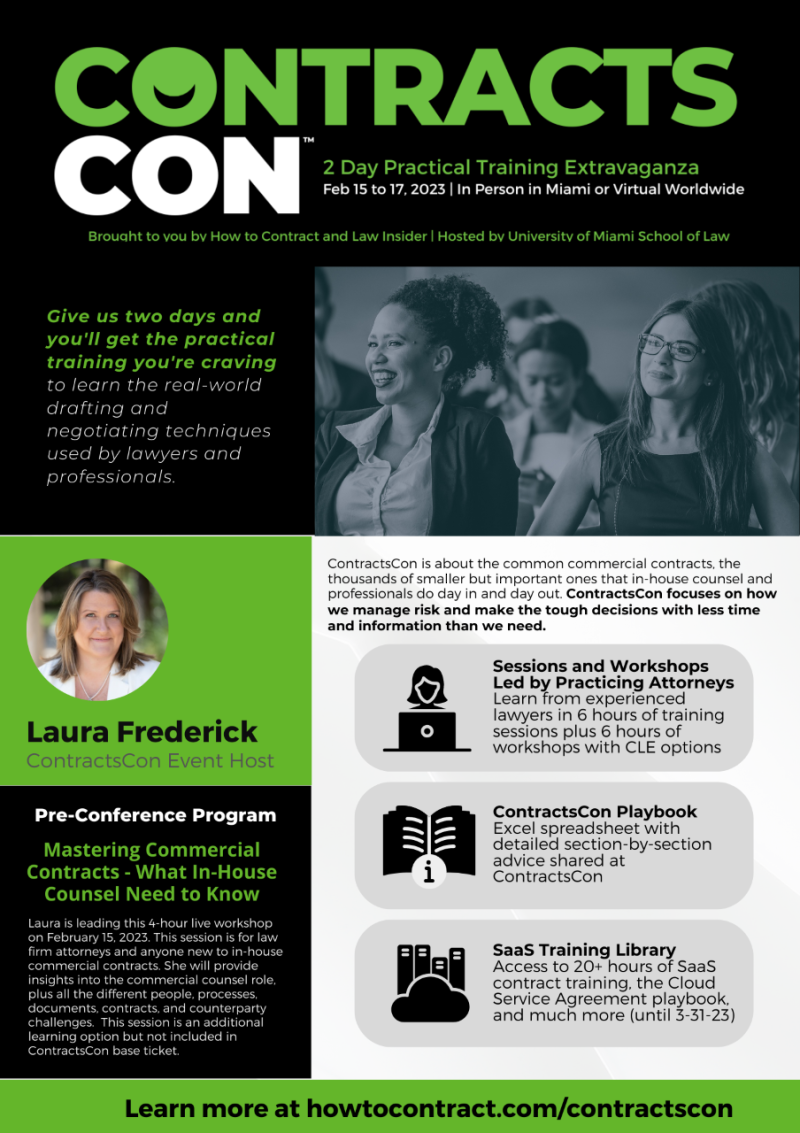
It’s the holidays and it’s time to treat yourself and members of your team to practical training and fantastic networking in sunny Miami in February. We don’t have bomb cyclones down here. The Transactional Skills Program at the University of Miami School of Law couldn’t be more excited to host the How to Contract Conference from February 15-17, 2023. 

Thumbnail_ContractsCon Flyer - 1 page (12-23-2022)

  • ContractsCon is a training and networking EXTRAVAGANZA focused on the practical contract drafting and negotiating skills that in-house counsel and contracts professionals need to know. 
  • This event is a zero-fluff, to-the-point training on the nitty-gritty details. ContractsCon includes:
    • speakers who get the in-house experience and can explain why we draft the way we do
    • training centered around provision-level playbooks for you and your company to use when you return to work
    • workshops that provide a deeper dive into more nuanced topics and include interactive group activities
    • ContractsCon Playbook, featuring the advice and drafting approaches discussed at ContractsCon
    • access to How to Contract’s SaaS Contracts Training Library, with 20+ hours of training videos, the Cloud Services Agreement Playbook, and lots more (through March 31, 2023)
    • CLE pending in 26 states for up to 7 hours for virtual ticket holders and up to 13 hours for in-person attendees
  • ContractsCon is an annual

I’m a huge football fan. I mean real football– what people in the US call soccer. I went to Brazil for the World Cup in 2014 twice and have watched as many matches on TV as I could during the last tournament and this one. In some countries, over half of the residents watch the matches when their team plays even though most matches happen during work hours or the middle of the night in some countries. NBC estimates that 5 billion people across the world will watch this World Cup with an average of 227 million people a day. For perspective, roughly 208 million people, 2/3 of the population, watched Superbowl LVI in the US, which occurs on a Sunday.

Football is big business for FIFA and for many of its sponsors. Working with companies such as Adidas, Coca-Cola, Hyundai / KIA, Visa, McDonald’s, and Budweiser has earned nonprofit FIFA a record 7.5 billion in revenue for this Cup. Fortunately for Budweiser, which paid 75 million to sponsor the World Cup, Qatar does not ban alcohol. But in a plot twist, the company had to deal with a last-minute stadium ban. FIFA was more effective in Brazil, which has