If you happen to be in Miami or think it’s worth it to fly there next week, this is for you. I’ll be moderating the panel on regulatory considerations for promoters and influencers and we have student teams competing from all over the country. 

February 29 – March 1
University of Miami

Content is king. We live in the golden age where content creators, artists, and influencers wield power and can shift culture. Brands want to collaborate. Creators need to be sophisticated, understand deal points and protect their brand and intellectual property. Miami Law will be the first law school in the country to pull together law students with leading lawyers, influencers, artists, creatives and trendsetters for a negotiation competition and conference.  

Negotiation Competition – Thursday, February 29 

Where

Shalala Student Center, 1330 Miller Drive, Coral Gables, FL 33146

Who Should Participate

This competition is ideal for law and business students. THE. TEAMS ARE FINALIZED ALREADY.

What to Expect

Participants will have the chance to represent influencers, brands, artists, fashion companies and other creators in the first ever Counseling Creators: Influencers, Artists and Trendsetters Negotiation Competition

  • Register a team of law students (can include business school students)
    1. Team of

We just finished our second week of the semester and I’m already exhausted, partly because I just submitted the first draft of a law review article that’s 123 pages with over 600 footnotes on a future-proof framework for AI regulation to the University of Tennessee Journal of Business Law. I should have stuck with my original topic of legal ethics and AI.

But alas, who knew so much would happen in 2023? I certainly didn’t even though I spent the entire year speaking on AI to lawyers, businesspeople, and government officials. So, I decided to change my topic in late November as it became clearer that the EU would finally take action on the EU AI Act and that the Brussels effect would likely take hold requiring other governments and all the big players in the tech space to take notice and sharpen their own agendas.

But I’m one of the lucky ones because although I’m not a techie, I’m a former chief privacy officer, and spend a lot of time thinking about things like data protection and cybersecurity, especially as it relates to AI. And I recently assumed the role of GC of an AI startup. So

Whatever your life’s work is, do it well. 
-Martin Luther King Jr., “Facing the Challenge of a New Age,” Dec. 3 1956, Montgomery, Alabama

These words from Dr. King have meaning for me today and every day.  Many lawyers and law professors are strivers, and I count myself among them.  We understand the burdens and joys of our roles and pursue them with vigor.  Having recently stepped back from an interim administrative role at UT Law, I feel more free to refocus on my instructional mission.

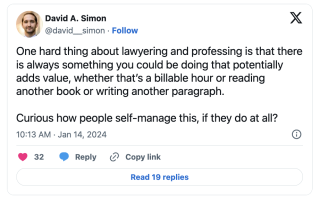
A tweet from a law prof colleague over the weekend asks a question that resonates.

Screen Shot 2024-01-15 at 12.11.00 PMI just love this observation and the related question! I am not on social media as much as I used to be, but when I am, I often am rewarded by tidbits like this.  Thank you, David, for commenting and asking.

I did reply.  FWIW, my reply was “For me, it’s about setting limits and persevering. There’s always more one can do. But we need sleep and time away to be most effective. And so we must sleep and save things for another day!”  Other replies offered similar and other personal wisdom.

Our roles as law

I was honored to be invited recently to write a column for our local bar magazine, DICTA, entitled “Privileged to Be a Lawyer.”   My contribution, Joy in Lawyering, can be found here.  It took no time at all to write this short piece.  The words came straight from my heart through my fingers to the keyboard.  The punchline (for those who don’t care to read the entire column): “Truly, I know of few career choices that could have given me so much.”  I can only hope that many of you feel the same way.

I’m a law professor, the general counsel of a medtech company, a podcaster, and I design and deliver courses on a variety of topics as a consultant. I think about and use generative AI daily and it’s really helped boost my productivity. Apparently, I’m unusual among lawyers. According to a Wolter’s Kluwers Future Ready Lawyer report that surveyed 700 legal professionals in the  US and EU, only 15% of lawyers are using generative AI right now but 73% expect to use it next year. 43% of those surveyed see it as an opportunity, 25% see it as a threat, and 26% see it as both.

If you’re planning to be part of the 73% and you practice in the US, here are some ethical implications with citations to select model rules. A few weeks ago, I posted here about business implications that you and your clients should consider.

  • How can you stay up-to-date with the latest advancements in AI technology and best practices, ensuring that you continue to adapt and evolve as a legal professional in an increasingly technology-driven world? Rule 1.1 (Competence)
  • How can AI tools be used effectively and ethically to enhance your practice, whether in legal research,

Last week I had the pleasure of joining my fellow bloggers at the UT Connecting the Threads Conference on the legal issues related to generative AI (GAI) that lawyers need to understand for their clients and their own law practice. Here are some of the questions I posed to the audience and some recommendations for clients. I’ll write about ethical issues for lawyers in a separate post. In the meantime, if you’re using OpenAI or any other GAI, I strongly recommend that you read the terms of use. You may be surprised by certain clauses, including the indemnification provisions. 

I started by asking the audience members to consider what legal areas are most affected by GAI? Although there are many, I’ll focus on data privacy and employment law in this post.

Data Privacy and Cybersecurity

Are the AI tools and technologies you use compliant with relevant data protection and privacy regulations, such as GDPR and CCPA? Are they leaving you open to a cyberattack?

This topic also came up today at a conference at NCCU when I served as a panelist on cybersecurity preparedness for lawyers.

Why is this important?

ChatGPT was banned in Italy for a time

BLPB(labor-day-messages-email-headers-6)

I am the daughter of two Depression Era babies.  My parents always appreciated what they had and worked hard to earn it.  And they were aware of and respected those who contributed their time and efforts to bring them products and services.

On Labor Day, it seems appropriate to channel my parents’ gratitude and share it here.  Too often, I take for granted that so much in my life comes from or relies on the labors of others.  I welcome the opportunity today to remember and give thanks.

Parenthetically, I have learned over time (through leadership training and mindfulness activities) that gratitude is an amazingly powerful character strength for lawyers.   As explained on the Via Institute on Character’s website

The character strength of gratitude involves feeling and expressing a deep sense of thankfulness in life, and more specifically, taking the time to genuinely express thankfulness to others. This thankfulness can be for specific gifts or thoughtful acts. . . .Gratitude tends to foster the character strengths of kindness and love, and therefore is closely associated with empathy and with connection to others.

I am certain you can see from this excerpted description why gratitude can be a great asset

Greetings from SEALS, where I’ve just left a packed room of law professors grappling with some thorny issues related to ChatGPT4, Claude 2, Copilot, and other forms of generative AI. I don’t have answers to the questions below and some are well above my pay grade, but I am taking them into account as I prepare to teach courses in transactional skills; compliance, corporate governance, and sustainability; and ethics and technology this Fall.

In no particular order, here are some of the questions/points raised during the three-hour session. I’ll have more thoughts on using AI in the classroom in a future post.

  1. AI detectors that schools rely on have high false positives for nonnative speakers and neurodivergent students and they are easy to evade. How can you reliably ensure that students aren’t using AI tools such as ChatGPT if you’ve prohibited it?
  2. If we allow the use of AI in classrooms, how do we change how we assess students?
  3. If our goal is to teach the mastery of legal skills, what are the legal skills we should teach related to the use of AI? How will our students learn critical thinking skills if they can

Depending on who you talk to, you get some pretty extreme perspectives on generative AI. In a former life, I used to have oversight of the lobbying and PAC money for a multinational company. As we all know, companies never ask to be regulated. So when an industry begs for regulation, you know something is up. 

Two weeks ago, I presented the keynote speech to the alumni of AESE, Portugal’s oldest business school, on the topic of my research on business, human rights, and technology with a special focus on AI. If you’re attending Connecting the Threads in October, you’ll hear some of what I discussed.

I may have overprepared, but given the C-Suite audience, that’s better than the alternative. For me that meant spending almost 100 hours  reading books, articles, white papers, and watching videos by data scientists, lawyers, ethicists, government officials, CEOs, and software engineers. 

Because I wanted the audience to really think about their role in our future, I spent quite a bit of time on the doom and gloom scenarios, which the Portuguese press highlighted. I cited the talk by the creators of the Social Dilemma, who warned about the dangers of social

The University of Tennessee College of Law’s business law journal, Transactions: The Tennessee Journal of Business Law, recently published my essay, “The Fiduciary-ness of Business Associations.”  You can find the essay here.  This essay–or parts of it, anyway–has been rattling around in my brain for a bit.   It is nice on a project like this to be able to get the words out on a page and release all that tension building up inside as you fashion your approach.

The abstract for the essay is included below. 

This essay offers a window and perspective on recent fiduciary-related legislative developments in business entity law and identifies and reflects in limited part on related professional responsibility questions impacting lawyers advising business entities and their equity owners. In addition—and perhaps more pointedly—the essay offers commentary on legal change and the legislative process for state law business associations amendments in and outside the realm of fiduciary duties. To accomplish these purposes, the essay first provides a short description of the position of fiduciary duties in U.S. statutory business entity law and offers a brief account of 21st century business entity legislation that weakens the historically central role of fiduciary duties in unincorporated