If you follow me on LinkedIn, you know that I posted almost every day in May for Mental Health Awareness Month.
 
Last week,  I had the opportunity to discuss mental health and well being for an AmLaw 20 firm (one of my coaching clients) that opened the presentation up to all of its legal professionals. Hundreds registered. Too often, firms or companies focus on those with the highest salaries. As a former paralegal, I know how stressful that job can be. And I know I could never have done my job as a lawyer without the talented legal professionals who supported me.

Here are some scary statistics that I shared from the most recent ALM Mental Health and Substance Abuse Survey.

If you’re a law firm leader or work with legal professionals in any capacity, please read the report and take action. If you can’t get rid of the billable hour (which would solve a lot of issues), think about how you allocate work, respond to unreasonable client demands, and reward toxic perfectionism and overwork. 

✅ 71% of the nearly 3,000 lawyers surveyed said they had anxiety

✅ 45% said their morale has not changed since the pandemic

✅ 38%

I’m excited to announce this new position. It’s particularly timely as just this morning, I had breakfast with venture capitalists, founders, and others in the tech ecosystem nurtured and propelled by the founders of Emerge Americas. This is a great time to be in Miami. Here are the details.

The University of Miami School of Law seeks to appoint an Inaugural Law & Technology Resident Fellow.  

This will be an exciting opportunity as the Fellow will join a vibrant community of scholars and practitioners working at the intersection of law and technology. Miami-Dade County and the surrounding Tech Hub is enjoying a dramatic expansion in technology-related startups and finance.  MiamiLaw has an established J.D. degree concentration in Business of Innovation, Law, and Technology (BILT). Faculty have set up numerous technology-related programs including Law Without Walls (LWOW) and the We Robot conference.

MiamiLaw currently offers courses in: AI and Robot Law; Blockchain Technology and Business Strategies; Digital Asset and Blockchain Regulation; Digital Transformation Services: Business & Legal Considerations; Dispute Resolution; Technology and The Digital Economy; E-Sports; Electronic Discovery; Genomic Medicine, Ethics and the Law; Intellectual Property in Digital Media; Introduction to Programming For Lawyers; NFTs: Legal and Business Considerations

In 2021 and again in 2022, I blogged about Well-Being Week in Law.  The first week in May bears this title, offering a chance for all of us to focus on how to best ensure that those involved in legal service work can flourish in our work and in the rest of our lives.  As the website notes:

When our professional and organizational cultures support our well-being, we are better able to make good choices that allow us to thrive and be our best for our clients, colleagues, organizations, families, and communities. It is up to all of us to cultivate new professional norms and cultures that enable and encourage well-being.

I agree with all of that.  And as an instructor and researcher and public servant who dedicates significant time to lawyer leadership, I focus a lot of attention on the legal profession and developing the whole lawyer.  So, count me in as a fan.

But this year, I did not post on Well-Being Week in Law, which was last week.  I carry a small amount of guilt for that (and for not getting this post up yesterday, too, when I had originally planned to publish it), since

A few months ago, I asked whether people in the tech industry were the most powerful people in the world. This is part II of that post.

I posed that question after speaking at a tech conference in Lisbon sponsored by Microsoft. They asked me to touch on business and human rights and I presented the day after the company announced a ten billion dollar investment in OpenAI, the creator of ChatGPT. Back then, we were amazed at what ChatGPT 3.5 could do. Members of the audience were excited and terrified- and these were tech people. 

And that was before the explosion of ChatGPT4. 

I’ve since made a similar presentation about AI, surveillance, social media companies to law students, engineering students, and business people. In the last few weeks, over 10,000 people including Elon Musk, have called for a 6-month pause in AI training systems. If you don’t trust Musk’s judgment (and the other scientists and futurists), trust the “Godfather of AI,” who recently quit Google so he could speak out on the dangers, even though Google has put out its own whitepaper on AI development. Watch the 60 Minutes interview with the CEO of

A great joy in my law practice over the years has been to work on a pro bono basis with creative and social enterprises.  For the 2021 Business Law Prof Blog symposium, Connecting the Threads, I offered some wisdom from my work with creatives in legally organizing and funding their projects.  I wrote briefly about that presentation here.

I recently posted the article that I presented back then, Choice of Entity: The Fiscal Sponsorship Alternative to Nonprofit Incorporation, 23 Transactions: Tenn. J. Bus. L. 526 (2022), on SSRN.  The associated abstract follows.

For many small business ventures that qualify for federal income tax treatment under Section 501(a) of the U.S. Internal Revenue Code of 1986, as amended, the time and expense of organizing, qualifying, managing, and maintaining a tax-exempt nonprofit corporation under state law may be daunting (or even prohibitive). Moreover, the formal legal structures imposed by business entity law may not be needed or wanted by the founders or promoters of the venture. Yet, there may be distinct advantages to entity formation and federal tax qualification that are not available (or not as easily available) to unincorporated not-for-profit business projects. These advantages may include, for example, exculpation

Warning: this post addresses suicide.

I was supposed to post yesterday about a different topic but I’m posting today and not next week because someone needs to read this today.

Maybe it’s you. Maybe it’s your “strong” friend or colleague.

I found out yesterday that I lost a former student to suicide. She lit up every room she walked into and inspired me, her classmates, and everyone she met. I had no idea she was living in such darkness. Lawyers, law students, compliance professionals, and others in high stress roles are conditioned to be on top of everything. We are the strong ones that clients and colleagues rely on. We worry so much about the stigma of not being completely in control at all times, that we don’t get help. We worry that clients won’t trust us with sensitive or important matters. We worry that we won’t pass the character and fitness assessments to get admitted to the bar. 

The CDC released a report this week showing an alarming rise in depression, suicidal thoughts, and anxiety among our youth. The report noted that:

  • Female students and LGBQ+ students are experiencing alarming rates of violence, poor mental health, and suicidal thoughts

My mind is still reeling from my trip to Lisbon last week to keynote at the Building The Future tech conference sponsored by Microsoft.

My premise was that those in the tech industry are arguably the most powerful people in the world and with great power comes great responsibility and a duty to protect human rights (which is not the global state of the law).

I challenged the audience to consider the financial price of implementing human rights by design and the societal cost of doing business as usual.

In 20 minutes, I covered  AI bias and new EU regulations; the benefits and dangers of ChatGPT; the surveillance economy; the UNGPs and UN Global Compact; a new suit by Seattle’s school board against social media companies alleging harmful mental health impacts on students; potential corporate complicity with rogue governments; the upcoming Supreme Court case on Section 230 and content moderator responsibility for “radicalizing” users; and made recommendations for the governmental, business, civil society, and consumer members in the audience.

Thank goodness I talk quickly.

Here are some non-substantive observations and lessons. In a future post, I’ll go in more depth about my substantive remarks. 

1. Your network

An ambitious question, yes, but it was the title of the presentation I gave at the Society for Socio-Economists Annual Meeting, which closed yesterday. Thanks to Stefan Padfield for inviting me.

In addition to teaching Business Associations to 1Ls this semester and running our Transactional Skills program, I’m also teaching Business and Human Rights. I had originally planned the class for 25 students, but now have 60 students enrolled, which is a testament to the interest in the topic. My pre-course surveys show that the students fall into two distinct camps. Most are interested in corporate law but didn’t know even know there was a connection to human rights. The minority are human rights die hards who haven’t even taken business associations (and may only learn about it for bar prep), but are curious about the combination of the two topics. I fell in love with this relatively new legal  field twelve years ago and it’s my mission to ensure that future transactional lawyers have some exposure to it.

It’s not just a feel-good way of looking at the world. Whether you love or hate ESG, business and human rights shows up in every factor and many firms have built

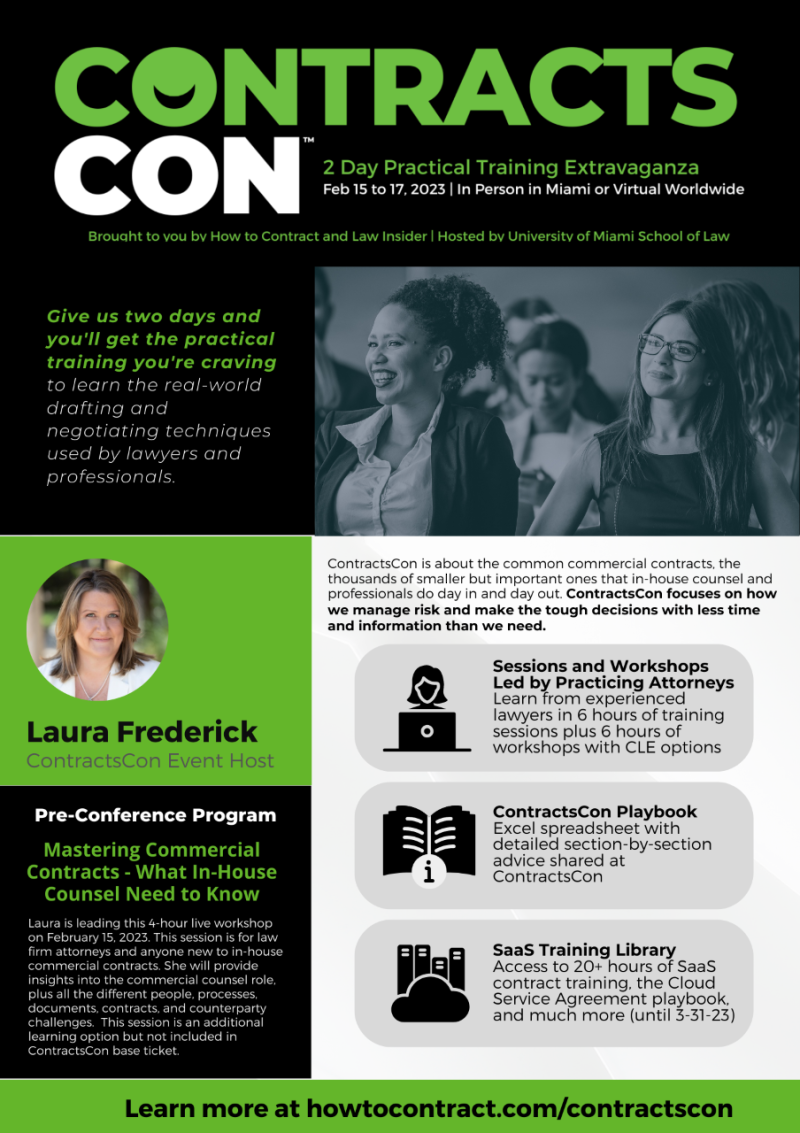
It’s the holidays and it’s time to treat yourself and members of your team to practical training and fantastic networking in sunny Miami in February. We don’t have bomb cyclones down here. The Transactional Skills Program at the University of Miami School of Law couldn’t be more excited to host the How to Contract Conference from February 15-17, 2023. 

Thumbnail_ContractsCon Flyer - 1 page (12-23-2022)

  • ContractsCon is a training and networking EXTRAVAGANZA focused on the practical contract drafting and negotiating skills that in-house counsel and contracts professionals need to know. 
  • This event is a zero-fluff, to-the-point training on the nitty-gritty details. ContractsCon includes:
    • speakers who get the in-house experience and can explain why we draft the way we do
    • training centered around provision-level playbooks for you and your company to use when you return to work
    • workshops that provide a deeper dive into more nuanced topics and include interactive group activities
    • ContractsCon Playbook, featuring the advice and drafting approaches discussed at ContractsCon
    • access to How to Contract’s SaaS Contracts Training Library, with 20+ hours of training videos, the Cloud Services Agreement Playbook, and lots more (through March 31, 2023)
    • CLE pending in 26 states for up to 7 hours for virtual ticket holders and up to 13 hours for in-person attendees
  • ContractsCon is an annual

My classroom teaching for the semester is over.  I am in “grading mode”–not my favorite way of being.  But final assessments must be completed!  (Wishing you well in completing yours.)

Before I left the classroom, however–specifically, in the last class meeting for my corporate finance students–I did have some fun.  I saved my last class session in the course to address what my students wanted me to cover.  I asked for the topics in advance.  They covered a range of corporate finance topics, from litigation issues (Theranos, FTX, and current hot legal claims) through common mistakes to avoid in a corporate finance practice to survival tips for first-year law firm associates.  Weaving all of that together in a 75-minute class period was a tall task.

My ultimate vehicle was to come up with a list of maxims–short-form guidance statements–that would allow me to address all of what my students had asked me to cover.  I came into class with just a few maxims to get us started and cover the basics.  But the conversation was very engaged and got rich relatively quickly.  As we riffed off each other’s questions and comments, my little list grew to a robust thirteen maxims!