If you follow me on LinkedIn, you know that I posted almost every day in May for Mental Health Awareness Month.
 
Last week,  I had the opportunity to discuss mental health and well being for an AmLaw 20 firm (one of my coaching clients) that opened the presentation up to all of its legal professionals. Hundreds registered. Too often, firms or companies focus on those with the highest salaries. As a former paralegal, I know how stressful that job can be. And I know I could never have done my job as a lawyer without the talented legal professionals who supported me.

Here are some scary statistics that I shared from the most recent ALM Mental Health and Substance Abuse Survey.

If you’re a law firm leader or work with legal professionals in any capacity, please read the report and take action. If you can’t get rid of the billable hour (which would solve a lot of issues), think about how you allocate work, respond to unreasonable client demands, and reward toxic perfectionism and overwork. 

✅ 71% of the nearly 3,000 lawyers surveyed said they had anxiety

✅ 45% said their morale has not changed since the pandemic

✅ 38%

A few months ago, I asked whether people in the tech industry were the most powerful people in the world. This is part II of that post.

I posed that question after speaking at a tech conference in Lisbon sponsored by Microsoft. They asked me to touch on business and human rights and I presented the day after the company announced a ten billion dollar investment in OpenAI, the creator of ChatGPT. Back then, we were amazed at what ChatGPT 3.5 could do. Members of the audience were excited and terrified- and these were tech people. 

And that was before the explosion of ChatGPT4. 

I’ve since made a similar presentation about AI, surveillance, social media companies to law students, engineering students, and business people. In the last few weeks, over 10,000 people including Elon Musk, have called for a 6-month pause in AI training systems. If you don’t trust Musk’s judgment (and the other scientists and futurists), trust the “Godfather of AI,” who recently quit Google so he could speak out on the dangers, even though Google has put out its own whitepaper on AI development. Watch the 60 Minutes interview with the CEO of

This just in from friend-of-the-BLPB Christina Sautter:

The Louisiana State University Paul M. Hebert Law Center seeks visiting or adjunct professors for the 2023-2024 academic year to teach Business Associations I (fall and spring) and Business Associations II (spring).  Additional courses, such as Mergers & Acquisitions or Securities Regulation will also be considered. Interested individuals should email Pamela Hancock at phancock@lsu.edu for more information, as well as to obtain a link and instructions for uploading a CV and cover letter.

LSU is committed to providing equal opportunity for all qualified persons in admission to, participation in, or employment in the programs and activities which the University operates without regard to race, creed, color, marital status, sexual orientation, gender identity, gender expression, religion, sex, national origin, age, mental or physical disability, or veteran’s status. LSU is committed to diversity and is an equal opportunity/ equal access employer. LSU believes diversity, equity, and inclusion enrich the educational experience of our students, faculty, and staff, and are necessary to prepare all people to thrive personally and professionally in a global society.

I teach business law courses that involve planning and drafting in connection with business transactions. I know many of you do, too.  My question is, how do you teach your students to find drafting precedents (if that is part of your teaching) for transactional business law projects/tasks?  Do you advise students to use forms or to walk back provisions in fully negotiated agreements?

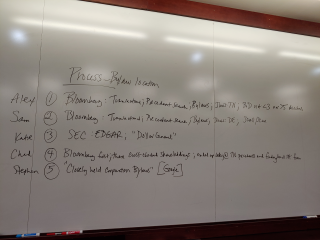
In our capstone 3L planning and drafting course at UT Law, Representing Enterprises, I let students take their own path in finding drafting precedents and ask them to report out their process to the class.   We talk through the pros and cons of their individual approaches, which I capture on the whiteboard.  My board notes from a recent class (during which we talked through how students located precedent bylaws for a closely held–preferably Tennessee–corporation) are included below.

RE(LocatingBylaws2023)

Although Bloomberg Law was a popular resource for students who shared their process in this particular class meeting, the Securities and Exchange Commission’s website and Google also got some love.  In the ensuing discussions, a student also mentioned Westlaw’s Practical Law as a resource, although that’s not reflected in this picture.

In other advanced business law planning/drafting courses, I

Health Sciences at Belmont University | Professional Graduate &  Undergraduate Degree Programs

Belmont University (my employer) is seeking an Assistant Professor and Program Director of Legal Studies.

This professor will sit across campus from me, in our College of Liberal Arts and Social Sciences (“CLASS”), but I will likely interact with them because my Business Law 1 and 2 classes feature in the legal studies major, in addition to the business majors on campus. Happy to discuss Belmont University with anyone who may be interested. 

You can apply for the position (by March 15) here.  

Warning: this post addresses suicide.

I was supposed to post yesterday about a different topic but I’m posting today and not next week because someone needs to read this today.

Maybe it’s you. Maybe it’s your “strong” friend or colleague.

I found out yesterday that I lost a former student to suicide. She lit up every room she walked into and inspired me, her classmates, and everyone she met. I had no idea she was living in such darkness. Lawyers, law students, compliance professionals, and others in high stress roles are conditioned to be on top of everything. We are the strong ones that clients and colleagues rely on. We worry so much about the stigma of not being completely in control at all times, that we don’t get help. We worry that clients won’t trust us with sensitive or important matters. We worry that we won’t pass the character and fitness assessments to get admitted to the bar. 

The CDC released a report this week showing an alarming rise in depression, suicidal thoughts, and anxiety among our youth. The report noted that:

  • Female students and LGBQ+ students are experiencing alarming rates of violence, poor mental health, and suicidal thoughts

As some of you may have heard, following on the success of the Yada Yada Law School, administered by friend-of-the-BLPB Greg Shill, a group of law faculty are getting together to teach classes in the waystar/ROYCO School of Law this semester.  Classes start this week.  Class meetings will be held weekly, on prescribed days, at 6pm-7pm Pacific/8pm-9pm Central/9pm-10pm Eastern.  The first two sessions are as follows:

Tuesday, January 24:
Professor Diane Kemker
Introduction: Using “Succession” (And Scripted Entertainment) to Teach Law: How and Why
[Assignment: Required: any/all of “Succession,” Seasons 1-3; Optional/recommended: any/all of “Yellowstone,” Seasons 1-5]

Wednesday, February 1:
Professor Megan McDermott
Greg Needs a Lawyer. Is He Getting an Ethical One?
[Assignment: Season 3, Ep. 2]

I will be presenting on February 16 on What the Roys Should Learn from the Demoulas Family (But Probably Won’t), a lesson on corporate law fiduciary duties.

General information is provided in the syllabus included below.  A full schedule of class sessions will be available soon.  I will publish that, too.  I hope many of you will plan on attending.

++++++++++++

WaystarROYCOlogo

SYLLABUS
“Succession and the Law”
Spring 2023

About the course

This is a completely unofficial course for lawyers

An ambitious question, yes, but it was the title of the presentation I gave at the Society for Socio-Economists Annual Meeting, which closed yesterday. Thanks to Stefan Padfield for inviting me.

In addition to teaching Business Associations to 1Ls this semester and running our Transactional Skills program, I’m also teaching Business and Human Rights. I had originally planned the class for 25 students, but now have 60 students enrolled, which is a testament to the interest in the topic. My pre-course surveys show that the students fall into two distinct camps. Most are interested in corporate law but didn’t know even know there was a connection to human rights. The minority are human rights die hards who haven’t even taken business associations (and may only learn about it for bar prep), but are curious about the combination of the two topics. I fell in love with this relatively new legal  field twelve years ago and it’s my mission to ensure that future transactional lawyers have some exposure to it.

It’s not just a feel-good way of looking at the world. Whether you love or hate ESG, business and human rights shows up in every factor and many firms have built

BLPB(XmasCookies2)

As a law professor, I find December a very confusing month.  On the one hand, exams are given and papers are in, and grading them and determining course grades loom large.   These activities consume inordinate amounts of time and are stressful, adding to the stress of holiday preparations (a real thing some of us do not acknowledge).  And then there always is the need to work in medical appointments that did not make it into one’s schedule during the fall semester.  The negative energy can be overwhelming.

Yet, on the other hand, class preparation is done.  Scheduling things gets a bit easier since class meetings are no longer happening.  The many hours of grading even have some bright moments–moments in which you are confident someone really “gets it” (whatever “it” is)  There is some joy in the gift-buying and wrapping, menu-planning and cooking, and certainly in gift-giving.  And there is gratitude that those medical appointments are finally happening, and that any necessary follow-ups can be organized and implemented.

The little happy surprises are, however, the best–like the wonderful homemade gingerbread pictured above, a gift from a young woman I met almost four years ago because of a talk I

My classroom teaching for the semester is over.  I am in “grading mode”–not my favorite way of being.  But final assessments must be completed!  (Wishing you well in completing yours.)

Before I left the classroom, however–specifically, in the last class meeting for my corporate finance students–I did have some fun.  I saved my last class session in the course to address what my students wanted me to cover.  I asked for the topics in advance.  They covered a range of corporate finance topics, from litigation issues (Theranos, FTX, and current hot legal claims) through common mistakes to avoid in a corporate finance practice to survival tips for first-year law firm associates.  Weaving all of that together in a 75-minute class period was a tall task.

My ultimate vehicle was to come up with a list of maxims–short-form guidance statements–that would allow me to address all of what my students had asked me to cover.  I came into class with just a few maxims to get us started and cover the basics.  But the conversation was very engaged and got rich relatively quickly.  As we riffed off each other’s questions and comments, my little list grew to a robust thirteen maxims!