Greetings from SEALS, where I’ve just left a packed room of law professors grappling with some thorny issues related to ChatGPT4, Claude 2, Copilot, and other forms of generative AI. I don’t have answers to the questions below and some are well above my pay grade, but I am taking them into account as I prepare to teach courses in transactional skills; compliance, corporate governance, and sustainability; and ethics and technology this Fall.

In no particular order, here are some of the questions/points raised during the three-hour session. I’ll have more thoughts on using AI in the classroom in a future post.

  1. AI detectors that schools rely on have high false positives for nonnative speakers and neurodivergent students and they are easy to evade. How can you reliably ensure that students aren’t using AI tools such as ChatGPT if you’ve prohibited it?
  2. If we allow the use of AI in classrooms, how do we change how we assess students?
  3. If our goal is to teach the mastery of legal skills, what are the legal skills we should teach related to the use of AI? How will our students learn critical thinking skills if they can

Depending on who you talk to, you get some pretty extreme perspectives on generative AI. In a former life, I used to have oversight of the lobbying and PAC money for a multinational company. As we all know, companies never ask to be regulated. So when an industry begs for regulation, you know something is up. 

Two weeks ago, I presented the keynote speech to the alumni of AESE, Portugal’s oldest business school, on the topic of my research on business, human rights, and technology with a special focus on AI. If you’re attending Connecting the Threads in October, you’ll hear some of what I discussed.

I may have overprepared, but given the C-Suite audience, that’s better than the alternative. For me that meant spending almost 100 hours  reading books, articles, white papers, and watching videos by data scientists, lawyers, ethicists, government officials, CEOs, and software engineers. 

Because I wanted the audience to really think about their role in our future, I spent quite a bit of time on the doom and gloom scenarios, which the Portuguese press highlighted. I cited the talk by the creators of the Social Dilemma, who warned about the dangers of social

I’m excited to announce this new position. It’s particularly timely as just this morning, I had breakfast with venture capitalists, founders, and others in the tech ecosystem nurtured and propelled by the founders of Emerge Americas. This is a great time to be in Miami. Here are the details.

The University of Miami School of Law seeks to appoint an Inaugural Law & Technology Resident Fellow.  

This will be an exciting opportunity as the Fellow will join a vibrant community of scholars and practitioners working at the intersection of law and technology. Miami-Dade County and the surrounding Tech Hub is enjoying a dramatic expansion in technology-related startups and finance.  MiamiLaw has an established J.D. degree concentration in Business of Innovation, Law, and Technology (BILT). Faculty have set up numerous technology-related programs including Law Without Walls (LWOW) and the We Robot conference.

MiamiLaw currently offers courses in: AI and Robot Law; Blockchain Technology and Business Strategies; Digital Asset and Blockchain Regulation; Digital Transformation Services: Business & Legal Considerations; Dispute Resolution; Technology and The Digital Economy; E-Sports; Electronic Discovery; Genomic Medicine, Ethics and the Law; Intellectual Property in Digital Media; Introduction to Programming For Lawyers; NFTs: Legal and Business Considerations

A few months ago, I asked whether people in the tech industry were the most powerful people in the world. This is part II of that post.

I posed that question after speaking at a tech conference in Lisbon sponsored by Microsoft. They asked me to touch on business and human rights and I presented the day after the company announced a ten billion dollar investment in OpenAI, the creator of ChatGPT. Back then, we were amazed at what ChatGPT 3.5 could do. Members of the audience were excited and terrified- and these were tech people. 

And that was before the explosion of ChatGPT4. 

I’ve since made a similar presentation about AI, surveillance, social media companies to law students, engineering students, and business people. In the last few weeks, over 10,000 people including Elon Musk, have called for a 6-month pause in AI training systems. If you don’t trust Musk’s judgment (and the other scientists and futurists), trust the “Godfather of AI,” who recently quit Google so he could speak out on the dangers, even though Google has put out its own whitepaper on AI development. Watch the 60 Minutes interview with the CEO of

This week, I read Professor Ganesh Sitaraman’s fascinating article, Deplatforming (forthcoming, Yale Law Journal).  As he states in the introduction, “Deplatforming has also not been limited to individuals and content on social media.”  My research isn’t focused on tech platforms or social media.  However, it does encompass banking, financial market infrastructures, and other evolving financial market platforms where this issue either has arisen or might arise in the future.  I’m grateful that this article will help me in thinking about such questions.  Here’s the abstract:

Deplatforming in the tech sector is hotly debated, and at times, it might even seem unprecedented. In recent years, scholars, commentators, jurists, and lawmakers have focused on the possibility of treating social media platforms as common carriers or public utilities, with the implication that imposing a duty to serve the public would restrict them from deplatforming individuals and content.

But in American law, the duty to serve all comers was never absolute. In fact, the question of whether and how to deplatform—to exclude content, individuals, or businesses from critical services—has been utterly common and regularly debated throughout American history. In the common law and the major infrastructural and utility sectors—transportation, communications, energy, and banking—American

An ambitious question, yes, but it was the title of the presentation I gave at the Society for Socio-Economists Annual Meeting, which closed yesterday. Thanks to Stefan Padfield for inviting me.

In addition to teaching Business Associations to 1Ls this semester and running our Transactional Skills program, I’m also teaching Business and Human Rights. I had originally planned the class for 25 students, but now have 60 students enrolled, which is a testament to the interest in the topic. My pre-course surveys show that the students fall into two distinct camps. Most are interested in corporate law but didn’t know even know there was a connection to human rights. The minority are human rights die hards who haven’t even taken business associations (and may only learn about it for bar prep), but are curious about the combination of the two topics. I fell in love with this relatively new legal  field twelve years ago and it’s my mission to ensure that future transactional lawyers have some exposure to it.

It’s not just a feel-good way of looking at the world. Whether you love or hate ESG, business and human rights shows up in every factor and many firms have built

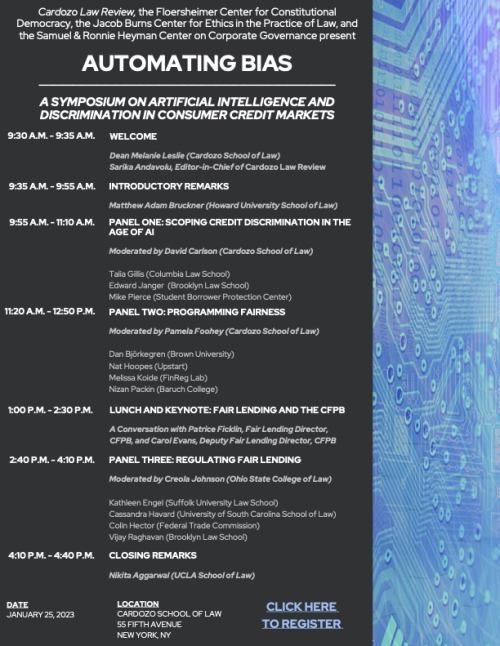
If you are interested in business law topics at the intersection of law & technology and social inclusion, and if you are in NYC on January 25 (or just generally available that day for a webinar!), you may want to check out the Cardozo Law Review symposium on “Automating Bias.”  The program agenda is included below.  Thanks to the symposium editor for bringing this program to our attention.

The symposium is being held at Cardozo School of Law, 55 Fifth Avenue, New York, New York, with an option to attend by webinar. (The symposium editor will send a link to the webinar to all registrants closer to the event).  In-person and live webinar attendees can receive CLE credits for attending; no CLE credits are available for remote attendees accessing the program later in recorded form.  [Note: This last sentence has been revised from the version of this post originally published to indicate that live webinar attendees may receive CLE credit.]

Those interested can register through the Eventbrite page linked here.  Click on the image below for a higher resolution copy of the program agenda and speakers.

BLPB(CardozoSymposium2023)

You can’t read the business press without seeing some handwringing about ESG. It’s probably why I’ve been teaching, advising, and sitting on a lot more panels about the topic lately. Like it or not, it’s here to stay (at least for now) so I decided to do a completely unscientific experiment on lawyer and law student perceptions of ESG using a class simulation. Over the past three months, I’ve used the topic of tech companies and human rights obligations to demonstrate how the “S” factor plays out in real life. I used the same simulation for foreign lawyers in UM’s US Law in Action program, college students who participated in UM’s Summer Legal Academy, Latin American lawyers studying US Business Entities, and my own law students in my Regulatory Compliance, Corporate Governance, and Sustainability class at the University of Miami.

Prior to the simulation, I required the students to watch The Social Dilemma,  the Netflix documentary about the potentially dangerous effects of social media on individuals and society at large. I also lectured on the shareholder v. stakeholder debate; the role of investors, consumers, NGOs, and governments in shaping the debate about ESG; and the basics

BelmontU

We are hiring for an open Assistant Professor of Business Systems and Analytics position.

We will consider lawyers/law professors with data governance/privacy law experience/research.

I am on the hiring committee; feel free to reach out to me with any questions.

Position posting here.

We need to be honest. Most of our students aren’t learning or retaining the information we teach them. If you’re not in academia, you’ve likely attended a a required training or taken a course on your own and you probably can’t fully articulate what you’ve learned or how it applies to what you do daily in your profession. Over the past few months, I’ve been spending time with neuroscientists learning about learning. I’ll pass on some pointers over the next posts to translate how and what we want to teach to how our students or employees actually learn. For example, we all know about the “gunners” in our classrooms or those who beg for the extra point on the exam so that they can maintain their stellar GPAs. But for the most part, adults don’t get motivated through gold stars and report cards in the same way that younger learners do. 

I’ll start with an overview of ten things we need to know about how adults learn. I’ll expand on them in future posts. 

1) Many professors focus on pedagogy, which is based on how children learn and still stick to the teacher-centered approach of learning. The science of adult