In 2013, acclaimed short-story writer George Saunders gave a commencement speech on kindness at Syracuse University. The speech went viral, the transcript landed on The New York Times blog, and the talk later became the basis of a book

The entire speech is well worth listening to, but the gist is Saunders saying: “What I regret most in my life are failures of kindness.”

Oxford English Dictionary defines “kindness” as “the quality of being friendly, generous, and considerate.”

When I think of the profession of law, “kindness,” “friendly,” “generous,” and “considerate” are sadly not among the first words that come to mind. “Analytical,” “bold,” “competitive,” “critical,” and “justice” were the first five words I would use to describe our field. 

As C.S. Lewis reportedly said, “love is something more stern and splendid than mere kindness,” but I am not sure love is ever less than kindness. There may be ways, as negotiation theory teaches us, to “be soft on the person, but hard on the problem.” We can tackle injustice with vigor, but be mindful of the people across the tables from us. 

Pre-pandemic, I put a real premium on “tough love” and preparing students for the
People rarely keep resolutions, much less ones they don’t make for themselves, but here are some you may want to try.

  1. Post information about the law and current events that lay people can understand on social media. You don’t need to be a TikTok lawyer and dance around, but there’s so much misinformation out there by “influencers” that lawyers almost have a responsibility to correct the record.
  2. Embrace legal tech. Change is scary for most lawyers, but we need to get with the times, and you can start off in areas such as legal research, case management, accounting, billing, document automation and storage, document management, E-discovery, practice management, legal chatbots, automaton of legal workflow, contract management, artificial intelligence, and cloud-based applications. Remember, lawyers have an ethical duty of technological competence.
  3. Learn about legal issues related to the metaverse such as data privacy and IP challenges.
  4. Do a data security audit and ensure you understand where your and your clients’ data is and how it’s being transmitted, stored, and destroyed. Lawyers have access to valuable confidential information and hackers know that. Lawyers also have ethical obligations to safeguard that information. Are you communicating with clients on WhatsApp

Happy Labor Day Weekend!

It’s time to relax and recharge. If you’re a professor or a student, you’ve likely just started class again. If you’re like me, you’re already behind and a bit overwhelmed. If you’re a practicing lawyer, you may be working at home, in an office, or both. With all of the uncertainty about office re-openings, the economy, wildfires, hurricanes, and COVID, you may be a bit stressed, and not in a good way (yes, there is “good” stress). Lawyers, as we know, have high rates of burnout, chronic stress, suicide, depression, substance use disorders, and other maladies that could affect the way we practice law and our level of fulfillment while practicing. 

I’ve been a happy lawyer for thirty years. But I’ve had personal and health challenges, so I’ve spent most of the past eighteen months learning healing modalities to help me physically and mentally. I’ve become certified in meditation facilitation, NLP (neurolinguistic programming), EFT (emotional freedom technique)/tapping, reiki, mental health first aid, and hypnotherapy. 

Below are some of the quick fixes that work for me. I’ve also conducted CLEs for lawyers on stress management, and have received feedback that the methods below work. I’ve even taken

Set me free from the laziness that goes about disguised as activity when activity is not required of me, and from cowardice that does what is not demanded in order to escape sacrifice.” Thomas Merton, New Seeds of Contemplation (p. 47). 

IMG_0955

Countless people reminded me how lucky I was to have my first sabbatical this past spring semester. 

And I acknowledge my good fortune, not only for the change of pace, but also for the break during a difficult year. 

But there was something uncomfortable about this past semester. I missed the classroom. I missed my colleagues and students. I missed my office. I missed my office calendar with multiple defined events scheduled throughout the day. I even missed my commute and faculty meetings. I missed–believe it or not–busyness. 

While I had an endless amount of research and childcare responsibilities last semester, I realized that this was likely the least scheduled I’ve been since early childhood. For the first time that I can remember, I wasn’t constantly thinking about the next thing on my calendar. 

I have always been fairly future oriented, and I think legal training makes you even more focused on the future. Good

So much going on today . . . .   Rather than choose one focus, I will offer three.  Each is near and dear to my heart in one way or another.

Happy International Yoga Day to all.  This year’s theme is “Yoga for well-being” or “Yoga for wellness.” The Hindustan Times reports: “On International Yoga Day on Monday, Prime Minister Narendra Modi said yoga became a source of inner strength for people and a medium to transform negativity to creativity amid the coronavirus pandemic.” The United Nations’s website similarly adds that:

The message of Yoga in promoting both the physical and mental well-being of humanity has never been more relevant. A growing trend of people around the world embracing Yoga to stay healthy and rejuvenated and to fight social isolation and depression has been witnessed during the pandemic. Yoga is also playing a significant role in the psycho-social care and rehabilitation of COVID-19 patients in quarantine and isolation. It is particularly helpful in allaying their fears and anxiety.

Yes!  I am so grateful for yoga, including asanas and meditation, and other mindfulness practices at this time–for their positive effects on me, my faculty and staff colleagues, and my students.  👏🏼 

Please join me in participating in Well-Being Week in Law (WWIL), #WellbeingWeekInLaw.  WWIL is a week-long event that is aligned with Mental Health Awareness Month.  (Yes, that’s this month!)  From the event website:

What’s The Purpose of WWIL?

The aim of WWIL is to raise awareness about mental health and encourage action and innovation across the profession to improve well-being. In 2021, the event’s name was changed from “Lawyer Well-Being Week” to Well-Being Week in Law to be more explicitly inclusive of all of the important contributors to the legal profession who are not lawyers.

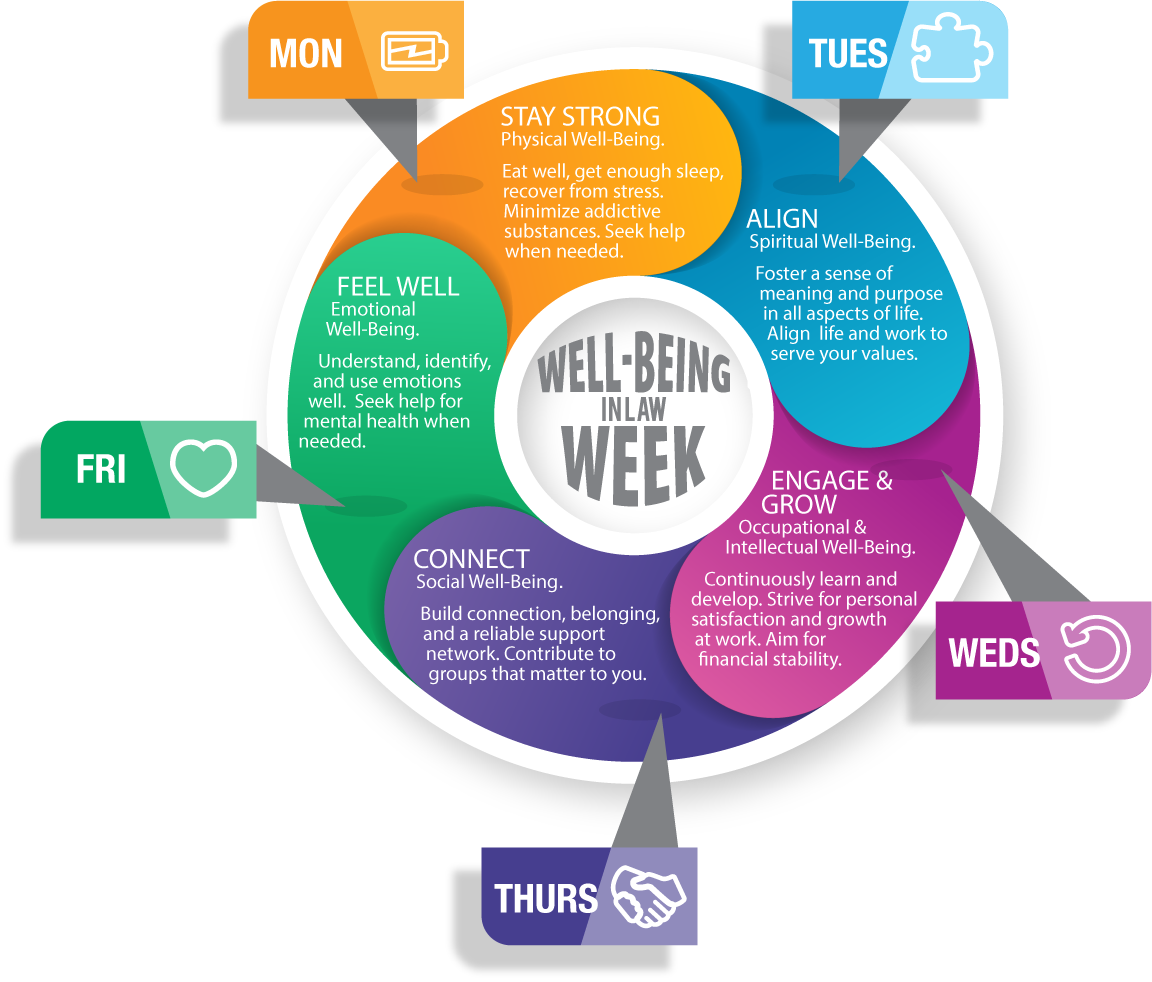
Each day in the week, the WWIL program invites participants to focus on a different aspect of well-being, using this graphic as a guide:

image from lawyerwellbeing.net

I am planning on participating in WWIL activities as much as I can in this busy week filled with exams, papers, and the graduation for our third-year students. 

Today’s WWIL focus is physical well-being.  I had a lovely 10,000+ step walk planned for this morning with a colleague to start the week off right.  Rainstorms put the kibosh on that.  (We are rescheduling . . . .)  But I will try to get a walk in later in

On sabbatical, so this was a pretty good semester of reading (for me). 23 books and two online courses. A good bit about contemplation and religion with some philosophy and fiction. The Remains of the Day and A River Runs Through It were probably my two favorite, though the Merton and Willard books were meaningful too.  

Private Government: How Employers Rule Our Lives (and Why We Don’t Talk About it) – Elizabeth Anderson (2017)  (Philosophy). Tanner Lectures on Human Values at Princeton University. Four commenting essays by different professors follow, then Professor Anderson responds. Her main claim is that Adam Smith and others envisioned a free market with large amounts of self-employment. But powerful modern employers have become “unaccountable communist dictators” who use the rhetoric of freedom, but provide very little of it within their firms. Many employees have no “dignity, standing, or autonomy” in their firms and Anderson calls for more of an employee role in governance, perhaps along the German codetermination model. 

Invitation to Solitude and Silence- Ruth Haley Barton (2004) (Religion). “We are starved for quiet, to hear the sound of sheer silence that is the presence of God himself.”

The Stranger – Albert Camus (1942)

It’s been one year since the US declared a pandemic. It’s been a stressful time for everyone, but this post will focus on lawyers.

I haven’t posted any substantive legal content on LinkedIn in weeks because so many of my woo woo, motivational posts have been resonating with my contacts. They’ve shared the posts, and lawyers from around the world have reached out to me thanking me for sharing positive, inspirational messages. I hope that this care and compassion in the (my) legal community will continue once people return back to the office.

Earlier this week, I took a chance and posted about a particularly dark period in my life. I’ve now received several requests to connect and to speak to legal groups and law firms about mindset, wellness, resilience, and stress management. I’ve heard from executives that I used to work with 15 years ago asking to reconnect. Others have publicly or privately shared their own struggles with mental health or depression. I’m attaching a link to the video here. Warning- it addresses suicide prevention, but it may help someone. 

I’m also sharing an article that my colleague Jarrod Reich wrote last year. He and I have just finished

Happy New Year!

I first posted this on Thrive Global a few weeks ago. In the spirit of the New Year, I’m sharing it with you all. 

It’s time to work on your happiness like it’s a full-time job. 2020 has challenged everyone and 2021 may not be much better. You’ve made it this far so now it’s time to reclaim your power at work with these five tips.

  • Worklife balance is a myth. Whether you’re working from home or actually going to a work site, there’s no such thing as work life balance and there never has been. It’s impossible to devote your full attention to work and family at the same time — something will suffer. As time management guru David Allen explained, you can do anything you want, you just can’t do everything you want. Learn how to say no to anything that isn’t absolutely necessary. For me, if it’s not a hell yes, then it’s a hell no. Unless you can’t say “no,” use your non-work time to do something that brings you joy and sustains you. Find a passion project. When you focus on life balance, your work life will improve.
  • Change your thoughts

IMG_9322 (1)

(A bit of the harvest picked from my parent’s garden in north Georgia yesterday)

Last Thursday my neighborhood book club discussed work by poet David Whyte. This book club has been especially life-giving during the pandemic. I have deep admiration for every member of the group and always learn from our meetings. In March and April, we briefly moved to Zoom, but were unable to capture the same energy. We then decided to meet in person, bringing chairs to a member’s spacious driveway that backs up to common green space.

The work we discussed last week was not actually a book, but rather a few hours of David Whyte’s musings, only available in audio form. Much of the talk involves Whyte reading poetry – primarily his own, Rainer Maria Rilke’s and Mary Oliver’s – and relating that poetry to questions many of us ponder in midlife.

While I can’t locate the exact quote in the long recording, Whyte used a harvesting metaphor effectively. Whyte suggests that if we don’t slow down to be present for the harvest times in our lives, the fruit will rot on the vine. He reminds us, for example, that our child will only be