Whenever Haskell Murray writes a running post, I always want to write one too.  I think he’s written two (here, here) since my last one (here), so I’ve decided it’s time for another!

The tenuous link to business law is this…I was blessed to have a phenomenal first-year contracts professor.  Over the years, one of my closest friends (also in that course) and I have reminded each other of the professor’s pearls of wisdom about contracts and life. “Life is a marathon, not a sprint,” he would assure us. 

I would imagine that many of us feel in the midst of a marathon these days.  As another week in these unusual times begins, I was thinking about a few of the lessons I’ve learned in distance running that were helping me to run the course we’re all on these days.  First, the importance of paying attention to your breath (Joan Heminway has written about breath and mindfulness here).  Second, if you just keep putting one foot in front of the other, you’ll eventually reach the destination/be done.  Third, the need for pacing (likely the point my contracts prof was making).  Fourth, you’ve always got one more mile in you than you think you have. Fifth, running with others pushes you to be your best and makes the miles fly by.  While this is harder to do at the moment, I know that staying connected (via zoom, Skype, Strava etc.) to encouraging, positive people is especially important in these challenging times.      

While Haskell went to the 2020 Olympic men’s marathon trials (here), I only read about them in his post and in Runners World.  I first learned about the surprise, unsponsored, second-place finisher, Jake Riley, from the article Jake Riley and His Coach Were ‘Broken.’ Now, They’re Going to the Olympics (here).  Amazingly, over the past three years, Riley has apparently dealt with a serious bacterial infection, major Achilles surgery, and a divorce.  The article ends by quoting his coach as saying “‘There’s nothing better than seeing a broken man come back,’ Troop said. ‘And when they come back, they’ve got nothing to lose.’”  Of course, Riley will now have to wait an additional year for his Olympic run.   His story of grit, perseverance, and hope really inspired me.  As another week in these unusual times begins, I hope that it might offer inspiration to some of you too.  

[Revision: actually, I think my last running post is here, but Haskell has still written two since I wrote it!]

One of the things that’s fascinated me about this strange time we’re living in is how it’s altered our buying habits.

For sure, some alterations were pretty predictable: more demand for work-from-home tools, computers, sanitizers, and protective gear (certainly, some people seem to have made very accurate forecasts.)

But some of the reports are less intuitive.  For example, lots of people have turned to home baking – either because they have more time or because they don’t/can’t buy in stores – leading to a yeast shortage. (Except, as this Twitterer explains, you can always make your own, a philosophy that many have apparently extended to eggs). 

Other people have figured now’s a good time to care for a pet, emptying out NYC’s shelters.  Or to pretend you’re still in college.

People seeking ways to amuse themselves have turned to jigsaw puzzles and, umm, other things.

On Zoom, nobody can tell if you’re drunk.  (Maybe.)  They definitely can’t tell what you’re wearing from the waist down, though (unless you show them). 

You’ve all heard about the toilet paper shortages, but I appreciated this explanation for them.

And then, we have handy lists of the things that even in times of desperation, no one seems to want.

Please note the following regarding the postponement of the biennial conference at Emory law, previously posted and promoted on the BLPB here:

Due to the uncertain length of the COVID-19 global pandemic, and out of an abundance of caution, we have decided to cancel the Transactional Law and Skills Education Conference currently scheduled for June 5-6, 2020. 

We will re-schedule the Conference and revisit our theme – “Hindsight, Insight, and Foresight: Transactional Law and Skills Education in the 2020s” – when it is appropriate and safe to do so.

If you have already registered for the Conference, we will refund your money.  If you have submitted a proposal or a nomination for the Tina L. Stark Award for Teaching Excellence, you will have the opportunity to resubmit your proposal or nomination when we establish the new Conference date. 

If you have already reserved a room at the Emory Conference Center Hotel please call them at 800.933.6679 to cancel your reservation.  For other Conference-related questions, please contact our Conference Coordinator, Kelli Pittman at kelli.pittman@emory.edu.

During this period of “social distancing,” we are proud to be members of a community of transactional law and skills educators dedicated to excellence.  We look forward to re-scheduling the Conference and welcoming you back to Emory.

If you have trouble viewing the embedded Tweets, please try a different browser (I recommend Internet Explorer).

It’s been three weeks since the WHO declared the coronavirus outbreak a pandemic, and the NBA cancelled games. As of this writing, the NY Post reports: Total cases globally: 857,487; Deaths: 42,107.

This post comes to us from friend-of-the BLPB Nadia B. Ahmad.  Many thanks to her for this contribution.  Her post follows nicely on the spirit of my “Teaching through the Pandemic” posts, which can be found here and here.  My favorite part may be the bit on “Troubleshooting Life and Expectations.”

image from cdnimages.barry.edu

As I begin this post on Sunday, March 29, 2020, there are currently 674,466 confirmed cases of coronavirus (COVID-19). Immunology and infectious disease researchers are working round the clock with their heads down for a cure and a vaccine, but we have nothing in the near term for an end to this situation. The markets have been a tumbling since January 2020 and spiraling downward since March 2020. Even Brexit and the deceleration of China’s economy could not have expected this downturn in the market.  

On March 12, 2020, I taught my last in person Business Organizations class for the semester. For the first half of the class, I had the students complete a practice essay in Canvas on the business judgment rule. The remainder of the time, I had them join via WebEx on their laptops. In that class, approximately 40 percent of the students were able to login to WebEx via Canvas for a lecture of derivative litigation. The rest could join with a direct link. During that triage session while they were in the room, I learned how to troubleshoot connectivity issues with the help of my students. For the past two weeks of online learning, I have had 100 percent attendance in both my classes and student engagement is up as well.

I wanted to share some insights related to teaching via WebEx as well as online teaching generally.

Learning WebEx’s Virtual Classroom

Spending some time on YouTube helped me with figuring out how the platform works. The university also offered some training sessions, but I found YouTube video easier to help me.

Troubleshooting WebEx

Periodically, WebEx may be down altogether because of the load on its system, you can check WebEx’s global status here.

For troubleshooting WebEx audio issues, visit here.

For WebEx video support, visit here.

Some students may have a weak Wifi connection. To alleviate this issue, I also provide the dial-in number. Only one or two students have this issue, but it is also a reliable backup if students cannot connect via WebEx. To locate the dial-in number for your WebEx meeting, visit here.

Checking Hardware and Connectivity (WiFi and Audio)

Some issues with WebEx meeting will be unrelated to the platform itself. While your computer’s existing audio and video functionalities may work, I have found that using a microphone enhances the audio experience. I used Professor Josh Blackman recommendation of the Blue Snowball USB microphone.

Check your high speed internet connection here. You should be running at around 50 mbps. If your internet connection is slower, consider an upgrade in speed.

Troubleshooting Life and Expectations

As an introvert, I welcome this scaling back on social interactions on some levels. At the same time, I miss my students. I have chosen to do hybrid asynchronous/synchronous sessions. I record part of my lectures, but also have live class sessions as well. I was bit nervous to record the classes until I actually did do it and later read a post by Professor William Fischer (Harvard) on Emergency Online Pedagogy. Recording classes is considerate of not only students, but the server. Fischer writes:

First, the quality of a pre-recorded lecture is likely to be substantially higher than that of lecture delivered live. Pre-recorded lectures can be constructed in segments — which can then either be posted online separately (like this) or stitched together and posted online as a single unit. If you are not happy with one segment, you can discard and replace it. Equally important, it is much easier to integrate graphics and audiovisual material in a pre-recorded lecture. (Some techniques for doing this will be discussed shortly.) Last but not least, pre-recorded lectures can be edited.

Having used both formats, I am now strongly in favor of pre-recorded rather than live lectures. Feedback from my students over several years makes clear that they share this preference. My lectures are significantly tighter and clearer when I record them in advance. You may think that you can produce an elegant lecture in “one take,” and perhaps you are right — but I confess that I thought so as well until I watched a recording of one of my unedited presentations.

The second advantage of a pre-recorded lecture is that it is not vulnerable to a major technological threat posed by the sudden and massive shift to online education prompted by the pandemic. … Betting a class on the availability of Zoom [or WebEx] at a particular time is thus risky. By contrast, a pre-recorded lecture can be uploaded to the Internet at any time. In addition, students need not “stream” it, but instead can download it to their computers and then watch it at their convenience. This delivery method is far less vulnerable to technological overload. In addition, the larger the number of teachers who rely on pre-recorded lectures, the smaller will be the aggregate burden imposed on Zoom [and other platforms] and thus the greater the likelihood that it will be available when we need it.

Part of wanting to record a portion of the lectures is also a practical matter for me. I have three kids (ages 2.5, 6, and 9) and my partner is a health care worker and is still working. At any rate, I look forward to welcoming week #4 of online learning and will share tips on integrating current events into discussion on business organizations, the markets, and derivative litigation.

Strava

The Social Enterprise Alliance (SEA) previously defined “social enterprise” as businesses that (1) Directly address social need; (2) Commercial activity [not donations] drives revenue; and (3) Common good is the primary purpose. SEA’s definition has evolved to be more inclusive, now recognizing three different models based on — (1) opportunity employment, (2) transformative products/services, or (3) donations. While the first definition could be criticized for being too narrow (Ben & Jerry’s would not qualify because their product does not directly address a “social need”), SEA’s new definition is likely too broad because it seems to cover all donating businesses. 

Personally, I am most fond of social enterprises that produce products/services that lead directly to human flourishing. 

For Lent, I gave up Facebook/Twitter/Instagram. While these products have their uses, on the whole they tend distract me from what is truly important. Perhaps social media has improved since the advent of Covid-19, and I admit to feeling somewhat out of the loop. But I also feel much more at peace, and may not return to those forms of social media after Easter, or, if I do, I hope it will be on a much more limited basis. 

In contrast, Strava is one form of social media that has been a constant positive in my life. Strava, for those who don’t know, is a free app to log all kinds of physical exercise. I credit Strava (and my friends on Strava) with keeping me accountable to exercise 4+ times a week for the past 4+ years. The community on Strava is unlike any social media I have seen or heard of elsewhere. People are relentlessly encouraging, and the focus is on fitness not controversy. Also, as a Strava friend recently posted — “love Strava because it’s the only social media platform with almost 100% factually accurate information and statistics. (Besides minor GPS errors and the occasional ‘wrong activity type’).” Strava has truly created a product that likely improves the lives of nearly all of its users.

Anyway, no sponsorship for me for this post, but I do hope to see more readers on Strava!

COVID-19’s effects on financings and M&A, as well as contracts more generally (as covered here, here, and here among many other places), the rapid adoption of the Coronavirus Act, Relief, and Economic Security Act, a/k/a the “CARES Act” (key terms summarized briefly here and elsewhere), and the President’s invocation of the Defense Production Act have me feeling like I am drinking business law water out of a fire hose this past week.  Anyone else feeling that way?  Whew!

I am still sorting through it all.  I am sure that I will have more to say on some of this as time passes.  However, earlier today, in the process of reading online resources and watching and listening to others talk about the many legal aspects of the current pandemic, I came across this YouTube video, done by one of my former students, a local attorney who works with entrepreneurs, start-ups, and small businesses.

I have not fact-checked this video.  And he jumps in to correct himself.  But what I like about it is that it represents unvarnished, even humorous, boots-on-the-ground legal public service.  He does not want businesses in the local community to miss out or waste time/money shooting in the dark–or in the wrong direction.  

Sometimes, our students do great things after they leave the hallowed halls of law school.  Many times, those good deeds go unrecognized.  Haseeb has always been passionate.  It makes me so happy to see him using his passion to help the local business community.  I want to offer a “shout out” to him here.  (And his dog, Simon, is the cutest! ♥)

Here is the latest on this summer’s annual conference for the Southeastern Association of Law Schools (SEALS), scheduled for July 30 – August 5 at the Marriott Fort Lauderdale, from SEALS Executive Director Russ Weaver:

Dear Deans, Program Committee members and SEALS friends,

First, and foremost, I hope that everyone is staying well and adjusting to the new normal in legal education (with all classes being taught online).

Second, I want to let you know that SEALS’ Board of Trustees is meeting regularly to assess how to move forward on this summer’s meeting. At this point, the situation is uncertain and no decision has been made. However, the Board is meeting regularly and constantly assessing/reassessing the situation. As the situation becomes clearer, we will be making further announcements.

Third, I also want to let you know that, in order to ensure that no attendee is placed in a difficult situation, SEALS has moved the registration cancellation date back to July 1st. In other words, you can cancel your registration and receive a full refund through July 1st. Hopefully, by that time, we will be able to more accurately assess whether our meeting will go forward and in what form.

In the meantime, please stay safe!

Russell L. Weaver
Professor of Law & Distinguished University Scholar
University of Louisville
Louis D. Brandeis School of Law
Louisville, KY 40292
Email: russ.weaver@louisville.edu
PH: (502) 852-6559
FAX: (502) 852-0862

I currently serve as an officer of SEALS.  Fee free to contact Russ, me, or any SEALS officer or board member if you have any questions.

In a December 2018 post (here), I noted that “although esoteric, such issues as who has access to an account at the Fed are critical social policy choices with real world implications that merit broad-based public debate.” 

This past week, a federal district court judge granted the Federal Reserve Bank of New York’s (FRBNY) motion to dismiss The Narrow Bank’s (TNB) complaint in TNB USA Inc. v. Federal Reserve Bank of New York (USDC SDNY) (here).  In light of this recent opinion, I wanted to reiterate my invitation to BLPB readers to think about seemingly technical, arcane issues such as who gets an account at the Fed – a master account is essentially a bank account at a regional Federal Reserve Bank enabling access to the Federal Reserve Payments System –  and how such decisions should be made. The importance of this critical policy issue is only set to increase.  A few months ago, the Federal Reserve announced plans to develop FedNow Service (here).

TNB is a financial institution with an innovative business model.  Professor Peter-Conti Brown has written about it (here).  It’s model is essentially this: open an account at the Federal Reserve, deposit customer funds (financial institution customers), receive interest on the funds deposited at the Fed’s Interest on Excess Reserves Rate (“IOER rate”), keep a slice of the gains, and pay out the remainder to customers.  The Federal Reserve is a risk-free counterparty, but it is not limited to paying the risk-free interest rate.  So, TNB has a really clever business model.  TNB’s Chairman & CEO, James McAndrews spent 28 years working in the Federal Reserve System (19 at the FRBNY).  Its Board members also includes two highly respected finance professors: Gary Gorton at Yale University and Darrell Duffie at Stanford University.         

TNB received a “temporary Certificate of Authority” from the Connecticut Department of Banking, contingent on several things, including “that the FRBNY would open a master account for TNB.”  As the opinion explains, the FRBNY has not actually denied TNB’s application for a master account…though at least 18 months have passed since TNB applied for it!  However, as the opinion notes, “the FRBNY’s delay is not TNB’s cause of action.”  Hence, United States District Judge Andrew L. Carter, Jr. granted the FRBNY’s motion to dismiss, writing that “TNB lacks standing to pursue its claim, which is also constitutionally and prudentially unripe.”    

The decision strikes me as technically correct, and it will be interesting to see TNB’s strategy from here.  I’m not taking a position on whether TNB should/should not have a master account without additional research and thought.  However, what I am taking a position on is the importance of greater public debate about the underlying policy questions surrounding who does/doesn’t get an account at the Fed. 

In Regulating the Invisible: The Case of Over-the-Counter Derivatives (here), I noted that ICE US Trust LLC, an uninsured NY trust company clearing credit default swaps – controversial financial instruments that had just played a huge role in the financial crisis of 2007-08 – had been granted membership in the Federal Reserve System in 2009 (here).  ICE Trust was essentially the predecessor of ICE Clear Credit, which essentially has the monopoly on CDS clearing today.  Dodd-Frank’s Title VIII explicitly provides the Federal Reserve with the ability to provide accounts and services to clearinghouses designated as systemically important under that title.  But prior to Dodd-Frank, I think that granting ICE Trust membership in the Federal Reserve System was a questionable decision.   

The Fed obviously has its hands full at the moment with much more urgent issues.  In the future, however, it should provide additional clarity about the granting of master accounts and the general timing of such decisions.   

We just reached the part of my M&A class where I teach The Williams Companies v. Energy Transfer Equity LP, 159 A.3d 264 (Del. 2017).  It’s a difficult case – I try to explain the tax aspects which makes part of it a slog – but I do it anyway because I find both the facts and the opinions endlessly fascinating.

The basic set up is that Energy Transfer Equity (“ETE”) and The Williams Companies (“Williams”) had agreed that Williams would be acquired by ETE for a combination of cash and ETE partnership units.  One condition of closing, however, was that ETE’s tax counsel at Latham would issue an opinion to the effect that the second leg of the deal should be non-taxable under IRS regulations.  The Latham Tax Lawyer did not issue the opinion, ETE refused to close, and Williams sued, alleging that ETE breached the merger agreement by failing to use its best efforts to obtain the opinion.  After a trial in Chancery, VC Glasscock ruled for ETE, and the Delaware Supreme Court affirmed, Strine dissenting.

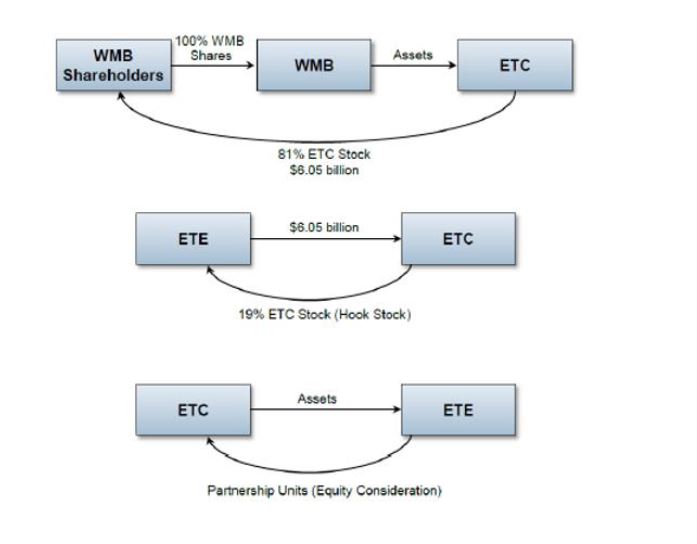
So, the deal itself is complicated but it’s worth explaining.  The actual transaction was to proceed in two steps.  First, Williams merged into a shell company, ETC, and former Williams shareholders received 81% of ETC’s stock.  ETE purchased the remaining 19% of ETC’s stock for $6.05 billion cash, which was immediately distributed to the former Williams shareholders, so now they would have cash plus an 81% interest in a company that was essentially just a reorganized version of Williams itself.

In the next step, ETC planned to sell all of the Williams assets to ETE, in exchange for ETE partnership units, leaving ETC a shell company whose only assets were ETE partnership units, 81% owned by the former Williams shareholders.

+Williams

Originally, ETE’s tax counsel at Latham had opined that the transaction was not taxable, but that changed after the energy industry took a downturn.  The deal suddenly became very unfavorable to ETE, and ETE was looking for an exit ramp.

At that point, ETE’s in-house tax lawyer, Whitehurst, purportedly noticed that the first leg of the transaction required ETE to pay $6.05 billion for a fixed amount of ETC stock – 19% – rather than a floating percent.  This meant, thought Whitehurst, that ETE would now be massively overpaying for ETC stock given the industry downturn, and the overpayment would trigger IRS scrutiny.  He conveyed his concerns to Latham, and a Latham Tax Lawyer (discreetly never identified by name in the Delaware Supreme Court opinion although he is named in Chancery) decided he could not issue the opinion, and the deal collapsed.

There’s a lot to talk about here, and first is the doubtfulness ETE’s claim that Whitehurst, experienced tax guy, suddenly just “noticed” that the deal called for a fixed rather than floating exchange rate, or that the Latham counsel just “noticed” the same. 

It all starts with asking why a simple acquisition – ETE buys Williams shares in exchange for cash and equity interest in its partnership – was accomplished through such a convoluted set of maneuvers.  And the reason for that is, Williams was a publicly traded corporation with a lot of mutual fund shareholders who could not hold ETE partnership units.  Why?  Because partnership units have a complex tax structure that mutual funds can’t handle.  If ETE simply issued cash and partnership units in exchange for Williams shares, the mutual funds would have been forced to sell those units immediately, and they would have paid tax on that sale for a merger that would have otherwise had a tax-free equity component.  And if Williams simply sold assets to ETE, then that sale itself would have been taxable.

So the whole point of the deal was to transfer ETE partnership units to a shell entity that was taxable as a corporation, and distribute stock in that entity to the former Williams shareholders, so that mutual funds could hold a financial interest in ETE without holding ETE directly and dealing with its tax structure, without making anything seem like an asset sale.

In other words, every single thing about this deal, down to its bones, was designed to avoid taxes. 

I’m not saying that as a criticism, I’m saying that to highlight how carefully the tax aspects were integrated into the structure from the get-go, making it extremely unlikely that anyone would be “surprised” by any tax aspects of the deal without an intervening change in the law.

But there’s more.

Notice that in that first leg, Williams shareholders end up with 81% of ETC while ETE ends up with 19%.  Those are very odd numbers; they suggest that someone is trying to avoid a regulatory cut-off at 80/20.  And that seems to be the case; because as I understand it – and I am not a tax person so I genuinely welcome comments from anyone who understands the tax aspects better than I do – 80/20 is a common cut off needed to make deals nontaxable, according to this document drafted by – oh look, Latham. 

Thus, to my uninformed eye, if it was previously doubtful, it now becomes actually incredible that Whitehurst suddenly noticed, several months in, that the deal called for a fixed rather than floating exchange rate.  The fixed rate – 19% – seems to have been necessary to avoid taxes.  If it was floating – if ETE acquired more of ETC as ETC’s value dropped – the deal would have been taxable in the first leg.  So the fixed rate was a fundamental aspect of the deal’s design.

But that’s not actually the most interesting part of the opinion.  No one believed Whitehurst was truly surprised by the fixed rather than floating structure; indeed, Glasscock was openly skeptical of Whitehurst’s testimony.  But Glasscock’s view – and also the view of the Delaware Supreme Court – was that Whitehurst’s good faith or lack thereof was irrelevant.  Yes, said the Delaware Supreme Court, ETE breached its covenant to use its best efforts to obtain the tax opinion, but Williams could only succeed if ETE’s breach was proximately related to the failure of the condition itself.  And, whatever machinations it took to get there, the Latham Tax Lawyer acted in good faith when he said he could not issue the opinion.  Therefore, ETE’s breach was not the cause of the failure.  The Latham Tax Lawyer’s good faith functioned as an intervening event that broke the chain of causation from ETE’s lack of enthusiasm to the failure of the closing condition. 

What’s critical, then, to both Delaware courts’ analyses, is their implicit belief that the Latham Tax Lawyer’s good faith was independent of his client’s behavior or obvious desire to escape a newly-disfavored deal.

Strine, dissenting, saw the matter differently.  In his view, lawyers strive to please their clients, and their good faith on complex legal issues is therefore somewhat malleable.  If ETE had used its best efforts to obtain the opinion – if it had not suggested to Latham that it wanted out of the deal, and pressured it in that direction – the Latham Tax Lawyer’s “good faith” may have led him to a different conclusion.

So what intrigues me about all of this are the fundamentally different views of law that are reflected in the majority and the dissenting opinions.  The majority endorses classical legal theory: in its view, the law is a fixed point, perhaps reflected – like the shadows in the cave – in an attorney’s good faith, but still existing as a universal truth to which the lawyer aspires.  As a result, despite any client bullying or cajoling, in the end, if the lawyer acts in good faith with all available facts, his or her position is immutable – it is a function of The Law itself.

Strine, however, appears to view the law itself as something either manipulable or at the very least unknowable, and thus any particular opinion is as subject to motivated reasoning as any other opinion might be.  In true Legal Realist fashion, Strine’s view is that “law” is inherently indeterminate, constructed out of the policy preferences and incentives of the decisionmaker, which is why something as banal as a client’s preferred outcome will affect even the good faith judgments of the advocate.

So yeah, what I am saying is: Williams v. ETE is ultimately a battle about the nature of law itself, miniaturized in a dispute about commercially reasonable efforts to obtain a tax opinion.