I am both a business law professor and an energy law professor, which is sometimes surprising to people. That is, some folks are surprised that have a research focus in two areas that are seemingly very distinct.  In one sense, that’s true, at least in the academic realm.  Most energy law scholars tend to have a focus on more close related disciplines, such as environmental law, administrative law, and property law.  And business law scholars tend to trend toward things like commercial law, bankruptcy, tax, and contracts.  

There is substantial overlap, though, in the energy and business law spaces, as I have noted on this blog before. I am even working on some research that looks specifically at the role laws and regulations have on business and economic development.   My work with the WVU Center for Innovation in Gas Research and Utilization builds on this energy and business nexus. 

I am pleased to share a newly published article I wrote with Amy Stein from the University of Florida’s Levin College of Law. The piece is called Decarbonizing Light-Duty Vehicles, and it appears in the July issue of Environmental Law Reporter. It is available here. This article is based on our forthcoming book chapter that will appear in Legal Pathways to Deep Decarbonization in the United States (Michael B. Gerrard & John C. Dernbach eds.) and published by the Environmental Law Institute.  The book expands on the U.S. work of the Deep Decarbonization Pathways Project, and was prepared in collaboration with that organization. Following is an excerpt that gives a sense of how energy and business law and policy sometimes intersect. 

    A last challenge surrounds the existing business models that revolve around the [internal combustion vehicle (ICV)]. First, a number of states have a strong incentive to maintain a core of ICVs due to their heavy reliance on the gasoline tax to fund highway infrastructure in their respective states. The gasoline tax has been in place since 1956 to help pay for construction of the interstate highway system.  Since that time, Congress has directed the majority of the revenues from this tax to the Highway Trust Fund (HTF).  At the federal level, Congress has not increased the tax in more than 20 years, leaving it at 18.4 cents a gallon.  As of July 2015, state taxes on gasoline averaged 26.49 cents a gallon, bringing the total tax on gasoline to about 45 cents per gallon.  All efforts to reduce reliance on gas-dependent vehicles therefore stand in sharp contrast to efforts to maintain a healthy highway fund. The interplay between fuel economy and the dependence on gasoline tax revenues should not be overlooked, as well as the conflicting demands placed on legislators.

    Second, dealers, mechanics, and gas stations have a strong incentive to maintain the dominance of ICVs. Dealers may not be as familiar with [alternative fuel vehicles (AFVs)] and so are less likely to be able to demonstrate specifics about available incentives, nor be able to exude confidence about charging, range, and battery life-span.  More importantly, dealers may also be hesitant to sell AFVs for some of the same reasons that customers may be inclined to purchase them—specifically, the expectation of reduced maintenance costs. These misaligned incentives exist because an essential part of a dealer’s business model relies on post-sale revenues related to the sale of used cars, oil changes, and engine maintenance repairs, avoided costs for AFV owners.  More car dealers may need to explore options that evolve with the technology, including maintaining and repairing fleets of autonomous vehicles.

    In short, although the United States has begun the transition to AFVs, there are a number of obstacles, financial, psychological, and cultural, that stand in the way of a greater shift to AFVs.

Amy L. Stein & Joshua Fershée, Decarbonizing Light-Duty Vehicles, 48 Environmental Law Reporter 10596 (2018) (footnotes omitted). 

image from www.homesforwoundedwarriors.com

As a legal advisor to both for-profit and not-for-profit ventures for more than 30 years, I have had to learn about the business operations of new clients many, many times.  The facts are so important in these knowledge acquisition processes (which generally take time to complete).  The more experienced one is as a business lawyer, the more adept one is at getting the right facts–and analyzing the legal risks, rights, and responsibilities they represent or signal.

As a law professor, I have had many opportunities to experience joy from the work of my students.  They do such amazing things!  As the careers of my former students lengthen and deepen, my pride in them often exponentially increases.

With all that in mind, I bring you today a podcast featuring one of my beloved former students.  She doesn’t work for a law firm or a major multinational corporation.  She is not a general counsel.  Instead, she works for a relatively small nonprofit organization in a broad-based planning and development role.

The podcast consists of an exposition/interview by that former student, Betty Thurber Rhoades.  In the podcast, Betty explains–from soup to nuts (i.e., application to move-in)–the process of getting disabled veterans into modified or new homes through Jared Allen’s Homes for Wounded Warriors (JAH4WW), the nonprofit organization for which she works.  Betty started her career post-law school thirteen years ago as a Presidential Management Fellow working for the Department of Veterans Affairs (VA) on regulatory policy matters.  She stayed with the VA until March 2017, ending her VA career as Executive Management Officer (Chief of Staff) to the Deputy Under Secretary for Economic Opportunity, before beginning her work for JAH4WW.  Totally impressive; totally heartwarming.

What I love about this podcast (other than how proud it makes me of the work Betty does) is the utility this kind of description would have/could have for a lawyer who wants to volunteer or otherwise sign on to help with one of JAH4WW’s housing projects.  She mentions in the podcast the contributions of lawyers; she talks about acquiring and titling property, identifying and selecting contractors, etc.  She is, of course, herself a lawyer, so she is sensitive to the facts that matter.  I could easily create a checklist for an engagement letter from this podcast–and get a good overall sense of the “givens” and uncertainties of the representation, too.

We probably ought to talk more in this space about the work that some of our students do once they graduate.  I know I have done very little of this.  But Betty’s work and podcast inspire action–at least for me.

One of the topics I’ve repeatedly discussed in this space is how layers of doctrine have been so piled on top of inquiries like materiality and loss causation in the Section 10(b) context that the legal analysis  has become completely unmoored from the ultimate factual inquiry, namely, did the fraud actually result in losses to investors.  As I put it in one post:

[A]ll of our measures of impact and harm and loss are, at this point, so far removed from reality as to border on complete legal fiction.  Materiality is a construct from case law, with numerous additional doctrines piled on to it by courts without any heed for actual evidence of how markets behave. …. [W]hat we call “harm” and “damage” for the purpose of private securities fraud lawsuits have become so artificial that it no longer seems as though we’re even trying to measure the actual real-world effects of fraud.  I believe private lawsuits are an essential supplement to SEC action but a system of fines or statutory damages would make so much more sense.

This week, I call attention to another recent example of the phenomenon.  In Mandalevy v. BofI Holding, 2018 WL 3250154 (S.D. Cal. June 19, 2018), the plaintiffs alleged that the defendant BofI Federal Bank lied about various money laundering offenses and falsely denied that federal authorities were looking into the matter, in violation of Section 10(b).  The court dismissed their claims on various grounds, including that the plaintiffs had failed to show that they had experienced any losses caused by the defendant’s false denial of an SEC investigation.  The plaintiffs alleged that BofI’s stock price dropped after publication of a New York Post article disclosing the SEC’s interest, but the court observed that the story was based on information that the reporter had obtained by making a FOIA request.  Information available via FOIA, the court concluded, is information generally available to the public, and, by extension, the market.  As a result, the article itself was deemed to have merely summarized previously-public information, and could not qualify as a corrective disclosure that revealed the truth.  As the court explained its reasoning:

The efficient market theory presumes that interested, “information-hungry” market participants are actively and continuously trading a company’s stock. Basic Inc. v. Levinson, 485 U.S. 224, 249 n.29 (1988). One obvious source of information about a particular company is its regulator, particularly when—as we have here—the company has denied the existence of a regulatory investigation in response to reports stating the contrary. The Court must assume that, in the nearly seven months between BofI’s denial [of the investigation] and the October 25 article, a market participant would have made the sensible step of asking the SEC whether BofI’s denial was accurate. The fact that a market participant would have had to jump through a bureaucratic hoop to obtain this information does not mean that the information was not “public.” To the contrary, the Court must assume that “information-hungry” market participants seeking an edge in trading BofI’s stock would expend at least some effort to obtain material information about the company. The Court’s understanding of an efficient market’s collective reach, in other words, cannot be limited to information one can find on Google….

Having been offered no reason to believe that any other market participant could not have made a FOIA request from the SEC about BofI prior to October 25, the Court must assume that he or she did. The CAC therefore fails to allege with particularity a revelation of the falsity of BofI’s March 31 statement.

Let’s take a moment to unpack the factual inferences here that the court is willing to draw at the 12(b)(6) stage: that unspecified investors made a FOIA request, that they got their response faster than the reporter’s own inquiry, and that they used that information to trade in sufficient quantities to completely offset the effects of the initial lie.  And that despite the fact that markets, apparently, can be expected to behave in this manner, these investors believed, ex ante, it would be cost-efficient to justify the time and expense of making the FOIA request in the first place so that they could exploit the information that the request – might! – reveal.

And, it should be noted, in drawing these inferences, the court remained untroubled by the fact that the stock did, in fact, drop upon publication of the Post article. 

Forgive me if I have a little trouble accepting – without any additional evidence – that markets are imbued with this kind of near-mystical perfection.  Indeed, as the Supreme Court made clear, they don’t need to be in order to justify the fraud on the market presumption.   Yet, as Stephen Bainbridge and Mitu Gutali put it, “federal judges are claiming–at least implicitly–a level of expertise about the workings of markets and organizations that, in some areas, not even the most sophisticated researchers in financial economics and organizational theory have reached.”  Stephen M. Bainbridge & G. Mitu Gulati, How Do Judges Maximize? (The Same Way Everybody Else Does—Boundedly): Rules of Thumb in Securities Fraud Opinions, 51 Emory L.J. 83 (2002).

To be fair, plenty of other courts approach market evidence with more humility.  For example, in Pub. Empls. Ret. Sys. of Miss., Puerto Rico Teachers Ret. Sys. v. Amedisys, Inc., 769 F.3d 313 (5th Cir. 2014), the Fifth Circuit concluded that publicly-available raw data – later analyzed and reported in a Wall Street Journal article – could not be presumed to have impacted stock prices because “it is plausible that complex economic data understandable only through expert analysis may not be readily digestible by the marketplace.”  Similarly, in In re Massey Energy Co. Sec. Litig., 883 F. Supp. 2d 597 (S.D. W. Va. 2012), the court refused to presume that information in a public database was sufficiently available to the market to offset defendants’ lies about their safety record.  (Notably – as I previously posted – the Massey court’s intuition that raw data would not be easily digested by investors was subsequently validated by an empirical study of the impact on such information on stock prices.)

That said, despite my snarky subject line, the goal here is less to attack this particular opinion – which follows a line of similar cases that, while perhaps not quite as aggressive, are also willing to draw broad conclusions about market behavior on a thin record – than to question the value of this entire mode of analysis.  It seems increasingly likely that an alternative system that avoids judicial measures of market impact (like, for example, a system of a statutory damages) would better serve investors and deter misconduct.

Earlier today, the Justice Department announced that it had reached a non-prosecution agreement with Credit Suisse.  The bank admitted to hiring the relatives of Chinese government officials and exempting them from performance reviews in order to curry favor.  The DOJ press release lays out the issue:

“In the banking industry, not every undertaking is fair game,” said Assistant Director-in-Charge Sweeney.  “Trading employment opportunities for less-than-qualified individuals in exchange for lucrative business deals is an example of nepotism at its finest. The criminal penalty imposed today provides explicit insight into the level of corruption that took place at the hands of Credit Suisse Group AG’s Hong Kong-based subsidiary.”

According to CSHK’s admissions, between 2007 and 2013, several senior CSHK managers in the Asia Pacific (APAC) region engaged in a practice to hire, promote and retain candidates referred by or related to government officials and executives of clients that were state-owned entities (SOEs).  The employment of these “relationship hires” or “referral hires” was part of a quid pro quo with the officials who referred the candidates for employment, whereby CSHK bankers sought to and did win business from the referral sources.  Employees of other subsidiaries of CSAG were aware of the referral hires and facilitated the conduct.

In situations like this, DOJ may be unlikely to ever actually indict a major bank because of fears about what the indictment would do to global markets.  Andrew Baker has flagged this issue, explaining that:

the DOJ also instructs their attorneys to consider the “collateral consequences” associated with prosecuting corporations when considering whether to seek charges. Following the indictment and subsequent collapse of the accounting firm Arthur Andersen, federal prosecutors became excessively risk-averse, relying on the collateral consequences carve-out to justify an increasing reliance on alternative corporate prosecution agreements. This shift in practice was misplaced but predictable given the public backlash to Arthur Andersen’s prosecution and the DOJ’s lack of subject matter expertise in determining corporate systemic importance. To regain the public’s trust in equality before the law, the DOJ should divest its undue collateral consequences determination to an agency with the requisite expertise, and such a determination should be made formally and should be subject to public inspection.

From what I know about this particular situation, I don’t think it would be appropriate to indict the bank as a whole here for an issue isolated to a Hong Kong subsidiary.  Still, it would be worthwhile to get more insight into how fears about collateral consequences compel the decision to go for a non-prosecution agreement.  It might make sense to break up banks that frequently benefit from this doctrine.

Bernard Sharfman has posted Dual Class Share Voting versus the “Empty Voting” of Mutual Fund Advisors’ and it is an interesting read.  He argues: 

Dual class shares (shares with unequal voting rights) arise when the board of directors of a company decides to raise capital through the sale of newly issued shares, but wants one or more insiders, who may be giving up economic control through the issuance of the shares, to retain voting control in the company.  Typically, this occurs in an initial public offering (IPO), but it can also occur before.  In an IPO, a company will usually issue a class of common stock to the public that carries one vote per share (ordinary shares), while reserving a separate class, a super-voting class, that provide insiders with at least 10 votes per share.  However, both types of shares will have equal rights to the cash flow of the company.  The issuance of dual class shares may create a wide gap between voting and cash flow rights over time, especially if the insiders periodically sell a significant amount of their ordinary shares.

But this is the critical point.  A dual class share structure cannot exist without the permission of those shareholders who are purchasing the ordinary shares at the price offered.  The bargaining process that leads to the issuance of dual class shares is referred to as “private ordering.”  . . . .

. . . 

By contrast, the empty voting of mutual fund advisors is not a firm specific corporate governance arrangement that results from private ordering.  It is the consequence of the industry practice of centralizing the voting of mutual funds into the hands of their advisor’s corporate governance department.  As a result of this delegation of voting authority, mutual fund advisors have the voting power, but not the economic interest in the shares that they vote. 

I am not evangelical about dual-class shares, but I do appreciate his point on private-ordering, which is similar (as I have noted before) to my take in many circumstances. His distinction between dual-class shares and empty voting for mutual fund advisors is a compelling one, and I recommend checking out the whole post. 

Seton Hall University School of Law welcomes applications for tenure-track positions to begin July 1, 2019. Candidates should have a J.D. or equivalent degree and a record of academic excellence. Candidates should be able to demonstrate both extraordinary scholarly promise and the ability or potential to be an outstanding teacher who can motivate students while preparing them for the practice of law in the twenty-first century. The School of Law will consider entry-level and junior lateral candidates in a variety of subject areas with particular focus on 1) Law and Technology, including data analytics/AI as it intersects with law and compliance, social media and electronic discovery, and ethics in the intersection of law and technology; 2) Business Law, preferably with a focus on Securities Regulation; and 3) Health Law, preferably with a focus on Healthcare Fraud or Food and Drug Law.

Seton Hall Law School offers a vibrant, energetic academic environment. Located in downtown Newark, New Jersey, approximately 20 minutes from Manhattan, Seton Hall Law is especially well-regarded in the health and life sciences law, intellectual property, cybersecurity, and privacy arenas, and it is in the process of expanding its role in energy, technology and data analytics. The faculty includes nationally recognized scholars and teachers with expertise in a wide range of areas.

Seton Hall Law School is an equal opportunity and affirmative action employer. We welcome applications from minorities, women, and others whose background and experiences will contribute to institutional diversity.

To apply, please send a resume and cover letter to Professor Marina Lao, Chair, Faculty Appointments Committee, Seton Hall Law School, at lawfacultyappointments@shu.edu.

RobinHood

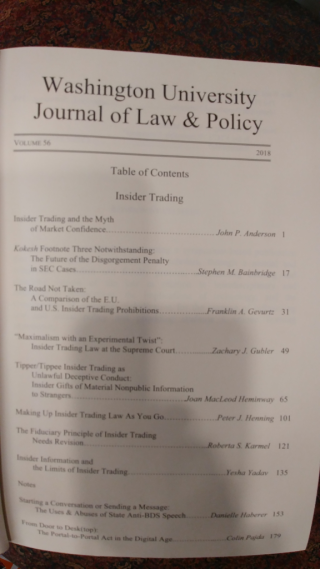
What would the world look like if a public company officer or director, recognizing the value of material nonpublic firm information in his possession and intending to benefit people of limited means, gave this valuable information to those less fortunate without the knowledge or consent of the firm and without any expectation of benefit in return? How, if at all, do we desire to regulate that behavior? The officer or director apparently would be in breach of his or her fiduciary duty absent a valid, binding, and enforceable agreement to the contrary. Does that conduct also, however, violate U.S. federal insider trading rules? Should it? This article, a relatively short piece that I wrote for a “virtual symposium” issue of the Washington University Journal of Law & Policy, offers answers to those questions.

Other symposium authors with insider trading pieces in this volume include:

John Anderson 
Steve Bainbridge
Frank Gevurtz
Zach Gubler
Peter Henning
Roberta Karmel
and
Yesha Yadav

Great reading on this topic, all around.  As we await the next insider trading regulation volley after Salman v. United States, this collection of essays and articles fills a nice gap.  Although the issue is not yet posted to the journal’s website, it soon should be.  In the mean time, here is a photo of the relevant page from the table of contents:

(Sorry for the faint image and the shadows! I took this in my office; no natural light was available, if you know what I mean . . . .)

Enjoy!