As some of you know (and as I noted in a prior post), I have taught from time to time in the past (and will be teaching again this fall) a course focusing on nonhuman animals and the law.  The course reveals, among many other things, that business law doctrine and practice have a number of significant intersections with nonhuman animals.  Although I am likely to say more on that later, the earlier post linked in above notes a few things.

Yesterday, I received the “Call for Papers and Features” reproduced below.  Many of the suggested topics–and the overall theme of “animal welfare in the context of human development”–engage business law.  In particular, agricultural business seems to be on the ends of the editors . . . .  Accordingly, I am posting the call thinking that some of our readers would be interested in knowing about this.

[Aside: I do not subscribe to the citation policy of the journal for the “features” being sought through this call–e.g., “Almost every sentence must be cited” and “If a sentence does not have a citation, you should have a good reason (i.e., it is your concluding argument or a recommendation).”  Unless those who established these requirements are confident that “features” otherwise meeting their requirements do not contain novel legal or policy arguments or recommendations, that pair of citation “requirements” is absurd, imv.]

*          *          *

Logo_sm

CALL FOR PAPERS AND FEATURES

The Sustainable Development Law & Policy Brief (SDLP) is currently accepting submissions for its Fall 2017 edition on topics related to animal welfare in the context of human development. Development will not be sustainable if animal welfare and human-animal relationships are not included in development programs, policies, and laws. Therefore, it is important to highlight the commonality between animal welfare issues and human justice issues.

If you would like to submit an article or feature for consideration, please contact us at sdlp@wcl.american.edu immediately. We will accept submissions on a rolling basis. The deadline for submissions is Monday, September 25, 2017. We will select up to four articles and four features for publication, and we will notify the Authors by Monday, October 2, 2017. Article Requirements differ from Feature Requirements – see below.

Topics may include but are not limited to:

§ Consumption of Species Versus Ecotourism in Developing Nations
§ Exploitation of Natural Fisheries and the Associated Issue of Bycatch
§ Challenges in Regulating Offshore Aquaculture
§ The Effects of Anthropogenic Noise on Marine Life
§ Going Meatless and Securing Food Sources: Moving Away from Concentrated Animal Feeding Operations and Meat Consumption
§ Socio-Economic Challenges in Shifting from Animal-Based Agriculture to Plant- Based/Non-Animal Based Agriculture
§ Intersection Between Concentrated Animal Feeding Operations and Environmental Justice
§ Habitat Loss and Deforestation from Agriculture
§ The Role of Financial Institutions in Animal Agriculture Projects
§ How to Move Toward a Global Animal Welfare Policy
§ Human Health Implications Associated with the Production and Consumption of Animal Products
§ Balancing Wildlife and Continued Land Exploitation in National Parks and Preserves
§ The Effects of Deep Sea Bed Mining on Marine Life

SDLP is available online at LexisNexis, Westlaw, VLex, Hein Online, and on our website at www.wcl.american.edu/org/sdlp.

It is also widely distributed at law and graduate schools, and to representatives of international organizations worldwide.

We reserve the right to reject submissions at any time or for any reason. We also reserve the right to hold all submissions on file for later publication and reserve the right to revise submissions and/or cut text. Authors will have the opportunity to accept or reject any revisions. SDLP accepts submission of timely articles that have already been published elsewhere, so long as permission of the previous publisher is received.

[Click on the “Continue reading” button below for the requirements for articles and features.]

Continue Reading Call for Papers and Features: Sustainable Development Law & Policy Brief – Animal Welfare

I am speaking at a plenary session tomorrow during the the Energy Impacts Symposium at the Nationwide & Ohio Farm Bureau 4-H Conference Center in Columbus, Ohio. The program is exciting, and I look forward to being a part of it.  The program is described as follows: 

Energy Impacts 2017 is a energy research conference and workshop, organized by a 9-member interdisciplinary steering committee, focused on synthesis, comparison, and innovation among established and emerging energy impacts scholars from North America and abroad. We invite participation from sociologists, geographers, political scientists, economists, anthropologists, practitioners, and other interested parties whose work addresses impacts of new energy development for host communities and landscapes.

The pace, scale, and intensity of new energy development around the world demands credible and informed research about potential impacts to human communities that host energy developments. From new electrical transmission lines needed for a growing renewable energy sector to hydraulically fracturing shale for oil and gas, energy development can have broad and diverse impacts on the communities where it occurs. While a fast-growing cadre of researchers has emerged to produce important new research on the social, economic, and behavioral impacts from large-scale energy development for host communities and landscapes, their discoveries are often isolated within disciplinary boundaries.

Through facilitated interactive workshop activities, invited experts and symposium participants will produce a roadmap for future cross-disciplinary research priorities.

I will be talking about Community Development and the North Dakota Sovereign Wealth Fund, and we’ll discuss the implications of the resource curse.  I am of the view that the resource curse is correlative, not causative, and that natural resource extraction can prove harmful to local communities, but that it doesn’t have to be.  From North Dakota’s $4.33 billion fund to Norway’s Government Pension Fund Global, there are examples of funding that can provide for the future. But there are numerous examples of struggling communities and bankrupt local governments where funds benefited few. And even North Dakota and Norway provide stark contrasts in how the funds are used. The point, for me, is that generalizations overstate the role of the resource and understate the role of local decision making.  What we prioritize matters, and often, I think, we can do better.  It’s not preordained.  We can do better, as long as we decide to do so. 

ABABookCover

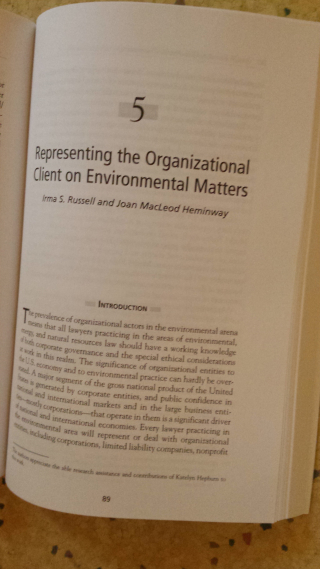
My good friend and long-time mentor Irma Russell and I wrote a chapter for the recently released ABA book, Ethics and the Environment: A Lawyer’s Guide.  Irma also is a co-editor of the book (with Vicki Wright).  In our joint contribution, the chapter entitled “Representing the Organizational Client on Environmental Matters,” Irma and I cover issues involving professional responsibility, corporate governance, and environmental compliance.  Guess which part was my primary responsibility . . . ?!)  Covering some 37 pages of the 242-page book, the rules we cover and the observations we make are fairly wide-ranging.  We hope, as we noted in our conclusion to the chapter, that we supply legal counsel representing corporations and other organizations with “foundational tools to assist them in providing advisory and advocacy-oriented services to organizational clients in the environmental law context.”  Irma and I received our copies last week.  The book soon will be available through the ABA and other outlets.


ABABookChapterPage


SaveSaveSaveSave

SaveSave

So Michael Piwowar inspired a bit of heartburn in the plaintiffs’ bar this week when, during a speech to the Heritage Foundation, he encouraged corporations to add mandatory arbitration provisions in their charters prior to an IPO. This is a subject on which I’ve frequently posted, but since it’s in the news again I can’t let it go by without comment.

Mandatory arbitration is an idea that terrifies plaintiffs’ attorneys because arbitration clauses typically come with a class action waiver, and that could sound the death-knell for federal securities litigation.  Moreover, because the Supreme Court has interpreted the Federal Arbitration Act to bar most attempts at regulating contracts to arbitrate, see, e.g., AT&T Mobility LLC v. Concepcion, 563 U.S. 333 (2011), the fear is that once an arbitration clause makes it into the corporate governance documents, it’s pretty much game over.  The plaintiffs’ bar has long taken comfort in the fact that (at least until now) the SEC has taken the position that such provisions are impermissible, which is exactly why Piwowar’s remarks raised concern.  Delaware, of course, recently amended its corporation law to prohibit the use of mandatory arbitration clauses in corporate charters and bylaws, see Del. Code tit. 8, § 115, but there’s some question as to whether the prohibition extends to federal securities claims, and, even if it does, whether Delaware’s law is preempted by the FAA.

But, as I explained in my article Manufactured Consent: The Problem of Arbitration Clauses in Corporate Charters and Bylaws, 104 Geo. L.J. 583 (2016) (and, to a lesser extent, my chapter Limiting Litigation Through Corporate Governance Documents, in Research Handbook on Representative Shareholder Litigation (Sean Griffith et al., eds., forthcoming 2017)) – and as I previously posted here, here, and here – I don’t think existing law permits charters and bylaws to regulate federal securities claims.  And even if charters and bylaws do extend that far, I do not believe the FAA applies.  To summarize briefly (you can consult older posts or Manufactured Consent for the long version):

First, corporate charters and bylaws only govern internal governance matters, i.e., the matters typically governed by the internal affairs doctrine.  This makes sense; corporate law is intended to govern stockholders’ relationship to the corporation in their capacity as stockholders.  It does not govern matters outside the role of the stockholder as a member of the corporate polity, such as personal torts.  Federal securities law may be closely related to corporate law, but it’s a different animal, and therefore outside the scope of the state-constructed corporate entity.

Second, though it is fashionable to describe charters and bylaws as “contractual,” I do not believe they are, at least not in the manner envisioned by the FAA.  Within the corporate form, shareholders are not treated as autonomous counterparties bargaining with directors over terms.  Thus, the preconditions for contract envisioned by the FAA jurisprudence are not present.

All of which is to say – I don’t think Piwowar’s suggestion is viable, no matter whether the SEC has changed its views.  Of course, there’s always the chance it’ll take a lot of litigation to settle the matter.

At the beach with my wife’s family, I read Parker J. Palmer’s Courage to Teach in a couple sittings. Palmer has a PHD in sociology from UC Berkeley, and has written extensively on education.

My mother-in-law was reading the book for her job at a private elementary school, and I brought a limited number of books (due to the weight of my hardcopy books), so I read this book too. Our teaching center at Belmont University has mentioned Palmer’s work a number of times, so I was interested in the book.

Simply stated, Palmer’s thesis is that “good teaching comes from the identity and integrity of the teacher.” He defines identity as “an evolving nexus where all the forces that constitute my life converge in the mystery of self,” and he defines integrity as “whatever wholeness I am able to find within that nexus as its vectors form and re-form the pattern of my life.” (13) Teaching, he argues, comes from the heart and soul of the teacher, and not primarily from chosen techniques. 

Palmer makes a solid point about paradox and pedagogical design. “The space should be bounded and open….hospitable and charged….invite the voice of the individual and the voice of the group…welcome both silence and speech.” (76-77). The tendency in teaching, I think, is to swing from one side to the other, when we really need to be addressing all of these things simultaneously. Making space for silence in the classroom is something that is especially difficult for me.

He observed, “students who have been well served by good teachers may walk away angry—angry that their prejudices have been challenged and their sense of self shaken. That sort of dissatisfaction may be a sign that real education has happened. It can take many years for a student to feel grateful to a teacher who introduces a dissatisfying truth.” (96-97). This made me wonder if we should add teaching evaluations from alums 5+ years after the class.

I also liked his description of subject-centered classes (instead of teacher-centered or student centered). In the subject-centered class, the students are active and important participants, but they are not the focus of the time.

Palmer notes that he uses mastery grading, allowing students to revise their papers as many times as they like with only the final grade counting. I tried this once, in an MBA class, because many of my colleagues utilize it. I found mastery grading lacking. It encourages weak initial effort, as the students wait for comments, knowing that they can revise their poor product with more specific guidance.

Finally, I really liked the Quaker concept of a “clearness committee” that Palmer describes. The committee consists of four or five colleagues and a focus person. Before the meeting, the focus person writes a description of the problem (as professors, likely stemming from the classroom). Then, for two to three hours the colleagues of the focus person ask him/her open-ended questions about the problem, being careful not to offer advice, bring attention to themselves, or ask questions that are really advice in disguise (e.g., Have you considered seeing a therapist?) After the questions, the focus person has the option of continuing with mirroring (“reflecting to the focus person things he or she said or did but might not be aware of: ‘When asked about A, you said B,’ or ‘When you spoke about X your voice dropped and you seemed tired.’”) (160). Confidentiality is pledged, not only to those outside of the committee, but also within the committee–meaning that the topic would not be raised again, even among the group members. The clearness committee would take a fair bit of time but seems like a great way to solves problems, as most solutions that stick seem to stem from personal realizations rather than merely outside advice.

There wasn’t all that much that surprised me in this book, but it was an easy read and had a few good reminders.

Last year, I was asked to contribute to a symposium on law and entrepreneurship hosted at the University of North Carolina.  Although I had to Skype in for my presentation from Little Rock, Arkansas (where I had just given a separate, unrelated CLE presentation), the panel to which I was assigned was fabulous.  Great scholars, with great ideas.

For my contribution to the symposium, I chose to reflect on the unfulfilled promise of the potentially mutually beneficial relationship between an entrepreneur and a business finance lawyer.  I recently posted the published work memorializing my thoughts on the topic, featured this spring with several other articles from the symposium in a dedicated edition of the North Carolina Law Review.  The brief abstract for my article follows:

Entrepreneurs have the capacity to add value to the economy and the community. Business lawyers—including business finance lawyers—want to help entrepreneurs achieve their objectives. Despite incentives to a symbiotic relationship, however, entrepreneurs and business finance lawyers are not always the best of friends. This Article offers several approaches to bridging this gap between entrepreneurs and business finance lawyers.

My hope in writing this article was to infuse some energy into conversations about the role of business finance and business finance lawyers in the start-up and small business environment.  Too many principals of emergent businesses with whom I interact think that business entity choice and formation are divorced–wholly or in major part–from finance.  Of course, governance and tax matters (as well as, e.g., intellectual property and employment law concerns) are key.  But my personal view is that entrepreneurs and promoters of new businesses should map out their plan for financing firms from the start and take that plan into account in choosing the form of legal entity for those businesses.  I may be fighting an uphill battle on this (for a variety of reasons, mostly relating to the limited resource environment in which start-ups and small businesses exist), but I hope the article gives both clients and lawyers in this space something to consider, at the very least.

The more I read about social enterprise entities, the less I like about them.  In 2014, my colleague Elaine Wilson and I wrote March of the Benefit Corporation: So Why Bother? Isn’t the Business Judgment Rule Alive and Well?  We observed:

Regardless of jurisdiction, there may be value in having an entity that plainly states the entity’s benefit purpose, but in most instances, it does not seem necessary (and is perhaps even redundant). Furthermore, the existence of the benefit corporation opens the door to further scrutiny of the decisions of corporate directors who take into account public benefit as part of their business planning, which erodes director primacy, which limits director options, which can, ultimately, harm businesses by stifling innovation and creativity.  In other words, this raises the question: does the existence of the benefit corporation as an alternative entity mean that traditional business corporations will be held to an even stricter, profit-maximization standard?

I am more firmly convinced this is the path we are on.  The emergence of social enterprise enabling statutes and the demise of director primacy threaten to greatly, and gravely, limit the scope of business decisions directors can make for traditional for-profit entities, threatening both social responsibility and economic growth. Recent Delaware cases, as well as other writings from Delaware judges, suggest that shareholder wealth maximization has become a more singular and narrow obligation of for-profit entities, and that other types of entities (such as non profits or benefit corporations) are the only proper entity forms for companies seeking to pursue paths beyond pure, and blatant, profit seeking. Now that many states have alternative social enterprise entity structures, there is an increased risk that traditional entities will be viewed (by both courts and directors) as pure profit vehicles, eliminating directors’ ability to make choices with the public benefit in mind, even where the public benefit is also good for business (at least in the long term). Narrowing directors’ decision making in this way limits the options for innovation, building goodwill, and maintaining an engaged workforce, to the detriment of employees, society, and, yes, shareholders. 

I know there are some who believe that I see the sky falling when it’s just a little rain. Perhaps. I would certainly concede that the problems I see can be addressed through law, if necessary.  I am just not a big fan of passing some more laws and regulations, so we can pass more laws to fix the things we added.  My view of entity purpose remains committed to the principle of director primacy.  Directors are obligated to run the entity for the benefit of the shareholders, but, absent fraud, illegality, or self-dealing, the directors decide what actions are for the benefit of shareholders. Period, full stop.