One of the hottest topics in business news today is the Snap IPO.

It’s the biggest tech IPO in some time (although some smaller ones apparently will be close behind), the company has so far been losing money and its growth has slowed, and oh yeah – its public shares do not have any voting rights.

In some ways, the disenfranchisement of Snap’s shareholders is the natural culmination of the dual-class share structures that have been popular with tech companies for a while.  But Snap is obviously taking things to extremes.  With no votes, there are no proxy statements.  Most of that information will be disclosed in Snap’s 10-K, but it also means there will be no say-on-pay votes and no shareholder proposals.  Sure, these are – or tend to be – nonbinding anyway, but Snap has shut down the mechanism by which shareholders as a group initiate conversations with the companies in which they invest. 

Some commenters call Snap a one-off; after all, even now, Snap’s shares have fallen well below their first day trading price, and analyst reaction has been less than enthusiastic.  But Snap is still trading higher than its offering price (at least for now), and Snap’s founders made hundreds of millions just from the IPO itself, without sacrificing control of the company – plenty of incentive for new players to try to replicate Snap’s results.  The matter has caused enough concern that the SEC has begun to examine it, though it’s unclear what – if anything – they expect to be able to do.  (I mean, the SEC’s power to directly regulate voting rights is a bit limited, but theoretically listing standards for NYSE and NASDAQ could be modified.).

One of the most interesting developments, at least to me, is the effort by institutional investors to have Snap excluded from major indexes (with a parallel effort across the pond); otherwise, they’d be forced to buy Snap’s shares despite their objections to Snap’s structure, and Snap would get a bit of a boost in its stock price – along with a class of shareholders who cannot vote with their feet.  I don’t know what the indexes are likely to do, but if they include Snap, will that open a space for alternative indexes that exclude no-vote shares – like Snap and perhaps Google Class C?  I have to admit, that would be an elegant free market solution.

One other interesting aspect of the Snap IPO concerns the nature of its shareholders: millennials.  Apparently, millennials have snapped up Snap shares, eager to invest in a company that plays such a role in their lives.  Snap doesn’t love them quite as much, of course, but if you view investing as consumption rather than a way to profit, I suppose it’s no worse than any other recreational activity.

In fact, there’s a whole startup devoted to encouraging consumers to buy stock in their favorite companies – and the companies will pay your brokerage fees.  (Joan posted earlier about a similar type of program at Domino’s Pizza.) The theory is, stockholder-consumers are more loyal customers (and, I assume, more pliant voters), so it’s worth it to companies to cultivate a consumer shareholder base.  It happened before, that retail investors helped management fend off attacks; I wonder if the next would-be Snap might consider a less draconian approach to shareholder voting, but a more aggressive approach to marketing shares to its user base.

Professor Keith Diener of Stockton University School of Business, who is a former law school classmate of mine and the current managing editor of the Atlantic Law Journal, agreed to answer some questions related to the journal.  

The flagship journals for the Academy of Legal Studies in Business (“ALSB”) are the American Business Law Journal (ABLJ) and the Journal of Legal Studies Education (JLSE, primarily pedagogy articles and teaching cases). In addition to these two journals, each regional association is generally responsibly for at least one journal with the Atlantic Law Journal coming out of the Mid-Atlantic region.

As Keith explains below, these journals are open to a wide range of scholars, including professors from law schools. I would encourage legal scholars who have not published in a traditional peer reviewed journal to consider submitting to one of the ALSB journals. I have published in both the ABLJ and the JLSE, and I have had good experiences in both cases.

———- 

Please provide us a brief overview of the Atlantic Law Journal and the MAALSB.

The Mid-Atlantic Academy for Legal Studies in Business (MAALSB) is an association of teachers and scholars primarily in the fields of business law, legal environment, and law-related courses outside of professional law schools with members from the Mid-Atlantic states, including Delaware, Maryland, Pennsylvania, Virginia & West Virginia.  Residence in those states is not required for membership in the MAALSB, and many of our members come from different regions and states. In addition to sponsoring the Atlantic Law Journal, MAALSB holds an annual conference for our region usually in April of each year, where our members meet, present papers, and exchange ideas. The MAALSB is one of the regional branches of the national Academy of Legal Studies in Business (ALSB).

For over a decade, the Atlantic Law Journal was tied to the MAALSB annual conference. Presentation at the conference provided an opportunity for publication in the journal. A few years ago, the journal restructured and began accepting articles on a rolling basis, year-round. We welcome submissions from law professors, whether in law schools or not, but generally do not accept student-authored articles. We are soon entering our twentieth year as a viable legal publication.

What is your current role with the journal and what roles do other faculty members play?

The Atlantic Law Journal has a dedicated team of editors who, depending on classification, perform different roles within the journal.

Our Editor-and-Chief, Professor Cynthia Gentile, leads the journal, manages its website, publishes the annual volume, manages its listings in Cabell’s and Washington and Lee’s Journal Rankings, and coordinates indexing and archiving on Westlaw. As Editor-and-Chief, Professor Gentile is primarily responsible for journal outreach, growth, and sustainability.

I currently serve the journal as the Managing Editor. In this capacity, I receive all submissions to the journal, sanitize them for double, blind peer review, send the sanitized articles to our staff editors for review, receive their recommendation and feedback forms, and notify authors of publication decisions.

We currently have two Articles Editors, Professors Laura Dove and Evan Peterson, who work with the accepted authors to prepare their manuscripts for publication, by editing the articles and making suggestions for improvement even after acceptance.

We also have a team of roughly 30-40 professors from around the country who serve the journal as Staff Editors. Without our Staff Editors, our journal would not function. They are responsible for peer-reviewing the submitted articles, and making recommendations for (i) acceptance, (ii) conditional acceptance, (iii) revision and resubmission, or (iv) rejection of the submitted articles.

What details can you provide about the submission process, including contact information, desired word-count range, typical article topics, etc.?

We generally publish annually, usually in July or August. September through January are typically the best months to submit if you are seeking to be published in the following summer. Spring semester submissions are also welcome, but are often more competitive. Although there are no per se word ranges, article lengths typically span 7,500 to 15,000 words. We publish a wide range of articles, but to be published in the Atlantic Law Journal, the article must have a nexus to business law theory or pedagogy, broadly construed.

The acceptance rate remains at or below 25%. This means that for every article we accept, at least three are initially turned down (although some are given the opportunity to resubmit).

You can submit by emailing the Managing Editor a complete copy and a blind copy, with Bluebook formatted footnotes, in accordance with the instructions and contact information found on our website.

What details can you provide about the review process and editing process?

Upon submission, you will receive a response, typically within a few days, confirming receipt of your article. From there, soon after, the article is typically sent to Staff Editors for peer review.   To the extent possible, we match article content with the expertise of our Staff Editors to ensure a fair and professional review. We also find that the feedback provided by Staff Editors to authors is most helpful when they have expertise related to the article.   Once appropriate and available Staff Editors are identified, they then review the article and return their recommendations to the Managing Editor. The Managing Editor then notifies the author of the publication decision. If an article is accepted, then the author is introduced to one of our Articles Editors for finalization of the essay.

We strive to inform authors of publication decisions within eight (8) weeks of submission.

In your opinion, what are the advantages and disadvantages of publishing with the Atlantic Law Journal?

In my opinion, there are many advantages to publishing with the Atlantic Law Journal.

The first advantage is that (unlike many law reviews today), if you submit to the Atlantic Law Journal, someone will respond to you when you submit it. Yet, not only will you receive a response, but you will also have your article read and reviewed by professional academics in the field of business law (who are also lawyers). We do not utilize law students in our publication process, and all our editors are professional academics.

Second, the Atlantic Law Journal is listed in Cabell’s, ranked by Washington and Lee, and available on Westlaw. This means that articles appear not only in our volumes linked on our website, but are also indexed, searchable, and fully archived on Westlaw. This produces the potential for a broad impact and increased author visibility.

Third, while there appears to be a trend towards some law reviews accepting shorter articles, the Atlantic Law Journal already accepts shorter pieces (circa 7500 words). Let’s face it, sometimes there’s just not 50,000 words to say about certain topics. If you have a shorter piece that might not be long enough for a law review, the Atlantic Law Journal may be interested in it.

Fourth, unlike many law reviews, the Atlantic Law Journal is interested in articles, not only as to theoretical and scholastic topics, but also topics related to business law pedagogy. If you’ve tried something new in the classroom, had good results, and desire to share it with others, the Atlantic Law Journal may be interested. Our primary readership includes business law professors, who are always looking for new and innovative pedagogical techniques. We also welcome scholarly and theoretical articles, and try to include a mix of both scholarly and pedagogical articles in each edition.

Finally, all articles are double, blind peer reviewed. If your article is not accepted, we endeavor to provide high quality feedback that will allow you to improve your article as you continue your work on it. Our blind review is a genuine process. As Managing Editor of the journal, I am committed to ensuring the journal’s integrity by sanitizing all submissions (removing all meta-data) prior to sending the articles for review.

For more on the MAALSB and the Atlantic Law Journal, see our website.

  • Dr. Keith William Diener


William W. Bratton has posted “The Separation of Corporate Law and Social Welfare” on SSRN. You can download the paper here. Here is the abstract:

A half century ago, corporate legal theory pursued an institutional vision in which corporations and the law that creates them protect people from the ravages of volatile free markets. That vision was challenged on the ground during the 1980s, when corporate legal institutions and market forces came to blows over questions concerning hostile takeovers. By 1990, it seemed like the institutions had won. But a different picture has emerged as the years have gone by. It is now clear that the market side really won the battle of the 1980s, succeeding in entering a wedge between corporate law and social welfare. The distance between the welfarist enterprise of a half century ago and the concerns that motivate today’s corporate legal theory has been widening ever since. This Essay examines the widening gulf. It compares the vision of the corporation and of the role it plays in society that prevailed during the immediate post-war era, before the fulcrum years of the 1980s, with the very different vision we have today, and traces the path we took from there to here. It will close with a brief prediction regarding corporate law’s future.

I’m too busy to blog today because I am preparing a training presentation on governance duties for nonprofits. The audience will consist of high level staff, not board members. I have served on many nonprofits and have advised others but I would be interested in your thoughts. Do you teach nonprofit law? Do you sit on nonprofits? What issues do you think nonprofit board members and staffer should know? Among other things, I plan to focus on fiduciary duties, maintaining 501(c)(3) exemption status, agency issues, the implications of Sarbanes-Oxley, conflicts of interest, document retention, code of ethics/whistleblower (to comport with 990),why nonprofits get sued, compensation issues, lobbying, insurance and indemnification, the role of different committees (particularly the audit committee), how to take good minutes, etc. I plan to use hypotheticals to help make the points stick. If you can think of other matters for my 3 hour module or some good case studies, please comment below or inbox me at mnarine@stu.edu. 

A new case, out just yesterday from the Southern District of Ohio, makes a mess of LLC veil piercing law. It appears that the legal basis put forth by the court in granting a motion to dismiss a veil piercing claim was probably right, but the statement of veil piercing law was not quite there.  

The case is ACKISON SURVEYING, LLC, Plaintiff, v. FOCUS FIBER SOLUTIONS, LLC, et al., Defendants., No. 2:15-CV-2044, 2017 WL 958620, at *1 (S.D. Ohio Mar. 13, 2017).  Here are the parties: the defendant is FTE Networks, Inc. (FTE), which filed a motion to dismiss claiming a failure to state a claim. FTE is the parent company of another defendant, Focus Fiber Solutions, LLC (Focus). The plaintiff, Ackison Surveying, LLC (Ackison) filed  a number of claims against Focus, added an alter ego/veil piercing claim against FTE. Thus, Ackison is, among other things, seeking to pierce the veil of an LLC (Focus). Focus appears to be a Pennsylvania LLC, based on a search here.

Pennsylvania law provides the liability cannot be imposed on a member of an LLC for failing to observe formalities. The law states: 

The failure of a limited liability partnership, limited partnership, limited liability limited partnership, electing partnership or limited liability company to observe formalities relating to the exercise of its powers or management of its activities and affairs is not a ground for imposing liability on a partner, member or manager of the entity for a debt, obligation or other liability of the entity.
15 Pa. Stat. and Consol. Stat. § 8106 (2017). 
 
However, the S.D. Ohio court states that a threshold question of whether an LLC’s veil can be pierced includes an assessment of the following factors: 
(1) grossly inadequate capitalization,
(2) failure to observe corporate formalities,
(3) insolvency of the debtor corporation at the time the debt is incurred,
(4) [the parent] holding [itself] out as personally liable for certain corporate obligations,
(5) diversion of funds or other property of the company property [ ],
(6) absence of corporate records, and (7) the fact that the corporation was a mere facade for the operations of the [parent company].
ACKISON SURVEYING, LLC, Plaintiff, v. FOCUS FIBER SOLUTIONS, LLC, et al., Defendants., No. 2:15-CV-2044, 2017 WL 958620, at *3 (S.D. Ohio Mar. 13, 2017) (alterations in original). 
 
The opinion ultimately find that the complaint made only legal conclusions and failed to provide any facts to support the allegations of the LLC as an alter ego of its parent corporation, and further determined that a proposed amended claim was equally lacking.  As such, the court dismissed FTE from the case.  This conclusion appears correct, but it still suggests that, in another case, one could support a veil piercing claim against an LLC by showing that the LLC’s “failure to observe corporate formalities,” formalities it may have no legal obligation to follow.  
 
This remains my crusade. When courts get cases like this, they should (at a minimum) provide a clear veil piercing law for LLCs that accounts for the differences between LLCs and corporations.  I keep saying it, again and again, and I will keep beating the drum. If state law allows for LLC veil piercing, then fine, but get the law right. LLCs and corporations provide limited liability for their residual interest holders, but they are not the same entity. You Can’t Pierce the Corporate Veil of an LLC Because It Doesn’t Have One, but the LLC does have a limited liability veil.  In cases such as these, courts should take the time make the law clearer so that future courts can stop applying the incorrect standards.  And lawyers bringing such cases could help, too, by framing their claims and responses appropriately.  Please.  

As you may know, I have had an abiding curiosity about the line between the U.S  private and public securities markets in large part because of my work on crowdfunding.  Almost three years ago, I published a post on the topic here at the BLPB.  I posted on the referenced paper here.  That paper recently was republished in a slightly updated form by The Texas Journal of Business Law,  the official publication of the Business Law Section of the State Bar of Texas (available here).

As a result of this work, my interest was (perhaps unsurprisingly) piqued by a this paper by Amy and Bert Westbrook.  Enticingly titled “Unicorns, Guardians, and the Concentration of the U.S. Equity Markets,” the article documents concentrations in both private and public equity markets in the United States and makes a number of interesting observations.  I was especially intrigued by the article’s identification of a potential resulting peril of this market concentration: the aggregation of both corporate management and ownership in the hands of the few.

[W]ealth has concentrated and private equity markets have emerged that serve as alternatives to the public equity market. At the same time, the public equity market has become dominated by highly concentrated shareholding, in the form of institutional investors, especially index funds, and the occasional founder. Both developments have resulted in concentrations of capital that mirror the concentration of management that concerned Berle and Means. For Berle and Means, the concern was concentrated management and dispersed ownership. The concern now is that both management and ownership are concentrated in the hands of very few people.

Very interesting . . . .  And this is only one of the conclusions that the authors draw.  As a foundation for its assertions, the article documents the concentration of ownership in both private and public markets, tying current participation in both markets back to salient economic and social data and trends.  The full abstract from SSRN is set forth below, for your convenience.

Developments in the private and public equity markets are changing the role equity investment plays in the United States, and therefore what “stock market” means as a matter of political economy. During the 20th century, securities and other laws did much to tame the “animal spirits” of industrial capitalism, epitomized by the “Robber Barons.” In order to raise large sums, businesses offered stock to the public, thereby subjecting themselves to the securities laws. Compliance required not only disclosure, transparency, but more subtly, that the firms themselves undergo a process of Weberian rationalization. A relatively broad middle class was comfortable investing in such corporations, and the governance of firms and thus much of the economy was understood to be answerable to this class. Citizens understood such arrangements as theirs, part of “the American way.”

In recent years, in conjunction with rising inequality in the United States, there has been a decisive shift from broad-based ownership of firms to much more concentrated forms of ownership in both private and public markets. Private equity markets are concentrated by legal definition: relatively few people are qualified to participate directly. Yet private equity has become the preferred method of capital formation, epitomized by “unicorns,” firms valued at over $1 billion without being publicly traded. Public equity markets are dominated by funds with trillions of dollars under management, and small staffs, who are in effect “guardians” for the portfolios that ensure long-term stability for individuals and institutions, notably through retirement and endowments. The governance of the U.S. economy has to a surprising degree become a matter of grace: the nation now relies on a small elite to make good decisions on its behalf about the allocation of capital, the governance of firms, and the preservation of portfolio value. This consolidation of ownership rivals that of the late 19th century, and may challenge the law to address the equity markets in new ways.

I think you’ll enjoy this one.  At the very least, it’s a great read for those of you who, like me, are interested in analyses of the U.S securities markets.  But perhaps more broadly, with contentious changes in federal business regulation in the offing under the current administration in Washington, this work should contribute meaningfully to the debate.

Trading

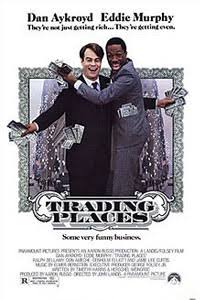
A couple of days ago, Marcia put out a call for business movie/TV recommendations.  A perennial favorite on such lists is the 1983 classic, Trading Places.  That movie is about two brothers who make a bet to see whether they can pluck a man off the street and – by providing him with the proper environment – turn him into a successful commodities trader.  Its stature is such that a real-life statutory amendment, intended to plug the regulatory loophole exploited by the film’s characters, is colloquially known as the “Eddie Murphy rule.”  The CFTC first exercised its authority under the new rule in 2015.

Well, apparently the movie was just as inspiring to business aficionados in 1983 as it remains today.  After seeing the film, two prominent commodities traders of the era, Richard Dennis and William Eckhardt, decided to reenact the brothers’ experiment.  (Except, rather than kidnap a homeless criminal and then frame one of their own employees for dealing PCP, Dennis just took out an ad in the newspaper).  Dennis selected people with a certain affinity for numbers and probability, but with no formal education in commodities, and trained them to trade.  The experiment panned out:  most of the participants (dubbed Turtles, for reasons that remain the subject of myth) not only generated extraordinary profits for Dennis and themselves, but eventually left for successful Wall Street careers.

The tale is recounted in the book The Complete Turtle Trader, and in this Bloomberg podcast.  For the podcast hosts, the unbelievable part of the story is how the methods taught to the Turtles are apparently still in use today – and remain profitable, for anyone disciplined enough to stick to them.  I’ll add that I also find it kind of unbelievable that anyone decided to risk millions of their own dollars to reenact the events of Trading Places, but, to be fair, it is a very good movie.