As readers may recall, I posted on broker fiduciary duties back at the end of December, focusing on a WaPo op ed written by friend-of-the-BLPB, Ben Edwards (currently at Barry, but lateraling later this year to UNLV).  He has a new op ed out today in the WaPo that says everything I could and would say regarding the POTUS’s recent executive order on this topic (referenced by Ann in her post earlier today), and more.  I commend it to your reading.  

It’s important to remember as you read and consider this issue what Ben’s op ed focuses in on at the end: the rule the POTUS executive order blocks is a narrow one, since it only applies to activities relating to retirement investments. A broader fiduciary duty rule for brokers has not yet been adopted.  Suitability is still the standard of conduct for brokers outside the application of any applicable fiduciary duty rule.  The central question at issue is whether a broker must recommend investments in retirement planning that are in the best interest of the client investor or whether, e.g., a broker can recommend a suitable investment to a retirement investor that makes the broker more money/costs the client more money.

I have had to answer friends-and-family questions on this issue in the last 24 hours.  Perhaps you have, too. Here‘s an article that may be helpful if you are in the same boat I am in on this in having to help inform folks in your circle of influence about what this means for them.

It’s a drive-by this week, but I wanted to call your attention to the recent Delaware Chancery decision in In re Merge Healthcare Inc. Stockholders Litigation.  The plaintiffs challenged IBM’s acquisition of Merge, alleging that a 26% Merge shareholder counted as a controller and was conflicted.  Therefore, the shareholder vote in favor of the merger could not cleanse the deal under Corwin v. KKR Financial Holdings LLC, 125 A.3d 304 (Del. 2015).

Vice Chancellor Glasscock rejected the argument.  Assuming (without deciding) that the 26% shareholder counted as a controller, he concluded that because the shareholder’s interests were aligned with those of the public shareholders – among other things, the alleged controller had no unusual need for liquidity/a fire sale – no heightened scrutiny was required and the stockholder vote in favor of the deal was sufficient to cleanse the transaction.

Of particular interest:  It turns out that the Merge corporation did not have a 102(b)(7) exculpatory clause in its charter, which potentially exposed its board to damages for duty of care violations (though, ultimately, the stockholder vote was sufficient to cleanse any problems).  I didn’t even know that was a thing that could happen.

In other news, the business media is aflutter with reports of Trump’s new executive order, which would roll back the Department of Labor’s new “fiduciary rule,” requiring brokers to adhere to fiduciary standards when giving investment advice to retirement plans.  Quoth Gary Cohn, the White House National Economic Council director, “We think it is a bad rule. It is a bad rule for consumers.  This is like putting only healthy food on the menu, because unhealthy food tastes good but you still shouldn’t eat it because you might die younger.”  Um, there may be legitimate reasons to object to the rule – namely, the argument (however spurious) that one way or another, you pay for investment advice, and the old way is cheaper – but treating investment advice like a consumption good is … not among them.

National Business Law Scholars Conference (NBLSC)

Thursday & Friday, June 8-9, 2017

Call for Papers

The National Business Law Scholars Conference (NBLSC) will be held on Thursday and Friday, June 8-9, 2017, at the University of Utah S.J. Quinney College of Law. 

This is the eighth meeting of the NBLSC, an annual conference that draws legal scholars from across the United States and around the world.  We welcome all scholarly submissions relating to business law. Junior scholars and those considering entering the legal academy are especially encouraged to participate. 

To submit a presentation, email Professor Eric C. Chaffee at eric.chaffee@utoledo.edu with an abstract or paper by February 17, 2017.  Please title the email “NBLSC Submission – {Your Name}.”  If you would like to attend, but not present, email Professor Chaffee with an email entitled “NBLSC Attendance.”  Please specify in your email whether you are willing to serve as a moderator.  We will respond to submissions with notifications of acceptance shortly after the deadline. We anticipate the conference schedule will be circulated in May. 

Keynote Speaker:

Lynn A. Stout, Distinguished Professor of Corporate & Business Law, Cornell Law School

Plenary Author-Meets-Reader Panel:

Selling Hope, Selling Risk: Corporations, Wall Street, and the Dilemmas of Investor Protection by Donald C. Langevoort, Thomas Aquinas Reynolds Professor of Law, Georgetown Law School

Commentators:

Jill E. Fisch, Perry Golkin Professor of Law, University of Pennsylvania Law School

Steven Davidoff Solomon, Professor of Law, University of California, Berkeley School of Law

Hillary A. Sale, Walter D. Coles Professor of Law, Washington University School of Law

Conference Organizers:

Tony Casey (The University of Chicago Law School)
Eric C. Chaffee (The University of Toledo College of Law)
Steven Davidoff Solomon (University of California, Berkeley School of Law)
Joan Heminway (The University of Tennessee College of Law)
Kristin N. Johnson (Seton Hall University School of Law)
Elizabeth Pollman (Loyola Law School, Los Angeles)
Margaret V. Sachs (University of Georgia School of Law)
Jeff Schwartz (University of Utah S.J. Quinney College of Law)

Please save the date for NBLSC 2018, which will be held Thursday and Friday, June 21-22, at the University of Georgia School of Law.

A few months ago, J.D. Vance, Yale Law School graduate and author of New York Times Best Seller Hillbilly Elegy, talked about “America’s forgotten working class.”

With the rise of Donald Trump, Vance’s book and the book’s topic have been much discussed.

I, however, want to focus on Vance’s discussion after the 10 minute mark where he thanks various mentors for helping him overcome family financial, and community-based problems. Without a stable immediate family, Vance found guidance from his grandparents, the military, and his professors.

Raised in a predominately individualistic culture, I believed, for a long time, that hard work was the primary driver of success. I still think individual dedication is important, but looking back, I am also incredibly thankful for the many people who provided a helping hand along the way.

While most schools do not specifically reward it, I think professors are particularly well situated to mentor students. We can also be incredibly helpful to our more junior colleagues. Recognizing the value of the mentors in my own life, I do hope to “pay it forward” and become increasingly involved in the mentorship process.

Donald Trump has had a busy two weeks. Even before his first official day on the job, then President-elect Trump assembled an economic advisory board. On Monday, January 23rd, President Trump held the first of his quarterly meetings with a number of CEOs to discuss economic policy. On January 27th, the President issued what some colloquially call a “Muslim ban” via Executive Order, and within days, people took to the streets in protest both here and abroad.

These protests employed the use of hashtag activism, which draws awareness to social causes via Twitter and other social media avenues. The first “campaign,” labeled #deleteuber, shamed the company because people believed (1) that the ride-sharing app took advantage of a work stoppage by protesting drivers at JFK airport, and (2) because they believed the CEO had not adequately condemned the Executive Order. Uber competitor Lyft responded via Twitter and through an email to users that it would donate $1 million to the ACLU over four years to “defend our Constitution.” Uber, which is battling its drivers in courts around the country, then established a $3 million fund for drivers affected by the Executive Order. An estimated 200,000 users also deleted their Uber accounts because of the social media campaign, and the CEO resigned today from the economic advisory board.

Other CEOs, feeling the pressure, have also issued statements against the Order. In response, some companies such as Starbucks, which pledged to hire 10,000 refugees, have faced a boycott from many Trump supporters, which in turn may lead to a “buycott” from Trump opponents and actually generate more sales. This leads to the logical question of whether these political statements are good or bad for business, and whether it’s better to just stay silent unless the company has faced a social media campaign. Professor Bainbridge recently blogged about the issue, observing:

The bulk of Lyft’s business is conducted in large coastal cities. In other words, Obama/Clinton country. By engaging in blatant virtue signaling, which it had to know would generate untold millions of dollars worth of free coverage when social media and the news picked the story up, Lyft is very cheaply buying “advertising” that will effectively appeal to its big city/blue state user base.

Bainbridge also asks whether “Uber’s user base is more evenly distributed across red and blue states than Lyft? And, if so, will Uber take that into account?” This question resonates with me because some have argued on social media (with no evidentiary support) that Trump supporters don’t go to Starbucks anyway, and thus their boycott would fail.

All of this boycott/boycott/CEO activism over the past week has surprised me. I have posted in the past about consumer boycotts and hashtag activism/slacktivism because I am skeptical about consumers’ ability to change corporate behavior quickly or meaningfully. The rapid response from the CEOs over the past week, however, has not changed my mind about the ultimate effect of most boycotts. Financial donations to activist groups and statements condemning the President’s actions provide great publicity, but how do these companies treat their own employees and community stakeholders? Will we see shareholder proposals that ask these firms to do more in the labor and human rights field and if so, will the companies oppose them? Most important, would the failure to act or speak have actually led to any financial losses, even if they are not material? Although 200,000 Uber users deleted their accounts, would they have remained Lyft customers forever if Uber had not changed its stance? Or would they, as I suspect, eventually patronize whichever service provided more convenience and better pricing?

We may never know about the consumers, but I will be on the lookout for any statements from shareholder groups either via social media or in shareholder proposals about the use or misuse of corporate funds for these political causes.

In 2012, the U.S. Patent Office instituted the Inter Partes Review (IPR) system—an administrative process allowing parties to challenge the validity of issued patents. If the agency determines a patent was erroneously granted, it is invalidated. IPR was intended as a less expensive alternative to litigating validity, and it serves this purpose. However—like many government programs—it had unforeseen consequences.

Almost any party hoping to challenge a patent can file for IPR; there is no requirement that they have a business interest in the patent. This lack of a standing requirement opened the door to a new type of rent seeking. Invalidity Assertion Entities (IAEs) threaten to use IPR to (attempt to) invalidate a patent, unless its owner pays a “settlement.” Anecdotal evidence shows that they target patents presently being litigated (presumptively because the patentee has the most to lose from invalidation at that time), but IAEs have no actual interest in the subject patent.

When this business model came to light, Congress reflexively proposed to do away with the practice. The legislation didn’t pass, but the negative response wasn’t surprising; rent seekers in patent law (e.g., patent trolls) have a bad reputation. I’ve written on IAEs (here and here), and despite the negative response to their business model, I argue for restraint in legislating to do away with them. As described below (and described fully in my articles), there are potential socially positive externalities that may arise from their business practices.

Erroneously granted patents create an unjustified deadweight economic loss, which is remedied when IAEs invalidate such patents (per their business model). Moreover, IAEs are likely to target weak (probably invalid) patents, which are commonly asserted by patent trolls. The weakness of these patents incentivizes their owners to avoid validity challenges (and to pay to do so), making them a prime target for IAEs. In fact (as I set out here), incentives exist for IAEs to generally target patent trolls, which is socially beneficial because it discourages future troll activity.

To be clear, I don’t think IAEs are a panacea for all of patent law’s problems. And I recognize the possibility that IAEs will engage in a nuisance-value business model (e.g., targeting all patents being litigated), though I’ve argued that this isn’t likely. My position is simply that—despite the fact that IAEs engage in rent seeking—it is possible that they are a social benefit.

On Monday President Trump signed an Executive Order on Reducing Regulation and Controlling Regulatory Costs. The Order uses budgeting powers to constrict agencies and the regulatory process requiring that for each new regulation, two must be eliminated and that all future regulations must have a net zero budgeting effect (or less). The Order states:

“Unless prohibited by law, whenever an executive department or agency (agency) publicly proposes for notice and comment or otherwise promulgates a new regulation, it shall identify at least two existing regulations to be repealed.”

Two points to note here.  First, the Executive Order does not cover independent agencies like the Securities and Exchange Commission and the Commodity Futures Trading Commission, agencies that crafted many of the rules required by the 2010 Dodd-Frank Wall Street reform law–an act that President Trump describes as a “disaster” and promised to do “a big number on“.  The SEC, the CFTC and Dodd-Frank are not safe, they will just have to be dealt with through even more sweeping means.   Stay tuned.  The 2-for-1 regulatory special proposed on Monday is a part of President Trump’s promise to cut regulation by 75%.

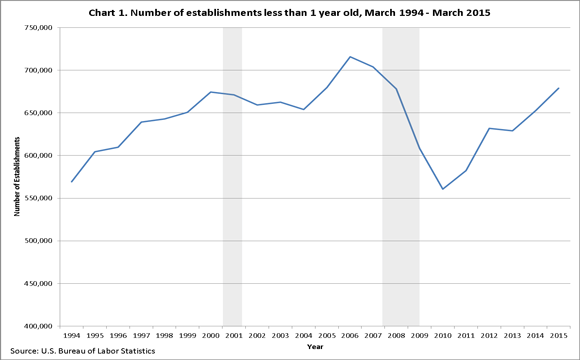
Second, the Order is intended to remove regulatory obstacles to Americans starting  new businesses.  President Trump asserted that it is “almost impossible now to start a small business and it’s virtually impossible to expand your existing business because of regulations.” Facts add nuance to this claim, if not paint an all-together different story.  The U.S. Department of Labor Statistics documents a steady increase in the number of new American businesses formed since 2010.  The U.S. small business economy grew while regulations were in place.  President Trump asks us to believe that they will grow more without regulation.  Some already do. The U.S. Chamber of Commerce “applauded” the approach decrying the “regulatory juggernaut that is limiting economic growth, choking small business, and putting people out of work.”

Chart 1. Number of establishments less than 1 year old, March 1994–March 2015

Yet, as shocking as this feels (to me), the U.K. and Canada both have experience with a similar framework.  The U.K.’s two for one regulation rule has been touted as saving businesses £885 million from May 5, 2015 to May 26, 2016 and there is now a variance requiring three regulations to be removed for each one.  Canada takes a more modest one in- one out approach.  No information is available yet on any externalities that may be caused by decreased regulations.  For some, and I count myself in this camp, the concern is that the total cost of failed environmental protection, wage fairness, safety standards, etc. may outweigh individual gains by small business owners.

The 2-for-1 special evokes some odd memories  for me (Midwestern, of modest means) of a K-Mart blue-light special.  The Trump Administration is flashing a big, blue light with the promise to cut regulation by 75% without reference to the content of those regulations.  The first tool, a “two for one approach” strikes me as a gimmick where the emphasis is on marketing the message of deregulation through quantity, not quality.  Not to mention the arbitrariness of the numerical cut off (why not 1 or 13?). It is the type of solution, that if offered in answer to a law school hypo, would quickly be refuted by all of the unanswered questions.  Can it be any two regulations?  Can the new regulation just be longer and achieve the work of several?  Should there be a nexus between the proposed regulation and the eliminated ones?  What is the administrative process and burden of proof for identifying the ones to be removed?  The Executive Order, targeted at business regulation, but in doing so has created the most “significant administrative action in the world of regulatory reform since President Reagan created the Office of Information and Regulatory Affairs (OIRA) in 1981.” Hold on folks, this is going to be a bumpy ride.

Image result for blue light special images

-Anne Tucker


Energy and business are closely related, and the former often has a direct impact on latter.  At Whitehouse.gov, the President has posted his energy plan, making the following assertions: 

Sound energy policy begins with the recognition that we have vast untapped domestic energy reserves right here in America. The Trump Administration will embrace the shale oil and gas revolution to bring jobs and prosperity to millions of Americans. We must take advantage of the estimated $50 trillion in untapped shale, oil, and natural gas reserves, especially those on federal lands that the American people own. We will use the revenues from energy production to rebuild our roads, schools, bridges and public infrastructure. Less expensive energy will be a big boost to American agriculture, as well.

It is certainly true that we “have vast untapped domestic energy reserves right here in America.” It has brought some wealth and prosperity to the nation, and low oil prices because the country “embrace[d] the shale oil and gas revolution to bring jobs and prosperity to millions of Americans.” However, low oil and gas prices (which largely remain) have slowed that growth and expansion because shale oil and gas exploration and production was wildly successful. 

The President says, “We must take advantage of the estimated $50 trillion in untapped shale, oil, and natural gas reserves, especially those on federal lands that the American people own.”  But it’s not clear how that’s helpful. That is, selling our (the American people’s) assets when the market is at or near record lows doesn’t seem like very good asset management.  

The plan is to “use the revenues from energy production to rebuild our roads, schools, bridges and public infrastructure.”  I am very fond of all of these things, though I am skeptical that the federal government should take a leading role in all of them. I am open to the discussion.  But, if we’re selling our assets at pennies on the dollar of historic value, I am particularly skeptical of the benefits. 

“Less expensive energy will be a big boost to American agriculture, as well.” Low energy costs do help agriculture. That is certainly true.  But notice that making energy even less expensive means we get less for our assets, and we’re dumping more cheap energy into a market where private businesses in the oil and gas sector are already having a hard time.  

Facilitating a boom from cheap energy means investing in new jobs to use the energy, not just getting more of the energy.  Plants that use our cheaper fuels to make and build new products could help, but it’s never easy.  High energy prices can stifle an economy, but low ones rarely spur growth.  About a year ago, an Economist article from January 2016 remains accurate, as it explained that sudden and major price increases can slow an economy rapidly, as we saw in Arab oil embargo of 1973. However, “when the price slumps because of a glut, as in 1986, it has done the world a power of good. The rule of thumb is that a 10% fall in oil prices boosts growth by 0.1-0.5 percentage points.”  

The article further explains: 

Cheap oil also hurts demand in more important ways. When crude was over $100 a barrel it made sense to spend on exploration in out-of-the-way provinces, such as the Arctic, west Africa and deep below the saline rock off the coast of Brazil. As prices have tumbled, so has investment. Projects worth $380 billion have been put on hold. In America spending on fixed assets in the oil industry has fallen by half from its peak. The poison has spread: the purchasing managers’ index for December, of 48.2, registered an accelerating contraction across the whole of American manufacturing. In Brazil the harm to Petrobras, the national oil company, from the oil price has been exacerbated by a corruption scandal that has paralysed the highest echelons of government.

I am all for a new energy plan to help the economy grow, and I support continued energy exploration and production as long as it is done wisely, which I firmly believe can be done.  But adding new competitors (by allowing more exploration on federal lands) simply won’t help (and it really won’t help increase coal jobs). More supply is not the answer in an already oversupplied market.  And the current proposal is just giving away assets we will want down the road. 

Conference information from an e-mail I recently received. 

———

The second annual Susilo Symposium of the Susilo Institute for Ethics in the Global Economy will be held on June 15-17, 2017 at Boston University Questrom School of Business.

The event will feature distinguished and varied speakers, including Professor Francesca Gino of Harvard Business School, and site visits at Aeronaut Brewing, Bright Horizons, and Fenway Park, among other exciting area companies.

The Susilo Symposium will be part of a new Global Business Ethics week, which begins at Bentley University from June 12-15 for the Global Business Ethics Symposium and teaching workshop, and then will move to BU for June 15-17.

The event promises an audience of both scholars and practitioners from around the world. All seek to explore and exchange ideas in a unique and interactive forum about the role of ethics in the global economy.

This year’s Susilo Symposium follows the inaugural symposium, which was held in May 2016 in Surabaya, Indonesia. Featuring foremost business, academic, and political leaders, it reflected on “Global Business Ethics – East Meets West.”

What to Expect

The program is directed specifically toward both academics and practitioners. Our hope is that attendees will learn from each other and take away ideas and practices that they can implement immediately.

It will feature onsite visits to global corporations and the latest start-ups, from which you will learn about today’s cutting-edge responses to challenging dilemmas.

Symposium sessions will range from traditional academic paper presentations on the most recent research on global ethics, to interactive panels of faculty and practitioners discussing their shared perspectives, to active problem-solving and learning, to programs showcasing effective practices by leading corporate decision-makers.

The conference design intentionally builds in plenty of opportunities for networking among your colleagues and between academics and practitioners, including a Thursday evening social event, a Friday luncheon and Friday evening reception.

Registration & Questions

Registration is open now. If you have additional questions, please contact us by e-mail at susilo@bu.edu