
A few weeks ago, I blogged about the proposed amendments to the DGCL, and the questions they raised.  Well, I wasn’t the only one who had concerns, and so, now, there are new amendments to the amendments (which The Chancery Daily has posted here).  And once again, I just got these last night and I read quickly (in the middle of end-of-semester grading) so I reserve the right to be completely wrong, but, here is my quick reaction.

As I explained in my prior post , many of the original amendments were intended as a response to VC Laster’s decision in West Palm Beach Firefighters’ Pension Fund v. Moelis & CoMoelis struck down a shareholder agreement that functionally conveyed management power on a particular stockholder, by giving him veto power over most board decisions.  VC Laster held that a board’s authority can only be cabined to such a degree in the charter, including through a preferred share issuance – and he also suggested that there may be some outer limits on how far even a charter provision could go in restricting board authority.

The original proposed DGCL amendments would have overruled Moelis in both respects.  They would have authorized stockholder agreements that usurped board authority and would not have placed any limits on the degree of authority that could be usurped.  The latter point struck me as particularly important, because traditionally, the corporate form is defined by its board-centric model.  If that can be contractually avoided, does the corporate form have any value at all?

The new amendments are a little different, in that they do not permit contracts that would confer governance powers beyond what could be included in the charter, or would be contrary to Delaware law.  In other words, if there are certain core powers that must remain with the board and can’t be visited in someone else via the charter, then, these amendments to the amendments would not allow those powers to be transferred via stockholder contracts.  The new language provides:

no provision of such contract shall be enforceable against the corporation to the extent such contract provision is contrary to the certificate of incorporation or would be contrary to the laws of this State … if included in the certificate of incorporation.

But also, in determining what these “core” board powers are, courts can’t rely on the fact that the power is one that is statutorily conferred on the board.  As the amendments put it, “a restriction, prohibition or covenant in any such contract that relates to any specified action shall not be deemed contrary to the laws of this State or the certificate of incorporation by reason of a provision of this title or the certificate of incorporation that authorizes or empowers the board of directors (or any one or more directors) to take such action.”

Now, the first thing that leaps out at me is how these new amendments interact with VC Laster’s decision in McRitchie v. Zuckerberg.  There, Laster held that the directors of a Delaware corporation have a duty to maximize the value of the equity, and do not have a duty to maximize the value of a diversified portfolio. (I blogged about the case when the complaint was first filed).  But Laster went on to hold that corporations could adopt charter provisions that would change directors’ fiduciary duties, so that they are obligated to consider diversified shareholders.   That’s contestable; Steve Bainbridge, for example, has suggested that Delaware corporations cannot by private ordering depart from shareholder wealth maximization and I personally would ask what’s the difference between Laster’s proposal and a charter provision that waives the duty of loyalty – which has long been assumed to be unwaivable, except as otherwise statutorily provided (like, opportunity waivers). 

But if Laster is right, then, of course, that represents a very broad view of how far charters can go to alter the board’s authority, which would also mean that stockholder agreements, under the amended proposed amendments, could go very far in altering board authority. 

Which then raises the question: Is there value to requiring that restrictions on board authority be placed in the charter rather than a separate shareholder agreement?

One obvious value is transparency; at least if the company is not subject to SEC reporting, shareholder agreements may not be available to the public or even to other shareholders.  Another value may concern the ease with which an agreement versus a charter could be amended, though I still think that if you conferred special rights to preferred shareholders, you could also confer the right to vote on amendments to those rights to the same preferred shareholders, which would make ease of amendment roughly equivalent.

Another value, though, concerns choice of law.  As I previously blogged, shareholder agreements are subject to ordinary choice of law principles; charter provisions and preferred share terms are subject to the internal affairs doctrine.  (Read my paper addressing this!)

The comments to the amendments to the amendments now discuss choice of law, but I don’t think they change the landscape.  The comments say:

Notwithstanding any choice of law provision in the contract, the reference in the last sentence of § 122(18) to the law “governing” the contract shall be deemed to refer to the laws of this State if and to the extent choice of law principles (such as the internal affairs doctrine) so require.

In other words, it’ll be another state’s law if choice of law principles so require, which, for stockholder agreements, they often do.

But further muddying the waters is this:  The new amendments say that stockholder contracts can’t go beyond what a charter amendment would permit except with respect to DGCL §115, which can be waived in a stockholder contract.

DGCL §115 requires that a Delaware forum be available for claims that “(i) that are based upon a violation of a duty by a current or former director or officer or stockholder in such capacity, or (ii) as to which this title confers jurisdiction upon the Court of Chancery.”

So, as I understand it, let’s say a stockholder agreement conferred extraordinary governance powers on a single stockholder.  Let’s say those powers arguably made the stockholder a “controller” subject to fiduciary obligations.  The contract could also provide that claims against the stockholder for breach of fiduciary duty must be brought in an arbitral or non-Delaware forum.  Presumably, this would include derivative claims – a shareholder would sue derivatively claiming self-dealing by a controller, the corporation would be bound by the forum selection clause, and so, the claim would be heard outside of Delaware.

I also assume that disputes regarding compliance with, or even the interpretation of, a stockholder agreement could be heard in a non-Delaware forum.  So, if someone wanted to claim that a particular stockholder agreement was unenforceable because it conferred power on a stockholder that went beyond what Delaware law permits, and it turned out that the agreement selected another state’s courts as the forum for disputes, that argument – that Delaware law does not permit delegation of such-and-such power – would not be heard in a Delaware court.

As far as I can tell, this provides an incentive for stockholders to enter into these agreements – even if they have hard control over the board and don’t really need them – because it allows them to opt out of DGCL 115, and possibly even the statutory limits on the agreements themselves, which will no longer be policed in Delaware.

Well, I have no idea how this ends but, I gotta tell you, all this drama fascinated my corpgov seminar students, so I suppose I will have much to discuss with my classes next year.
ESG greenwashing has been getting attention among legal academics.  In Rainbow-Washing, 15 Ne. U. L. Rev. 285 (2023), LMU Law’s John Rice explores the

increasingly common, but destructive, practice in which corporations make public-facing statements espousing their support of the LGBTQIA+ community . . . to draw in and retain consumers, investors, employees, and public support, but then either fail to fulfill the promises implicit in those statements or act in contravention to them. 

My own forthcoming article in the University of Pennsylvania Journal of Business Law, presented at the November 2023 ILEP-Penn Carey Law symposium honoring Jill Fisch, mentions the increasing notoriety of ESG greenwashing and cites to John’s article.

Last week, UVA Law Professor Naomi Cahn called out ESG greenwashing in Forbes, citing to a study to be published in the Journal of Accounting Research that finds “firms’ ESG rhetoric may not match their reality.”  She suggests that “a meaningful analysis of a firm’s ESG commitment requires much further digging, and ultimately it requires meaningful oversight from outside the ESG community on what should be disclosed and the accuracy of the reports.”  The article references a forthcoming book coauthored by Cahn, June Carbone (Minnesota Law) ,and Nancy Levit (UMKC Law) and quotes Minnesota Law Professor Claire Hill.  (Hat tip to Claire for leading me to this Forbes piece.)  It’s a solidly good read.  I added a citation to it in my forthcoming article.

I suspect more will be done in this space academically and practically as ESG continues to occupy the minds of legal academics, lawyers, and business principals.  I will be continuing to work in this area, focusing next on corporate compliance issues.  Stay tuned for news on that project (and for a notification about the publication of my forthcoming University of Pennsylvania Journal of Business Law article referenced above).

Corporate & Securities Litigation Workshop: 

Call for Papers 

UCLA School of Law, in partnership with the University of Illinois College of Law, University of Richmond School of Law, and Vanderbilt Law School invites submissions for the Eleventh Annual Workshop for Corporate & Securities Litigation. This workshop will be held on September 20-21, 2024 in Los Angeles, California. 

Overview 

This annual workshop brings together scholars focused on corporate and securities litigation to present their scholarly works. Papers addressing any aspect of corporate and securities litigation or enforcement are eligible, including securities class actions, fiduciary duty litigation, and SEC enforcement actions. We welcome scholars working in a variety of methodologies, as well as both completed papers and works-in-progress at any stage. Authors whose papers are selected will be invited to present their work at a workshop hosted by UCLA School of Law. Participants will pay for their own travel, lodging, and other expenses. 

Submissions 

If you are interested in participating, please send the paper you would like to present, or an abstract of the paper, to corpandseclitigation@gmail.com by Friday, June 7, 2024 Please include your name, current position, and contact information in the e-mail accompanying the submission. Authors of accepted papers will be notified in early July. 

Questions 

Any questions concerning the workshop should be directed to the organizers: Jim Park (james.park@law.ucla.edu), Jessica Erickson (jerickso@richmond.edu), Amanda Rose (amanda.rose@vanderbilt.edu), and Verity Winship (vwinship@illinois.edu). 

I very much enjoyed Edwin Hu, Nadya Malenko, and Jonathon Zytnick’s new paper, Custom Proxy Voting Advice.   They find that most institutional investors who buy proxy voting advice from ISS and Glass Lewis don’t use their benchmark recommendations, but instead create a tailored set of preferences and get recommendations that are based on those preferences.  Then, in particular cases, they may depart from those recs and vote another way – which in fact appears to happen quite a bit for shareholders who use customized recommendations, because, the authors speculate, the customized recommendations free up attention from less contentious votes, and permit shareholders to focus on the more contentious ones.

The point is important because, first, it may mean that headlines like “ISS recommends XXX” may be less meaningful than we think, because the benchmark recommendation may not be what many clients receive.  And second, these findings continue to demonstrate the folly of the perennial corporate complaints that proxy advisors have too much power and/or shareholders “robovote” in response to proxy advisor recommendations.   The real complaint is that shareholders have too much power and too many preferences, and if that’s the problem – well, management should take it up with them.

The final thing to note is that much of the differential comes, unsurprisingly, environmental/social proposals.  Which makes me want to draw attention to this paper by Roni Michaely, Guillem Ordonez-Calafi, and Silvina Rubio, Mutual Funds’ Strategic Voting on Environmental and Social Issues.  They find that ESG-themed mutual funds within larger mainstream families engage in a subtle form of greenwashing, whereby funds within larger families tend to vote for the E/S proposals when the proposals are very likely to pass, or very likely not to pass – and they deviate and vote with the family for the closer votes.  So they vote E/S more than regular-themed funds, but only when those votes won’t make a difference in outcome.  Which is consistent, I think, with Hu, Malenko, and Zytnick’s findings regarding how institutions use custom proxy voting advice, and deviate from it.

I’m delighted to share that I’ll be presenting this Friday at the SMU Energy, Environment, and Natural Resources Colloquium.  Anyone interested in attending can register here.  A description of the event is below.  I’m excited to be working on my third (one and two) article with SMU energy law Professor James W. Coleman. It’s at the intersection of energy and financial regulation, and I look forward to sharing more about it with readers soon!  I’m particularly grateful to co-blogger Joan Heminway and the University of Tennessee Law School for hosting the Connecting the Threads CLE series, the forum in which we first shared our initial papers! 

Description

The SMU Energy, Environment, and Natural Resources Colloquium is an annual program, in its second year, which focuses on the interdisciplinary connections between the fields of energy, environment, and natural resources (“EENR”). It promises to be a pivotal gathering for academics, students, practitioners, and other stakeholders in the fields of law, science, engineering, business, and the humanities. The conference will delve into crucial topics like environmental justice initiatives, natural resource management using law and markets, carbon management, and interdisciplinary solutions to environmental challenges, featuring a mix of talks, panel discussions, and followed by graduate student presentations.


Previously, I posted about the grumbles of discontent from the corporate bar regarding several recent Delaware Court of Chancery rulings, resulting in proposals for statutory amendments that seemed somewhat hasty and poorly thought-out.  Sujeet Indap had a piece in the Financial Times about it; before that, there was coverage in a local Delaware outlet.

Now, Law360 reports on a new memo issued by Wilson Sonsini, reminiscent of Martin Lipton’s famous Interco memo, warning that Delaware may no longer be as friendly to business.  From the memo:

In recent months, a conversation has emerged as to whether Delaware should remain the favored state of incorporation for business entities. Indeed, many of our clients have asked us whether they should remain in Delaware or choose Delaware as the state of incorporation for their new ventures. In this discussion, we provide our reflections on that question and various factors that entrepreneurs, investors, and companies should consider when weighing incorporation in Delaware against incorporation in another state. …

In the conversations that we have had with clients, businesspeople, and others in the corporate bar, we have heard the following reasons given for reconsidering incorporation in Delaware:

  • A growing number of cases that have addressed technical issues, in the M&A context and elsewhere, and reached unexpected results in a manner that has impacted corporate structuring and transaction planning
  • A perception that Delaware judges have in several opinions adopted an increasingly suspicious or negative tone toward corporate boards and management, and toward the corporate bar
  • The challenges that the case law can pose for companies with influential founders or significant stockholders, the process mechanisms that such companies are expected to use, and the remedies that have been reached in those cases
  • A sense that Delaware judges can be skeptical of the governance of venture-backed private companies and many Silicon Valley-based companies
  • The increasingly active, and successful, plaintiffs’ bar in both technical and fiduciary claims, which can leave boards and management with the sense that they are planning around “gotcha” litigation driven by plaintiffs’ lawyers more than those lawyers’ individual clients

Obviously, the third point here regarding influential founders/significant stockholders is a reference to the MFW process, which the Delaware Supreme Court just reaffirmed.  But the Delaware Supreme Court also just granted interlocutory review in TripAdvisor, which raises the possibility that some of the tension will be ratcheted down through a narrowed definition of what counts as a conflicted transaction that triggers the need for entire fairness review/MFW cleansing in the first place.

What’s more interesting to me are points 2 and 4.  I assume that some of those objections are about Moelis, which struck down the type of shareholder agreement that seems to have become common in VC-backed firms and was carried over to the public space, and maybe even go as far back as decisions like Trados, which held that in a VC backed firm, the directors’ fiduciary obligations run to the common over the preferred (even though Trados itself did not grant any damages to the common shareholders).

But I also suspect that some of the sturm und drang has its antecedents in In re Oracle Corp. Derivative Litig., 824 A.2d 917 (Del. Ch. 2003), when then-Vice Chancellor Strine held that the independence of a special committee was compromised by close professional and networking ties.  The case was a break from prior Delaware jurisprudence, which treated directors as independent in almost all situations that didn’t involve either blood or money, and the Delaware Supreme Court rejected his approach in Beam v. Stewart, 845 A.2d 1040 (Del. 2004).  Once Strine ascended to the Delaware Supreme Court, though, the caselaw started inching back his way, starting with Sanchez, continuing on with Sandys v. Pincus, and culminating in Marchand v. BarnhillThe thing about these more nuanced tests for dependence/independence is that they may, in fact, hit Silicon Valley companies particularly hard, because of the chumminess of the tech world, and it’s not surprising that once independence is questioned, the tone of the opinions is going to come off as skeptical, in a manner that defendants do not like.  

Anyway, I’ll just conclude by echoing the comments in the Law360 article, namely, that whatever the correct direction of Delaware law, this kind of open warfare (and, frankly, attempted deployment of political muscle) challenges the reputation Delaware has built for comity and a technocratic approach to lawmaking. That’s the kind of thing that undermines Delaware’s legitimacy as, in a sense, a de facto federal agency.  It’s the kind of thing that invites more intrusion from federal regulators, and less respect from other jurisdictions – not just other states, but around the world.


In September, I was honored to deliver the Boden Lecture at Marquette Law School; a video of that lecture is available here.  (I also gave a vaguely similar, but not identical, talk at College of the Holy Cross earlier this month, which is available here).

Anyway, the Boden Lecture, in a more formalized form, will be published in the Marquette Law Review.  Here is the abstract:

Of Chameleons and ESG

Ever since the rise of the great corporations in the late nineteenth and early twentieth centuries, commenters have debated whether firms should be run solely to benefit investors, or whether instead they should be run to benefit society as a whole. Both sides have claimed their preferred policies are necessary to maintain a capitalist system of private enterprise distinct from state institutions. What we can learn from the current iteration of the debate—now rebranded as “environmental, social, governance” or “ESG” investing—is that efforts to disentangle corporate governance from the regulatory state are futile; governmental regulation has an inevitable role in structuring the corporate form.

The paper is available on SSRN at this link.

The Department of Labor recently released its new fiduciary rule.  I covered the initial announcement here.  These are direct links to the parts of the rulemaking package:

FINAL RULE: https://www.dol.gov/sites/dolgov/files/EBSA/laws-and-regulations/laws/erisa/retirement-security/final-rule.pdf

PTE 2020-02: https://www.dol.gov/sites/dolgov/files/EBSA/laws-and-regulations/laws/erisa/retirement-security/prohibited-transaction-exemption-2020-02.pdf

PTE 84-24: https://www.dol.gov/sites/dolgov/files/EBSA/laws-and-regulations/laws/erisa/retirement-security/prohibited-transaction-exemption-84-24.pdf

Other PTE Amendments: https://www.dol.gov/sites/dolgov/files/EBSA/laws-and-regulations/laws/erisa/retirement-security/prohibited-transaction-exemptions-75-1-77-4-80-83-83-1-and-86-128.pdf

The New York Times has also covered the release.  I contributed my view to the piece.  As I see it, if printing a financial adviser’s disclosers will run your printer out of toner, you should just find a different financial adviser.  

The simplest way to buy advice is to hire a “fee-only” independent certified financial planner who is a registered investment adviser, which means they are required to act as fiduciaries when providing investment advice about securities (stocks, mutual funds and the like). As part of that fiduciary duty, they must eliminate conflicts or disclose them.

“Your odds of conflicts go up, the longer their disclosures are,” said Benjamin Edwards, a professor at the William S. Boyd School of Law at the University of Las Vegas.

There will be much more on this to come.  The rule is great for ordinary people because it uniformly raises standards for advice about their retirement account money.  One of the major problems in this space is that lots of different people offer “financial advice” to retirement savers under different standards.  Insurance producers are probably the most loosely regulated and also the most likely to oversell complex financial products for a quick payday.  The rule applies whether someone is a broker, registered adviser, or an insurance producer.  It’s the same standard for people doing the same basic thing.

Some of the industry opposition and litigation defense strategies often revolve around “personal responsibility.”  And there is something to that.  People should understand what’s going on when they invest significant sums.  But the reality is that people hire or work with financial advisers because they need advice.  If they knew what they were doing, they wouldn’t need any help.  We need to make it safer for people to trust their financial advisers.  This rule goes a long way to help get us there.

Dear BLPB Readers:

“The Department of Finance and Economics at Texas State University is seeking a full-time lecturer to start in the Fall semester 2024. A JD from an ABA-accredited law school is required. Job duties include teaching onsite sections of Legal Environment of Business (and perhaps other classes as needed) as well as engaging in department, college, and university service. The contracts are annual but renewable. Because the position is non-tenure-track, there is no search committee; accordingly, if you are interested in the position or want to know more, you can contact Jeff Todd (jat169@txstate.edu) directly.”

Check out the third issue of volume 73 of the DePaul Law Review!  It includes a series of papers emanating from the HBO series Succession.  As you may recall, I posted a call for papers for this issue about a year ago.  Most of the papers in the issue came from a venture originated and organized by Susan Bandes and Diane Kemker called the Waystar Royco School of Law.  I wrote about that enterprise here.  

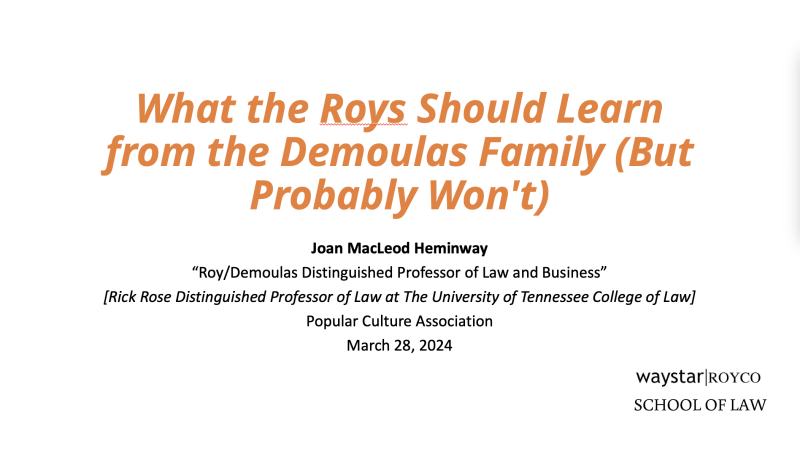
I participated in the Waystar Royco School of Law Zoom meetings as the “Roy/Demoulas Distinguished Professor of Law and Business.”  I presented on fiduciary duty issues comparing the principals of two family businesses–The Demoulas family from Northern Massachusetts and Succession‘s Roy family from New York.  You can find my Zoom session here (Passcode: #hN+7J5N).  That presentation resulted in an essay that I wrote for the DePaul Law Review issue as well as an advanced business associations course based on the Succession series. I finish teaching that course this week.  I also presented on the topic of my Succession essay at the Popular Culture Association conference back in March.  I include a screenshot of my cover slide below.

I just posted the essay to SSRN.  The piece is entitled What the Roys Should Learn from the Demoulas Family (But Probably Won’t).  The SSRN abstract is set forth below.

This essay offers a comparison of the actions taken by members of two families: the Demoulas family, best known as owner-operators of northeastern regional supermarkets, and the Roy family featured in HBO’s series “Succession.” The comparative appraisal focuses principally on the selfish pursuit of individualized financial, social, and familial status by key members of both the Demoulas and Roy families as they relate to the law of business associations (principally corporate law). At the heart of the matter is the legal concept of fiduciary duty. A comparison of the two families’ exploits reveals that lessons earlier learned by the Demoulas family (and observers of the multifaceted, multi-year litigation involving them and their business undertakings) fail to positively impact the destiny and legacy of Succession’s Roy family—at least as far as the Roy family story has been told to date. Although hope may be limited, there is still time for the remaining Roy family members to take heed and make changes.

To execute and comment on the comparison of these two families, the essay starts by outlining relevant information concerning legally recognized fiduciary duties in the corporate (and, to a lesser degree, partnership) contexts. Next, the essay offers background information about the Demoulas and Roy families and their respective businesses (both organized as corporations) and selected business dealings and governance, noting actual and potential breaches of fiduciary duty in each case. A brief conclusion offers comparative observations about the actions taken by members of the Demoulas and Roy families that contravene or challenge applicable fiduciary duties and the opportunity for general reflection. Of particular note is the observation that the ability of corporate directors and officers to comply with their fiduciary duties may become more difficult and complicated when integrating family dynamics and business succession issues into business decisions in a family business context.

I have enjoyed the research and teaching I have done in this area over the past year.  It always is nice to take a fresh approach to familiar concepts.  I daresay my students have felt the same way in covering business associations topics through the lens of the happenings in the series.  They certainly have been attentive and communicative, which is what I had been shooting for in teaching corporate and other business associations law through the course.  I am happy to answer questions about the course and provide my syllabi to anyone who wants to see what I assigned and did for the course.  Just ask.

Screen Shot 2024-04-21 at 6.42.58 PM