
Mississippi College School of Law invites applications from entry-level candidates for multiple tenure-track faculty positions expected to begin in July 2024. Our search will focus primarily on candidates with an interest in teaching one or more of the following subject areas: Civil Procedure, Business/Commercial Law, Contracts, Cyber Law/Law & Technology, International Law, and Sports/Entertainment Law. We seek candidates with a distinguished academic background (having earned a J.D. and/or Ph.D.), a commitment to excellence in teaching, and a demonstrated commitment to scholarly research and publication. We particularly encourage applications from candidates who will enrich the diversity of our faculty. We will consider candidates listed in the AALS-distributed FAR, as well as those who apply directly. Applications should include a cover letter, curriculum vitae, a scholarly research agenda, the names and contact information of three references, and teaching evaluations (if available). Applications should be sent in a single PDF to Professor Donald Campbell, Chair, Faculty Appointments Committee, via email at dcampbe@mc.edu.
Ripple and Forman
Thanks to Ann for her great “So, Ripple” post last week. I have been waiting for a case like this—one that engages a court in the details of how the Howey test applies to the way different types of cryptoassets work. I was especially interested in how the court in the SEC v. Ripple Labs opinion would handle the different ways in which cryptoassets are sold and traded. Well, now we have an opinion to work with.
I especially appreciate Ann setting the stage so well with the doctrinal legal background of the case. Well done, friend! Like Ann, I teach Securities Regulation every year. Unlike Ann, I am gleeful about teaching definitional content in the federal securities laws, including the definition of the term “security.” It is amazing how, as financial investment instruments have evolved, significant numbers of practitioners and their clients have paid insufficient attention to the niceties of that definition and the definition of the embedded term “investment contract.”
Like Ann, I am comfortable that a single financial instrument can be a security in some contexts and not in others. And, like Ann, I have questions about the court’s analysis in Ripple. Specifically, I am disappointed in the way the Ripple court fails to take on the profit expectations element of the Howey test head-on—especially as to the “Programmatic Sales” made by Ripple—sales made into the XRP market after Ripple’s initial “Institutional Sales” were made. Instead, the court’s opinion joins the concept profit expectations to the efforts of others in its analysis in ways that I find perplexing. Undertaking an analysis of the profit expectations piece of the Howey test independently may be hard work. But it may have been worth the court’s while to dig in more on whether the purchasers of XRP expect profits before assessing whether those profits are generated through the efforts of others.
For this profit expectations part of the Howey analysis, I reflect on the U.S. Supreme Court’s opinion in United Housing Foundation v. Forman. Leaving aside the fact that Forman was really a case about whether stock—not an investment contract—is a security, the Forman Court defines financial instrument profits in three distinct ways:
- “capital appreciation resulting from the development of the initial investment” (421 U.S. at 852)
- “a participation in earnings resulting from the use of investors’ funds” (421 U.S. at 852)
- the ability to resell at a price that exceeds the cost of purchase (421 U.S. at 854)
The Ripple opinion somewhat addresses each of these potential types of profit, but not always directly, distinctly, or completely. The court focuses significantly on the first of the three, noting that “the Institutional Buyers reasonably expected that Ripple would use the capital it received from its sales to improve the XRP ecosystem and thereby increase the price of XRP,” but that “Programmatic Buyers could not reasonably expect the same.” (And I am not sure about that latter piece, by the way.)
Considerations relating to the third profit type, however, may be the most interesting—and challenging in application. After reading the court’s analysis, I still had many questions about whether those who bought the XRP that Ripple was selling in the Programmatic Sales were buying because of anticipated market appreciation—appreciation that may be generated in part by the activities of Ripple in establishing and promoting (not to mention selling) XRP—or for more instrumental reasons. The court finds that “each Institutional Buyer’s ability to profit was tied to Ripple’s fortunes and the fortunes of other Institutional Buyers because all Institutional Buyers received the same fungible XRP.” Yet, those who purchased XRP in Programmatic Sales also receive that same fungible XRP. In general, I wonder how the Programmatic Sales made by Ripple are different from sales of stock made by, e.g., a founder into a preexisting trading market—an analogy worth considering.
The Ripple court’s analysis of profit expectations under Howey in its opinion is, however, combined with its inquiry as to the “efforts of others.” In my teaching, I separate Howey into five prongs: (1) contract, transaction, or scheme; (2) investment of money; (3) common enterprise; (4) expectation of profits; (5) efforts of others. Overall in my work (as exemplified in this article, in which I apply the Howey test to early crowdfunding interests), I have found it helpful to engage each of these five prongs of Howey independently, then follow with a synthesis that looks at the overall context in which the security determination is being made (including the related “economic realities” of the instrument in the circumstances). That analysis of context is, of course, invited by the lead-in to Section 2(a) of the Securities Act of 1933, as amended (the “1933 Act”), which qualifies the definitions offered in Section 2(a) by an assessment of whether “the context otherwise requires.”
The Ripple court’s failure to keep the two prongs—expectation of profits and efforts of others—analytically separate handicaps the court from addressing the Forman Court’s core argument relating to the connection between the investment of money prong and the expectation of profits prong: that an instrument may represent a consumption or other interest, rather than an investment or profit-making interest. Those who invest do so with the goal of achieving financial gain or another element of value. The Forman Court’s reasoning as applied in Ripple logically would result in a judicial determination of the nature of the XRP interest purchased by those acquiring XRP in the Programmatic Sales, which may well be different from the nature of the XRP interest acquired in the Institutional Sales. Why were purchasers of XRP acquiring it at the time Ripple was selling in the Programmatic Sales? What was at the heart of their acquisitions of XRP? The Ripple court fails to grapple with these questions.
The Ripple court does acknowledge in its opinion that some of those purchasers may have acquired XRP because they expected profits—even profits generated through Ripple’s efforts. The court offers: “Of course, some Programmatic Buyers may have purchased XRP with the expectation of profits to be derived from Ripple’s efforts.” But it discounts this rationale without offering an alternative. Instead, the court points out that Ripple never made any promises to the purchasers of XRP who bought in Programmatic Sales. Yet, explicit promises between a seller and a buyer are not the only conduct that can lead purchasers of financial instruments to expect profits . . . .
In that regard, the Ripple opinion somewhat conflates its Howey analysis of the “efforts of others” with an assessment of whether (and if so, how) Ripple offered to sell XRP to those who bought it (which may be irrelevant since Ripple did sell XRP into the market). Section 5 of the 1933 Act—the legal provision that the Securities and Exchange Commission asserts Ripple violated—only applies to offers and sales of securities. Consequently, it would seem logical to determine first whether what was offered or sold is a security and only then to address whether that security was offered or sold by the defendant.
Instead, in analyzing whether there was an expectation of profits (and whether Ripple’s efforts were sufficiently connected with profit generation) under the Howey test, the Ripple court focuses on whether the XRP purchasers knew from whom they were buying and where their money was going, alluding to a privity or tracing requirement of sorts. Specifically, the Ripple opinion avers that “with respect to Programmatic Sales, Ripple did not make any promises or offers because Ripple did not know who was buying the XRP, and the purchasers did not know who was selling it,” noting that “a Programmatic Buyer stood in the same shoes as a secondary market purchaser who did not know to whom or what it was paying its money.” These considerations are more applicable to a determination of whether Ripple was offering or selling securities to a particular purchaser—a consideration relevant in a private action under Section 12(a)(1) of the 1933 Act—than to the determination of whether XRP is a security when it is sold by Ripple into a pre-existing market.
There’s more I could say on all of this, but this post already has gotten quite long. So, I will leave it here. Suffice it to say, in addition to the profit expectations analysis in the Ripple opinion, I have questions about the Ripple court’s analysis of the investment of money and expectation of others prongs of the Howey test. Perhaps some of that will be a good topic for another post . . . .
Teaching Leadership in Law Schools – Zoom Sessions
I am a member of the Executive Committee of the Association of American Law Schools (AALS) Section on Leadership. This year, members of the have been hosting a series of Zoom forums on teaching. The remaining forums (although more may be scheduled) are set forth below.
Wednesday, July 19, 2023 – 12:00 p.m. – 1:00 p.m. EST – Joan Heminway, Interim Director, Institute for Professional Leadership and Rick Rose Distinguished Professor of Law, The University of Tennessee College of Law ,and Martin Brinkley, Dean and Distinguished Professor, University of North Carolina School of Law
Monday, September 25, 2023 – 3:00 p.m. – 4:00 p.m. EST – Lee Fisher, Dean, Cleveland State University College of Law
Wednesday, October 18, 2023 – 3:00 p.m. – 4:00 p.m. EST – Kellye Testy, President and CEO, LSAC, and Hillary Sale, Associate Dean for Strategy, Georgetown University
You can register for a session by clicking on the link for that session. As you can see, I am cohosting Wednesday’s forum, which will feature two adjunct professors who have worked with full-time faculty to design and implement law school leadership courses.
Business law and leadership are naturally related. The Section on Leadership may be something you are interested in following. If so (and you are a law professor at an AALS member school), you can register to be a member of the section here after logging into your AALS account.
So, Ripple
This week, I was going to blog about the decision in Sobel v. Thompson, 2023 WL 4356066 (W.D. Tex. July 5, 2023), where a Texas district court relied on a forum selection bylaw to dismiss a derivative Section 10(b) claim in favor of Delaware Chancery, which – you guessed it – has no jurisdiction to hear Section 10(b) claims. The court could have dismissed on the merits, especially given the dismissals of related cases in other jurisdictions, but instead, it purported to follow Lee v. Fisher, which I blogged about most recently here, but of course, Lee v. Fisher involved Section 14, and the court relied heavily on the purportedly-suspect pedigree of derivative Section 14 claims. The SolarWinds court did not bother with that kind of analysis before extending Lee v. Fisher to derivative 10(b) claims and yeah, pretty much that’s it, you can read Alison Frankel’s Reuters piece here, and in the meantime just call me Cassandra.
Anyway, I was going to blog about all of that, but now I’m not, obviously, because the summary judgment opinion in the SEC’s enforcement action against Ripple finally came down, and I think I’ve made it clear by the absence of discussion that crypto is very much not my thing but sadly I do, in fact, have to teach “What is a security” to my students so I forced myself to read the decision and, well, yikes.
*deep breath*
Section 2 of the Securities Act defines a “security” to mean multiple kinds of instruments (stock, notes, voting trust certificates), and then has a catch-all provision that an “investment contract” is a security. But “investment contract” is not a recognized type of instrument and so needed a definition. In 1946, the Supreme Court decided SEC v. Howey Co., 328 U.S. 293 (1946), which laid out the so-called Howey test for whether a new instrument is an investment contract. There must be an investment of money, in a common enterprise (which usually means pooling of investor resources), with the expectation of profit by the investor, derived from the efforts of others (usually, a centralized management team).
This test is, intentionally, broad, in order to prevent promoters from designing instruments that evade the Act but nonetheless are of the type that Congress felt needed regulation. (These instruments tend to be ones where the purchaser is vulnerable to disloyalty or shirking by centralized management, and ones where a collective action problem among investors would inhibit bargaining to cure informational asymmetries. Thus, the need for registration – forced disclosure – before their sale).
As a result, a number of rather esoteric arrangements have been found to be investment contracts. In Howey itself, purchasers bought small strips of land in an orange grove, coupled with a service contract to have the oranges cultivated and harvested. The oranges from all the plots were pooled, sold, with profits returned pro rata to each investor. The Supreme Court held that these collective arrangements were akin to buying a fractional interest in an orange business with centralized management. In another case, investors were sold chinchillas, and promised that if they bred them, the seller would repurchase the babies at a higher price and resell them to new investors. Investors were promised that raising chinchillas was nearly effortless. It wasn’t, they died, and the Eighth Circuit held that the entire set of arrangements might be the equivalent of investing in a chinchilla business, and hence potentially a security.
In Ripple, the defendants created the XRP Ledger and the XRP token, which had various uses, but critically, would end up being used for cross-border payments. Like a lot of crypto, XRP was also traded speculatively – people bought it in hopes the price would rise and they could sell it. Additionally, as I understand it, this dynamic was necessary for the cross-border payments to work. Someone wanting to transmit US dollars to someone else who would receive payment in Japanese yen would instead use the dollars to buy XRP, and then the XRP would be transmitted on the XRP Ledger, and the recipient would sell the XRP for yen. That only works if there’s consistent liquidity and transparent pricing.
The defendants generated a lot of XRP token, which they sold to initial investors – mainly institutions – touting XRP as an investment tied to the company’s success. The funds raised were used to continue to grow Ripple’s business. Defendants also made a number of public statements about XRP’s potential, including in XRP market reports and on Reddit.
Later, once a secondary market for XRP had developed, defendants sold additional XRP tokens into the market and raised funds that way. Defendants also paid employees in XRP token, which they could then sell in the secondary market.
The SEC brought an enforcement action claiming that XRP was a security, and therefore all of the defendants sold securities without registering them, in violation of Section 5 of the Securities Act. The court held that the sales to institutional investors were sales of securities, but not the remaining sales.
I’ll start with: The holding makes no sense, but to understand where it’s coming from, you need to understand the arguments, which are similar to those made in other crypto cases.
The SEC’s position was this was straight up Howey. People paid money or other currency; the common enterprise was Ripple itself and the other crypto buyers; they expected to profit by flipping the tokens – and that expectation was cultivated by Ripple itself through its statements about the tokens’ potential – and they relied on Ripple’s management team to develop use cases for the token and otherwise market it to cause the price to rise.
Among the defendants’ arguments was the claim that when the Securities Act uses the phrase “investment contract,” it means there must be something like an actual contract – a promise, or legal obligation, of some kind, between the promoter and the investor. Howey did not formally include such a requirement, but most of the cases do in fact have such a feature. In Howey, the promoter promised to cultivate the land, sell the oranges, and distribute the proceeds; in the chinchilla case, the promoter promised to buy back the chinchillas, and so forth. But with the XRP tokens, there was no obligation between Ripple/the defendants and token holders. That might not be true for all crypto tokens – there are some where the token holder has some kind of continuing rights against the issuer – but with XRP, there were no such rights. Therefore, argued the defendants, there was no contract, and no investment contract.
That argument, the court rejected, and decided to apply Howey as written:
The Court declines to adopt Defendants’ “essential ingredients” test, which would call for the Court to read beyond the plain words of Howey and impose additional requirements not mandated by the Supreme Court. The Court sees no reason to do so. Neither Howey, nor its progeny, hold that an investment contract requires the existence of Defendants’ “essential ingredients.” To the contrary, these cases make clear that the relevant test reflects a focus on an investor’s expectation of “profits . . . from the efforts of others,” rather than the formal imposition of post-sale obligations on the promoter or the grant to an investor of a right to share in profits.
The court further found that the initial institutional investors who bought XRP from the defendants clearly did so with an expectation of profit. They knew Ripple planned on using their funds to develop its business and promote the token, and they agreed to lockups and resale restrictions that only made sense if one was buying as an investment.
When it came to the sales into an existing market, however, it was a different story. Those buyers were buying in an impersonal market, and had no idea that it was the defendants, rather than anyone else, who was selling to them. That meant they had no expectation that the money they paid for their tokens would be received by Ripple and plowed back into the business. And that – said the court – meant they could not have invested with an expectation of profit from Ripple’s efforts. As the court put it:
Having considered the economic reality of the Programmatic Sales, the Court concludes that the undisputed record does not establish the third Howey prong. Whereas the Institutional Buyers reasonably expected that Ripple would use the capital it received from its sales to improve the XRP ecosystem and thereby increase the price of XRP, Programmatic Buyers could not reasonably expect the same. Indeed, Ripple’s Programmatic Sales were blind bid/ask transactions, and Programmatic Buyers could not have known if their payments of money went to Ripple, or any other seller of XRP….
Therefore, the vast majority of individuals who purchased XRP from digital asset exchanges did not invest their money in Ripple at all. An Institutional Buyer knowingly purchased XRP directly from Ripple pursuant to a contract…
It may certainly be the case that many Programmatic Buyers purchased XRP with an expectation of profit, but they did not derive that expectation from Ripple’s efforts (as opposed to other factors, such as general cryptocurrency market trends)—particularly because none of the Programmatic Buyers were aware that they were buying XRP from Ripple
Now, I’m comfortable with the idea that a particular asset may be sold as a security in some instances and not others, because whether something is promoted as “for profit” may depend on the facts and circumstances. But the distinction the court draws here does not make sense. The purchasers may not have known they were supplying capital to Ripple, but they knew what the institutional investors knew about Ripple’s intentions. They knew Ripple was making efforts to expand the business, promote the token, and develop it as an asset. They almost certainly were motivated to buy it for that reason; Ripple made statements encouraging them to do so. That they didn’t know their particular moneys would assist that effort isn’t really …. relevant. Moreover, as I said, the cross border system depended on a liquid market for XRP – of course Ripple would promote one.
What it looks to me is going on is that the court kind of stealthily accepted defendants’ “contract” argument after all, in a way. The judge held that it was a security for the buyers who had a direct relationship with Ripple and knew where their money was going. For buyers who had no such relationship, there was no security.
Presumably, the outcome would have been different if, say, the instrument were more like debt sold in an impersonal at-the-market offering. In those cases, the buyer might not know they were buying from the issuer rather than another trader, but the buyer would know they had a debt claim – a contract, with ongoing obligations – against the issuer. Thus, an expectation of profit.
In Ripple, buyers in an impersonal market did not have any expectation of profit directly from a contractual relationship (defendants’ argument), and so the court, rather than saying a contractual relationship was necessary, instead said that absent one – by directly supplying capital – there’s no expectation of profit from Ripple’s efforts. The court split the difference between the defendants’ argument and the SEC’s, and came up with something that is incoherent on its face.
She casually rejected other arguments that the buyers in the impersonal market might have expected profits from Ripple’s efforts even if they did not know they were supplying capital. She said that Ripple’s public statements – some of which were inconsistent and shared across many different media – were just too complicated to assume an ordinary retail investor, rather than an institutional investor, would have understood:
There is no evidence that a reasonable Programmatic Buyer, who was generally less sophisticated as an investor, shared similar “understandings and expectations” and could parse through the multiple documents and statements that the SEC highlights, which include statements (sometimes inconsistent) across many social media platforms and news sites from a variety of Ripple speakers (with different levels of authority) over an extended eight-year period
And, she noted, the buyers in the open market did not agree to lockups and resale restrictions, the way the institutional investors did.
That also meant the XRP issued to Ripple employees was not a security. They had not made an investment of money/currency, and they could not have functioned as underwriters with their resales because – again – sales into the impersonal market were not sales of securities.
And, with that, she said remaining issues would go to trial (these include some aiding and abetting claims, I’m not sure what else).
Okay.
Let’s just get out of the way that it’s perverse that sales to institutions are treated as securities because institutions are sophisticated. That’s backwards; it subverts the purpose of the securities laws (to protect less sophisticated investors) and contradicts other tests for whether assets are securities (the Reves test often weights investor sophistication against finding the presence of a security).
Beyond that, I would not be surprised to see both sides seek an interlocutory appeal, in which case, the Second Circuit would get a crack at it.
What about future crypto cases? Well, the thing about crypto is, the facts are different in every case. Assuming the Ripple decision is followed in other cases, some would involve ongoing obligations of some kind between the issuer and the token holder, and in those cases, courts may be more likely to find there was an expectation of profit from the promoter’s efforts. And some courts may be more sympathetic to claims that public statements promoting the token are sufficient to demonstrate an expectation of profit by open market purchasers. Those courts don’t even necessarily have to reject the Ripple analysis; they can just distinguish it, and say well, the promoters were more blatant here.
Call for Papers – Journal of Financial Market Infrastructures
Dear BLPB Readers,
I wanted to share the below call for papers with interested readers. Please note the submission deadline of September 15, 2023.
“We are welcoming submissions in the form of technical papers and policy-oriented papers (forum discussions) on the listed topics below (but not limited to). Please be aware that submissions deadline expires in September 15, 2023.
Topics of interest:
- Payment and settlement systems;
- Digital money (including CBDCs) and central bank operations;
- Trade repositories, central counterparties (CCPs) and central securities depositories (CSDs);
- Risk management of FMIs (including liquidity, market, counterparty, operational and other risks);
- Correspondent banking and network analysis of FMIs;
- Non-bank payment service providers and access to central bank payment rails;
- Exchanges and multilateral trading platforms;
- Regulation, oversight and supervision of FMIs;
- Tokenized deposits and stablecoins;
- New technologies for FMIs, including distributed ledger technologies (DLTs), machine learning (ML) and artificial intelligence (AI).
To learn more about our submission guidelines, please click here“
Belmont University College of Law – Hiring For Business Law
The Belmont University College of Law invites applications for entry-level and junior-
lateral candidates in the area of business law for a tenure-track, faculty position to
begin Fall 2024.
lateral candidates in the area of business law for a tenure-track, faculty position to
begin Fall 2024.
The Belmont College of Law encourages applications from people whose background,
life experiences, and scholarly approaches would contribute to the diversity of our
faculty, curriculum, and programs.
life experiences, and scholarly approaches would contribute to the diversity of our
faculty, curriculum, and programs.
Applicants must possess a J.D. from an accredited U.S. law school and must
demonstrate strong scholarly potential and a commitment to excellence in teaching.
Belmont is an EOE/AA employer. Belmont College of Law reserves the right to
exercise a preference for those candidates who support the goals and missions of the
University.
demonstrate strong scholarly potential and a commitment to excellence in teaching.
Belmont is an EOE/AA employer. Belmont College of Law reserves the right to
exercise a preference for those candidates who support the goals and missions of the
University.
If interested, please submit a letter of interest and curriculum vitae to the Chair of the
Faculty Recruitment Committee, Professor Kristi W. Arth, using the recruitment
committee’s email address – lawfaculty.recruitment@belmont.edu. If you have
questions about the position or Belmont University, please contact Professor Arth at
kristi.arth@belmont.edu.
Faculty Recruitment Committee, Professor Kristi W. Arth, using the recruitment
committee’s email address – lawfaculty.recruitment@belmont.edu. If you have
questions about the position or Belmont University, please contact Professor Arth at
kristi.arth@belmont.edu.
Belmont University is a private, Christian university focusing on academic excellence
and is located in the heart of Nashville, one of the fastest growing and most culturally
rich cities in the country. Belmont is the second largest private university in Tennessee
approximating 9,000 students. Belmont students come from every state, more than 35
countries, and all faiths. The Belmont faculty is dedicated to teaching, service, and
active engagement in scholarship. The median LSAT/GPA for the 124 students who
entered the law school in August 2022 were 160 and 3.70 (75th percentile: 162 and
3.88; 25th percentile: 156 and 3.47). Belmont’s ultimate bar passage rate for 2018 and
2019 was 100%, one of only a few law schools in the country to have achieved a perfect
pass rate in those years.
and is located in the heart of Nashville, one of the fastest growing and most culturally
rich cities in the country. Belmont is the second largest private university in Tennessee
approximating 9,000 students. Belmont students come from every state, more than 35
countries, and all faiths. The Belmont faculty is dedicated to teaching, service, and
active engagement in scholarship. The median LSAT/GPA for the 124 students who
entered the law school in August 2022 were 160 and 3.70 (75th percentile: 162 and
3.88; 25th percentile: 156 and 3.47). Belmont’s ultimate bar passage rate for 2018 and
2019 was 100%, one of only a few law schools in the country to have achieved a perfect
pass rate in those years.
Time for an Italian Symposium!
Ciao, from Italy.
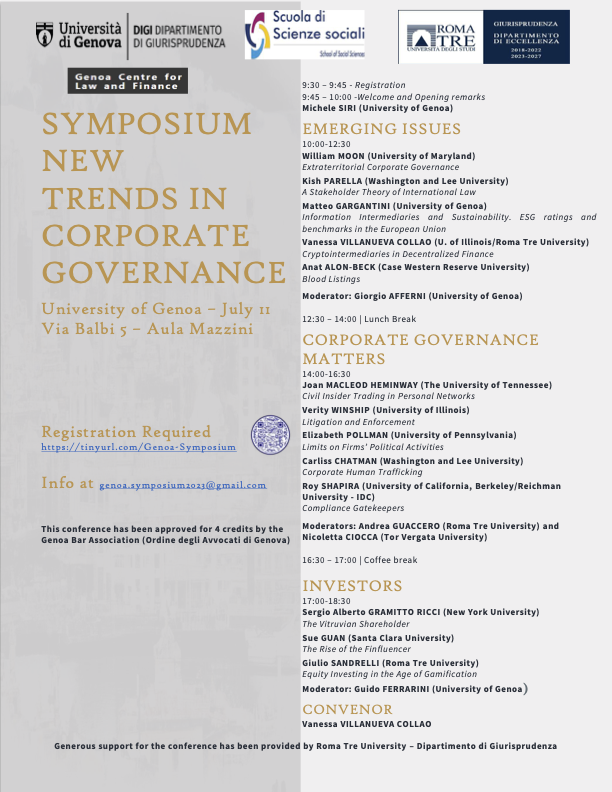
Tomorrow, I have the privilege of sharing my work in an international symposium at the University of Genoa at the invitation of Vanessa Villanueva Collao. This symposium offers a unique opportunity for transnational collaboration among corporate governance scholars. We also are celebrating Vanessa’s completion of her J.S.D. degree (University of Illinois 2023).
I am presenting my paper, forthcoming in the Michigan State Law Review, on civil insider trading in personal networks. This is the companion paper to my article on criminal insider trading in personal networks, recently published in the Stetson Business Law Review and part of my larger, long-term project on U.S. insider trading in friendships and family situations. As many readers may know, this project has fascinated me for a number of years now. Each phase of the project offers new insights. And each audience helps provide valuable food for thought. I am confident that the participants in and audience members at tomorrow’s symposium will be no exception. I look forward to the interchanges on my work and the work of others being featured.
The program for the symposium is included below. You will see more than a few fascinating members of the U.S. corporate governance law academic community (and friends of the BLPB) on the program for this event! It is always good to reconnect with colleagues, especially our contributors and readers.
Generative AI Is the Greatest Thing Since the Discovery of Fire And/Or Will Kill Us All
Depending on who you talk to, you get some pretty extreme perspectives on generative AI. In a former life, I used to have oversight of the lobbying and PAC money for a multinational company. As we all know, companies never ask to be regulated. So when an industry begs for regulation, you know something is up.
Two weeks ago, I presented the keynote speech to the alumni of AESE, Portugal’s oldest business school, on the topic of my research on business, human rights, and technology with a special focus on AI. If you’re attending Connecting the Threads in October, you’ll hear some of what I discussed.
I may have overprepared, but given the C-Suite audience, that’s better than the alternative. For me that meant spending almost 100 hours reading books, articles, white papers, and watching videos by data scientists, lawyers, ethicists, government officials, CEOs, and software engineers.
Because I wanted the audience to really think about their role in our future, I spent quite a bit of time on the doom and gloom scenarios, which the Portuguese press highlighted. I cited the talk by the creators of the Social Dilemma, who warned about the dangers of social media algorithms and who are now raising the alarms about AI’s potential existential threat to humanity in a talk called the AI Dilemma.
I used statistics from the Future of Jobs Report from the World Economic Forum on potential job displacement and from Yale’s Jeffrey Sonnenfeld on what CEOs think and are planning for. Of the 119 CEOs from companies like Walmart, Coca-Cola, Xerox and Zoom, 34% of CEOs said AI could potentially destroy humanity in ten years, 8% said that it could happen in five years, and 58% said that could never happen and they are “not worried.” 42% said the doom and gloom is overstated, while 58% said it was not. I told the audience about deepfakes where AI can now mimic someone’s voice in three seconds.
But in reality, there’s also a lot of hope. For the past two days I’ve been up at zero dark thirty to watch the live stream of the AI For Good Global Summit in Geneva. The recordings are available on YouTube. While there was a more decidedly upbeat tone from these presenters, there was still some tamping down of the enthusiasm.
Fun random facts? People have been using algorithms to make music since the 60s. While many are worried about the intellectual property implications for AI and the arts, AI use was celebrated at the summit. Half of humanity’s working satellites belong to Elon Musk. And a task force of 120 organizations is bringing the hammer down on illegal deforestation in Brazil using geospatial AI. They’ve already netted 2 billion in penalties.
For additional perspective, for two of the first guests on my new podcast, I’ve interviewed lawyer and mediator, Mitch Jackson, an AI enthusiast, and tech veteran, Stephanie Sylvestre, who’s been working with OpenAI for years and developed her own AI product somehow managing to garner one million dollars worth of free services for her startup, Avatar Buddy. Links to their episodes are here (and don’t forget to subscribe to the podcast).
If you’re in business or advising business, could you answer the following questions I asked the audience of executives and government officials in Portugal?
- How are you integrating human rights considerations into your company’s strategy and decision-making processes, particularly concerning the deployment and use of new technologies?
- Can you describe how your company’s corporate governance structure accounts for human rights and ethical considerations, particularly with regards to the use and impact of emerging technologies?
- How are you planning to navigate the tension between increasing automation in your business operations and the potential for job displacement among your workforce?
- How does your company approach balancing the need for innovation and competitive advantage with the potential societal and human rights impact of technologies like facial recognition and surveillance?
- In what ways is your company actively taking steps to ensure that your supply chain, especially for tech components, is free from forced labor or other human rights abuses?
- As data becomes more valuable, how is your company ensuring ethical data collection and usage practices? Are these practices in line with both domestic and international human rights and privacy standards?
- What steps are you taking to ensure digital accessibility and inclusivity, thereby avoiding the risk of creating or enhancing digital divides?
- How is your company taking into account the potential environmental impacts of your technology, including e-waste and energy consumption, and what steps are being taken to mitigate these risks while promoting sustainable development?
- What financial incentives do you have in place to do the ”right thing” even if it’s much less profitable? What penalties do you have in place for the “wrong” behavior?
- Will governments come together to regulate or will the fate of humanity lie in the hands of A few large companies?
Luckily, we had cocktails right after I asked those questions.
Are you using generative AI like ChatGPT4 or another source in your business 0r practice? If you teach, are you integrating it into the classroom? I’d love to hear your thoughts.
The one where the word “noobs” appears in an opinion of the Court of Chancery
Today, I’m blogging about Vice Chancellor Laster’s post-trial decision in In re Columbia Pipeline Group Merger Litigation. This is a fascinating case for many reasons, starting with its procedural history.
The sum is, TransCanada bought Columbia Pipeline in 2016, and shareholders have been suing about it ever since.
First, there was a fiduciary claim against the Columbia Pipeline directors, which was dismissed on the pleadings. Then, there was a securities action in federal court alleging disclosure failures in the merger proxy, which was also dismissed on the pleadings. Then, there was an appraisal action, which resulted in a judgment that the deal price was equal to the fair value. And then, finally, there was the second fiduciary action – this action, which made it to trial – and which Laster refused to dismiss on the pleadings in March 2021. The plaintiffs brought claims against Robert Skaggs, the CEO and Chair, and Stephen Smith, the CFO and Executive VP. They also sued TransCanada as an aider and abetter of Skaggs’s and Smith’s fiduciary breaches.
On the motion to dismiss back in 2021, no one claimed that the first fiduciary action – where the plaintiffs had not even sought books and records – was preclusive of the second one, but the defendants did argue that the earlier securities action and the appraisal action precluded – through estoppel, or as precedent, or as persuasive legal authority – the second fiduciary action.
Laster rejected both arguments. For the earlier securities action, he spent some time on the difference between federal and Delaware’s pleading standards, but his reasoning carries a whiff of disdain for federal courts’ understanding of materiality in the merger context.
As for the appraisal action, he held that it was asking a different legal question than the fiduciary action, namely, whether the deal price represented fair value, not whether Skaggs and Smith breached their fiduciary duties by failing to obtain the best value for the stockholders.
The upshot of all of this was that Laster permitted a fiduciary claim to proceed against Skaggs, Smith, and TransCanada. After the Skaggs and Smith settled, the claims against TransCanada proceeded to trial, and that was the decision issued earlier this week, where Laster found that TransCanada did, in fact, aid and abet breaches of fiduciary duty.
Several things to talk about here, so behind a cut it all goes.
Continue Reading The one where the word “noobs” appears in an opinion of the Court of Chancery
Fourth of July Learning Moment – Foundations of U.S. Business Law
The history of the present King of Great Britain is a history of repeated injuries and usurpations, all having in direct object the establishment of an absolute Tyranny over these States. To prove this, let Facts be submitted to a candid world.
. . .
He has combined with others to subject us to a jurisdiction foreign to our constitution, and unacknowledged by our laws; giving his Assent to their Acts of pretended Legislation:
. . .
For cutting off our Trade with all parts of the world:
For imposing Taxes on us without our Consent:
. . .
We, therefore, the Representatives of the United States of America, in General Congress, Assembled, appealing to the Supreme Judge of the world for the rectitude of our intentions, do, in the Name, and by Authority of the good people of these Colonies, solemnly publish and declare, That these United Colonies are, and of Right ought to be Free and Independent States; that they are Absolved from all Allegiance to the British Crown, and that all political connection between them and the State of Great Britain, is and ought to be totally dissolved; and that as Free and Independent States, they have full Power to . . . establish Commerce, and to do all other Acts and Things which Independent States may of right do. And for the support of this Declaration, with a firm reliance on the Protection of Divine Providence, we mutually pledge to each other our Lives, our Fortunes and our sacred Honor.
Words from the Declaration of Independence that protected and catalyzed the development of the laws that I teach. Of course, there is a lot more there than support for self-determined business laws. Perhaps as a result, I rarely have paused to consider the importance of our Declaration of Independence to U.S. business law.
Is the connection obvious? Yes. We all learn about the Boston Tea Party in school, and I worked downtown in the Government Center part of Boston for the better part of fifteen years at the beginning of my career–a constant reminder of that part of our history. But, for me, the connection of the Declaration of Independence to business law has been all but ignored–or at least forgotten.
Today, I am grateful for this part of the Declaration of Independence as well as the rest. We do not always execute our lawmaking freedom perfectly, but our laws are ours. And that’s important.
Happy Fourth to all!