
Ave Maria School of Law seeks applicants for an entry-level tenure-track position to begin in the 2026-2027 academic year.  In particular, we seek faculty teaching in the 1L areas of Contracts and Property, which at Ave Maria involve significant student contact. Candidates may also be requested to teach a section of business law courses such as Business Organizations or Commercial Law from time to time. Applicants must have a Juris Doctorate or equivalent degree and a strong academic record.  Responsibilities will include teaching, scholarship, and service to the Law School and community.

Ave Maria offers students a distinctive legal education marked by the integration of the Catholic faith and the law. Students are trained to reflect critically on the law and to understand that all areas of legal practice serve the common good. The Law School emphasizes the importance of faith and community among its faculty, staff, and students, and desires applicants attracted by, and supportive of its mission. The Law School community is small but close-knit and seeks faculty members who will participate in, and contribute to, its continued growth.

Ave Maria School of Law recognizes the inherent value and dignity of all members of the human family. The

THE UNIVERSITY OF KENTUCKY ROSENBERG COLLEGE OF LAW invites applications to fill three regular title series tenure-track faculty positions at the rank of Assistant or Associate Professor, beginning in August 2026. The positions will be 9-month appointments corresponding with the University’s fall and spring. The College welcomes applications from candidates across all areas of law and particularly from persons whose teaching interests span multiple subjects. Contracts, business law, and commercial law are among the subjects sought. We may consider an applicant for a full Professor position. The Rosenberg College of Law is an important part of a major research university and offers a collegial and supportive atmosphere for its faculty, staff, and students. Applicants should have a J.D. or equivalent law degree, a record of high academic achievement, and a demonstrated potential for excellence in teaching and in scholarly productivity. Successful applicants will be expected to distribute their work effort as follows: 45% of effort into teaching, 45% of effort into research, and 10% of effort into service. We are interested in applicants with a wide variety of professional and academic experiences and backgrounds. Salary for this position will be commensurate with experience.  

To receive consideration for this position

Friend-of-the-BLPB Beth Burch has announced that the University of Georgia School of Law is conducting an open-rank search for four or five full-time, tenure-track or tenured faculty. Hiring priorities include multiple business law areas–contracts, bankruptcy, and secured transactions–as well as property, torts, environmental law, business law/corporations, banking, international law, administrative law, and employment law. You can find the posting here.

If you’re interested, feel free to reach out to Beth at LawHiring@uga.edu.

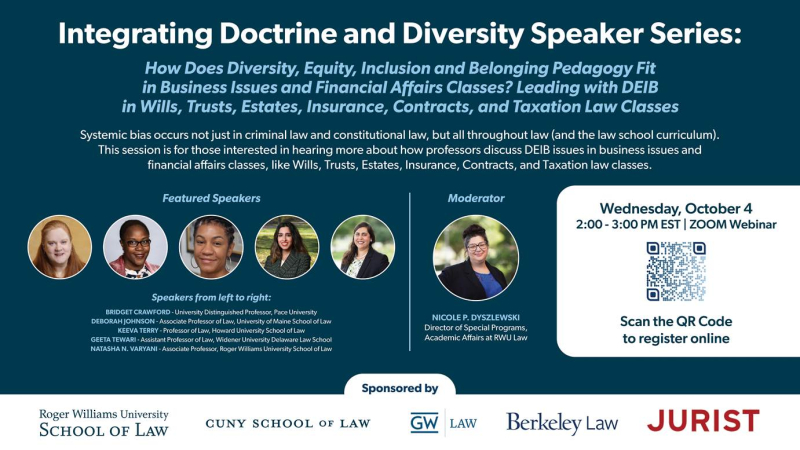
Friend of the BLPB Geeta Kohli (formerly Tewari) at Widener Law Delaware recently launched a newsletter on Substack called Defining Money that may be of interest to business law profs and their students (as well as others). She circulated a message about the newsletter through the AALS Section on Business Associations listserv earlier this week–very timely as we all start to prepare for fall classes. I have checked the newsletter out. Geeta covers a bunch of great topics (some traditional in the business law space and some nontraditional but truly helpful–including for family businesses and the divorce and trust/estate law areas that intersect with family business practice) informed by her business law background and personal experience. Here is what she personally noted in the listserv message.

I’ve recently launched a newsletter called Defining Money, where each week I break down a finance or business law term and pair it with a short story or example-designed especially for those of us who may have experienced financial issues or abuse. After the semester starts, I’ll be focusing more on contract and business related terms.

This project grew out of my desire to make financial concepts more accessible, particularly for students navigating

Friends keep sending me contracts they created with ChatGPT or Claude.

They read well. The formatting is clean.

But essential clauses are often missing—or the terms don’t reflect the actual business deal.

Sometimes I revise heavily. Sometimes I start over.

This post isn’t about whether AI is capable.

It’s about whether the person prompting knows how contracts actually work in business.

A contract isn’t a CYA document like my friends think. It reflects how the parties have chosen to allocate risk, reflect their priorities, and protect relationships and business interests.

AI can assist with drafting. I use it. I teach it. But without commercial judgment, even the best prompt won’t protect the business.

We’re need to train future lawyers and all workers not to rely on AI but to partner with it.

At University of Miami School of Law, we’re preparing students to step into the real world—with both digital and business acumen.

In our Transactional Skills Program, students don’t learn theory.

They negotiate, redline, bill, meet with simulated clients, and use AI responsibly. They also work with real-world agreements—documents they’ll see in practice:

✅ NDAs, employment, and contractor agreements

✅ SaaS, MSAs, and licensing deals

✅ Escrow, loan

This year’s symposium, titled Navigating the Relationship Between the Administrative State and Emerging Technology, will focus on the evolving regulatory frameworks around emerging technologies like digital assets and artificial intelligence (AI). These technologies are rapidly transforming the way individuals and businesses engage in commerce, interact socially, and innovate. These advancements, however, raise profound questions about the applicability of existing regulatory structures. The symposium will bring together leading experts to discuss how the administrative state can balance the protection of innovation with the mitigation of risks associated with these technologies, while ensuring that laws evolve to meet the challenges of the future.

We are thrilled to welcome Michele Korver, Head of Regulatory & Operating Partner at a16z crypto, to deliver the opening keynote. Michele’s wealth of experience in both the public and private sectors will provide invaluable insights into the state of digital asset regulation. The event will conclude with a thought-provoking closing address, offering reflections on the key discussions of the day.

Welcome and Opening Remarks (1:15 PM – 1:25 PM)

The symposium will begin with brief welcoming remarks, setting the stage for an afternoon of in-depth discussions and exploring the complexities surrounding the intersection of technology, law, and
Mercer University School of Law invites applications for up to two faculty members (one entry-level and one tenured), with appointments beginning in Fall 2025. We welcome applicants from all subject areas, with a particular focus on legal writing, commercial law, contracts, evidence, and remedies.

Founded in 1873, Mercer University School of Law has a long tradition of producing practice-ready lawyers who are committed to service. The school has earned a reputation for providing excellent legal education with an intense focus on student and faculty interaction. With an enrollment of approximately 375 students, Mercer Law School is one of 12 schools and colleges of Mercer University, which is consistently listed among the top institutions of higher education in the nation. The School of Law is nationally recognized for its exceptional programs in legal writing, advocacy (moot court and mock trial), public service, and professionalism and ethics.

The School of Law is located in Macon, Georgia, a city of approximately 156,000 residents. Macon is known for its rich musical heritage (e.g., Otis Redding, Little Richard, the Allman Brothers), vibrant arts community, recreational offerings (e.g., the Ocmulgee Mounds National Historic Park), and affordable cost of living. Located 85 miles from Atlanta, Macon offers

A law firm recently reached out to me to conduct a CLE on Mental Health Challenges in the Age of AI. It was an interesting request. I’ve spoken about AI issues on panels, as a keynote speaker, and in the classroom, and I wrote about it for Tennessee Journal of Business Law. I also conduct workshops and CLEs on mental health in the profession. But I’ve never been asked to combine the topics. 

Before I discussed issues related to anxiety about job disruption and how cognitive overload affects the brain, I spent time talking about the various tools that are out there and how much our profession will transform in the very near future.

If you’re like many lawyers I know, you think that AI is more hype than substance. So I’ll share the information I shared with the law firm.

According to a  2024 Bloomberg survey on AI and the legal profession, 69% of Bloomberg survey respondents believe generative AI can be used ethically in legal practice. But they harbor “extreme” or “moderate” concerns about deep fakes (e.g., human impersonations, hallucinations and accuracy of AI-generated text,  privacy, algorithmic bias, IP, and of course, job displacement.

Those are all legitimate

I’m super excited to attend and moderate a panel on How to Improve Your Contract Skills with Gen AI Tools and Products at the ContractsCon in Las Vegas from January 22-23, 2025. As the GC for a startup and a nonprofit, and someone who directs the Transactional Skills Program for a law school, I have to stay up to date on the future of contracts for my clients and to prepare our students for a world that will be completely different from the one they expected.

This is not the typical boring CLE. How to Contract Founder, Laura Frederick describes it as “practical training for the work you do all the time.For every mega M&A transaction or financing, there are thousands of regular contracts that companies handle day-in and day-out. This training helps you learn how to do those BETTER with strategies based on best practices used by top lawyers with solid real-world in-house experience. Have a ton of experience already? This event is perfect for lawyers and professionals with 10+ years of contract experience too. We’ve added a whole day of training built to teach advanced contract skills. Plus you can connect with your peers and help out

One of the best ways for students to feel like “real lawyers” is for them to negotiate and draft contracts. The University of Miami will be announcing an inaugural invitational in the coming weeks so if you want to be in sunny Florida in early February, stay tuned. That competition will not require knowledge of M&A.

If M&A is your happy place, here’s a fantastic opportunity from the American Bar Association. 

MAC CUP II- ABA M&A Committee Invitational

Fall 2024 – January 2025

Application and Preliminary Instructions

The M&A Committee of the American Bar Association’s Business Law Section is seeking applications from JD students enrolled in ABA-approved law schools in the US and Canada to participate in its annual ABA M&A Committee Invitational (the “MAC Cup”).

Get your sunscreen and sunglasses ready — the “Final Four” teams will win an expense-paid trip to Laguna Beach, California, to compete for the championship at the ABA M&A Committee’s annual meeting on January 30 – 31, 2025.

Students should apply, and will participate, in teams of two. Qualifying rounds will be held during Fall 2024, with final rounds in January 2025. Additional information is attached below. Materials from last year’s MAC Cup, and