
One of the best ways for students to feel like “real lawyers” is for them to negotiate and draft contracts. The University of Miami will be announcing an inaugural invitational in the coming weeks so if you want to be in sunny Florida in early February, stay tuned. That competition will not require knowledge of M&A.

If M&A is your happy place, here’s a fantastic opportunity from the American Bar Association. 

MAC CUP II- ABA M&A Committee Invitational

Fall 2024 – January 2025

Application and Preliminary Instructions

The M&A Committee of the American Bar Association’s Business Law Section is seeking applications from JD students enrolled in ABA-approved law schools in the US and Canada to participate in its annual ABA M&A Committee Invitational (the “MAC Cup”).

Get your sunscreen and sunglasses ready — the “Final Four” teams will win an expense-paid trip to Laguna Beach, California, to compete for the championship at the ABA M&A Committee’s annual meeting on January 30 – 31, 2025.

Students should apply, and will participate, in teams of two. Qualifying rounds will be held during Fall 2024, with final rounds in January 2025. Additional information is attached below. Materials from last year’s MAC Cup, and

The School of Law at Texas Tech University invites applications for a full-time, 9-month tenure-track Professor of Law position to begin in August of 2025.  The position is open to both entry-level candidates and candidates who are on the tenure-track or tenured at another school.  Candidates who satisfy Texas Tech University’s requirements to be hired with tenure will also be eligible to hold the Frank McDonald Endowed Professorship in business law.

Required Qualifications

In line with TTU’s strategic priorities to engage and empower a diverse student body, enable innovative research and creative activities, and transform lives and communities through outreach and engaged scholarship, applicants should have experience or demonstrated potential for working with diverse student populations at the undergraduate and/or graduate levels within individual or across the areas of teaching, research/creative activity, and service.

Specific required qualifications are:

  1. Candidates should have a J.D.;
  2. Candidates should have a demonstrated potential for excellence in research, teaching, and service; and
  3. Candidates should have demonstrated potential for excellence in the areas of Contracts and in corporate/business law, such as Business Entities, Securities Regulation, Mergers & Acquisitions, and related courses.

Preferred Qualifications

In addition to the required qualifications, individuals with the following preferred qualifications are

Many in the business law world have been following the saga involving the adoption of  S.B. 313 by Delaware’s General Assembly last week.  S.B. 313 adds a new § 122(18) to the General Corporation Law of the State of Delaware (DGCL) that broadly authorizes corporations to enter into free-standing stockholder agreements (not embodied in the corporation’s charter) that restrict or eliminate the management authority of the corporation’s board of directors.  See my blog posts here and here and others cited in them, as well as Ann’s post here.

In the floor debate on S.B. 313 last Thursday in the Delaware State House of Representatives, a proponent of the legislation stated that fiduciary duties always trump contracts.  That statement deserves some inspection in a number of respects.  I offer a few simple reflections here from one, limited perspective.

The historical centrality of corporate director fiduciary duties (which were the fiduciary duties referenced on the House floor) is undeniable.  Those who have taken business associations or an advanced business course with me over the years know well that I emphasize in board decision making that the directors’ actions must be both lawful and consistent with their fiduciary duties in order to

We just finished our second week of the semester and I’m already exhausted, partly because I just submitted the first draft of a law review article that’s 123 pages with over 600 footnotes on a future-proof framework for AI regulation to the University of Tennessee Journal of Business Law. I should have stuck with my original topic of legal ethics and AI.

But alas, who knew so much would happen in 2023? I certainly didn’t even though I spent the entire year speaking on AI to lawyers, businesspeople, and government officials. So, I decided to change my topic in late November as it became clearer that the EU would finally take action on the EU AI Act and that the Brussels effect would likely take hold requiring other governments and all the big players in the tech space to take notice and sharpen their own agendas.

But I’m one of the lucky ones because although I’m not a techie, I’m a former chief privacy officer, and spend a lot of time thinking about things like data protection and cybersecurity, especially as it relates to AI. And I recently assumed the role of GC of an AI startup. So

Widener Law Commonwealth seeks an entry-level or pre-tenure lateral faculty member to fill one tenure track position starting in the 2024-2025 academic year. We have a specific need in our year-long Contracts course. The remainder of the teaching package is flexible. This position reports to the dean of the law school.

WLC is a dynamic community of teachers and scholars. We pride ourselves on our dedication to our students, our engagement with teaching, and our scholarly impact. Many of our scholars are actively engaged in law reform efforts at both the state and federal level.

The law school is committed to fostering an environment in which faculty, staff, and students from a variety of backgrounds, cultures, and personal experiences are welcomed and can thrive. Faculty and staff are active participants in our work to enhance diversity, equity, inclusion, and belonging. We welcome applications from members of historically underrepresented groups.

Established in 1989, Widener Law Commonwealth is an independently accredited law school within Widener University. Located in Harrisburg, PA, the law school’s location in the capital of Pennsylvania provides impactful experiences for both our faculty and students. . . .

+++++

The full position announcement is here.


BLPB(DiversityProgramGraphic)

RWU Law looks forward to the next installment of the Integrating Doctrine & Diversity Speaker Series:

HOW DOES DIVERSITY, EQUITY, INCLUSION AND BELONGING PEDAGOGY FIT IN BUSINESS ISSUES AND FINANCIAL AFFAIRS CLASSES? LEADING WITH DEIB IN WILLS, TRUSTS, ESTATES, INSURANCE, CONTRACTS, AND TAXATION LAW CLASSES

Wednesday, October 4 | 2:00 – 3:00 PM EST

Zoom Webinar Registration here.

Details about the Featured Speakers & Program here.

Greetings from SEALS, where I’ve just left a packed room of law professors grappling with some thorny issues related to ChatGPT4, Claude 2, Copilot, and other forms of generative AI. I don’t have answers to the questions below and some are well above my pay grade, but I am taking them into account as I prepare to teach courses in transactional skills; compliance, corporate governance, and sustainability; and ethics and technology this Fall.

In no particular order, here are some of the questions/points raised during the three-hour session. I’ll have more thoughts on using AI in the classroom in a future post.

  1. AI detectors that schools rely on have high false positives for nonnative speakers and neurodivergent students and they are easy to evade. How can you reliably ensure that students aren’t using AI tools such as ChatGPT if you’ve prohibited it?
  2. If we allow the use of AI in classrooms, how do we change how we assess students?
  3. If our goal is to teach the mastery of legal skills, what are the legal skills we should teach related to the use of AI? How will our students learn critical thinking skills if they can
An ambitious question, yes, but it was the title of the presentation I gave at the Society for Socio-Economists Annual Meeting, which closed yesterday. Thanks to Stefan Padfield for inviting me.

In addition to teaching Business Associations to 1Ls this semester and running our Transactional Skills program, I’m also teaching Business and Human Rights. I had originally planned the class for 25 students, but now have 60 students enrolled, which is a testament to the interest in the topic. My pre-course surveys show that the students fall into two distinct camps. Most are interested in corporate law but didn’t know even know there was a connection to human rights. The minority are human rights die hards who haven’t even taken business associations (and may only learn about it for bar prep), but are curious about the combination of the two topics. I fell in love with this relatively new legal  field twelve years ago and it’s my mission to ensure that future transactional lawyers have some exposure to it.

It’s not just a feel-good way of looking at the world. Whether you love or hate ESG, business and human rights shows up in every factor and many firms have built

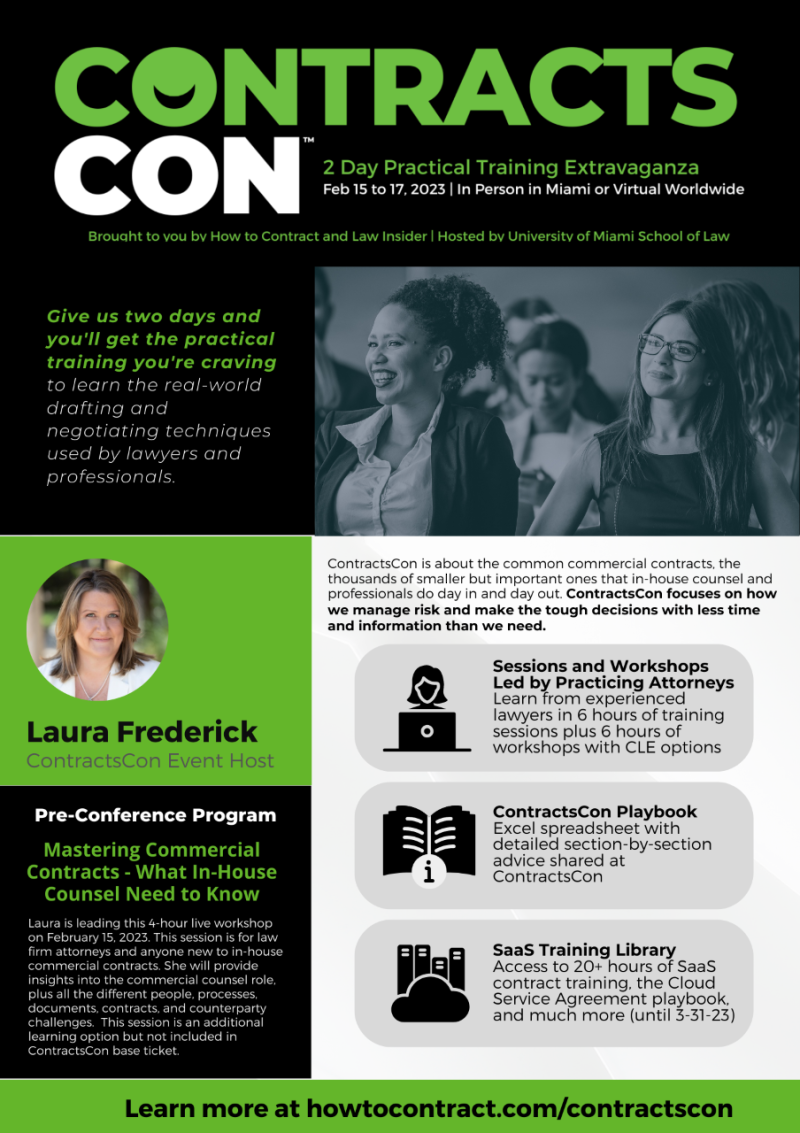
It’s the holidays and it’s time to treat yourself and members of your team to practical training and fantastic networking in sunny Miami in February. We don’t have bomb cyclones down here. The Transactional Skills Program at the University of Miami School of Law couldn’t be more excited to host the How to Contract Conference from February 15-17, 2023. 

Thumbnail_ContractsCon Flyer - 1 page (12-23-2022)

  • ContractsCon is a training and networking EXTRAVAGANZA focused on the practical contract drafting and negotiating skills that in-house counsel and contracts professionals need to know. 
  • This event is a zero-fluff, to-the-point training on the nitty-gritty details. ContractsCon includes:
    • speakers who get the in-house experience and can explain why we draft the way we do
    • training centered around provision-level playbooks for you and your company to use when you return to work
    • workshops that provide a deeper dive into more nuanced topics and include interactive group activities
    • ContractsCon Playbook, featuring the advice and drafting approaches discussed at ContractsCon
    • access to How to Contract’s SaaS Contracts Training Library, with 20+ hours of training videos, the Cloud Services Agreement Playbook, and lots more (through March 31, 2023)
    • CLE pending in 26 states for up to 7 hours for virtual ticket holders and up to 13 hours for in-person attendees
  • ContractsCon is an annual

I had originally planned to post Pt. 2 of the blog post I did a couple of weeks ago, but this announcement is time sensitive.

I’m thrilled to announce that the Transactional Skills Program at the University of Miami School of Law is partnering with Laura Frederick for the second How to Contract conference. It’s time sensitive because we are considering holding a side event with a contract drafting and negotiation competition for law students if there’s enough interest. If you think you would be interested, please email me at mweldon@law.miami.edu.

For lawyers, there are virtual and live options for the contract conference. I’ve cut and pasted from the website so you can see why you should come to sunny Miami (and it won’t be hurricane season):

It is not about the mega deals.

ContractsCon is about the contracts you work on EVERY DAY. We want to help you learn how to draft and negotiate the deals you see all the time.

Because for every 100-page specialized contract sent to outside counsel, there are thousands of smaller but important ones that in-house counsel and professionals do day in and day out.

ContractsCon focuses on how we manage risk and make the tough decisions with less