
States frequently compete with each other to attract businesses.  They’ll offer tax credits, subsidies, and regulatory waivers to persuade corporations to set up shop locally.  (Right now, Amazon is asking cities to compete to host its second headquarters.)  These incentives may or may not work out well for the state; it’s not uncommon for the promised jobs to disappear.  Meanwhile, competition among states can promote a race to the bottom, with states offering increasingly generous – and unaffordable – financial packages in exchange for a temporary boost in economic activity.

Wisconsin’s new deal with Foxconn represents a striking new frontier in these wars between the states.  Foxconn is a Taiwanese company with a history of reneging on its promises to establish manufacturing plants in exchange for rich government incentives.  Nonetheless, Wisconsin has promised it $2.85 billion over 15 years if it will build a $10 billion plant and hire 13,000 workers.   And to sweeten the deal, Wisconsin has also promised Foxconn preferential treatment in the Wisconsin court system.

Apparently concerned that its grant of certain environmental waivers may prompt local lawsuits, Wisconsin has promised Foxconn an expedited litigation process, including automatic stays of trial court orders, interlocutory appeals, and priority review by the Wisconsin Supreme Court for any legal challenges to Wisconsin’s decisions regarding Foxconn.  The legislation does not single out Foxconn specifically for these benefits; it simply says that they apply to any litigation concerning an Electronic and Information Technology Manufacturing Zone, but I gather Foxconn’s is the only such zone around.

A memo from the Wisconsin Legislative Council expresses concern that the litigation provisions may violate Wisconsin’s constitution by interfering with the independence of the judiciary.  (I’d also wonder about equal protection, since Foxconn is being singled out, if not by name).  But leaving aside the constitutional issues, I’m deeply troubled by the precedent.  If Wisconsin is promising favorable treatment in court, other states may feel they have to match those benefits in the future.   Corporations can already opt out of the legal system in many respects via arbitration agreements inserted into contracts of adhesion; I fear a future where for noncontractual disputes, we get a tiered court system, in which corporations are able to buy their preferred rules of civil procedure.

Below are a few wellness tips, with a focus on student life. I didn’t do all, or even many, of these things consistently well when I was in school, but I was better off when I did, and I paid for it when I didn’t. Many of these things are obvious, but many are also ignored.

Consistent Sleep. Sleep is incredibly important. So many of the things we do during waking hours depend on getting good sleep. Shoot for going to bed at a consistent time and waking up at a consistent time. This might be difficult with roommates and you may need to request new roommates. All-nighters, either from studying or social events, are relatively common in college and law school, but all-nighters almost always produce more poor results than if the studying or social events were more evenly distributed across the semester. Sadly, I see too many students sleep walking through the day, armed with caffeine to self-medicate.

Eat Well. I am always in search of fast, healthy, and inexpensive meals. The options are not plentiful, but I can really feel it when the quality of my food slips. Thankfully, most colleges, like Belmont, have a well-stocked cafeteria, but students still have to make the right choices within the cafeteria.  

Exercise Regularly. I definitely ignored this tip for my first year and a half of law school, but making time for regular exercise is important for wellness.  (Shoot for 2 ½ hours a week)

Intentional Quiet Time. Carving out time that is intentionally quiet and reflective is a constant struggle, but it can really improve the day, even if it is just 10-15 minutes.   

Distraction-Free Studying. Sometimes students who did poorly on an exam claim that they studied for “48 hours straight” for my exam. As discussed above, this is a bad idea because it interrupts consistent sleep. I also ask where this studying was done. Often this studying was done in a noisy dorm room, with the TV on, which simply isn’t a very efficient way to study. Students may not read many physical books these days, but the library is still a great place to get in some focused, distraction-free studying.  

Quality Social Time. During my first two years of college I had much more social time than during the last two, but I had more quality time during the last two years. Too much of social time is unintentional and low quality – playing video games comes to mind. Better, I think, is to spend social time creating memories, taking trips, having focused conversations.

Extracurricular Focus. Opinions will differ on this, but I think it is better to do a few extracurricular activities really well rather than being involved in fifteen different things, on a very surface level. Personally, I am more impressed by someone who was a captain of a sports team or president of a serious organization or founded and grew their own organization or worked dozens of hours a week or started their own business than I am by someone who just showed up for a plethora of somewhat unrelated organizations. That said, college and even graduate school can and should be places to explore, so, by all means, check out many different extracurricular activities, but try to just pick a couple, relatively early on, to do with excellence.

This from friend-of-the-BLPB Andrea Boyack, Professor of Law and Co-Director of Business & Transactional Law Center at the Washburn University School of Law:

POSITION ANNOUNCEMENT – DEAN, SCHOOL OF LAW

Washburn University invites applications and nominations for the position of Dean of the Washburn University School of Law. The Law School is recognized for its outstanding teaching and faculty scholarship and its commitment to public service. It has a highly favorable student/faculty ratio, with an excellent student body drawn from a national pool.

One of only two law schools in the state of Kansas, Washburn University School of Law is located in Topeka, the state capital. It was established in 1903 and has built a long tradition and legacy of providing an outstanding legal education. Washburn Law offers a broad-based curriculum in national and international law to students enrolled in the J.D., LL.M., and M.S.L. programs. It features six centers for excellence, nine certificate programs, and four dual degree programs. The thirty-two full-time faculty members, along with a strong cohort of adjunct professors, teach and conduct scholarship across a wide array of legal specializations. The Law School enjoys a dedicated staff and strong support from the community.

For more than a century, Washburn Law has demonstrated its commitment to academic excellence, innovation, and diversity. Students choose from nearly 150 courses, including a variety of seminars and clinical offerings. From the first year through graduation, the comprehensive curriculum and innovative programs prepare students for success in the legal profession. For over forty years, Washburn’s Law Clinic has functioned as an in-house general practice law firm, providing students the opportunity to represent actual clients in eight practice areas.

Washburn University School of Law has excelled in the categories most important to our students and alumni: a high-quality curriculum; an exceptional faculty; outstanding library resources; favorable graduation statistics, bar passage rates, and employment outcomes; and affordability. Among other accolades, Washburn University School of Law is ranked #2 in the nation for Government Law and is one of twenty law schools recognized by National Jurist as “Top Law Schools for Government Jobs.” Washburn Law is also among the top seventeen law schools in the country for Business and Corporate Law programs. Washburn Law’s Trial Advocacy program is ranked in the top sixteen programs this year.

Washburn Law’s six signature programs – the Center for Law and Government, the Center for Excellence in Advocacy, the Business and Transactional Law Center, the Children and Family Law Center, the Oil and Gas Law Center, and the International and Comparative Law Center – establish an extensive learning network for law students and experienced professionals.

Our Legal Analysis, Research, and Writing program is consistently recognized as a top program by U.S. News & World Report, ranked 15th in the nation in the current edition. We are one of only a few law schools in the country with full-time, tenured and tenure-track legal writing professors who are involved in service and scholarship in the national legal writing community.

WashLaw, initiated in 1991 by the Washburn Law Library, is a legal research portal that provides users with links to significant sites of law-related materials on the Internet. It is one of the premier legal internet research services available to a worldwide audience of practicing and academic legal experts. WashLaw also hosts a large number of law-related discussion groups.

Washburn University seeks an exceptional candidate who has the vision, strategic acumen, entrepreneurial spirit, character, and presence to enhance the school’s existing strengths while moving the School of Law forward to a higher level of distinction. The Dean serves as the academic, fiscal, and administrative leader for the School of Law.

The School of Law is seeking a Dean who will work with the School of Law community to articulate a strategic vision to enhance its reputation, strengthen its fiscal position, and lead its efforts to meet the challenges of the changing landscape for legal education. The successful applicant must have a J.D. degree and demonstrate critical thinking and an ability to adapt to the changing market while moving the School of Law forward successfully.

The successful candidate will have a record of experience commensurate with appointment as a Professor of Law; a passion for academic excellence and intellectual inquiry; a recognized dedication to teaching excellence; a demonstrated commitment to institutional and community service; a thorough and current understanding of the legal environment; effective interpersonal and communication skills; and the ability to develop strong relationships with all of the law school’s constituencies thereby growing private financial support for the School of Law. Candidates must possess a collaborative work style, well-developed organizational skills, a commitment to diversity and inclusion, and the highest degree of integrity and professionalism. A record of progressively responsible leadership experience in administration is required.

To be considered, submit electronically in pdf format a cover letter, resume, and at least three references to Joan Bayens at joan.bayens@washburn.edu. A search committee will begin to review candidate materials by October 27, 2017, and will continue until interviews are scheduled. Employment at Washburn University will be conditioned upon satisfactory completion of a background check. The successful candidate will submit official transcripts prior to hire. Washburn University is an Equal Opportunity Employer. To enrich education through diversity, candidates from underrepresented groups are encouraged to apply.

No one had a National Compliance Officer Day when I was in the job, but now it’s an official thing courtesy of SAI Global, a compliance consulting company. The mission of this one-year old holiday is to:

  • Raise awareness about the importance of ethics and compliance in business and shine a spotlight on the people responsible for making it a reality.
  • Provide resources to promote the wellness and well-being of ethics and compliance professionals so they can learn how to overcome stress and burnout.
  • Grow the existing ethics and compliance community and help identify and guide the next generation of E&C advocates.

Although some may look at this skeptically as a marketing ploy, I’m all for this made-up holiday given what compliance officers have to deal with today.

Last Saturday, I spoke at the Business Law Professor Blog Conference at the University of Tennessee about corporate governance, compliance, and social responsibility in the Trump/Pence era. During my presentation, I described the ideal audit committee meeting for a company that takes enterprise risk management seriously. My board agenda included: the impact of climate change and how voluntary and mandatory disclosures could change under the current EPA and SEC leadership; compliance budgetary changes; the rise of the whistleblower; the future of the DOJ’s Yates Memo and corporate cooperation after a recent statement by the Deputy Attorney General; SEC and DOJ enforcement priorities; data protection and cybersecurity; corporate culture and the risk of Google/Uber- type lawsuits; and sustainability initiatives and international governance disclosures. I will have a short essay in the forthcoming Transactions: The Tennessee Journal of Business Law but here are a few statistics that drove me to develop my model (and admittedly ambitious) agenda:

  • According to an ACC survey of over 1,000 chief legal officers:
    • 74% say ethics and compliance issues keep them up at night
    • 77% handled at least one internal or external compliance-related investigation in their department
    • 33% made policy changes in their organizations as a result of geopolitical events.
    • 28% were targeted by regulators in the past two years
  • Board members polled in September 2016 were most concerned about the following compliance issues:
    • Regulatory changes and scrutiny may heighten
    • Cyber threats
    • Privacy/identity and information security risks
    • Failure of corporate culture to encourage timely identification/escalation of significant risk issues
  • During the 2017 proxy season, shareholders submitted 827 proposals (down from 916 in 2016):
    • 112 related to proxy access,
    • 87 related to political contributions and lobbying,
    • 35 focused on board diversity (up from 28 in 2016),
    • 34 proposals focused on discrimination or diversity-related issues (up from 16 in 2016),
    • 69 proposals related to climate change (3 of those passed, including at ExxonMobil)
    • 19 proposals focused on the gender pay gap (up from 13 in 2016)

General counsels are increasingly taking on more of a risk officer role in their companies, and compliance officers are in the thick of all of these issues. The government has also recently begun to hold compliance officers liable for complicity with company misdeeds. My advice- if it’s not against your company/school policy, take SCCE’s suggestion and hug your compliance officer. I’m sure she’ll appreciate it.

Friend of the blog and South Texas College of Law (Houston) Professor Joe Leahy sent over the following post he authored. It is cross-posted at UberLaw.Net and Medium. Embarrassingly, I had not heard about Loftium before reading this post, though at least I know of and have used Airbnb. Joe has some interesting thoughts, and I am happy to include his post on this blog. 

———-

Yesterday, the New York Times trumpeted a new internet company, Loftium, and its interesting, new-economy business model (which, for the time being, operates only in Seattle):

Loftium will provide prospective homebuyers with up to $50,000 for a down payment, as long as they are willing to continuously list an extra bedroom on Airbnb for one to three years and share most of the income with Loftium over that time.

At first glance, the arrangement between Loftium and participating homebuyers might sound like a loan.  (Indeed, the Times even describes it as such in an infographic.)  But upon a closer look, the arrangement that Loftium contemplates with homebuyers clearly is not a loan.  First of all, Loftium says it is not a loan; rather, according to Loftium, the down payment assistance it provides to homebuyers is “a part of a services agreement” lasting 12-36 months.  Second, and more important, the arrangement between Loftium and homebuyers has none of the characteristics of a traditional (term) loan.  There is no “principal” amount that the homebuyer is required to repay in a set period of time, and Loftium does not charge the homeowner any “interest.”  In fact, the homebuyer is not required to make anypayments to Loftium in return for the company’s cash (unless the homeowner breaches the parties’ agreement and stops renting on Airbnb before the term expires).

All the homebuyer must do in exchange for Loftium’s money is (1) list her spare room on Airbnb continuously through the term of her agreement with Loftium, (2) be a decent host (i.e., “not be[] rude to guests”) and (3) split her Airbnb  rental revenue with Loftium (with two-thirds going to the company.)  If, at the end of the term, Loftium has not been repaid its initial investment, the homeowner is not required to repay Loftium’s initial contribution. Hence, if renting out the homeowner’s spare room is not profitable during the term of the parties’ agreement, “Loftium takes full responsibility for that loss.”

Of course, Loftium expects that the total income from renting out a homeowner’s spare room will greatly exceed the amount that it originally provided to the homebuyer, so that both will profit.  If Loftium makes more in rental income than it pays towards the homeowner’s down payment, Loftium will make a profit.

Further, by all appearances, there is no cap on Loftium’s potential profit is its business arrangement with homebuyers.  In fact, Loftium makes clear that it wants to maximize the income that it splits with homebuyers:  Loftium promises that it will work with them “to increase monthly bookings as much as possible, so both sides can benefit from the additional income.”  To that end, Loftium provides homebuyers with some start-up supplies for their spare bedroom (and a keyless entry lock), access to advice and know-how regarding how to rent an Airbnb room, and online tools to help maximize their rental income.

So, if the business arrangement between Loftium and homeowners is not a loan, what is it?  It is almost certainly a general partnership for a term (i.e., a “joint venture”).

[Post continues after the page break]

Continue Reading Professor Leahy on “Loftium Unwittingly Forms General Partnerships with Homebuyers”

A recent New Republic article states: 

The Community Law Center, a local legal services group, launched an investigation into 1906 Boone and hundreds of other vacant properties around Baltimore. The hunt took more than a year. In many cases, the identity of a property owner was hidden behind a maze of shell companies; an operation called Baltimore Return Fund LLC, for example, had purchased 1906 Boone at a city tax sale for $5,452. Eventually, the investigation revealed a Texas-based web of nearly a dozen LLCs—limited liability corporations, a form of legal tax shelter—that controlled more than 300 properties in Baltimore. Nearly all had been purchased at tax sales, often online, between 2001 and 2010. Most sold for less than $5,000. Many were vacant and in bad shape.

Okay, so we all know LLCs are not limited liability corporations (right?). But the entity form is a “legal tax shelter?”  As a pass-through entity?  What does this word salad mean?  Would this be less of a scourge if some guy owned them instead of the magical LLC?  I don’t understand what the entity form has to do with any such concerns at all.  

Suppose they did the research and found out Benefit Corporation, Inc., owned all of them. Would they have breathed a sigh of relief?  

So many questions, so few answers. 

H/T to our astute and helpful reader Gregory J. Corcoran.

Yale Law School invites applications for an inaugural, full time faculty director for its new Entrepreneurship Clinic. The position, which will be at the rank of Clinical Associate Professor or Clinical Professor of Law, will begin on July 1, 2018.

A key ambition of Yale University is “to provide an unsurpassed campus learning environment that cultivates innovators, leaders, pioneers, creators, and entrepreneurs in all fields and for all sectors of society.” Yale Law School is contributing to that goal by forming a new Entrepreneurship Clinic, which will provide transactional services and related legal advice to individuals or entities seeking to start or expand their own ventures. The Entrepreneurship Clinic is expected to become a central component of the Yale University student innovation ecosystem, which encompasses both curricular programs (such as the Yale School of Management Programs on Entrepreneurship and Social Enterprise), as well as independent, cross disciplinary centers (such as the Tsai Center for Innovative Thinking at Yale). Although it is envisioned that clients for the Entrepreneurship Clinic will come primarily from these programs, there may be opportunities for creating partnerships with the Office of Cooperative Research (which focuses on faculty ventures) and with the greater New Haven entrepreneurial community.

In addition to being a central component of the Yale University student innovation ecosystem, the Entrepreneurship Clinic will become an integral part of the business law programs at Yale Law School. Yale Law School has a rich tradition in corporate law (http://ccl.yale.edu/history-business-law-yale) and has two Centers devoted to corporate and commercial law, the Center for the Study of Corporate Law (http://ccl.yale.edu/) and the Center for Private Law (https://law.yale.edu/centers-workshops/yale-law-school-center-private-law). The Centers sponsor lectures, panels, and symposia, which bring together academics, policymakers, and members of the bar and business communities. There is also a large and vibrant student group, the Yale Law & Business Society. In addition, Yale Law School has a strong partnership with the Yale School of Management, as evinced by the joint J.D./M.B.A. program, which students can complete on an accelerated track in three years, as well as in the more conventional four years.

As the inaugural director and a member of the full time law faculty, the director will shape the future of the Entrepreneurship Clinic. The responsibilities of the position include:

  • designing the curriculum for the seminar component of the Clinic, which may cover, among other things: pre venture counseling; entity selection and tax planning; entity formation or entry into joint ventures or strategic alliances; intellectual property; licensing and regulatory compliance; employee management; non-profit ventures; and start-up financing, and teaching the seminar;
  • arranging the fieldwork component of the Clinic and supervising law student representation of clients, including transactional drafting, review, or negotiation, as appropriate, of organizational documents, founder 2 agreements, non- disclosure agreements, employment agreements and accompanying equity compensation agreements, independent contractor agreements, supplier or other vendor agreements, debt documents, and venture investment term sheets;
  • building and maintaining relationships between the Clinic and the Yale student innovation programs; and
  • participating in the intellectual life of Yale Law School, including interaction with academic and clinical faculty and Centers or Workshops that may touch upon substantive aspects of entrepreneurship.

Yale Law School is open to director candidates at varying stages of their career. If not currently a member, admission to the State Bar of Connecticut will be required before the end of the first year of full time appointment. Salary is commensurate with experience.

Applicants should have a J.D. degree and a minimum of three plus years of relevant transactional experience, concentrating on startups or venture capital, or transactional experience in related areas, such as mergers and acquisitions, private equity, capital markets (especially initial public offerings), or intellectual property. A strong candidate will have excellent supervisory and communication skills, the ability to work effectively with students and clients, and an interest in developing clinical experiences for students within a community that supports interdisciplinary collaboration and innovative, passionate teaching.

To apply, please submit a letter of interest, resume, and list of three references to Professor Roberta Romano, Chair, Entrepreneurship Clinic Appointments Committee, at roberta.romano@yale.edu. Please write “Entrepreneurship Clinic Application” in the subject line of the email. Review of applications will begin on October 15, 2017 and will continue until the position is filled.

Information about clinical and experiential legal education at Yale Law School can be found at: https://law.yale.edu/studying-law-yale/clinical-and-experiential-learning; additional information about corporate and commercial Law at Yale Law School can be found at: https://law.yale.edu/studying-law-yale/areas-interest/corporate-commercial-law.

Yale University considers applicants for employment without regard to, and does not discriminate on the basis of, an individual’s sex, race, color, religion, age, disability, status as a veteran, or national or ethnic origin; nor does Yale discriminate on the basis of sexual orientation or gender identity or expression.

BLPBConferenceLogo

As I earlier reported, on Saturday, The University of Tennessee College of Law hosted “Business Law: Connecting the Threads”, a conference and continuing legal education program featuring most of us here at the BLPB–Josh, me, Ann, Doug, Haskell, Stefan, and Marcia.  These stalwart bloggers, law profs, and scholars survived two hurricanes (Harvey for Doug and Irma for Marcia) and put aside their personal and private lives for a day or two to travel to Knoxville to share their work and their winning personalities with my faculty and bar colleagues and our students.  It was truly wonderful for me to see so many of my favorite people in one place together enjoying and learning from each other.

Interestingly (although maybe not surprisingly), in many of the presentations (and likely the essays and articles that come from them), we cite to each other’s work.  I think that’s wonderful.  Who would have known that all of this would come from our decision over time to blog together here?  But we have learned a lot more about each other and each other’s work by editing this blog together over the past few years.  As a result, the whole conference was pure joy for me.  And the participants from UT Law (faculty, students, and alums) truly enjoyed themselves.  Papers by the presenters and discussants are being published in a forthcoming volume of Transactions: The Tennessee Journal of Business Law.

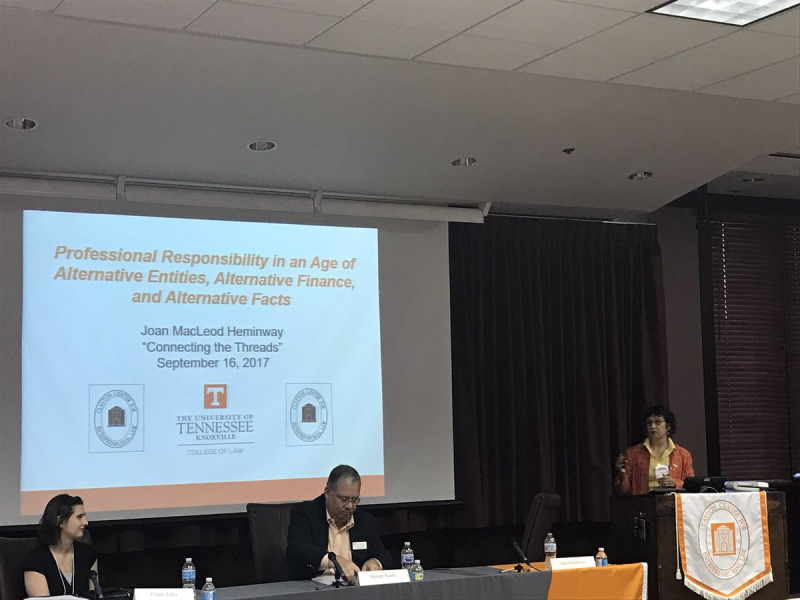
My presentation at the conference focused on the professional responsibility and ethics challenges posed by complexity and rapid change in business law.  I will post on my related article at a later date.  But if you have any thoughts you want to share on the topic, please let me know.  A picture of me delivering my talk, courtesy of Haskell, is included below.  (Thank you, Haskell!)  So, now you at least know the title, in addition to the topic . . . .  :>)  Also pictured are my two discussants, my UT Law faculty colleague George Kuney and UT Law 3L Claire Tuley.

Heminway(BLPBConf2017)