I’m delighted to share that I’ll be presenting this Friday at the SMU Energy, Environment, and Natural Resources Colloquium.  Anyone interested in attending can register here.  A description of the event is below.  I’m excited to be working on my third (one and two) article with SMU energy law Professor James W. Coleman. It’s at the intersection of energy and financial regulation, and I look forward to sharing more about it with readers soon!  I’m particularly grateful to co-blogger Joan Heminway and the University of Tennessee Law School for hosting the Connecting the Threads CLE series, the forum in which we first shared our initial papers! 

Description

The SMU Energy, Environment, and Natural Resources Colloquium is an annual program, in its second year, which focuses on the interdisciplinary connections between the fields of energy, environment, and natural resources (“EENR”). It promises to be a pivotal gathering for academics, students, practitioners, and other stakeholders in the fields of law, science, engineering, business, and the humanities. The conference will delve into crucial topics like environmental justice initiatives, natural resource management using law and markets, carbon management, and interdisciplinary solutions to environmental challenges, featuring a mix of talks, panel discussions, and followed by graduate student presentations.


Previously, I posted about the grumbles of discontent from the corporate bar regarding several recent Delaware Court of Chancery rulings, resulting in proposals for statutory amendments that seemed somewhat hasty and poorly thought-out.  Sujeet Indap had a piece in the Financial Times about it; before that, there was coverage in a local Delaware outlet.

Now, Law360 reports on a new memo issued by Wilson Sonsini, reminiscent of Martin Lipton’s famous Interco memo, warning that Delaware may no longer be as friendly to business.  From the memo:

In recent months, a conversation has emerged as to whether Delaware should remain the favored state of incorporation for business entities. Indeed, many of our clients have asked us whether they should remain in Delaware or choose Delaware as the state of incorporation for their new ventures. In this discussion, we provide our reflections on that question and various factors that entrepreneurs, investors, and companies should consider when weighing incorporation in Delaware against incorporation in another state. …

In the conversations that we have had with clients, businesspeople, and others in the corporate bar, we have heard the following reasons given for reconsidering incorporation in Delaware:

  • A growing number of cases that have addressed technical issues, in the M&A context and elsewhere, and reached unexpected results in a manner that has impacted corporate structuring and transaction planning
  • A perception that Delaware judges have in several opinions adopted an increasingly suspicious or negative tone toward corporate boards and management, and toward the corporate bar
  • The challenges that the case law can pose for companies with influential founders or significant stockholders, the process mechanisms that such companies are expected to use, and the remedies that have been reached in those cases
  • A sense that Delaware judges can be skeptical of the governance of venture-backed private companies and many Silicon Valley-based companies
  • The increasingly active, and successful, plaintiffs’ bar in both technical and fiduciary claims, which can leave boards and management with the sense that they are planning around “gotcha” litigation driven by plaintiffs’ lawyers more than those lawyers’ individual clients

Obviously, the third point here regarding influential founders/significant stockholders is a reference to the MFW process, which the Delaware Supreme Court just reaffirmed.  But the Delaware Supreme Court also just granted interlocutory review in TripAdvisor, which raises the possibility that some of the tension will be ratcheted down through a narrowed definition of what counts as a conflicted transaction that triggers the need for entire fairness review/MFW cleansing in the first place.

What’s more interesting to me are points 2 and 4.  I assume that some of those objections are about Moelis, which struck down the type of shareholder agreement that seems to have become common in VC-backed firms and was carried over to the public space, and maybe even go as far back as decisions like Trados, which held that in a VC backed firm, the directors’ fiduciary obligations run to the common over the preferred (even though Trados itself did not grant any damages to the common shareholders).

But I also suspect that some of the sturm und drang has its antecedents in In re Oracle Corp. Derivative Litig., 824 A.2d 917 (Del. Ch. 2003), when then-Vice Chancellor Strine held that the independence of a special committee was compromised by close professional and networking ties.  The case was a break from prior Delaware jurisprudence, which treated directors as independent in almost all situations that didn’t involve either blood or money, and the Delaware Supreme Court rejected his approach in Beam v. Stewart, 845 A.2d 1040 (Del. 2004).  Once Strine ascended to the Delaware Supreme Court, though, the caselaw started inching back his way, starting with Sanchez, continuing on with Sandys v. Pincus, and culminating in Marchand v. BarnhillThe thing about these more nuanced tests for dependence/independence is that they may, in fact, hit Silicon Valley companies particularly hard, because of the chumminess of the tech world, and it’s not surprising that once independence is questioned, the tone of the opinions is going to come off as skeptical, in a manner that defendants do not like.  

Anyway, I’ll just conclude by echoing the comments in the Law360 article, namely, that whatever the correct direction of Delaware law, this kind of open warfare (and, frankly, attempted deployment of political muscle) challenges the reputation Delaware has built for comity and a technocratic approach to lawmaking. That’s the kind of thing that undermines Delaware’s legitimacy as, in a sense, a de facto federal agency.  It’s the kind of thing that invites more intrusion from federal regulators, and less respect from other jurisdictions – not just other states, but around the world.


In September, I was honored to deliver the Boden Lecture at Marquette Law School; a video of that lecture is available here.  (I also gave a vaguely similar, but not identical, talk at College of the Holy Cross earlier this month, which is available here).

Anyway, the Boden Lecture, in a more formalized form, will be published in the Marquette Law Review.  Here is the abstract:

Of Chameleons and ESG

Ever since the rise of the great corporations in the late nineteenth and early twentieth centuries, commenters have debated whether firms should be run solely to benefit investors, or whether instead they should be run to benefit society as a whole. Both sides have claimed their preferred policies are necessary to maintain a capitalist system of private enterprise distinct from state institutions. What we can learn from the current iteration of the debate—now rebranded as “environmental, social, governance” or “ESG” investing—is that efforts to disentangle corporate governance from the regulatory state are futile; governmental regulation has an inevitable role in structuring the corporate form.

The paper is available on SSRN at this link.

The Department of Labor recently released its new fiduciary rule.  I covered the initial announcement here.  These are direct links to the parts of the rulemaking package:

FINAL RULE: https://www.dol.gov/sites/dolgov/files/EBSA/laws-and-regulations/laws/erisa/retirement-security/final-rule.pdf

PTE 2020-02: https://www.dol.gov/sites/dolgov/files/EBSA/laws-and-regulations/laws/erisa/retirement-security/prohibited-transaction-exemption-2020-02.pdf

PTE 84-24: https://www.dol.gov/sites/dolgov/files/EBSA/laws-and-regulations/laws/erisa/retirement-security/prohibited-transaction-exemption-84-24.pdf

Other PTE Amendments: https://www.dol.gov/sites/dolgov/files/EBSA/laws-and-regulations/laws/erisa/retirement-security/prohibited-transaction-exemptions-75-1-77-4-80-83-83-1-and-86-128.pdf

The New York Times has also covered the release.  I contributed my view to the piece.  As I see it, if printing a financial adviser’s disclosers will run your printer out of toner, you should just find a different financial adviser.  

The simplest way to buy advice is to hire a “fee-only” independent certified financial planner who is a registered investment adviser, which means they are required to act as fiduciaries when providing investment advice about securities (stocks, mutual funds and the like). As part of that fiduciary duty, they must eliminate conflicts or disclose them.

“Your odds of conflicts go up, the longer their disclosures are,” said Benjamin Edwards, a professor at the William S. Boyd School of Law at the University of Las Vegas.

There will be much more on this to come.  The rule is great for ordinary people because it uniformly raises standards for advice about their retirement account money.  One of the major problems in this space is that lots of different people offer “financial advice” to retirement savers under different standards.  Insurance producers are probably the most loosely regulated and also the most likely to oversell complex financial products for a quick payday.  The rule applies whether someone is a broker, registered adviser, or an insurance producer.  It’s the same standard for people doing the same basic thing.

Some of the industry opposition and litigation defense strategies often revolve around “personal responsibility.”  And there is something to that.  People should understand what’s going on when they invest significant sums.  But the reality is that people hire or work with financial advisers because they need advice.  If they knew what they were doing, they wouldn’t need any help.  We need to make it safer for people to trust their financial advisers.  This rule goes a long way to help get us there.

Dear BLPB Readers:

“The Department of Finance and Economics at Texas State University is seeking a full-time lecturer to start in the Fall semester 2024. A JD from an ABA-accredited law school is required. Job duties include teaching onsite sections of Legal Environment of Business (and perhaps other classes as needed) as well as engaging in department, college, and university service. The contracts are annual but renewable. Because the position is non-tenure-track, there is no search committee; accordingly, if you are interested in the position or want to know more, you can contact Jeff Todd (jat169@txstate.edu) directly.”

Check out the third issue of volume 73 of the DePaul Law Review!  It includes a series of papers emanating from the HBO series Succession.  As you may recall, I posted a call for papers for this issue about a year ago.  Most of the papers in the issue came from a venture originated and organized by Susan Bandes and Diane Kemker called the Waystar Royco School of Law.  I wrote about that enterprise here.  

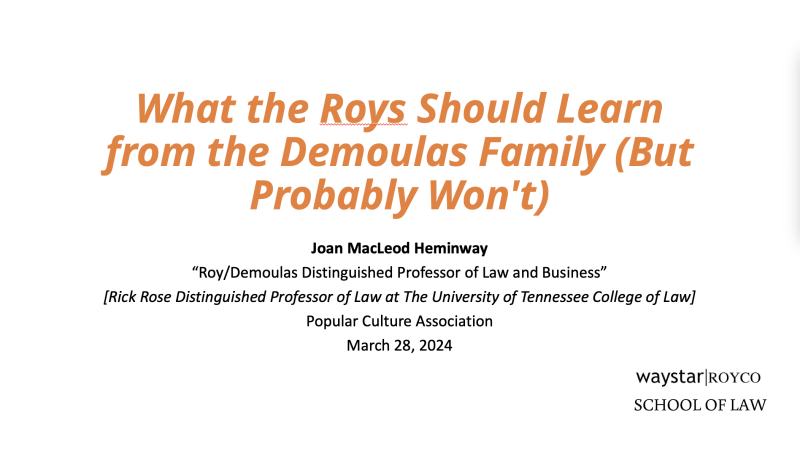
I participated in the Waystar Royco School of Law Zoom meetings as the “Roy/Demoulas Distinguished Professor of Law and Business.”  I presented on fiduciary duty issues comparing the principals of two family businesses–The Demoulas family from Northern Massachusetts and Succession‘s Roy family from New York.  You can find my Zoom session here (Passcode: #hN+7J5N).  That presentation resulted in an essay that I wrote for the DePaul Law Review issue as well as an advanced business associations course based on the Succession series. I finish teaching that course this week.  I also presented on the topic of my Succession essay at the Popular Culture Association conference back in March.  I include a screenshot of my cover slide below.

I just posted the essay to SSRN.  The piece is entitled What the Roys Should Learn from the Demoulas Family (But Probably Won’t).  The SSRN abstract is set forth below.

This essay offers a comparison of the actions taken by members of two families: the Demoulas family, best known as owner-operators of northeastern regional supermarkets, and the Roy family featured in HBO’s series “Succession.” The comparative appraisal focuses principally on the selfish pursuit of individualized financial, social, and familial status by key members of both the Demoulas and Roy families as they relate to the law of business associations (principally corporate law). At the heart of the matter is the legal concept of fiduciary duty. A comparison of the two families’ exploits reveals that lessons earlier learned by the Demoulas family (and observers of the multifaceted, multi-year litigation involving them and their business undertakings) fail to positively impact the destiny and legacy of Succession’s Roy family—at least as far as the Roy family story has been told to date. Although hope may be limited, there is still time for the remaining Roy family members to take heed and make changes.

To execute and comment on the comparison of these two families, the essay starts by outlining relevant information concerning legally recognized fiduciary duties in the corporate (and, to a lesser degree, partnership) contexts. Next, the essay offers background information about the Demoulas and Roy families and their respective businesses (both organized as corporations) and selected business dealings and governance, noting actual and potential breaches of fiduciary duty in each case. A brief conclusion offers comparative observations about the actions taken by members of the Demoulas and Roy families that contravene or challenge applicable fiduciary duties and the opportunity for general reflection. Of particular note is the observation that the ability of corporate directors and officers to comply with their fiduciary duties may become more difficult and complicated when integrating family dynamics and business succession issues into business decisions in a family business context.

I have enjoyed the research and teaching I have done in this area over the past year.  It always is nice to take a fresh approach to familiar concepts.  I daresay my students have felt the same way in covering business associations topics through the lens of the happenings in the series.  They certainly have been attentive and communicative, which is what I had been shooting for in teaching corporate and other business associations law through the course.  I am happy to answer questions about the course and provide my syllabi to anyone who wants to see what I assigned and did for the course.  Just ask.

Screen Shot 2024-04-21 at 6.42.58 PM

Samantha Prince, Timothy G. Azizkhan, Cassidy R. Prince, and Luke Gorman recently released an interesting paper on the effects of 401(k) vesting schedules. With defined-contribution plans, employees always get to keep the contributions withheld from their paychecks.  Whether the employee will always keep the employer contributions depends on the vesting schedule in play, if any.

And vesting schedules really matter.  The authors found that in the 909 2022 filings they reviewed at least 1.8 million employees lost out on at least a portion of their employer contributions.  After the employees forfeit employer contributions on termination, the employers get to recycle the funds within the plan, avoiding the need for additional contributions. The filings indicated that employer contributions that were recycled were over $1.5 billion. This large sum represents money failing to follow the employee out the door because employment terminated before employees “vested” under the plans.

The analysis shows a partial picture of the broader American landscape because they analyzed 909 different single employer plans.  Still, the plans analyzed covered some major employers such as Amazon and Home Depot.

There are two main types of vesting schedules–graded vesting and cliff vesting.  In graded plans, the employee gradually gets to keep more and more of the employer contribution over time on their departure. In cliff vesting, employees who don’t make it a set number of years (often three) lose all of the employer contributions to their retirement. The employers with employees losing the most money on departure generally use cliff schedules.

What happens to the money that gets left behind?  The employer gets to put it to work.  Usually, this means that it won’t make more contributions for other employees.  Instead it’ll just allocate some of the forfeited funds to cover its obligation to make an employer contribution.  Sometimes, they’ll also use the money to offset other expenses.  In any event, employers with these vesting schedules benefit significantly when someone’s employment ends before the vesting deadline.

Marketwatch recently covered the draft article and made some follow up calls to employers.  The responses were 

Almost as absurdly, several teams of flacks tried to deny that the companies themselves benefited from this clawback in 401(k) contributions. No, no, they insisted. We don’t benefit. It goes to the other employees in the 401(k) plan.

No, it doesn’t. If this money really went to the other employees, it would appear as a separate bonus. Instead, as Prince and her team’s investigation has shown, most of the money clawed back is used to cut the company’s contributions.

In other words, it’s a shell game. The employers don’t get that $1.5 billion. It just cuts the amount they have to spend on 401(k) contributions next year. By how much? Oh … er … $1.5 billion.

Amazon and Home Depot led the pack with the most employees affected by these plans.  In 2022, Amazon employees forfeited $102 million in employer contributions. Home Depot had the second most affected employees, but the total forfeiture amount came to around $7 million.

Interestingly, immediate competitors now often use different vesting schedules.  Prospective employees considering whether to work at firm A or firm B probably do not have the sophistication or access to information to understand vesting schedule differences and what it will mean for them in practical terms.

Although vesting schedules result in lower overall American retirement savings, employers may face some market pressure to adopt them.  If they face no real negative repercussions in the labor market for a three-year cliff vesting schedule, shifting their retirement vesting could allow them to delay or avoid millions in annual expenses over time. 

Absent some government intervention, I expect more employers will probably move to vesting schedules.  It’s not hard to imagine how a management consultant could take the paper’s data and then use it to go from company to company selling retirement plan adjustments that will more than pay for millions in consulting fees.

Yup, we have another opportunity for Elon Musk to make new law.

This time, it comes in the form of an extraordinary proxy statement recommending that shareholders vote to ratify the compensation package that Chancellor McCormick invalidated in Tornetta v. Musk, and that they vote to reincorporate the company in Texas.

There are many many questions raised and I’m sure I’ll be revisiting a bunch of them over the next couple of months, but I’m zeroing in on one in particular: the pay package ratification vote.  Can they really do that?

And hoo boy did this get long, so behind a cut it goes; however, I personally find the most interesting part to be the realpolitik of it all if it ends up in a courtroom, so knowledgeable readers may want to skip to that part at the end.

More under the jump

Continue Reading Tesla and Waste

Dear BLPB Readers:

“The American Business Law Journal invites ALSB members who are interested in serving on the Editorial Board of the ABLJ to apply for the position of Articles Editor.

The ABLJ is widely regarded, nationally and internationally, as a premier peer-reviewed journal. Serving as an Articles Editor provides an opportunity to serve the Academy of Legal Studies in Business and broader academic discipline at the highest levels of service. 

The incoming Articles Editor will begin to serve on the Board in August 2024. Board members commit to serve for three years: two years as Articles Editor and one year as Senior Articles Editor. After that, Articles Editors have the option of continuing to serve two more years—one as Managing Editor and another as Editor-in-Chief. 

Articles Editors supervise the review of articles that have been submitted to the ABLJ to determine which manuscripts to recommend for publication. If a manuscript is accepted, the Articles Editor is responsible for working with the author to oversee changes in both style and substance. If a manuscript is believed to be publishable but in need of further work, the Articles Editor outlines specific revisions and further lines of research that the author should pursue. The Articles Editor’s recommendations for works-in-process are perhaps the most important and creative aspect of the job because they provide the guidance necessary for works to blossom into publishable manuscripts.  

An applicant for the position of Articles Editor should have an established track record of publications. We prefer applicants who have previously published with the ABLJ and have familiarity with our peer review process. However, we also welcome applicants, including international applicants, who have published with high quality law journals and/or peer reviewed law journals that adhere to the Harvard Bluebook style.  Experience serving as a Reviewer for the ABLJ or as a Staff Editor is helpful. 

The ABLJ is committed to ensuring that financial resources, including the support of a research assistant, are not an obstacle to service on the Board. 

Applicants are encouraged to contact us to learn more about the position and financial assistance that may be available.

Please send a resume and letter of interest to Inara Scott, ABLJ Editor-in-Chief, at inara.scott@oregonstate.edu by May 31, 2024, for full consideration.”

I appreciate Ann’s super helpful post on omissions liability after the U.S. Supreme Court’s decision in Macquarie Infrastructure Corp. et al. v. Moab Partners, L. P., et al.  The hair splitting in that opinion is, in my view, dubious at best.  The Court’s creation of a legally significant concept of “pure omissions” in a public company disclosure context is doctrinally counterfactual.  The omission to state a fact required to be disclosed under a mandatory disclosure rule like Item 303 of Regulation S-K necessarily occurs in a veritable river of disclosures in SEC filings and more generally and has the potential of making those disclosures misleading.  If material, such an omission should be actionable as deceptive or manipulative conduct under Section 10(b) of and Rule 10b-5 under the Securities Exchange Act of 1934, as amended.  Period.

Of course. civil liability would require proof of all elements of the claim, including (even for public enforcement officials) the requisite state of mind or scienter.  Private class action plaintiffs also would have heightened pleading burdens.  And a criminal prosecution can only be sustained if the predicate conduct is willful, as provided in Section 32(a) of the Exchange Act.

The point is that there is no such thing as a “pure omission.”  Investors logically rely on the interplay between and among public statements made in filings and elsewhere.  If X exists for Public Company A, and Public Company A is required to disclose X in a public filing but does not do so, investors will view and assess all of the relevant public information about Public Company A assuming X does not exist for Public Company A.  If the omission makes existing disclosures misleading, is material, is made withe the action-appropriate state of mind, and deceives or manipulates, the basis for a Rule 10b-5 cause of action against Public Company A plainly exists based on the language of Section 10(b) and Rule 10b-5.  Back in January, wben I first wrote about Macquarie and an amicus brief I coauthored for the case (which you can fined here), I stated as much.  It seems Ann agrees when she says that “whatever the language of 10b-5(b), it seems entirely unobjectionable that it should be considered a “manipulative or deceptive device or contrivance” within the broader meaning of Section 10(b) to intentionally withhold information you have a duty to disclose – from some other source – in order to mislead someone else.”  (Her further analysis follows.)

As Ann’s post notes, much remains to be seen and said about the impact of Macquarie, and the Court has signaled that the true wisdom we can gain from its opinion in Macquarie may be constrained to actions brought under Rule 10b-5(b) and to certain factual contexts.  As a result, I have determined it is still appropriate–and wise–to caution public company clients that their failure to comply with mandatory disclosure requirements may make them subject to, among other things, Section 10(b)/Rule 10b-5 litigation.  One should, of course, note (among other things) that the omission would have to be material, make other disclosed facts misleading, and be made recklessly or willfully in order for liability to attach. 

Do you disagree?  Do you believe there are “pure omissions” in a public company disclosure context? Let me know.