
Many in the business law world have been following the saga involving the adoption of  S.B. 313 by Delaware’s General Assembly last week.  S.B. 313 adds a new § 122(18) to the General Corporation Law of the State of Delaware (DGCL) that broadly authorizes corporations to enter into free-standing stockholder agreements (not embodied in the corporation’s charter) that restrict or eliminate the management authority of the corporation’s board of directors.  See my blog posts here and here and others cited in them, as well as Ann’s post here.

In the floor debate on S.B. 313 last Thursday in the Delaware State House of Representatives, a proponent of the legislation stated that fiduciary duties always trump contracts.  That statement deserves some inspection in a number of respects.  I offer a few simple reflections here from one, limited perspective.

The historical centrality of corporate director fiduciary duties (which were the fiduciary duties referenced on the House floor) is undeniable.  Those who have taken business associations or an advanced business course with me over the years know well that I emphasize in board decision making that the directors’ actions must be both lawful and consistent with their fiduciary duties in order to be legally valid and enforceable.  I doubt my teaching is exceptional in that regard.

But the floor debate involved a different kind of tangle between legal obligations and fiduciary duties than exists in the board decision-making context in which corporate action is written on a tabula rasa.  The comment made in last Thursday’s legislative session responded to the suggestion that a board of directors may later decide to breach a contract that is lawful and was approved by the board in a manner that is consistent with director fiduciary duty compliance.  That scenario involves board action to disregard the terms of an agreement—by authorizing and directing the corporation to breach a legal obligation of the corporation because the directors have, in good faith and with due care, determined that the breach of contract is in the best interest of the corporation.

This type of board action is certainly not unprecedented.  An example from my practice immediately springs to mind: no-shop, non-solicitation, and related clauses in business combination (M&A) agreements.  These provisions may be (or at least appear to be) lawful and compliant with director fiduciary duties when made but may interfere with a target board’s fiduciary duties if the board later determines it has a fiduciary obligation to engage in interactions with a potential transactional partner in violation of that type of deal protection provision. 

The resolution of this issue in the M&A context has largely been contractual.  Fiduciary outs of various kinds have been common in M&A agreements for decades.  (I gave my first CLE talk on them back in the 1980s.)  Through these provisions, directors consider and prepare in advance for the potentiality of a later conflict between the deal protection obligations of the corporation and their fiduciary duties to the corporation.  Properly drafted, fiduciary outs help  protect the legal validity and enforceability of the original contract from future challenge and preserve the board’s legal right to respond to new circumstances without breaching the contract.

As those who work in this space well know, a watershed case involving deal protection provisions is Omnicare, Inc. v. NCS Healthcare, Inc., 818 A.2d 914 (Del. 2003). In its Omnicare opinion, the Delaware Supreme Court assesses the validity of a merger agreement that effectively locked up a majority of the votes needed to approve the merger.  The merger agreement did not include a fiduciary out provision. The directors had no ability to terminate the merger agreement or nullify its terms to comply with their fiduciary duties without breaching the contract.  The court found the deal protections invalid and unenforceable.

Proponents of S.B. 313 clearly state that a corporation’s exercise of its authority to enter into stockholder agreements under § 122(18) will be subject to challenge if the directors breach their fiduciary duties to the corporation in approving a stockholder agreement or in later authorizing the corporation’s performance under that agreement.  If the corporation’s directors are found to be in breach, the stockholder agreement then may be found invalid or unenforceable.  The prospect of that occurring in the stockholder agreement context is as real as it is in the M&A deal protection context.

Perhaps, then, fiduciary outs are a best practice that should grow out of the new DGCL § 122(18).  If the parties truly intend for fiduciary duties to trump the contract (as the bill proponents have claimed) and we can anticipate challenges in that regard based on the nature of the agreement, stockholder agreements should provide in advance for the eventuality of a conflict.  Otherwise, a stockholder agreement authorized under DGCL § 122(18) may be found either invalid ex post because the board’s original approval of the agreement may later be determined to have been a breach of the directors’ fiduciary duties (for failure to include a fiduciary out, as in Omnicare) or unenforceable in litigation over a board decision to breach or refrain from breaching the agreement in the face of a perceived fiduciary duty conundrum related to the corporation’s performance under the terms of the agreement.  A well-crafted fiduciary out (which would undoubtedly be somewhat bespoke, as it should be in the M&A context, based on the nature of the corporation’s obligations in the contract) should help avoid litigation, or at least enable its early dismissal, in the event of either type of legal claim.

Your reactions to these musings are, as always, welcomed.  We will be operating in new territory here assuming the Governor of Delaware signs S.B. 313 into law (as he has signaled).  If I am missing an element of statutory or decisional law or strategic litigation practice that impacts my arguments, I would appreciate hearing about it.  Regardless, it is now time that we all think about how to address anticipated issues arising from the Pandora’s box that the Delaware General Assembly has opened.  That may include practice-oriented solutions to perceived legal questions or tensions as well as potential further adjustments to the DGCL.  As to the latter, I note that I raised in one of my earlier posts the desirability of looking at DGCL subchapter XIV in light of the provisions of DGCL § 122(18).  Perhaps that issue merits a subsequent post . . . .
Some variations on a theme this week.

First, the Delaware legislature has now passed the amendments to the DGCL, which means that as of August 1, it will be legal for a company like Tesla, say, to contract with a shareholder like Elon Musk, say, to give him power to veto or demand specific AI initiatives, regardless of his particular financial stake in the company.  By contrast, at least as I read Texas law, such a contract would not be possible for Texas-organized entities, because Texas only permits agreements to restrict board discretion in nonpublic corporations.

Do you suppose this means Tesla will reincorporate back to Delaware?

Second, the Senate raked Boeing CEO Dave Calhoun over the coals this week.  Sen. Josh Hawley said: “I think you’re focused on exactly what you were hired to do.  You’re trying to squeeze every piece of profit out of this company. You’re strip mining it.”  He also posted to Twitter, “Boeing’s planes are falling out of the sky in pieces, but the CEO makes $33 million a year. What exactly is he getting paid to do?”  Meanwhile, at the hearing, Sen. Richard Blumenthal said, “Boeing needs to stop thinking about the next earnings call and start thinking about the next generation.”

So I, for one, am very glad to see in this polarized age that Democrats and Republicans can come together to endorse ESG.

I kid, I kid, of course they’re not endorsing ESG – they’re just endorsing a reduced focus on profit seeking in favor of corporate social responsibility.

For real, it reminds me of this clip of Katie Porter, that I like to show to my students.  In the clip, she establishes that a drug company executive would increase his bonus by increasing drug prices.  Which sounds bad, until you look at the results of the shareholder vote overwhelmingly approving his compensation package – which shareholders are required to approve due to – let me check this – ah right, congressional legislation and (federal) stock exchange listing rules.   Not to mention the pay-for-performance disclosures that, wait let me see – Congress also mandates.  If members of Congress are unhappy with how that’s worked out, they have some tools in the box beyond jawboning executives.

And third, Exxon.  Exxon, Exxon.  Exxon bypassed the SEC and sued its own shareholders to avoid putting another climate change shareholder proposal on the ballot – ironically, even though Engine No. 1’s purportedly climate-transition-focused directors are still right there on the board – and even after it got everything it wanted, still tried to press the case until Judge Pittman concluded there was no remaining controversy to adjudicate.  

In response, some institutional shareholders, including various state pension plans, organized a “vote no” campaign against Exxon’s directors.  They varied as to which directors – some urged voting no for all of them, and there were some who focused on Joseph Hooley and Darren Woods, while Glass Lewis urged voting no for Joseph Hooley alone.  Their argument was less about the merits of this specific climate change proposal than about the importance of preserving shareholder voice.  There was no possibility that these directors would lose their seats, but a strong protest vote against them might have indicated that shareholders supported the principle of being free to bring items to a vote.

And, well ….   There does seem to have been a slight dip in support for Woods and Hooley as compared to last year, but not by a whole lot.

All of which suggests that large institutional investors may mouth words about stewardship or whatever but they actually don’t want these kinds of public votes, and that’s partly because it puts them on record as taking positions (that can then become controversial), and partly because the largest investors don’t need formal avenues of input; they can simply make phone calls, and partly, perhaps, because many large investors have their own shareholders they want to fight off.

Which takes us right back to the DGCL amendments and the muted response from investor advocates.  As I mentioned before in “Take Three” of my Takes on the Tesla vote, investors do seem to be sending a signal, and it’s that they don’t really place much value on governance rights; let’s not forget they only started exercising them seriously after the SEC and the DOL largely required them to.

The Corporate Transparency Act is among the most talked about business law topics in the bar communities I frequent. Basic information and guidance can be found in many places, but nuanced treatments are more rare. I offer one of those rare ones up for your review and consideration today.

Entitled The Corporate Transparency Act Is Happening To You and Your Clients: Dealing with the Tsunami, the analysis and guidance comes from Stoll Keenon Ogden PLLC.  More specifically, one of the two co-authors is friend-of-the-BLPB Tom Rutledge.  His work never disappoints.  I urge you to check it out–all 58 pages of it!  There is even a short resource list at the end with links to some of the key public guidance.  I am grateful for Tom and his colleague, Allison, for putting this together.

Sarah Haan recently led an effort to file an amicus in support of Maine’s effort to bar foreign governments from using business entities to make political contributions.  A copy of the amicus is available here.   I joined in good company alongside Gina-Gail S. Fletcher, George S. Georgiev, Andrew Jennings, Paul Rose, Faith Stevelman, Ciara Torres-Spelliscy, Anne M. Tucker, Cynthia A. Willliams, and Karen Woody.

Maine’s law set a 5% foreign-government-ownership threshold to bar corporations from political donations.  The District Court saw the 5% threshold as arbitrary.  The brief points out that many laws use a 5% ownership threshold to test for shareholder influence and that shareholders may wield significant influence over corporate policies with a 5% stake.

Although it didn’t make the final brief, this background section provides context:

On February 29, 2024, the U.S. District Court for the District of Maine granted Plaintiffs’ motion for preliminary injunction and enjoined a Maine law, “An Act to Prohibit Campaign Spending by Foreign Governments,” 21-A M.R.S. § 1064 (the “Act”). The Act prohibits any “foreign government-influenced entity” from making, directly or indirectly, a “contribution, expenditure, independent expenditure, electioneering communication or any other donation or disbursement of funds to influence the nomination or election of a candidate [for public office] or the initiation or approval of a referendum” in Maine.[1] The Act became law via the direct democracy provision of the Maine Constitution; when enacted in November 2023, it was “the biggest win for a citizens’ initiative in either percentage or absolute terms in Maine’s history.” (Order at 5.)

In its order enjoining the Act, the District Court concluded that Plaintiffs were likely to succeed on the merits of their challenge to the law. With regard to foreign spending in elections for federal office, the Court found that the Federal Election Campaign Act (“FECA”) likely expressly preempts the statute. (Order at 14.) However, the Court found no likely preemption with regard to referenda or to elections for state or local office. For those types of elections, the Court concluded that Plaintiffs were likely to succeed on the merits of their facial challenge to the Act on First Amendment grounds. Applying strict scrutiny, the Court affirmed Maine’s compelling interest in limiting foreign government influence in candidate elections, and assumed without deciding that Maine has a compelling interest in limiting foreign government influence in referenda elections. Notably, the Court found that Maine has no compelling interest in limiting the appearance of foreign government influence on elections. (Order at 31-32.)

The District Court’s determination that the Act likely violates the First Amendment turned on its narrow tailoring analysis. The Court agreed with Plaintiffs’ argument that the Act is not narrowly tailored because it uses an “arbitrarily chosen” 5% ownership threshold to define a “foreign-government influenced entity.” (Order at 35.) The Court wrote,

“I agree [with Plaintiffs] that a 5% foreign ownership threshold would prohibit a substantial amount of protected speech. I cannot reconcile the Supreme Court’s holding in Citizens United with a law that would bar a company like CMP—incorporated in Maine, governed by a Board of Directors comprised of United States citizens and run by United States citizen executive officers who reside in Maine—from campaign spending. The 5% threshold would deprive the United States citizen shareholders—potentially as much as 95% of an entity’s shareholders—of their First Amendment right to engage in campaign spending. Simply put, it would be overinclusive.”

(Order at 34.) It added that the judge could not see how the Act could “survive the observation in Citizens United that a restriction ‘not limited to corporations or associations that were created in foreign countries or funded predominately by foreign shareholders’ would be overbroad.” (Order at 35 (quoting Citizens United at 362 (emphasis added)).)


[1] The Act defines a “foreign government-influenced entity” as:

    • A foreign government; or
    • A firm, partnership, corporation, association, organization or other entity with respect to which a foreign government or foreign government-owned entity:
      • Holds, owns, controls or otherwise has direct or indirect beneficial ownership of 5% or more of the total equity, outstanding voting shares, membership units or other applicable ownership interests; or
      • Directs, dictates, controls or directly or indirectly participates in the decision-making process with regard to the activities of the firm, partnership, corporation, association, organization or other entity to influence the nomination or election of a candidate or the initiation or approval of a referendum, such as decisions concerning the making of contributions, expenditures, independent expenditures, electioneering communications or disbursements.

21-A M.R.S. 1064(1)(E).

Further to Ann’s post on Sunday sharing the text of her comment letter on Delaware’s S.B. 313 (and more particularly the proposal to add a new § 122(18) to the General Corporation Law) and my post on § 122(18) last week, I share below the text of my comment letter to the Delaware State House of Representatives Judiciary Committee.  Although Ann and I each got one minute to deliver oral remarks at the hearing held by the Judiciary Committee on Tuesday, 60 seconds was insufficient to convey my overarching concerns–which represent a synthesis and characterization of selected points from my post last week.  The comment letter shared below includes the prepared remarks I would have conveyed had I been afforded additional time.

Madame Chair and Committee Members:

I appreciated the opportunity to speak briefly at today’s hearing. As I explained earlier today, although I am a professor in the business law program at The University of Tennessee College of Law, my appearance before the committee relates more to my nearly 39 years as a corporate finance practitioner, which has included bar work (most recently and extensively in the State of Tennessee) proposing and evaluating corporate and other business entity legislation. This letter expands on the virtual oral comments I offered at the hearing on the proposed addition of § 122(18) to the General Corporation Law of the State of Delaware (DGCL). My goal is simply to best ensure that the committee and the General Assembly are well informed about the significance of this proposed new section of the DGCL.

Both proponents and critics of proposed § 122(18) concur that the stockholder agreements that would be authorized by that provision can currently be accomplished in a corporation’s certificate of incorporation—the corporate charter. Indeed, as was alluded to in the testimony earlier today, current Delaware law expressly authorizes transferring governance authority from a corporation’s board of directors to its stockholders through charter amendments and through certificates of designation (instruments providing for new classes or series of stock) as well as for statutory close corporations, a status designated in the certificate of incorporation. As a result, questions raised at today’s hearing about why the new authority embodied in proposed DGCL § 122(18) is needed—or why it would be objectionable—are well taken. As I indicated in my oral testimony earlier today, the answer to those questions lies in public policy.

Current Delaware law on stockholder agreements promotes notice, transparency, and assent. Provisions in a Delaware corporation’s certificate of incorporation are matters of public record in the State of Delaware on which stockholders and prospective stockholders rely. They must be filed with the Delaware Secretary of State. Thus, Delaware’s corporate law currently requires that stockholders and potential future stockholders have public notice of any fundamental alteration in the statutory power of the board of directors to manage the corporation. Stockholder agreements like those authorized under proposed DGCL § 122(18) are not required to be filed with the state (although they would have to be filed with the U.S. Securities and Exchange Commission under the federal securities laws at some point after they are signed, for public companies). Moreover, under current Delaware law, if an amendment to the certificate of incorporation is required to achieve a shift in governance authority from the board of directors, then a stockholder vote is required. These requirements, which evidence Delaware’s public policies of notice, transparency, and assent, are what ultimately divide the supporters and detractors of proposed DGCL § 122(18). Your ultimate views on these policies—your determination as to whether they are important to the integrity of Delaware corporate law—should be strong factors in your determination of how to vote on proposed DGCL § 122(18). I submit that these policies should not be abandoned or reduced without careful consideration.

Last week, I wrote about my policy concerns relating to proposed DGCL § 122(18) in a blog post published on the Business Law Prof Blog. That post can be found here. Although my blog post was written for a different and broader legal audience (and therefore includes some technical legal references), it may be useful to you as additional statutory and judicial support for the positions I have taken in this letter and in my oral testimony. The post also includes several drafting observations relevant to the productive introduction of statutory authority for stockholder agreements that you may appreciate having.

I am grateful to have had the opportunity to share these insights with you today in writing and orally during the hearing this afternoon. I wish you well in your deliberations.

Very truly yours,

Joan M Heminway
Rick Rose Distinguished Professor of Law, The University of Tennessee College of Law
Member and Former Chair, Tennessee Bar Association Business Law Section
Former Chair and Member, Boston Bar Association Corporate Law Committee

The Delaware State House of Representatives may vote on the bill tomorrow (Thursday) afternoon.  It is the last item listed in the Main House Agenda for tomorrow’s session.  I can only hope that the members of the House feel better informed after the House Judiciary Committee hearing on Tuesday.  I know many of us tried to ensure that they are well informed.

Dear BLPB Readers:

“The Legal Studies and Business Ethics Department of the Wharton School, University of Pennsylvania, is seeking applicants for a full-time, tenure-track faculty position. We welcome candidates working in any business-relevant area of law and/or ethics, but we are particularly interested in the following areas:

  • Technology / artificial intelligence
  • Corporate law / governance / purpose / responsibility
  • Law and ethics of markets (antitrust / bankruptcy / consumer law)
  • Inequality and discrimination
  • Bioethics / health law
  • Energy / environment / climate

The appointment is expected to begin July 1, 2025. Information about the Legal Studies and Business Ethics Department and the research expertise of its current faculty may be found at: https://lgst.wharton.upenn.edu.”

The complete job posting is here.

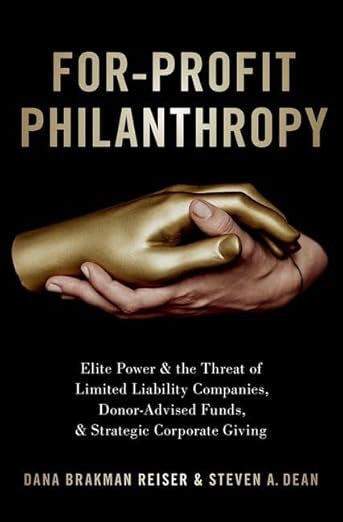
image from m.media-amazon.com


As I noted in one of my posts last week, I recently attended the 2024 Law and Society Association Annual Meeting in Denver, Colorado.  CRN46–the corporate and securities law collaborative research network that organizes sessions at the conference–supported a great series of programs at the conference this year.  I was privileged to be able to be a commenting reader for an Author Meets Reader session on Dana Brakman Reiser and Steven Dean’s book For-Profit Philanthropy.  The session was co-sponsored with the tax law collaborative research network (CRN31). 

For-Profit Philanthropy asserts that three for-profit vehicles (LLCs, donor-advised funds affiliated with investment banking entities, and strategic corporate philanthropy activities) operate to decrease donative trust.  They support their conclusion with observations from business entity and tax law.  Their focus is on accountability and transparency.  The story is compelling.  Ultimately, the book offers targeted reform proposals.

Although the panelists’ remarks were not recorded, I scripted out my comments to ensure that I stayed on track.  What I wrote is set forth below.  It represents a rough approximation of what I said (although I always change and add things as I go).

For-Profit Philanthropy represents an important and classic piece of legal scholarship. It approaches a novel issue and provides useful synthesis, careful analysis, sage commentary, and appropriately targeted responsive proposals. The problem-solving approach in the book unmistakably reveals laudatory aspects of design thinking. The book is incredibly well written—the structure is methodical, and the prose is beautiful, but accessible. Moreover, the research underlying For-Profit Philanthropy is extensive.  Nevertheless, it is clear to me, after flipping through the end notes that Dana and Steven cite in those end notes to only a fraction of what they read and absorbed in order to write the book. Kudos to them book for a job well done.

I come to this forum as a bit of a contrarian, but also as a huge fan of Dana and Steven’s work. Our scholarship intersects over social enterprise, but we each come at the field with different priors and research agendas. My 15-year practice background before becoming an academic was in for-profit transactional business finance and governance. My scholarly work and teaching continue in that vein but also wander into nonprofit finance and governance and technologies that facilitate business finance and governance, including crowdfunding and blockchain applications. I maintain a law license, work with the local and national bar and my law school’s business law clinic on business law issues, and periodically serve as an expert witness. Of course, in much of this, I work with tax law experts like many of you in the room!

What all of that means for purposes of my remarks this morning is that I am a significant (but not unbridled) proponent of entity choice and private ordering and overall an innovation realist. I have a general affinity for innovative private solutions to client issues that use the attributes of business entities—which is what underlies the problems with the philanthrocapitalism identified in Dana and Steven’s book. [Offering OpenAI’s sequential structuring and restructuring as a classic example.] Also, I should note that I come to the issues identified and addressed in For-Profit Philanthropy without a bias for or against charitable foundations. These attributes frame my interest in the book. Overall, the book made me stand up and take notice of a number of things about charitable giving at the highest levels of wealth and socio-economic status—things I had either not perceived or not fully credited. In addition, given the nature of some of my recent work, For-Profit Philanthropy has made me curious (and potentially concerned) about the potential engagement of blockchains in charitable donation processes (something that I looked into a bit in writing a recent book chapter that covered the use of NFTs in ground-level charitable fundraising and that I am pursuing in a different context this summer).

Dana and Steven’s book raises a number of concerns about the ways in which three donation models—philanthropy LLCs, the sponsors of commercially affiliated donor-advised funds, and strategic corporate philanthropy—have emerged as players in a larger picture of U.S. philanthropic giving.

Ultimately, Dana and Steven suggest that self-regulation (in addition to legal and regulatory changes) may help create a new grand bargain that offers benefits for both benefactors and those they intend to benefit in a way that is trustworthy and trusted. For-Profit Philanthropy raises many questions for me. Here are a few that I have been asking myself based on the book. They assume that Dana and Steven’s observations about the loss of trust in philanthropic giving and its pernicious effects are truths and that the problems they identify should be addressed. My questions also reflect the lawyer’s role in reforming the system through private ordering—a perspective worthy of independent consideration, imv, and I concentrate on it here.

As a business entity law expert, I will focus in closely on philanthropy LLCs. My foundational question is this: how, if at all, should I change my choice-of-entity advice to clients who may want to engage in philanthropy based on what Dana and Steven share in For-Profit Philanthropy?

Maybe, as chapter 7 in their book suggests, I should merely re-evaluate the governance norms in the entities I create to better demonstrate commitment—introduce new ideas about private ordering in the LLC context (e.g., a non-distribution constraint, transparency obligations) to achieve that goal. [Noting the CTA and state transparency laws.] The transparency/privacy debate is an undercurrent to so much of this area and affects entity choice in and outside the philanthropic giving space.

But is recommending these trust-enhancing norms consistent with my client’s risk profile and goals? I am concerned about ensuring that I act in accordance with my professional responsibilities.

How, if at all, does this affect my teaching of choice-of-entity?

I base my business associations course primarily on choice of entity—comparative agency attributes and entity elements. This substantive focus offers the opportunity to talk about private ordering in this context. But can students who do not have a background in charitable giving—no less tax law—grasp enough of the trust problem created by philanthrocapitalism to have them address these issues in a basic or even advanced business associations course? How would I suggest they approach issues of commitment and transparency with their clients?

What changes, if any, would I make to LLC law to help create a new grand bargain—enhancing philanthropic targeting, timing, and transparency?

I want to spend more time thinking about that. The contractual freedom of the LLC form is vast. Opportunities abound

And what will happen if charitable donations move to blockchains?

On the one hand, commitment could be assured and a level of transparency would exist w/r/t those on that blockchain. On the other hand, the automated nature of the transactions and the relatively private nature of the technology (and resulting capacity for fraud or obscured transactions) may make things worse. [Noting the Vera Bradley example of strategic corporate philanthropy—raising money for breast cancer research through a related foundation using NFTs that include images of Vera Bradley products and cloth patterns.]

In short, the book encourages many thought experiments for law professors, policy makers, philanthropists, and (yes) lawyers in the field. Given that large changes in the law may be unlikely (as Dana and Steven admit in places in the book, that genie may not be able to be put back in the bottle, so to speak), the roles of business entity law and the attorney-client relationship in resolving the issues identified in For-Profit Philanthropy may loom large. I hope that Dana and Steven may have more to say on those issues in their future collaborations.

For-Profit Philanthropy is an interesting and informative read. Having said that, as I noted in my remarks, it does leave me pondering unresolved questions as I consider translating its essence into law practice and legal education. I look forward to continuing to think through those questions on my own and in consultation with Dana and Steven.

Here is the text of a letter I submitted in advance of the Delaware House Judiciary Committee Meeting regarding the proposed amendments to the DGCL:

Dear Chair Griffith:

I write to express my concerns about S.B. 313, and in particular the proposed amendments to Section 122 of the Delaware General Corporation Law (DGCL).  I believe the proposed amendments will cause Delaware to lose control over its law.

As proposed, the statute authorizes a shift of corporate governance from the charter to private contracts.  Corporate charters are subject to the law of the chartering state, thus, Delaware law.  Private stockholder agreements are not necessarily subject to the law of the chartering state.  That means other states’ laws would govern the interpretation of these contracts, and the appropriate remedies for any breaches.[1]

Additionally, the Federal Arbitration Act (FAA) provides that agreements to arbitrate disputes “shall be valid, irrevocable, and enforceable.”[2]  In practical effect, the FAA bars states, including state courts, from prohibiting or regulating arbitration agreements, and requires that such agreements be enforced as written.  It is likely that the FAA does not apply to corporate charters,[3] which is why Delaware was able to adopt Section 115 of the DGCL, prohibiting corporations from including forum provisions in their charters that would bar access to the Delaware courts.[4]

By contrast, the FAA almost certainly would apply to stockholder agreements.  If parties to a stockholder agreement agree to arbitrate disputes, a Delaware court will be required to enforce that provision.  Those disputes could easily include questions about the legality of the contract under Delaware law, or whether a stockholder took on fiduciary obligations, and abused them, as a result of the control conferred by the contract.[5]  As a result, important questions of Delaware law would be decided by non-Delaware actors, often in confidential proceedings.  Arbitration provisions could also bind public stockholders who bring derivative actions on the corporation’s behalf.[6]   Even stockholders who bring direct actions regarding stockholder agreements, on behalf of themselves rather than the corporate entity, may find themselves bound to arbitrate disputes regarding the agreement.[7]

Moreover, as drafted, the amendments would explicitly permit stockholder agreements to select a forum for disputes outside of Delaware – either in arbitration or another state.  Once again, that would mean that other states, or arbitrators, would decide whether the stockholder contract violated Delaware law, and whether the stockholder abused its governance rights under the contract.

Delaware’s value to incorporators includes its robust body of caselaw decided by expert Delaware judges. The proposed amendments endanger that value proposition.

                                                                    Sincerely,

                                                                    Ann M. Lipton


[1] See generally Ann M. Lipton, Inside Out (or, One State to Rule Them All): New Challenges to the Internal Affairs Doctrine, 58 Wake Forest L. 321 (2023); see also KT4 Partners v. Palantir, 203 A.3d 738 (Del. 2019) (involving an investor in a Delaware corporation with a stockholder agreement governed by California law).

[2] 9 U.S.C. § 2.

[3] See generally Ann M. Lipton, Manufactured Consent: The Problem of Arbitration Clauses in Corporate Charters and Bylaws, 104 Geo. L.J. 583 (2016).

[4] Del. Code tit. 8, § 115.

[5] See, e.g., Basho Techs. Holdco B, LLC v. Georgetown Basho Invs., LLC, No. 11802, 2018 WL 3326693 (Del. Ch. July 6, 2018) (involving such a scenario).

[6] See, e.g., Ernst & Young, LLP v. Tucker ex rel. HealthSouth Corp., 940 So. 2d 269 (Ala. 2006).

[7] See Richard J. Tyler, Kicking and Screaming: Joinder of Non-signatories in Arbitration Proceedings, 75 Disp. Resol. J. 111 (2020).

Like so many others, I have wanted to say a word about West Palm Beach Firefighters’ Pension Fund v. Moelis & Company, 311 A.3d 809 (Del. Ch. 2024).  My angle is a bit different from that of many others.  It derives from my 15-year practice background, my 24-year law teaching background, and my 39-year bar service background.  It focuses on a doctrinal analysis undertaken through a policy lens.  But I want to note here the value of Ann Lipton’s existing posts on Moelis and the related proposed addition of a new § 122(18) to the General Corporation Law of the State of Delaware (DGCL).  Her posts can be found here, here, here, and here.  (Sorry if I missed one, Ann!)  Ben Edwards also published a related post here.  They (and others offering commentary that I have read) raise and touch on some of the matters I address here, but not with the same legislative policy focus.

I apologize at the outset for the length of this post.  As habitual readers know, long posts are “not my style” as a blogger.  This matter is one of relatively urgent legislative importance, however, and I am eager to get my thoughts out to folks here.

I begin by referencing the DGCL provision in the eye of the storm.  DGCL § 141(a) provides for management of the business and affairs of a Delaware corporation by or under the direction of the corporation’s board of directors, except as otherwise provided in the corporation’s certificate of incorporation or the DGCL.  In Moelis, Vice Chancellor Travis Laster found various provisions in a stockholder agreement unlawful under DGCL § 141(a).  Specifically, a series of governance-oriented contractual arrangements at issue in Moelis were not authorized under the corporation’s certificate of incorporation or another provision of the DGCL.

The tension in this space involving DGCL § 141(a) is not new.  For many years, the legal validity of so-called stockholder agreements—technically, agreements (as opposed to charter provisions) that shift governance power from the directors of a corporation to one or more of its stockholders—has been questionable for most Delaware corporations, including public companies.  (I say “many years” because the legal validity of these agreements was an issue I routinely wrestled with before I left the full-time private practice of law in 2000.) 

The DGCL is different from the Model Business Corporation Act (MBCA) in this regard.  The MBCA has long had a broad-based statutory provision, MBCA § 7.32, authorizing shareholder agreements under specified conditions.  States adopting the MBCA have made a (presumably) conscious choice to embrace shareholder governance under the circumstances provided in the MBCA, including through § 7.32.  The MBCA’s provision expressing the management authority of the corporation’s board of directors, MBCA § 8.01(b), expressly references MBCA § 7.32, providing that:

[e]xcept as may be provided in an agreement authorized under section 7.32, and subject to any limitation in the articles of incorporation permitted by section 2.02(b), all corporate powers shall be exercised by or under the authority of the board of directors, and the business and affairs of the corporation shall be managed by or under the direction, and subject to the oversight, of the board of directors.

There is no analogous provision in the DGCL.  The only way to be sure that one could accomplish a shift in governance power from directors to stockholders under the DGCL has been for a corporation either to include the governance provisions in its certificate of incorporation or to organize as a close corporation under Subchapter XIV.  Close corporation status requires charter-based notification and conformity to a number of statutory requirements set forth in DGCL §§ 341 & 342, including that the certificate of incorporation provide that the stock be represented by certificated shares “held of record by not more than a specified number of persons, not exceeding 30,” that the stock be subject to transfer restrictions, and that there not be a “public offering” of the stock. DGCL § 342(a)(1)-(3).  Thus, by legislative design, statutory close corporation status is not available to publicly held corporations organized under Delaware law (which makes total sense for those who understand what a closely held corporation is, in a general sense).

Members of the Delaware State Bar Association (DSBA) Corporation Law Section know all of this well.  As leaders in reviewing and proposing changes to the DGCL over the years, this group of folks has thoughtfully weighed policy considerations relating to the DGCL’s application to the myriad situations that Delaware corporations may face.  Without having researched or inquired about the matter, I find it hard to believe that the section has not previously discussed the desirability of an express statutory provision allowing for the approval and execution of stockholder agreements outside a corporation’s certificate of incorporation.  The matter has been addressed by the Executive Council of the Tennessee Bar Association’s Business Law Section, which engages in similar legislative initiatives in Tennessee, more than once during the time I have been serving on it.  I therefore assume that the choice to refrain from proposing a specific statute authorizing stockholder agreements outside a corporation’s certificate of incorporation over the years has been both informed and intentional.

Yet, earlier today, Senate Bill 313 passed in the Senate Chamber of the Delaware General Assembly.  In that bill, vetted and approved by the DSBA Corporation Law Section and blessed by the DSBA Executive Committee, the longstanding policy decision to refrain from allowing stockholder agreements outside of the certificate of incorporation or Subchapter XIV is being summarily reversed through the proposal to adopt a new DGCL § 122(18)—an alteration of the corporate powers provision of the DGCL.  That new proposed DGCL section provides a corporation with the power to enter into stockholder agreements within certain bounds, but those bounds are relatively broad.

As others have noted (at least in part), the drafting of the proposed DGCL § 122(18) (and the related additional changes to DGCL § 122) reflects a belt-and-suspenders approach and is otherwise awkward.  Multiple sentences are crammed into this one new subpart of DGCL §122 to effectuate the drafters’ aims.  The DGCL has been criticized for its complex drafting in the past (resulting in, among other things, a project creating a simplified DGCL), and the approach taken by the drafters of the proposed DGCL § 122 changes adds to the complexity of the statute in unnecessary ways.  A provision this significant should be addressed in a separate statutory section, the approach taken in MBCA §7.32.  That new section then can be cross-referenced in DGCL § 141(b)—and, if deemed necessary, DGCL § 122.  Breaking out the provision in its own section also should allow legislators to more easily and coherently identify strengths and weaknesses in the drafting and build in or remove any constraints on stockholder governance that they may deem necessary as the proposed provision gets continued attention in the Delaware State House of Representatives.  I offer that as a drafting suggestion.

Apart from the inelegance of the drafting, however, I have one large and important question as Senate Bill 313 continues to move through the Delaware legislative process: do members of the Delaware General Assembly voting on this bill fully understand the large shift in public policy represented by the introduction of DGCL § 122(18)?  If so, then they act on an informed basis and live with the consequences, as they do with any legislation they pass that is signed into law.  If not, we all must work harder to enable that understanding. 

It is all fine and good for us to point out how hasty the drafting process has been, how traditional debate and procedures may have been short-changed or subverted, how waiting for the Delaware Supreme Court to act on the appeal of the Chancery Court decision before proceeding is prudent, etc.  But the fact of the matter has been that potential and actual stockholders of Delaware corporations have been able to rely exclusively on charter-based exceptions to the management authority of the board of directors—whether those exception are authorized in Subchapter XIV of the DGCL or otherwise.  This has meant that prospective equity investors in a Delaware corporation knew to carefully consider a corporation’s certificate of incorporation to identify any pre-existing constraints on the management authority of the board of directors before investing.  This also has meant that any new constraints on the board of directors’ authority to manage the corporation’s business and affairs required a charter amendment of some kind—either a board-approved and stockholder-approved amendment of the certificate of incorporation or the board’s approval of a certificate of designations under charter-based authority of which existing stockholders should be aware.

Ann noted this issue in a previous post.  The enactment of proposed DGCL § 122(18) will make it more challenging for potential equity investors to identify the locus/loci of management power in the corporation.  Although both the certificate of incorporation and any stockholder agreement would be required to be filed with the U.S. Securities and Exchange Commission for reporting companies (the latter as an instrument defining the right of security holders under paragraph (b)(4) or as a material contract (b)(10) of Regulation S-K Item 601), the current draft of proposed DGCL § 122(18) does not provide that a copy of any contract authorized under its provisions be filed with the Delaware Secretary of State or that its existence be noted on stock certificates (a requirement included in MBCA §7.32(c)).  In addition, stockholders will lose their franchise if the stockholder agreement would otherwise have required a stockholder vote.

Finally, it seems important to note that the judicial doctrine or independent legal significance—or equal dignity—has been strong in Delaware over the years as a factor in the interpretation of Delaware corporate law.  This has helped practitioners and the judiciary to navigate difficult issues in advising clients about the outcomes of Delaware corporate law debates.  The rule typically has been that, if one takes a path afforded by the statute, they get what the statute provides.  And if one does not take a provided statutory path, they cannot later be heard to argue for what the statute provides for users of that untaken statutory path. 

Classically, in dicta in Nixon v. Blackwell, 626 A.2d 1366 (1993), Chief Justice Veasey wrote (on pp. 1380-81) about the importance of DGCL Subchapter XIV in construing corporate governance arrangements in light of the doctrine of independent legal significance:

 . . . the provisions of Subchapter XIV relating to close corporations and other statutory schemes preempt the field in their respective areas. It would run counter to the spirit of the doctrine of independent legal significance and would be inappropriate judicial legislation for this Court to fashion a special judicially-created rule for minority investors when the entity does not fall within those statutes, or when there are no negotiated special provisions in the certificate of incorporation, by-laws, or stockholder agreements.

With the passage of proposed DGCL § 122(18), parts of Subchapter XIV of the DGCL will seemingly be rendered vestigial (i.e., they will no longer have independent legal significance).  Consideration of this and any other potential collateral damage to the interpretation of Delaware corporate law that may be created by the enactment of proposed DGCL § 122(18) should be carefully undertaken and, as desired, additional changes to the DGCL should be debated before voting on Senate Bill 313 is undertaken in the Delaware State House of Representatives.

I do not argue for a specific result in this post.  Rather, I mean to illuminate further the significance of the decision facing the Delaware General Assembly (and, potentially, the decision of the Governor of the State of Delaware) in the review of proposed DGCL § 122(18).  In doing so, I admit to some sympathy for those who may have clients with stockholder agreements they now know or suspect to be unlawful under the Moelis opinion.  In all candor, any legislation on this topic should more directly address those existing agreements given that the provisions of proposed DGCL § 122(18) are not a mere clarification of existing law.  Agreements not re-adopted under any new legislative authority may be found unlawful in the absence of clarity on this point.  As a reference point, I note that, in amending MBCA § 7.32 to remove a previous 10-year duration limit, the drafters specified the effect on pre-existing agreements in MBCA § 7.32(h).  Take that as another drafting suggestion . . . .

I welcome comments on any or all of what I offer here.  If I have anything incorrect, please correct me.  Regardless, I hope this post provides some additional information to those in the Delaware General Assembly and elsewhere who have an interest in proposed DGCL § 122(18).

Corporate redomestication has been in the news.  Earlier this week, the Wall Street Journal ran an op-ed I penned with Nevada’s Secretary of state, Francisco Aguilar, explaining why some corporations seek to redomesticate from Delaware to Nevada or elsewhere.  Ann also covered the issue today in the context of Tesla’s redomestication to Texas.  

Although the Tesla redomestication proposal apparently passed at the shareholder meeting, not all redomestication proposals will pass.  Notably, Glass Lewis recommended against the Texas reincorporation.  I have some faith that states like Nevada will react and legislatively change their laws if they prove a barrier to securing additional incorporations.  After all, Delaware has been changing its laws to ensure it remains attractive for decades.  Indeed, much of the movement in Delaware around proposed amendments to Delaware’s corporate law seems aimed at maintaining Delaware’s dominance and securing continued incorporations.

The key will be striking the right balance between investor protection and shielding managers from possibly unwarranted and value-destroying litigation costs. Ultimately, striking the right balance is hard.  Under a too lenient standard for litigation, corporations and shareholders will suffer from costs driven by excess litigation.  Under too demanding a regime, shareholders may suffer losses from uncompensated fiduciary breaches with courts refusing to intervene despite some misconduct.

One of the best things about being a corporate law professor is that it continues to actively develop.  In her post today, Ann gave the example of a controller possibly seeking to monetize her control premium personally instead of splitting it with all shareholders when selling. The WSJ story frames it as the controller losing trust in a CEO “after extensive back and forth with him that resulted in her family getting less cash from the deal than in earlier proposals” Exactly how Nevada law would treat this issue warrants development, but I doubt it would allow a majority shareholder to wantonly expropriate value from minority shareholders.  While Nevada does have a broad business judgment statute, it only applies to officers and directors–not to shareholders that may owe fiduciary duties.  Yet the statute does not currently clearly address the obligations controlling shareholders owe to minority shareholders. 

It’s an area of Nevada law that needs more development.  As Keith Bishop pointed out in an email to me on this, there are some Nevada cases.  One is Foster v. Arata.  It found that stockholders in a dominant position owe fiduciary duties.  Another is Shivers v. AMERCO.  It’s a Ninth Circuit decision that also recognized that majority shareholders owe duties.  It’ll be an area to continue watch.