
I have given several talks on ESG (environmental, social, and governance) matters in the past few months.  And, of course, it is a subject discussed in the classroom.  As we celebrate the birthday of Dr. Martin Luther King Jr. today (and this week), I could not help but feel that his work provided a foundation for—somehow embraced—current ESG discussions and actions.  So, I went poking around on the Internet.

I guess I am not the only one who noticed this connection.

On the environmental part of ESG, Los Padres ForestWatch offers that:

Dr. King’s actions and teachings led to many important acts being passed in congress including the Civil Rights Act of 1964 and the Voting Rights Act of 1965. It’s through this work that Dr. King created a movement that was meant for us to understand how we are mutually tied together and that all life is interrelated. It’s this structure of thinking that has led many to believe that his work was the early structure for the Environmental Justice Movement. We see after Dr. King’s passing that environmentalists were able to pass the Clean Air Act of 1970, the Clean Water Act of 1972 and the Endangered Species Act. All of which that had a direct effect on communities of color which are often marginalized and impacted heavily by climate change.

Yet, Dr. King’s social issue impacts—including especially the social justice effects of his work—are far more central to communities and corporations.  Jeff Hilimire notes in a piece published on the Hands on Atlanta’s website, that “[a]fter fighting for human rights for all Americans, Dr. King began to focus on employment and corporations as the next evolution of equality. He believed that companies have a responsibility to be forces of good in the world, and that their influence could make powerful change.”  Finally, Natalie Runyon at Thomson Reuters Institute hints at governance accountability when she notes in an online article that, while Dr. King would view current ESG efforts favorably, “Dr. King . . . stated that words are not enough—action must follow, with measurement to demonstrate progress.”

I will be giving Dr. King’s connection to ESG more thought this week as we celebrate his legacy. But regardless of Dr. King’s level of responsibility for ESG, his work resonates for me in ESG discussions and debates.
An ambitious question, yes, but it was the title of the presentation I gave at the Society for Socio-Economists Annual Meeting, which closed yesterday. Thanks to Stefan Padfield for inviting me.

In addition to teaching Business Associations to 1Ls this semester and running our Transactional Skills program, I’m also teaching Business and Human Rights. I had originally planned the class for 25 students, but now have 60 students enrolled, which is a testament to the interest in the topic. My pre-course surveys show that the students fall into two distinct camps. Most are interested in corporate law but didn’t know even know there was a connection to human rights. The minority are human rights die hards who haven’t even taken business associations (and may only learn about it for bar prep), but are curious about the combination of the two topics. I fell in love with this relatively new legal  field twelve years ago and it’s my mission to ensure that future transactional lawyers have some exposure to it.

It’s not just a feel-good way of looking at the world. Whether you love or hate ESG, business and human rights shows up in every factor and many firms have built practice areas around it. Just last week, the EU Corporate Sustainability Reporting Directive came into force. Like it or not, business lawyers must know something about human rights if they deal with any company that has or is part of a supply or value chain or has disclosure requirements. 

At the beginning of the semester, we discuss the role of the corporation in society. In many classes, we conduct simulations where students serve as board members, government officials, institutional investors, NGO leaders, consumers, and others who may or may not believe that the role of business is business. Every year, I also require the class to examine the top 10 business and human rights topics as determined by the Institute of Human Rights and Business (IHRB). In 2022, the top issues focused on climate change:

  1. State Leadership-Placing people at the center of government strategies in confronting the climate crisis
  2. Accountable Finance– Scaling up efforts to hold financial actors to their human rights and environmental responsibilities
  3. Dissenting Voices– Ensuring developmental and environmental priorities do not silence land rights defenders and other critical voices
  4. Critical Commodities– Addressing human rights risks in mining to meet clean energy needs
  5. Purchasing Power– Using the leverage of renewable energy buyers to accelerate a just transition
  6. Responsible Exits– Constructing rights-based approaches to buildings and infrastructure mitigation and resilience
  7. Green Building– Building and construction industries must mitigate impacts while avoiding corruption, reducing inequality, preventing harm to communities, and providing economic opportunities
  8. Agricultural Transitions– Decarbonising the agriculture sector is critical to maintaining a path toward limiting global warming to 1.5 degrees
  9. Transforming Transport– The transport sector, including passenger and freight activity, remains largely carbon-based and currently accounts for approximately 23% total energy-related CO2 global greenhouse gas emissions
  10. Circular Economy– Ensure “green economy” is creating sustainable jobs and protecting workers

The 2023 list departs from the traditional type of list and looks at the people who influence the decisionmakers in business. That’s the basis of the title of this post and yesterday’s presentation. The 2023 Top Ten are:

  1. Strategic Enablers– Scrutinizing the role of management consultants in business decisions that harm communities and wider society. Many of our students work outside of the law as consultants or will work alongside consultants. With economic headwinds and recessionary fears dominating the headlines, companies and law firms are in full layoff season. What factors should advisors consider beyond financial ones, especially if the work force consists of primarily lower-paid, low-skilled labor, who may not be able to find new employment quickly? Or should financial considerations prevail?
  2. Capital Providers- Holding investors to account for adverse impacts on people- More than 220 investors collectively representing US$30 trillion in assets under management  have signed a public statement acknowledging the importance of human rights impacts in investment and global prosperity. Many financial firms also abide by the Equator Principles, a benchmark that helps those involved in project finance to determine environmental and social impacts from financing. Our students will serve as counsel to banks,  financial firms, private equity, and venture capitalists. Many financial institutions traditionally focus on shareholder maximization but this could be an important step in changing that narrative. 
  3. Legal Advisors- Establishing norms and responsible performance standards for lawyers and others who advise companies. ABA Model Rule 2.1 guides lawyers to have candid conversations that “may refer not only to law but to other considerations such as moral, economic, social and political factors, that may be relevant to the client’s situation.” Business and human rights falls squarely in that category. Additionally, the ABA endorsed the United Nations Guiding Principles on Business and Human Rights ten years ago and released model supply chain contractual clauses related to human rights in 2021. Last Fall, the International Bar Association’s Annual Meeting had a whole track directed to business and human rights issues. Our students advise on sanctions, bribery, money laundering, labor relations, and a host of other issues that directly impact human rights. I’m glad to see this item on the Top 10 list. 
  4. Risk Evaluators- Reforming the role of credit rating agencies and those who determine investment worthiness of states and companies. Our students may have heard of S&P, Moody’s, & Fitch but may not know of the role those entities played in the 2008 financial crisis and the role they play now when looking at sovereign debt.  If the analysis from those entities  are flawed or laden with conflicts of interest or lack of accountability, those ratings can indirectly impact the government’s ability to provide goods and services for the most vulnerable citizens.
  5. Systems Builders- Embedding human rights considerations in all stages of computer technology. If our students work in house or for governments, how can they advise tech companies working with AI, surveillance, social media, search engines and the spread of (mis)nformation? What ethical responsibilities do tech companies have and how can lawyers help them wrestle with these difficult issues?
  6. City Shapers-  Strengthening accountability and transformation in real estate finance and construction. Real estate constitutes 60% of global assets. Our students need to learn about green finance, infrastructure spending, and affordable housing and to speak up when there could be human rights impacts in the projects they are advising on. 
  7. Public Persuaders- Upholding standards so that advertising and PR companies do not undermine human rights. There are several legal issues related to advertising and marketing. Our students can also play a role in advising companies, in accordance with ethical rule 2.1, about persuaders presenting human rights issues and portraying controversial topics related to gender, race, indigenous peoples, climate change in a respectful and honest manner. 
  8. Corporate Givers- Aligning philanthropic priorities with international standards and the realities of the most vulnerable. Many large philanthropists look at charitable giving as investments (which they are) and as a way to tackle intractable social problems. Our students can add a human rights perspective as advisors, counsel, and board members to ensure that organizations give to lesser known organizations that help some of the forgotten members of society. Additionally, Michael Porter and Mark Kramer note that a shared-value approach, “generat[es] economic value in a way that also produces value for society by addressing its challenges. A shared value approach reconnects company success with social progress. Firms can do this in three distinct ways: by reconceiving products and markets, redefining productivity in the value chain, and building supportive industry clusters at the company’s locations.” Lawyers can and should play a role in this. 
  9. Business Educators- Mainstreaming human rights due diligence into management, legal, and other areas of academic training. Our readers teaching in business and law schools and focusing on ESG can discuss business and human rights under any of the ESG factors. If you don’t know where to start, the ILO has begun signing MOUs with business schools around the world to increase the inclusion of labor rights in business school curricula. If you’re worried that it’s too touchy feely to discuss or that these topics put you in the middle of the ESG/anti-woke debate, remember that many of these issues relate directly to enterprise risk management– a more palatable topic for most business and legal leaders. 
  10. Information Disseminators- Ensuring that journalists, media, and social media uphold truth and public interest. A couple of years ago, “fake news” was on the Top 10 and with all that’s going on in the world with lack of trust in the media and political institutions, lawyers can play a role in representing reporters and media outlets. Similarly, lawyers can explain the news objectively and help serve as fact checkers when appearing in news outlets.

If you’ve made it to the end of this post, you’re either nodding in agreement or shaking your head violently in disagreement. I expect many of my students will feel the same, and I encourage that disagreement. But it’s my job to expose students to these issues. As they learn about ESG from me and the press, it’s critical that they disagree armed with information from all sides.

So can the next generation of lawyers save the world? Absolutely yes, if they choose to. 

This is sort of arcane, but I am fascinated by two decisions that came out of Delaware this week from VC Laster and VC Glasscock.  They are remarkably similar in facts and result, but travel slightly different paths to get there.

The first case, Harris v. Harris, concerned a family corporation.  The mother was alleged to have systematically looted the company and – aware that a books-and-records action was likely to be filed by her children – forced through a merger with a shell New Jersey entity.  After the merger, all of the former shareholders of the old corporation now held identical interests in the new corporation, which was the same in every respect, except for the new state of organization.

The second case, In re Orbit/FR Stockholders Litigation, concerned a corporation with private equity investors.  The controller, a French corporation, was alleged to have systematically looted the company, and then effectuated a cash squeeze out merger in order to avoid any potential claims for breach of fiduciary duty.

Because in both cases, the minority stockholders no longer held shares in the looted entity – they held shares in the reorganized entity in Harris, and cash in Orbit/FR – the controller argued they had lost standing to pursue fiduciary claims based on pre-merger conduct.

Now, as background, in In re Primedia, Inc. Shareholders Litigation, 67 A.3d 455 (Del. Ch. 2013), VC Laster held that when derivative claims are extinguished in a merger, the shareholders of the old corporation may be able to bring direct claims arguing that the merger consideration was unfair due to failure to value the derivative claims and include them in the merger consideration.  To succeed on a Primedia claim, the plaintiff must plead the existence of viable pre-merger derivative claims, that were material in the context of the merger, and that the buyer would not pursue the claims therefore no value was received for them.  The Delaware Supreme Court adopted the Primedia framework in Morris v. Spectra Energy P’rs (DE) GP, LP, 246 A.3d 121 (Del. 2021).

In Orbit/FR, the controlling shareholder argued that the plaintiffs could not meet the pleading requirements of Primedia, in large part because any derivative claims that could have been brought against the controller were time-barred – shareholders should have brought the claims earlier and did not, therefore, they had no value, therefore, they did not need to be valued in the merger.  The shareholder-plaintiffs argued that what shareholders did or didn’t do was beside the point; the claims belonged to the company, and a controlling shareholder can’t time-bar claims against itself by having the controlled board refuse to bring them.

All of that is in the briefing, but isn’t addressed by VC Glasscock, who side-stepped it by concluding that Primedia is the wrong framework.  (He did address a laches argument but – this is confusing – it was a different laches argument, one concerning the fact that the plaintiffs had actually substituted in for earlier plaintiffs who filed a suit in 2018 and then attempted to settle for amounts that the new plaintiffs deemed inadequate).

In Glasscock’s view, Primedia is reserved for cases where a third party buys the company, has no interest in pursuing the old derivative claims, and therefore does not pay for them.  He noted there are “stringent” requirements for pleading such a claim, “in light of the general rule that the derivative asset had transferred to the acquiror, and was not retained by the former stockholders.”

Orbit/FR, however, was more like a straightforward entire fairness case, in which a controller stood on both sides of the transaction.  The shareholders had never filed a breach of fiduciary duty claim against the controller for its premerger conduct; instead, the only claim was that the controller looted the company and then effectuated an unfair merger, in part because it bought out its own liability for no value.  Per Glasscock, “to the extent the existence of a pre-merger litigation asset, held by Orbit, contributes to a finding of the unfairness of the merger, that unfairness is not extinguished via the merger; it is created by the merger.”  The plaintiff had adequately pled an unfair merger, and therefore it would be appropriate for the court to assess fairness in light of all of the assets of the acquired company, including its choses in action.

So. Primedia did not apply; plaintiffs’ claims survived the motion to dismiss.

Harris was bit more complex, in that the minority-shareholder-plaintiffs really did plead premerger fiduciary breaches against their mother, the controlling shareholder, in addition to other claims.  In that context, VC Laster also invoked Primedia, but, in his view, though Primedia itself involved a third party buyer, its logic was descended from the squeeze-out case of Merritt v. Colonial Foods, Inc., 505 A.2d 757 (Del. Ch. 1986), where a controller effectuated a merger for the purpose of eliminating derivative claims, and the minority shareholders were permitted to use those claims to demonstrate the unfairness of the merger price.  In Laster’s view, then, Primedia is simply a specific instance of a general rule that when a merger eliminates derivative claims, those claims are treated as assets of the target company and the fairness of the merger is assessed accordingly.  And, further demonstrating that he believed Primedia simply to be an extension of earlier caselaw, Laster noted that the plaintiffs might not need to show that the value of the claims was material in light of the overall merger consideration – as Primedia suggests – if the unfairness of the merger can be pled by other means:

In Parnes, the Delaware Supreme Court did not hold that a stockholder only could assert a direct claim challenging a merger by pleading facts indicating that the value of the diverted proceeds were so large as to render the price unfair. The Delaware Supreme Court instead recognized more broadly that a stockholder could assert a direct claim challenging a merger if the facts giving rise to what otherwise would constitute a derivative claim led either to the price or to the process being unfair. In Primedia, the court identified this dimension of Parnes and explained that “[t]here is a strong argument that under Parnes, standing would exist if the complaint challenging the merger contained adequate allegations to support a pleadings-stage inference that the merger resulted from an unfair process due at least in part to improper treatment of the derivative claim.”

Using the Primedia framework, Laster, like Glasscock in Orbit/FR, went on to find that the minority stockholders in Harris could pursue their claims as a direct attack on the fairness of the merger. 

So the cases reached the same result, but differed on the applicability of Primedia.  Do these divergent approaches make much of a difference?  Possibly.  Glasscock seemed to think Primedia requires the pleading of very specific elements, so categorizing a claim as “Primedia” or “not Primedia” really matters for whether a complaint is sufficient; the Primedia pleading burden was avoided in Orbit/FR by viewing the case through the simple lens of whether the plaintiffs had alleged facts that made it reasonably conceivable that a controlling shareholder freezeout merger was unfair.  Laster, by contrast, did not view Primedia so narrowly; though he found the formal elements met in Harris, he also went out of his way to note that Primedia’s test is really just a mechanism for assessing whether unfairness has been pled.

Conceptually, I do agree with Laster that there is really one unified concept here, namely, the extent to which a derivative claim is an asset of the target and whether its treatment renders the merger unfair to the selling stockholders.  The facts necessary to plead such a claim should be a separate issue that is adjusted as the circumstances warrant.

Another interesting point of note, though: In Harris, Laster also held that the minority plaintiffs satisfied the two exceptions that exist to the continuous holding rule for derivative standing.  As Laster pointed out, the continuous holding rule is waived if the merger is effectuated solely for the purpose of eliminating the derivative claims (known as the “fraud exception,” Ark. Tchr. Ret. Sys. v. Countrywide Fin. Corp., 75 A.3d 888 (Del. 2013)), and it is also waived if the merger is a mere reorganization of the old corporation with no substantive changes.  Here, that’s exactly what happened on both counts, but Laster concluded that it would be administratively simpler to treat this as a direct claim, and that’s what he did. 

Which means, among other things, we now have at least one example of a case where the fraud exception to the continuous holding rule was in fact met, which I think is – new? If there others, I don’t know what they are – feel free to let me know in the comments if it’s been done before.

Last year, I covered a lawsuit challenging FINRA’s constitutional status and the top-notch lawyers FINRA hired to defend it.  Since then, FINRA has filed its motion to dismiss.  You can read it yourself here if you’re interested.  The plaintiffs have until January 30th to respond.

My sense after reading it is that FINRA would prefer to shift the focus off itself and keep the court’s attention on the plaintiffs’ tattered regulatory history.  The initial robust defense argues that the case should be dismissed for purported jurisdictional, venue, and standing flaws.   The first seventeen and a half pages of the motion to dismiss focus on these arguments and a review of the plaintiffs.  As a matter of litigation strategy, taking these shots early makes sense to me.  If the arguments succeed, they’ll knock the case out entirely.

The final seven pages make the case for FINRA’s constitutional status.  It argues that:  (1) FINRA is a private entity exempt from separation of powers or appointments clause issues; and (2) that no non-delegation doctrine violation has occurred because the SEC supervises FINRA.  

It’ll be interesting to see how these arguments hold up, if Judge Scriven ever reaches them.  On the whole, the arguments so far seem to center around the issues I highlighted in my article warning about the possibility of these kinds of challenges for SROs.

For example, FINRA argues that it shouldn’t be deemed a part of government because FINRA wasn’t created by the government.  It relies in part on the Amtrak case, Lebron v. NationalRailroad Passenger Corp., 513 U.S. 374 (1995), for the proposition that only corporations “create[d]” by the government “for the furtherance of government objectives” will qualify as arms of the government.  

I discussed this issue in my article, and took the view that:

Drawing a constitutional line between whether these entities are government-created entities or government-authorized entities does not relate to the core concern animating Free Enterprise Fund.  Whether an entity is chartered under state law or is federally created has no bearing on whether the President is “stripped of the power . . . and his ability to execute the laws—by holding his subordinates accountable for their conduct.”  The precise method of creation of an SRO does not relate to the underlying separation of powers concerns.

The brief also argues that FINRA’s power is a permissible delegation.  I’m less confident about the scope of appropriate delegation with the post-Trump era Supreme Court.  My point here isn’t to say that one side or the other is right, but that there is real uncertainty about how far the Supreme Court will push on non-delegation issues.  It’s going to be an interesting case to follow.

For those readers interested in exchanges and clearing, I wanted to highlight that Oliver Wyman’s “Independent Review of Events in the Nickel Market in March 2022” was released yesterday.  As I noted in an earlier post (here), in March 2022, the price of nickel on the LME rose over 270%, and the exchange not only halted nickel trading, but also canceled trades.  Additionally, the LME, who engaged Oliver Wyman to produce this Review, released “LME Group Response to Oliver Wyman Independent Review.”  The Executive Summary – which is all I’ve had time to read thus far – notes that:

“The primary objectives of the review were to identify the factors that contributed to market conditions in the
nickel market in the period leading up to, and including, March 8, 2022, and make recommendations for how the
LME Group could reduce the likelihood of similar events occurring again”   

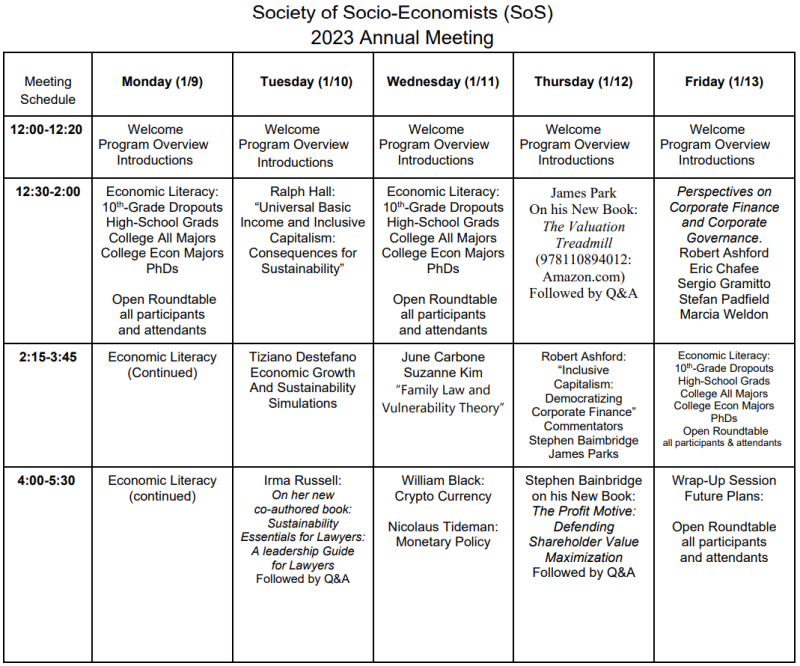
Below are the upcoming events taking place online as part of the Society of Socio-Economists Annual Meeting (all times EST). All events are accessible via a single link, which will be sent to you after registering here (registration is free). Readers of this blog will likely recognize a number of the presenters. I hope to see you there.

SOS 2023

UPDATE: You can find the paper Robert Ashford will be discussing Thursday at 2:15 here: https://scholarlycommons.pacific.edu/cgi/viewcontent.cgi?article=1372&context=uoplawreview

UPDATE 2: Two videos from economists discussing Professor Ashford’s Inclusive Capitalism: (1) https://youtu.be/lL1gEEj0tCU; (2) https://video.syr.edu/media/t/1_nnt9e504 .

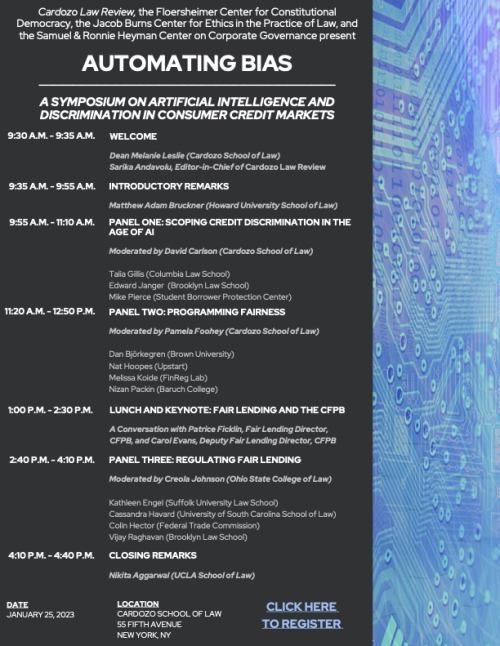
If you are interested in business law topics at the intersection of law & technology and social inclusion, and if you are in NYC on January 25 (or just generally available that day for a webinar!), you may want to check out the Cardozo Law Review symposium on “Automating Bias.”  The program agenda is included below.  Thanks to the symposium editor for bringing this program to our attention.

The symposium is being held at Cardozo School of Law, 55 Fifth Avenue, New York, New York, with an option to attend by webinar. (The symposium editor will send a link to the webinar to all registrants closer to the event).  In-person and live webinar attendees can receive CLE credits for attending; no CLE credits are available for remote attendees accessing the program later in recorded form.  [Note: This last sentence has been revised from the version of this post originally published to indicate that live webinar attendees may receive CLE credit.]

Those interested can register through the Eventbrite page linked here.  Click on the image below for a higher resolution copy of the program agenda and speakers.


BLPB(CardozoSymposium2023)

Dear BLPB Readers:

Fordham JCFL Volume XXVIII: Call for Submissions Update

The Fordham Journal of Corporate & Financial Law has extended its call for submissions for the Spring 2023 Issue of Volume XXVIII to February 3rd, 2023

As one of the premier student-edited business law journals in the country, the Journal ranks among the top-five specialty journals in banking and financial law, and among the top-ten specialty journals in corporate and securities law. The Journal welcomes articles and essays addressing important issues in antitrust, banking, bankruptcy, corporate governance, capital markets, finance, mergers and acquisitions, securities, and tax law and practice in the United States.

Please send all submissions to either our Scholastica page or our email at jcfl@fordham.edu. For more information regarding submissions, please visit our website. If you have any questions, please contact Brendan Finnerty, Senior Articles Editor, at bfinnerty6@fordham.edu.”

Couple of things this week.

First, the FTC proposed a new rule that would bar employers from requiring employees to sign noncompetes that extend post-employment.  It’s a very broad proposal; it applies to “a contractual term between an employer and a worker that prevents the worker from seeking or accepting employment with a person, or operating a business, after the conclusion of the worker’s employment with the employer,” and includes “a contractual term that is a de facto non-compete clause because it has the effect of prohibiting the worker from seeking or accepting employment with a person or operating a business after the conclusion of the worker’s employment with the employer.”

The sole exception is for “a non-compete clause that is entered into by a person who is selling a business entity or otherwise disposing of all of the person’s ownership interest in the business entity, or by a person who is selling all or substantially all of a business entity’s operating assets, when the person restricted by the non-compete clause is a substantial owner of, or substantial member or substantial partner in, the business entity at the time the person enters into the non-compete clause.”  A substantial owner must have at least a 25% interest in the entity. 

There’s lots to recommend a proposal like this – I’m not an expert in this area, but others have written about, for example, how Silicon Valley’s innovation may have been a result of California’s prohibition on non-competes.  

Right now, different states have different rules about the permissibility of non-competes, which is why – as I explore in my new paper, Inside Out (or, One State to Rule them All): New Challenges to the Internal Affairs Doctrine (forthcoming in the Wake Forest Law Review) – companies are increasingly trying to avoid them by writing non-competes and other employment-like terms into business entity documents (like LLC operating agreements and LP agreements), and then making employees members/partners/managers, on the theory that the non-compete is now no longer a “labor” contract, but an equity/investment contract, subject to the law of the state of organization.  That means courts – and, usually, Delaware courts – are left trying to sort out what counts as really an equity agreement versus what counts as an employment agreement.

So I wonder whether the FTC’s proposed rule could run into the same problem that Delaware is experiencing right now.  A plain reading of the proposal suggests that the rule applies to any contractual term between a worker and employer, regardless of whether the term appears in a contract of employment or some other kind of contract – but, another part of the rule (the model language for employers giving notice to workers) refers specifically to “employment contracts.”   If the rule becomes law, I can imagine employers might try to introduce some ambiguity by distinguishing “worker” contracts from entity documents.  To discourage that kind of gamesmanship, the FTC may want to add some language to clarify.

Second, previously, I blogged about Delman v. GigAcquisitions3 LLC, concerning the GigCapital3 de-SPAC transaction.   Well, VC Will has just sustained fiduciary duty claims against the Sponsor and directors of GigCapital3.  Among other things, she accepted plaintiffs’ allegations that the proxy was misleading because it represented that the SPAC’s shares were worth $10 each, when in fact they’d be worth less due to warrants and transaction fees.  Notably, VC Laster reached a similar conclusion in another SPAC case a few months ago.

But that’s not all. 

VC Will also held that Corwin cleansing simply is not available for SPACs, even if the vote is fully informed, because shareholders can both vote in favor of the deal and exercise their redemption rights (in fact, many are incentivized to vote in favor and exercise the redemption, rather than force liquidation, because they also hold warrants).  This means, according to Will, “the structure of the Gig3 stockholder vote is inconsistent with the principles animating Corwin.”  She also held that the MFW framework would be a poor fit because “The MFW process was designed to protect minority stockholders from the retribution of a controlling stockholder engaged in a self-dealing transaction—specifically, a squeeze-out. Those fears are not realized in a SPAC merger; public stockholders can simply redeem their shares.”

At this point, I’m feeling rather chuffed because these are exactly the arguments I made in one of my blog posts about the case, and later in my essay, The Three Faces of Control, at note 88 and accompanying text.

That said, even with the inapplicability of the MFW framework, she held that, at least for pleading purposes, the Sponsor’s control over the SPAC’s business – and ties to the directors – made it a controlling shareholder, even with less than 25% of the voting power (which meant the Sponsor had fiduciary duties to the SPAC).

Anyway, I’d say this is all a really big deal for SPACs – they’d have to do some pretty radical restructuring to avoid board-level/sponsor conflicts that would permit business judgment review in the absence of shareholder ratification under Corwin (and that doesn’t even get into the thing where they openly advertise for shareholders to vote even if they’ve already sold their shares) – except for how I think SPACs may pretty much be done anyway so we’ll all wake up one day and wonder what that was all about. 

Vikas Mittal and Jihye Jung have posted Strategic Management of Corporate Political Activism on SSRN.  Here is the abstract:

Senior leadership at many organizations engages in overt corporate political activism (CPA), defined as activities that are visible to stakeholders that support or undermine issues viewed as politically charged. According to media accounts, consumers, employees and shareholders want executives to engage in CPA. Evidence from peer-reviewed research shows that CPA does not help, but can harm companies on many fronts. This evidence shows that CPA is detrimental to a company’s brand equity, employee productivity, and financial performance while also alienating some customers. To help address these issues, this article develops a strategic framework to assess where a company is in its CPA journey and determine its path forward. The framework proposes four strategies: convergence, divergence, selective engagement, and depoliticized but supporting stance. Companies can use this framework to assess whether and how they should engage in political activism and then find ways to adapt their political activism strategy over time.