Matt Yglesias recently riled up the corporate law twittersphere with this tweet claiming that the shareholder value theory requires evil if evil increases shareholder value:


The  responses were swift and critical.  Stephen Bainbridge led off:


Dave Hoffman also critiqued the claim.


Hoffman went on to point out that directors are not obligated to seize every possible profit-maximizing opportunity:


Even though corporate law does not force corporate boards to extract every penny in every situation, many still have concerns about how a real or perceived shareholder wealth maximization obligation prohibits corporate boards from explicitly pursuing non-shareholder interests.  Haskell Murray has an interesting post on the issue.  Mark Underberg also explored the issue in the context of corporate free exercise claims.  As Emily Winston and others have explained, these concerns also underlie growing support for benefit corporations–for-profit entities that also explicitly pursue social goals.  Leo Strine, the Chief Justice of the Delaware Supreme Court, also addressed this issue in a 2012 essay.  He took the view that for-profit corporations were required to generally work to make money for shareholders and that empowering them to explicitly and purposefully advance other ends might not be wise: 

A group promoting a new form of for-profit corporation, the charter of which indicates that other ends, such as philanthropic or community-aimed ends, can be put ahead of profit, reacted with hyperbole, urging corporations to leave Delaware. If, they said, you remain incorporated in Delaware, your stockholders will be able to hold you accountable for putting their interests first. You must go elsewhere, to a fictional land where you can take other people’s money, use it as you wish, and ignore the best interests of those with the only right to vote. In this fictional land, I suppose a fictional accountability mechanism will exist whereby the fiduciaries, if they are a controlling interest, will be held accountable for responsibly balancing all these interests. Of course, a very distinguished mind of the political left, Adolph Berle, believed that when corporate fiduciaries were allowed to consider all interests without legally binding constraints, they were freed of accountability to any.

Dave Hoffman seems to share this view as well.


In any event, capital market pressures (and incentive compensation plans) may cause corporate managers to pursue profits–even in areas where shareholder profit maximization may not be good for society. After all, it’s not terribly difficult to find troubling examples of corporate profit-seeking behavior.  Just take a look at how corporations price insulin today.  Or think about how BP aggressively drilled without working to internalize the environmental risks before the spill.  This doesn’t necessarily mean that the right decision is to free corporate managers from an obligation to think about shareholder interests.  

Andrew Baker and Tamara Piety both make the functional point that market forces now drive managers toward shareholder wealth maximization even if they would rather balance objectives differently.

Putting the precise requirements of corporate law to the side there are a lot of forces that tempt corporate managers to focus on shareholder profits in a blinkered way.  These include capital market forces, incentive compensation plans, and widespread misconceptions about what corporate law actually requires.  The business judgment rule does a great deal to shape behavior here and provide freedom for corporate managers to make ethical choices.  Bainbridge captured it well:


I may update this list from time to time; feel free to e-mail me with additions. Looks like a pretty strong hiring season for business law. Updated 12/04/18.

Law School Professor Positions – Business Specialty Sought

  1. Barry University 
  2. Belmont University
  3. Campbell University
  4. Cardozo
  5. Case Western University
  6. Duke University
  7. Drake University (Director of the Entrepreneurial/Transactional Law Clinic)
  8. Drake University (Assistant, Associate, or Professor of Law)
  9. Drexel University
  10. Emory University
  11. Florida A&M University 
  12. Louisiana State University
  13. Mercer University 
  14. Pennsylvania State University, University Park
  15. Saint John’s University
  16. Seton Hall University
  17. Southern Illinois University Carbondale (Professor of Practice) (9/17/18 deadline or until filled)
  18. University of Alabama
  19. University of Arizona (International Business Law Focus) (Review begins 9/28/18)
  20. University of Arkansas, Fayetteville
  21. University of Buffalo
  22. University of California, Berkeley (initial review 8/15/18; accepted through 3/1/19)
  23. University of California, Davis
  24. University of California, Irvine
  25. University of Connecticut
  26. University of Kentucky
  27. University of Louisville
  28. University of Miami
  29. University of Nebraska
  30. University of New Mexico (Oil & Gas Focus)
  31. University of North Texas at Dallas
  32. University of Oregon (Business Law Clinic)
  33. University of Pittsburgh
  34. University of Richmond
  35. University of Saint Thomas (Miami)
  36. University of South Carolina
  37. University of Wyoming 
  38. Washington & Lee University
  39. Washington University (St. Louis)
  40. Willamette University

Legal Studies Professor Positions (Mostly Business Schools)

  1. Angelo State University
  2. California State Polytechnic University, Pomona (10/1/18 first consideration)
  3. California Polytechnic State University, San Luis Obispo (9/17/18 review begins)
  4. College of Charleston
  5. Community College of Philadelphia
  6. Contra Costa Community College (1/24/19 review closes)
  7. Dutchess Community College 
  8. James Madison University
  9. Kean University (Wenzhou, China) (posted 11/26/18)
  10. Indiana University, Bloomington (10/18/18 best consideration date) (and non-tenure track)
  11. Los Angeles Film School (Entertainment Business/Law Instructor)
  12. Mercy College (Director of Legal Studies)
  13. Morgan State University (opens 10/31/18 – closes 1/31/19)
  14. New Mexico University
  15. Prairie View A&M University 
  16. Princeton University (Fellowships) (11/14/18 deadline)
  17. Quinnipiac University
  18. Saint Joseph’s University (Visiting Instructor)
  19. Saint Joseph’s University (Assistant Professor)
  20. Santa Monica College
  21. State University of New York at Oswego (Instructor) (11/1/18 review begins)
  22. SUNY-Oswego (Instructor)
  23. Tulane University (Lecturers) and (Professors of Practice)
  24. University of the Bahamas (PHD in Law required)
  25. University of Georgia
  26. University of Michigan (10/15/18 guaranteed consideration)
  27. University of South Florida (Instructor) (JD/LLM or JD/PHD only)
  28. Virginia Tech (Instructor)
  29. Western Carolina University (10/1/18 review begins)

Last week, I made the argument that Nike’s Kaepernick Ad Is the Most Business Judgmenty Thing Ever.  I still think so.  

To build on that post (in part based on good comments I received on that post), I think it is worth exploring that ability and appropriateness of boards delegating certain duties, as this impacts any assessment of the business judgment rule. 

As co-blogger Stefan Padfield correctly noted, directors “become informed of all material information reasonably available.” However, does that apply to a particular ad campaign? Hiring of all spokespeople? Only certain ones? How about a particular ad?  Or is it the hiring of a marketing and ad team (internally or externally)? 

Nike has a long list of sponsorship (here) for teams and individuals. I sincerely doubt that all of those were run by the board of directors, though it is possible.  The board may also weigh in from time to time, based on the behavior of the people they sponsor.  Nike famously terminated contracts with Oscar Pistorius and Ray Rice in September 2014. Are these all board decisions? Maybe. Or maybe they have a protocol for dealing with such issues. Regardless, how they deal with this seems plainly within the BJR.  

Now, I also would agree that there comes a time when the board would need to do more with regard to their advertising and sponsorships, if they were on notice of a problem with their sponsored athletes, not unlike a Caremark duty or its predecessor. In discussing the applicability of the business judgment rule, an older, but classic, Delaware case stated, “it appears that directors are entitled to rely on the honesty and integrity of their subordinates until something occurs to put them on suspicion that something is wrong. If such occurs and goes unheeded, [only] then liability of the directors might well follow . . . “ Graham v. Allis-Chalmers Mfg. Co., 41 Del. Ch. 78, 85, 188 A.2d 125, 130 (1963). 

When I started to write this, I did not know if Nike’s board of directors saw this ad before it went out (more on that below). I expect they did (or at least knew about it), but I’m not sure.  Even it if the ad were raised with the board for informational purposes, trusting the judgment and recommendation of your marketing executives seems imminently reasonable to me. It seems to me that how the board chooses to work with their marketing people fall plainly under the business judgment rule (BJR) unless shareholders can rebut the presumption that the BJR applies.  It’s not like marketing mistakes are not common. Most years there are recap articles about the works gaffes in marketing for the year. This one from 2017 is a particularly good example, and I don’t think any of them would be likely to lead to director liability.  

The scope and power of board delegation of such duties would be a good topic for further research. I certainly concede that there are times when such decisions look more like board decisions that require an appropriate process and perhaps some demonstration of due care.  Maybe that goes to a need to review ads with certain risk factors, but you’d still have to delegate the decision about what needs to come to the board to someone.  And do you need such a process absent notice that your ad folks are taking enormous risks?  Is this a Caremark/Allis-Chalmers issue? Or could negligent hiring be the failure, if the ad folks are insane? 

Support for my assumptions, and for the idea that Nike, at least, views this as a delegation question, arrived in this breaking news from CNBC, which appeared as I was writing this blog post:  

Nike director Beth Comstock said Tuesday that the sports apparel giant’s management and CEO Mark Parker informed the board about the controversial Colin Kaepernick ad before it was released.

But Comstock, also a former vice chair of General Electric, said Parker didn’t need the board’s permission before running a “Just Do It” campaign featuring the former San Francisco 49ers quarterback.

“Parker runs the company really well,” Comstock said on CNBC’s “Squawk on the Street,” while also commenting about the new China tariffs. Parker “certainly doesn’t need board approval to figure out where to run an ad,” she added.

In the end, we know marketing decisions can harm stock prices, but we also know risky marketing decisions can improve stock prices.  That very fact, I maintain, puts this decision squarely in the BJR zone.  

I am still basking in the warm glow of having hosted a number of my fellow Business Law Prof Blog editors in Knoxville last week for our second annual “Connecting the Threads” event.  What a great day we had on Friday.  I could listen to these folks talk about business law until the cows come home (so to speak–no actual cows here!).

As BLPB readers may recall, the title of my paper for the 2018 “Connecting the Threads II” symposium is Lawyering for Social Enterprise.  I am sure that I will blog more on that topic in this space later–when my paper from the symposium has been published–but I want to offer here the three paragraphs of conclusion to the handout I prepared for the continuing legal education materials for the program, which focus on the need of judgment, discretion, and even wisdom.

Advising entrepreneurs, founders, promoters, and directors of social enterprises can be both satisfying and frustrating. The satisfaction most often comes from helping these businesses achieve financial success while also serving the public good. The frustration comes from the difficulty of the task in providing the necessary counsel—both in selecting the optimal legal form for the firm and in advising management as the business operates over time. These legal advisory contexts involving social enterprises are richly textured and immerse legal counsel in multi-level decision-making that impacts both internal and external business constituencies. The overall advisory environment implicates, among other things, hortatory text in the Preamble to the Model Rules of Professional Conduct providing that “[a] lawyer should strive to attain the highest level of skill, to improve the law and the legal profession and to exemplify the legal profession’s ideals of public service.” In lawyering for social enterprise, the legal advisor’s skill and public service responsibilities interact meaningfully.

Said another way, the complex decision-making involved in lawyering for social enterprise presents obvious challenges for business venturers and their legal counsel that involve not only baseline professional responsibility matters of competence (comprising doctrinal knowledge and solid, rational legal analysis), diligence (by offering patient and perceptive insights in helping the client to choose from among available alternatives), and communication (with the goal of ensuring informed client decision-making), but also the exercise of appropriate discretion and professionalism that require the savvy built from doctrinal, theoretical, and practical experience and leadership capabilities. As Professor Jeff Lipshaw has written in his intriguing and engaging book Beyond Legal Reasoning: A Critique of Pure Lawyering, “I am firmly convinced that great lawyers . . . bring something more than keen analytical skills to the table. They bring some kind of wisdom—a metaphorical creativity—that transcends disciplinary boundaries, both within the law and without.” That brand of wisdom is especially important in the kinds of questions that arise in lawyering for social enterprise.

Accordingly, as lawyers representing social enterprises, we need to develop knowledge of a complex set of laws and well-practiced, contextual legal reasoning skills. But that, while necessary, is insufficient to the task. We also must impose judgment borne of a deep understanding of the nature of social enterprise and of our clients and their representatives working in that space. Only then can we fulfill our professional promise as legal advisors: to provide clients with both “an informed understanding of . . . legal rights and obligations” and an explanation of “their practical implications.”

(footnotes omitted; hypertext links added).

Agree?  Disagree?  Can we help students (and inexperienced members of the bar) develop complex decision-making rubrics that incorporate judgment and wisdom?  Can we teach judgment, wisdom, and the like to law students?  Forever the optimist, I have an intuition that we can.

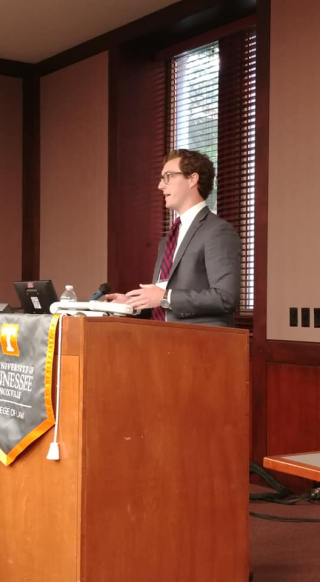
And with that thought in mind, I close with a picture of a UT Law student who gives me that hope.  He commented on my draft paper at the symposium on Friday.  He has been in my classroom for two semesters now (taking Advanced Business Associations, Corporate Finance, and Mergers & Acquisitions).  He spoke about why limited liability companies may be a better legal option for organizing social enterprise firms than corporations.  Proud moment for him and for me.  He aced it.

TransactionsBLPB2018(Adgent)


I knew it would be impossible. There was no way to relay my excitement about the potential of blockchain technology in a concise way to lawyers and law students last Friday at the Connecting the Threads symposium at the University of Tennessee School of Law. I didn’t discuss cryptocurrency or Bitcoin other than to say that I wasn’t planning to discuss it. Still, there wasn’t nearly enough time for me to discuss all of the potential use cases. I did try to make it clear that it’s not a fad if IBM has 1500 people working on it, BITA has hundreds of logistics and freight companies signed up to explore possibilities, and the World Bank, OECD, and United Nations have studies and pilot programs devoted to it. As a former supply chain person, compliance officer, and chief privacy officer, I’m giddy with excitement about everything related to distributed ledger technology other than cryptocurrency. You can see why when you read my law review article in a few months in Transactions.

I’ve watched over 100 YouTube videos (many of them crappy) and read dozens of articles. I go to Meetups and actually understand what the coders and developers are saying (most of the time). A few students and practitioners asked me how I learned about DLT/blockchain. First, see herehere, here, and here for my prior posts listing resources and making the case for learning the basics of the technology. What I list below adds to what I’ve posted in the past.

Here are some of the podcasts I listen to (there are others, of course):

1) The Decrypting Crypto Podcast 

2) Block that Chain

3) Block and Roll

4) Blockchain Innovation

Here are some of the videos that I watched (that I haven’t already linked to in past posts):

1) Using Blockchains for Supply Chains

2) IBM and Maersk demo: Cross-border supply chain solution on blockchain

3) How to Activate a Blockchain with IBM (Demo)

4) Examples of Blockchain Changing Every Day Life

5) 19 Industries The Blockchain Will Disrupt

6) Vitalek Buterin Explains Ethereum

7) In Conversation with Vitalik Buterin, Justin Drake and Karl Floersch (Ethereum Foundation)

8) Fireside Chat With Vitalek Buterin

9) Blockchain and Food Safety With IBM and Walmart

10) Applying Blockchain Technology to Customs Declarations

11) Your 31st Human Right Guaranteed by Blockchain

12) How Blockchain Can Transform India

13) Blockchain, A Tool for Social Good

14) Blockchain for Social Impact

15) Bitcoin, Blockchain, and the Law

16) Blockchain and the Law: What Lawyers (And their Clients) Need to Know

17) Blockchain and the Law: The Rule of Code

18) The Blockchain: A Revolution You Need to Understand

19) Vitalik Buterin on Ethereum, Bitcoin, and Scaling

20) Exploring Blockchain Use Cases: Microsoft Azure

21) How the Blockchain is Changing Money and Business

22) Blockchain and Corporate Law

23) Blockchain Innovation in Law and Corporate Governance

24) Changing the Legal Game With Blockchain

25) Blockchain and Smart Contracts

26) Code is Not the Law: Blockchain and Artificial Intelligence

27) Linklaters Blockchain Legal & Regulation Panel

28) How Do You Square Blockchain with Privacy Laws

29) Jeff Jonas on GDPR and Integrating IBM Blockchain with Senzing at IBM Think 2018

30) CPDP 2018: BLOCKCHAIN AND DATA PROTECTION: CHALLENGES AND OPPORTUNITIES

31) John McAfee: about blockchain, bitcoins and cyber security

There are dozens more, but this should be enough to get you started. Remember, none of these videos or podcasts will get you rich from cryptocurrency. But they will help you become competent to know whether you can advise clients on these issues.