
The Pep Boys – Manny, Moe & Jack (NYSE:  PBY) merger triangle with Bridgestone Retail Operations LLC and Icahn Enterprises LP is proving to be an exciting bidding war.  The price and the pace of competing bids has been escalating since the proposed Pep Boys/Bridgestone agreement was announced on October 16, 2015.  Pep Boys stock had been trading around $12/share. Pursuant to the agreement, Bridgestone commenced a tender offer in November for all outstanding shares at $15.  

Icahn Enterprises controls Auto Plus, a competitor of Pep Boys, the nation’s leading automotive aftermarket service and retail chain.  Icahn disclosed an approximately 12% stake in Pep Boys earlier in December and entered into a bidding war with Bridgestone over Pep Boys.  The price climbed to $15.50 on December 11th, then $17.00 on December 24th. Icahn Enterprises holds the current winning bid at $18.50/share, which the Pep Boys Board of Directors determined is a superior offer.  In the SEC filings, Icahn Enterprises indicated a willingness to increase the bid, but not if Pep Boys agreed to Bridgestone’s increased termination fee (from $35M to 39.5M) triggered by actions such as perior proposals by third parties.  Icahn challenged such a fee as a serious threat to the auction process.

Regardless of which company ends up claiming control over Pep Boys, this is a excellent example of sale principles in action and also shows the effect of merger announcements (and the promised control premiums) have on stock prices.  This will be a great illustration to accompany corporations/business organizations class discussions of mergers and the role of the board of directors.  For those teaching unincorporated entities as a separate course or component of the larger bus.org survey course, Icahn Enterprises is a publicly-traded limited partnership formed as a master limited partnership in Delaware– BONUS!  Bridgestone Retail Operations LLC, as in limited liability company, is a wholly-owned subsidiary of Bridgestone Corporation ADR, a publicly traded corporation.
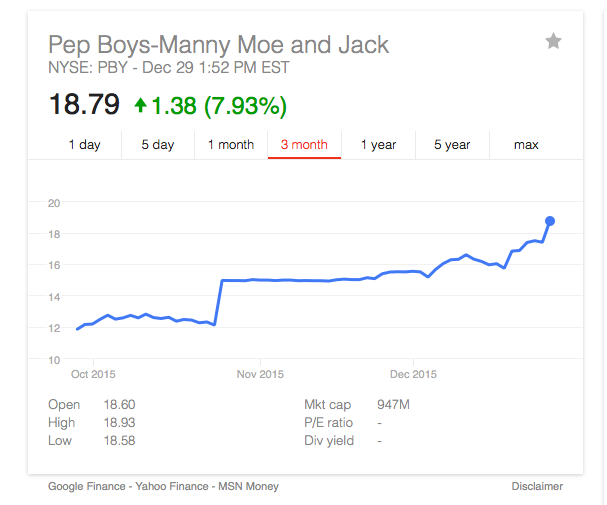
Pep boys stock price

 See you all in the New Year!  Anne Tucker

EDITED January 4, 2016.  Based on the thoughtful observations of fellow BLPB editor Haskell Murray, I removed the inarticulate references to this bidding war as a “Revlon” transaction.  As Haskell pointed out, Pep Boys is a Pennsylvania corporation and subject to a constituency statute.  The constituency statute modifies directors’ “Revlon” duties by authorizing (but not requiring) directors to consider:

The effects of any action upon any or all groups affected by such action, including shareholders, members, employees, suppliers, customers and creditors of the corporation, and upon communities in which offices or other establishments of the corporation are located.
(2) The short-term and long-term interests of the corporation, including benefits that may accrue to the corporation from its long-term plans and the possibility that these interests may be best served by the continued independence of the corporation…..
 
15 Pa. Stat. and Cons. Stat. Ann. § 515 (West)


A quick break from grading for my year-end report on the use of “limited liability corporation” instead of the correct “limited liability company” when referring to LLCs.  Hold on to your hats. 

Since December 31, 2014, Westlaw reports the following using the term “limited liability corporation”:

The most concerning of these, though, is Proposed & Enacted Legislation View all 169.  That’s not just misstating the law; it’s trying to make incorrect law. 

For example, Massachusetts has the following proposed legislation from, Sen. Tarr, Bruce (R), with the following summary: ” An Act relative to limited liability corporation filing fees.”  2015 Massachusetts Senate Bill No. 238, Massachusetts One Hundred Eighty-Ninth General Court. Of course, the proposed change is to the state’s Limited Liability Company Act, Mass. Gen. Laws Ann. ch. 156C, § 12 (West 2015).  

And one proposed change to “limited liability corporations” is not sufficient for that state this year. Rep. Arciero, James (D), similarly proposed “An Act relative to limited liability corporations dealing with children.” 2015 Massachusetts House Bill No. 304, Massachusetts One Hundred Eighty-Ninth General Court. The sponsors of these bills show that the “limited liability corporation” mistake is, at least, bipartisan.  

A bipartisan effort in the U.S. Congress is underway, as well, with “[a] bill to amend the Comprehensive Environmental Response, Compensation, and Liability Act of 1980 to modify provisions relating to grants, and for other purposes.”  This proposed amendment to Superfund boasts Sen. Inhofe, James M. R-OK, as the primary sponsor, and co-sponsors include Sen. Markey, Edward J. D-MA, Sen. Rounds, Mike R-SD, Sen. Boxer, Barbara D-CA, Sen. Crapo, Mike R-ID, Sen. Booker, Cory A. D-NJ.  The bill was referred to the Committee on Environment and Public works, and included the following provisions: 
Section 104(k)(1) of the Comprehensive Environmental Response, Compensation, and Liability Act of 1980 (42 U.S.C. 9604(k)(1)) is amended-

. . . .

(3) by adding at the end the following:
 
‘(I) an organization described in section 501(c)(3) of the Internal Revenue Code of 1986 and exempt from taxation under section 501(a) of that Code;
 
‘(J) a limited liability corporation in which all managing members are organizations described in subparagraph (I) or limited liability corporations whose sole members are organizations described in subparagraph (I);
 
‘(K) a limited partnership in which all general partners are organizations described in subparagraph (I) or limited liability corporations whose sole members are organizations described in subparagraph (I); or
 
‘(L) a qualified community development entity (as defined in section 45D(c)(1) of the Internal Revenue Code of 1986).’.
S. 1479, 114th CONGRESS, 1st Session (emphasis added).
 
Sigh.  
 
Finally, less binding than a statute would be, but perhaps more upsetting given its source, is Senate Resolution 210 from June 23, 2015.  A resolution “[c]elebrating the 125th anniversary of the State of Wyoming” as proposed by Wyoming Senator Enzi (for himself and Senator Barrasso) has the following bit of history wrong: “Whereas in 1977, Wyoming was the first State to establish a limited liability corporation (LLC) statute . . . .”  While the Senate resolution appropriately “commends and celebrates Wyoming and the people of Wyoming on the 125th anniversary of the State of Wyoming,” it is a something of a travesty that a “limited liability corporation” is part of that celebration of the state that gave us the limited liability company.  
 
Okay, just to be clear, I know that relative to real world problems like starvation, illness, and violence, this is not even a blip on the radar of relative importance. But, this should also not be that hard to fix, even with 169 proposed pieces of legislation last year using such abominable language.  
 
As we close out the year, I am hoping to see Michigan State at the top of both the men’s football and basketball rankings, and I wish everyone a happy and healthy New Year that is entirely free of LLCs being called “limited liability corporations.” 

Andrew Schwartz, a professor at the University of Colorado, has recently published an interesting article discussing how crowdfunding deals with the fundamental problems of startup finance: uncertainty, information asymmetry, and agency costs. His article, The Digital Shareholder, 100 MINN. L. REV. 609 (2015), is available here.

Here’s the abstract:

Crowdfunding, a new Internet-based securities market, was recently authorized by federal and state law in order to create a vibrant, diverse, and inclusive system of entrepreneurial finance. But will people really send their money to strangers on the Internet in exchange for unregistered securities in speculative startups? Many are doubtful, but this Article looks to first principles and finds reason for optimism.

Well-established theory teaches that all forms of startup finance must confront and overcome three fundamental challenges: uncertainty, information asymmetry, and agency costs. This Article systematically examines this “trio of problems” and potential solutions in the context of crowdfunding. It begins by considering whether known solutions used in traditional forms of entrepreneurial finance—venture capital, angel investing, and public companies—can be borrowed by crowdfunding. Unfortunately, these methods, especially the most powerful among them, will not translate well to crowdfunding.

Finding traditional solutions inert, this Article presents five novel solutions that respond directly to crowdfunding’s distinctive digital context: (1) wisdom of the crowd; (2) crowdsourced investment analysis; (3) online reputation; (4) securities-based compensation; and (5) digital monitoring. Collectively, these solutions provide a sound basis for crowdfunding to overcome the three fundamental challenges and fulfill its compelling vision.

Andrew was kind enough to share a draft of this article with me earlier this year, and I’ve been waiting for him to make it publicly available so I could bring it to your attention. I’m not quite as optimistic as Andrew that crowdfunding will solve the problems he identifies, but it’s a good piece and worth reading.

I was baffled by the idea of a film adaptation of this book – it doesn’t exactly lend itself to visual storytelling. But my skepticism was unwarranted; I enjoyed it tremendously, and, I have to admit, for a movie where everyone knows the ending going in, it was surprisingly suspenseful.

[Spoilers below the cut – but I’m giving it away now, the world economy collapses in the end]

Continue Reading Holiday Movie Blogging – The Big Short

I was a little rough on BigLaw last week, so I want to sing BigLaw’s praises this week. Granted, this post is scheduled for Christmas, so it may be even more lightly read than my previous post.

Students often ask me about BigLaw, and I tell them that if I had to do it over again, I would still start my career in BigLaw. Under the break, I explain why that is true.

Continue Reading BigLaw Strengths

Merry Christmas, Law Profs

Greeting cards have not been sent.

The Christmas stress is true.
But I still have one wish to make,
A special one for you:

Merry Christmas, law profs!
We’re on break(?), that’s true.
So I can dream,
And in my dreams,
There’s no more grading to do!
Grading’s ne’er joyful.
There’s always something “new.”
And every day’s a taxing one,
When grades and gifts are due.
The lights on my tree
( . . . Wait–is there a tree?)
Perhaps we’ll buy one today . . . ?!
No logs on the fire,
But I have real desire
To take a break and say
That I wish you Merry Christmas
–Happy New Year too.
I’ve just one wish
On this Christmas Eve:
I wish that grading was through!
I wish that grading was through!!
Merry Christmas, Merry Christmas, law profs.


Still grading, and (in the process) reflecting on the line in Marcia Narine’s post from last week on the references to “creepy tender offers” and “limited liability corporations” in her students’  final exam submissions . . . .  I thought I might share today a few of my own favorite outtakes from my students’ Business Associations exams.  I know that the time crunch and the nature of the exam software contribute mightily to the typing errors in student submissions, but on the reading end, some of the answers submitted are just . . . well . . . funny.  As you’ll no doubt note, today’s post focuses mostly on closely held corporations (with one typo relating to limited partnerships).

First , there are, of course, the transposed letters.  Most of these don’t warrant more than a brief mention.  The limited partnership act references to UPLA and RUPLA, instead of ULPA and RULPA fit into this category.  Similar are the inevitable variants of case names (Donahue becoming Danahue, Donahur, and Donaue, etc.). 

Then, there are the many misspelling of fiduciary(ies)–which I have come to believe may just be a hard word to type.  (Or maybe no one actually knows how to spell it.)  Uncommon misspellings of this often misspelled exam word include three versions that I found in one exam, in the same paragraph: foiducaries, fidurcairy, and fiducaiys.  (I should note that all of these correct to “fiduciary” or “fiduciaries” in the spellcheck, which I had to override to make this post.  Hmm.  Maybe they were not as far off as I thought.) 

Perhaps my favorite submission from the closely held corporation parts of the exam, however, was the one from the student who (repeating at the outset of his/her answer a short-form version of the prompt from my exam question) simply wrote: “What is the f duty?”  There was a bit of blank space after the letter “f” in that submission, so, given the possible existence of some exam period frustration . . . .  I think you can see where my mind went as I read that.  (Or maybe that would be–with words transposed–“What the f is duty?”)  :>)  Please forgive the irreverance!

Anyway, more on exams next week, when I am done.  Can’t wait.  To be finished with grading, that is.  Look for my holiday post for you all on my state of mind in that regard tomorrow morning.  Ho, ho, ho.