
My colleague Steve Bradford noted a little while back that this is the season grading, not grade whining. (Colleague Joan Heminway followed up with some sound advice on avoiding grade whining, too.) Add to the grading season an upcoming ABA site visit, and a few other deadlines, I’m feeling more overwhelmed than usual.  And, this morning, I went for my run in wet and rainy 55-degree weather with some a stiff wind in my face (on the way out).  

The wind in my face, coupled with Steve’s sound words, reminded me of a post I wrote in November 2014, Better Teaching Idea: Try to Notice When the Wind Is at Your Back.  When I got into the office, I read it again to try to help me get back to my work with a good mindset.  The close of that piece was this: 

If we want to be better teachers, better lawyers, and better people, we’d all do well to try to recognize when the wind might be (or might have been) at our backs.  At various times, because of our race, gender, sexual orientation, class, religion, familial situation, education, or other reality, we have faced challenges, feeling the wind blowing directly in our faces. But at some point, most of us had the wind at our back, at least as compared to someone else.  And certainly, some of us have had the help more than others. 

Recognizing the challenges others face does not make our challenges less real or our accomplishments less significant. It just gives us the chance to have a closer, if not full, understanding of the challenges others face.  Ideally, that can make us more fair, more accessible, and more reasonable. It is right to try, especially for those of us who have reaped the benefit of the wind at our backs more often than others. 

I still very much believe this is true, and with the holidays rapidly approaching, it’s a good reminder to me to be thankful for all I have, and to appreciate how well I have it.  

I wish you all happy holidays, efficient grading, good beer and wine (not whine), and great friends and family.  
I mentioned back in October that I spoke in Munich on Regulating Investment Crowdfunding: Small Business Capital Formation and Investor Protection. I discussed how crowdfunding should be regulated, using the U.S. and German regulations as examples.

If you’re interested, that talk is now available here. I expect this to be the top-rated Christmas video on iTunes.

If you want to know more about how Germany regulates crowdfunding, I strongly suggest this article: Lars Klöhn, Lars Hornuf, and Tobias Schilling, The Regulation of Crowdfunding in the German Small Investor Protection Act: Content, Consequences, Critique, Suggestions (June 2, 2015).

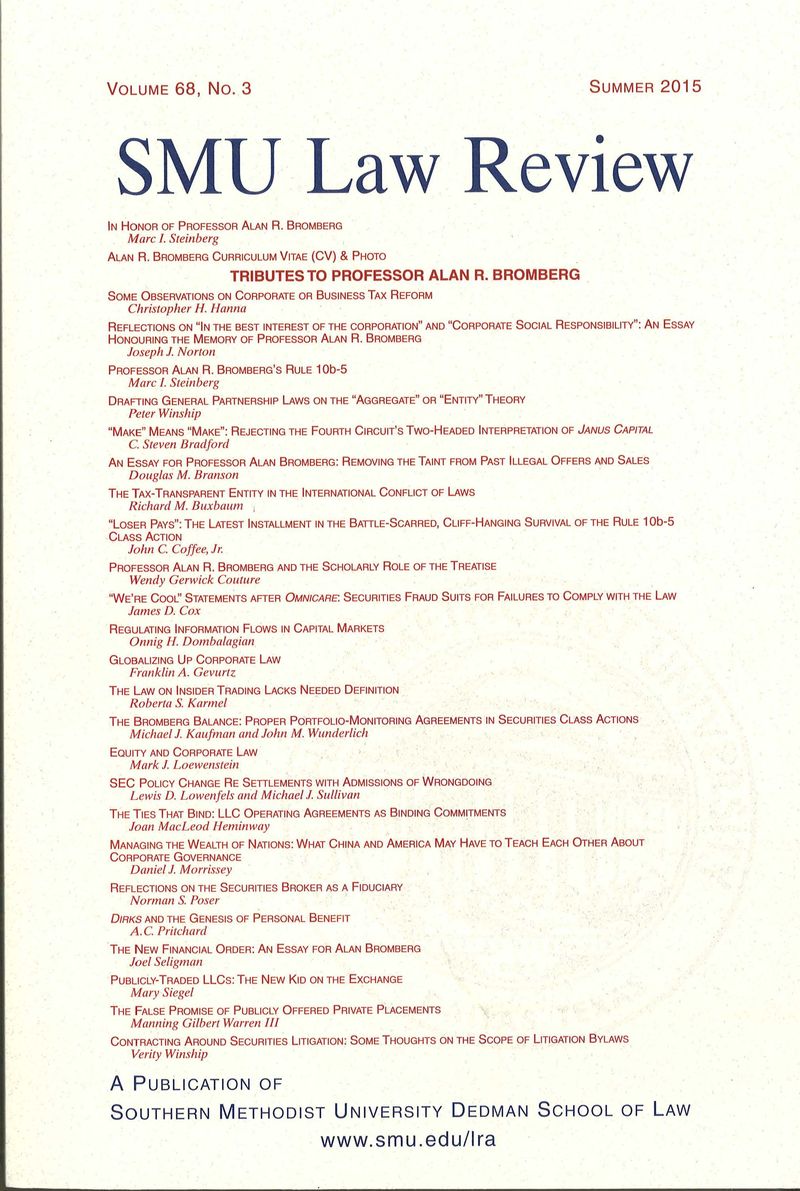
If you’re interested in securities law, there’s a new law review symposium issue worth reading. The SMU Law Review has posted an issue honoring the late securities law scholar Alan Bromberg. The symposium includes a number of interesting essays written by leading securities law scholars, including a piece by my co-blogger Joan Heminway. (I also have an article in the issue, so there’s also at least one non-interesting article by a non-leading scholar.). Here’s a copy of the cover, listing all of the articles:

SMU Cover

Here’s  a PDF copy of the cover, if you can’t see the image.

It was recently announced that Dow and DuPont plan to merge, and then split into three separate companies – focusing on agriculture, materials, and specialty products. The move has been described as a victory for activist shareholders, and doubts have been raised about the practical viability of the plan.

But the aspect that intrigues me is the tax planning.

Now, I’m not a tax lawyer – I just play one on the internet – but after consultation with my colleague, Shu-Yi Oei, here’s my understanding of how this works.

Ordinarily, if a company spins off an aspect of its business and distributes the shares to existing shareholders, it can be treated as tax free under 26 U.S.C. § 355. The idea is that the existing shareholders once held shares in a single company, but now hold shares in two companies, there has been no substantive change, and the entire transaction is not treated as a realization event. If, however, a company simply sells off a business line to a third party, that is treated as a realization event, and it is taxed.

As a result, companies have tried to structure sales as tax free spinoffs. For example, a target company might spin off one business line tax-free, then sell remaining business lines to an acquirer, rather than have the acquirer buy the entire target (with attendant taxes).

The tax code therefore has a series of provisions designed to distinguish between the two scenarios. In particular, it provides that if a company spins off a business to its shareholders, that will be treated as taxable if 50% of the voting or economic interest in either the original company or the spinoff is acquired in the period immediately preceding or following the spinoff.

The question, then, is whether DuPont and Dow merging “counts” as an acquisition of 50% of the voting/economic interest in either company prior to the three-way split.

Dow and DuPont maintain that it does not. They are structuring the deal as a “merger of equals” – two companies of approximately equal size, combining, so that shareholders of the former DuPont and Dow will each own 50% of the combined new entity. But to avoid tripping the 50% threshold that the IRS treats as an acquisition of one or the other, they’re relying on the significant overlap between the two companies’ shareholders. Specifically, Vanguard Group, State Street, Capital World, and BlackRock own something like (I hope my math is right) 17% of Dow Chemical, and 18% of DuPont. The theory goes, due to this overlap, when these shareholders receive stock in the combined post-merger entity, they have not actually acquired any new interests – they’ve simply consolidated their existing interests. Therefore, their interests don’t count when determining whether there’s been an acquisition of 50% immediately preceding the spinoff.

The fascinating thing here, of course, is that these shareholders – and a handful of others – are the top shareholders of lots of publicly traded companies.

Some literally random examples that I just thought to look up:

Delta.  Among the top investors are Vanguard, Capital World, State Street, and BlackRock.

Whole Foods, whose top investors include Vanguard, State Street, and BlackRock.

Microsoft, whose top investors you will be shocked to learn include Vanguard, Capital World, State Street, and BlackRock.

First Energy, whose top investors include – wait for it! – State Street, Vanguard, and BlackRock.

Everyone who’s surprised by the news that some of the top shareholders of Activision are Vanguard, State Street, and BlackRock, stand on your head.

And – hey, look! Vanguard, Capital World, State Street, and BlackRock are also sharing a Coke.

Now, many institutional investors, like Vanguard, hold shares through mutual funds or other types of entities, all of which are legally distinct.  So if the argument is that all of these funds count as a single “owner” for tax purposes, Dow and DuPont may (I guess?) be relying on 26 U.S.C. § 355(d)(4), which defines “interest” to mean either voting power or economic interest. Vanguard’s mutual funds may be the “owners” of the shares, but Vanguard has broad control over their votes across its fund holdings, which it appears may be enough for the IRS.*

In any event, if overlapping shareholders is the test, that’s one hell of a tax loophole.

*I gather that there are also special attribution rules for determining whether the 50% threshold has been reached; Skadden (as the tax advisor) clearly thinks they’ve got it covered.

My co-blogger Marcia Narine shared an article on social media this week entitled Lawyers have lowest health and wellbeing of all professionals, study finds. Sadly, this is not new news. 

Those results, I am afraid, would be even worse if only members of the nation’s largest law firms (a/k/a “BigLaw”) were surveyed. Deborah Rhode (Stanford) talks about some of the problems in BigLaw, described in her book the Trouble with Lawyers

Let’s assume, for the sake of this post, that the executive committee of a large law firm wants to improve employee welfare. What could the committee realistically do to improve employee wellbeing? Part of the low score for lawyers, I imagine, is just the nature of BigLaw, but under the break I make a few suggestions for consideration. 

Continue Reading Better BigLaw

A year ago today, President Obama shocked the world and enraged many in Congress by announcing normalization of relations with Cuba. A lot of the rest of the United States didn’t see this as much of a big deal, but here in Miami, ground zero for the Cuban exile community, this was a cataclysmic event. Now Miami is one of the biggest sources of microfinance for the island.

Regular readers of this blog know that I have been writing about the ethical and governance issues of doing business with the island since my 10-day visit last summer. I return to Cuba today on a second research trip to validate some of my findings for my second article on governance and compliance risks and to begin work on my third article related to rule of law issues, the realities of foreign direct investment and arbitration, what a potential bilateral or multilateral investment agreement might look like, and the role that human rights requirements in these agreements could play.

This is an interesting time to be visiting Cuba. The Venezuelan government, a large source of income for Cuba has suffered a humiliating defeat. Will this lead to another “special period” for the nation similar to the collapse of the Soviet Union? Major league baseball players who defected from Cuba just a few years ago announced a homecoming trip today. Yesterday, the US government authorized commercial flights to return to Cuba. The property claims for the multinationals and families who had homes and business confiscated by Castro are being worked out, or so some say.

Over the next few days in between touring Old Havana and fishing villages, I will learn from lawyers and professors discussing arbitration law in Cuba, foreign investment law 118/2014, tax and labor implications for the foreign investor, the 2015 amendments to the Cuban Assets Control Regulations, requirements for gaining government approval and forming state partnerships, and the Cuban banking system.

Strangely, I am excited. While I should be decompressing from the shock of reading student exams discussing “creepy tender offers” and “limited liability corporations,” I can’t wait to delve into the next phase of my research and practice my business Spanish at the bar of the Parque Central in La Habana. My internet access will be spotty and expensive but if you can think of any pressing questions I should ask leave a comment below or email me at mnarine@stu.edu.

David Epstein asked me to post the following. I was a commercial law teacher earlier in my career, so I’m happy to.

COMMERCIAL LAW CURRICULUM REDO

We – Wayne Barnes, David Epstein, Paula Franzese and Kevin Tu – are asking for your help.

More and more law schools are no longer regularly offering three-credit courses in (1) payment systems, (2) secured transactions, and/or (3) sales. In part because these schools do not have faculty members who want to teach the courses. And, in part because students do not sign up for commercial law courses. Even if the commercial law courses are taught from 11-12:e30 on Tuesdays and Thursdays.

And, the students are, of course, right. Most students do not need 42 class hours of payment systems or 42 hours of secured transactions or 42 hours more of sales. However, lawyers in a general civil practice do need to have familiarity with core commercial law concepts in order to master the specific statutory provisions that govern the transaction or litigation matter that they are working on. And, before that, there is a need to pass the state bar exam.

We propose that our students’ needs can best be meet in a two credit course covering just the core commercial law concepts and are working on course materials for such a course. We welcome your reasoned arguments against this proposal. Even more welcome would be your suggestions as to how 28 class hours can most effectively be used by students learning core commercial concepts.

Look forward to seeing you at the AALS and/or receiving your emails.

If you have any thoughts, please email Wayne Barnes (wbarnes@law.tamu.edu); Paula Franzese (Paula.Franzese@shu.edu); Kevin Tu (tu@law.unm.edu), or David Epstein (depstein@richmond.edu) directly. Don’t respond to me or the blog.

A number of months back, the Business Law Prof Blog hosted a series of five posts by Marcos Antonio Mendoza (here, here, here, here, and here) that were quite popular.  He wrote about (among other things) the need to educate students for the evolving roles in which they may serve as corporate counsel.  His recent article on corporate counsel.com offers much food for thought along those lines and serves as a good reminder, as we head into a new semester, of what our students may need long-term in the workplace.  In both this article and his earlier BLPB posts, Marcos is reacting to an academic research paper, “Finding the Right Corporate Legal Strategy” (available to subscribers or for purchase), published last year in the MIT Sloan Management Review by Professor Robert C. Bird of the University of Connecticut School of Business and Professor David Orozco from the Florida State University College of Business.

Although you all should read Marcos’s Corporate Counsel article (and his posts) for yourselves, I will offer a few quotes from the article and related law school instruction take-aways here.  These largely repeat and reframe Marcos’s own observations in his BLPB posts.

  • “[T]he most successful companies determine which of five legal strategies is the most effective in their legal environment, and then deploy their legal resources to accomplish their goals.” The five legal strategies are avoidance, compliance, prevention, value, and transformation.  We would be doing our students a great service in identifying and explaining these five strategies and showing the students how legal doctrine, theory, and policy connect with the strategies.
  • “One of the most effective ways for companies to promote . . . attorney education [about business issues] is through job rotations, in which counsel are temporarily assigned to managerial positions in the business units they support.”  Courses in the standard law school curriculum–and even new offerings focusing on business skills (e.g., reading and interpreting financial statements)–obviously do not (cannot) serve this function, although some clinic and simulation experiences offer students a limited exposure to business issues.  We should consider designing field placements, internships, externships, etc. for business law students to give them some quality, sustained exposure to business issues.
  • “[E]xecutives should create a cross-functional strategic team composed of lawyers and operational business managers who are guided by the chief legal strategist. The team’s responsibility is to hypothesize legal strategies that have a clear impact on a profit-loss statement.”  Can we model these strategic teams for our students? Can a consciously constructed curricular or co-curricular program with a business school (easier to accomplish for those of us in universities) offer a useful experience of this kind to our students?

Again, as we finalize course planning and syllabi for (and, in general, think about) the new semester, the types of educational experiences identified by Marcos in his earlier posts–including those highlighted here–are well worth bearing in mind.

CALL FOR PRESENTATION PROPOSALS 

 Institute for Law Teaching and Learning—Summer 2016 Conference

“Real-World Readiness”

June 10-11, 2016

Washburn University School of Law—Topeka, Kansas

 The Institute for Law Teaching and Learning invites proposals for conference workshops addressing the many ways that law schools are preparing students to enter the real world of law practice.  With the rising demands for “practice-ready” lawyers, this topic has taken on increased urgency in recent years.  How are law schools and law professors taking on the challenge of graduating students who are ready to join the real world of practicing attorneys?  Can we be doing more?

The Institute takes a broad view of educational practices that promote real-world readiness.  Accordingly, we welcome proposals for workshops on incorporating such teaching techniques in doctrinal, clinical, externship, writing, seminar, hybrid, and interdisciplinary courses.  Workshops can address real-world readiness in first-year courses, upper-level courses, required courses, electives, or academic support teaching.  Workshops can present innovative teaching materials, course designs, curricular or program designs, etc.  Each workshop should include materials that participants can use during the workshop and also when they return to their campuses.  Presenters should model best practices in teaching methods by actively engaging the workshop participants. 

The Institute invites proposals for 60-minute workshops consistent with a broad interpretation of the conference theme.  To be considered for the conference, proposals should be one single-spaced page (maximum) and should include the following information:

  • the title of the workshop;
  • the name, address, telephone number, and email address of the presenter(s);
  • a summary of the contents of the workshop, including its goals and methods; and
  • an explanation of the interactive teaching methods the presenter(s) will use to engage the audience.

The Institute must receive proposals by February 1, 2016.  Submit proposals via email to Emily Grant, Co-Director, Institute for Law Teaching and Learning, at emily.grant@washburn.edu.

More information is available at: http://lawteaching.org/conferences/2016/

Download CFP Summer 2016 Washburn Conference