My coauthor, SMU Law Professor James W. Coleman, recently posted a draft of our article, Metals Derivatives Markets and the Energy Transition, on SSRN.  It’s forthcoming in Transactions: The Tennessee Journal of Business Law, and was written in connection with Business Transactions: Connecting the Threads VII, the BLPB-related conference at the University of Tennessee Law School.  I had a wonderful time at the event, which has become one of my yearly favorites, and am truly grateful for UT Law School’s consistently outstanding hospitality! 

Here’s the abstract of our article:

Despite their escalating importance, thus far, there has been minimal legal scholarship on metals derivatives markets. Given the key role of these markets in the transition to a clean energy future, increased focus on them is imperative. Hence, it is not surprising that the agendas for the last four meetings of the Commodity Futures Trading Commission’s Energy and Environmental Markets Advisory Committee each dedicated a significant portion of the meeting to metals derivatives markets and their role in the transition to a clean energy future.

Fundamentally, the United States and the world are moving from their long-term dependence on the fossil fuels that built the modern world, to dependence on new commodities such as copper and lithium. Coal and then natural gas made the modern economy possible by providing heat, power, and electricity to growing industries and populations in the world’s growing urban centers. Then oil made globalization possible by powering international sea and air travel as well as overland vehicles. As electric vehicles increasingly displace fossil fuel vehicles and renewable energy sources increasingly replace fuels in heating and industry, the economic and geopolitical stakes of metals markets will grow higher and higher. The criticality of metals derivatives markets, such as the dysfunctional market for nickel, will also escalate as governments, businesses, and others seek to hedge risks related to the increasing global dependency on metals.

Our article makes at least two contributions. First, it expands the minimal analysis of metals derivatives markets in the legal scholarship. Indeed, to the best of the authors’ knowledge, this is the first law review article to focus primarily on these markets. Second, it explores the role of metals derivatives in preparing for the transition to a clean energy future. We provide a brief overview of metals derivatives, including new markets in development, and their regulation in Parts I and II, respectively. In Part III, we explore the central role of metals derivatives markets in securing a clean energy future.  
I had the opportunity to attend one of the sessions in the Interdisciplinary Workshop on Corporations, Private Ordering, and Corporate Law last week.  The program was co-hosted by Foundations of Law and Finance (Goethe University Frankfurt, Center for Advanced Studies) and Columbia Law School.  Luckily for me, the piece of the program I attended featured Nizan Geslevich Packin presenting a work-in-progress she is co-authoring with Anat Alon-Beck entitled Board Observers: Shadow Governance in the Era of Big Tech.

Although a draft of the paper is not yet posted, here is the SSRN abstract:

This Article examines the rise in corporate governance practice of appointing board observers, especially in the context of private equity, venture capital (VC), and corporate venture capital (CVC). Board observers are non-voting members attending board meetings to gain knowledge and insight. They arguably also provide valuable feedback, an outside perspective, and can even help ensure corporate operations. In recent years, board observer seats – a notion also existing in the nonprofit sector – have become increasingly popular in the for-profit business world, where investors have various market and business justifications for using board observers, including corporate governance considerations, minimizing litigation exposure, navigating antitrust issues, CFIUS regulation, and ERISA concerns. It was not until November 2023 that mainstream media started paying more attention to the concept of board observers, after OpenAI, the corporate entity that brought the world ChatGPT, gave Microsoft a board observer seat following the drama in OpenAI’s boardroom. But what the mainstream media did not explore in its coverage of the board observer concept was its seemingly less interesting nature as a non-voting board membership, which was an important element in the complex relationship between OpenAI and Microsoft. This signaled deepening ties between the two companies that also eventually got the attention of the DOJ and FTC, as well as the influential role of CVC in funding and governing the research and development of OpenAI.

This Article makes several contributions. First, it provides an account of the board observer phenomenon, which has significantly developed and become a common practice in recent years given antitrust and national security considerations and scrutiny. Second, it presents fresh insights, groundbreaking empirical findings, and data on the scope of this corporate governance vehicle. Third, it considers the theoretical circumstances and implications of these developments. It argues for a shift in contractual innovation in deal-making and regulatory reviews, necessitating the development of corporate culture norms emphasizing disclosure and prioritizing company interests, communication, and trust-building as crucial elements in service of board observers. Finally, the Article considers the practical implications of these developments and explains why more empirical data collection and further research are necessary to determine whether current corporate governance mechanisms require modification in connection with liability, accountability, and fiduciary duties for board observers.

As someone who had to deal with board observer requests and provisions in an earlier corporate finance era, I was fascinated by the work.  So much of what their research is revealing felt familiar (even though much also has changed): what is old can be new again.  I look forward to reading the draft and learning more.

Given all the news about Governor Abbott’s pitch to create a business law infrastructure that will compete with Delaware, and Musk’s threat to decamp there, it’s worth pointing out that this is an amendment that was recently proposed to the Texas Business Organizations Code:

BURDEN OF PROOF IN CERTAIN DERIVATIVE PROCEEDINGS. Notwithstanding any other law, in a derivative proceeding by a shareholder that alleges an act or omission related to the improper consideration of environmental, social, and governance criteria in the performance of the act or omission, the burden of proof is on the corporation to prove the act or omission was in the best interest of the corporation.

In 2022, Texas legislators proposed amending its law to permit shareholders to bring a fiduciary duty claim against the managers of any public company that provided women employees with travel benefits for abortion care (though, to be fair, in that case, the proposal would have applied even to non-Texas organized companies).

Texas Attorney General Ken Paxton has been very vocal about his objections to ESG – he is among those suing to block a Department of Labor rule, among other things – and as Attorney General, he would, as I understand it, have the power to seek involuntary dissolution of Texas entities.

We can also throw in Texas’s refusal to do business with financial institutions it perceives as “boycotting” oil companies, with “boycott” defined both capaciously and idiosyncratically.

I think it would be very difficult for Governor Abbott to assure companies that if they organize in Texas, their business decisions will not be second-guessed on political grounds.

So, anything interesting happening in corporate law this week?

I kid, I kid. On Tuesday, Chancellor Kathaleen McCormick of the Delaware Court of Chancery issued her long-awaited opinion in Tornetta v. Musk, where she took the extraordinary step of holding that Elon Musk’s Tesla pay package from 2018 was not “entirely fair” to Tesla investors, and ordered that it be rescinded.  In practical effect, she ordered the cancelation of stock options worth about $51 billion, or, according to news reports, about a quarter of his current wealth.  Put that together with the Twitter purchase, the State of Delaware and Chancellor McCormick have cost Musk about $90 billion, give or take (though a contrary take would involve the words “actions” and “consequences”).

The legal standards

Normally, the decision of what to pay a corporate CEO – like any other business decision – is controlled by the board of directors, and not subject to second-guessing by a court.  But, like any other business decision, that changes if the executive pay package can be seen as self-dealing, namely, the decisionmakers have a financial interest in the arrangement.

In a normal company, that isn’t a problem; the corporate directors act at arm’s length from the CEO for the purposes of negotiating the pay package. 

In companies with controlling shareholders – like Meta and Mark Zuckerberg, for example, which McCormick namechecks in her opinion – any compensation package would necessarily be tainted with the specter of self-dealing (how seriously can the Meta board bargain against Zuckerberg?), and so controllers tend to forego compensation entirely, which, of course, seems reasonable because they already have so much equity in the company that they are plenty incentivized to come to work every day.

That said, if a company chooses to engage in a conflicted transaction, it is not automatically illegal; it simply is assessed under a complex set of legal standards if it is later challenged in court by a stockholder.

The basic rule is, if an independent decisionmaker interposes themselves in the process, the court will defer to that decisionmaker.  If not, the court will closely examine the transaction to ensure its fairness.

Typically, the independent decisionmaker will be independent board members.  In the process of negotiating an executive pay package, for example, some board members may have close ties to the executive, but others will not, and so the ones who can be objective will make the call.

Alternatively, the independent decisionmaker can be the disinterested shareholders, who can vote to approve the transaction.

In Delaware, however, those rules only hold for conflicted transactions that do not involve a “controlling shareholder,” or controller.  Typically, controllers are those who control more than 50% of the company’s voting power, but control may in fact exist through other means.  More on that in a minute.

Delaware courts have come to coalesce around the rule that if a controlling shareholder is on the other side of a conflicted transaction, both board members and disinterested stockholders may be so intimidated or captured by the controller that they will be hesitant to buck his will.  Hence, those transactions can only be cleansed if both the independent directors, and the disinterested stockholders, approve it.

If only one mechanism is used – just independent directors, or just disinterested stockholders – controlling shareholder conflict transactions will still be assessed for their fairness, but the stockholder plaintiff will have the burden of proving by a preponderance of evidence a lack of fairness, rather than the defendant controller proving fairness.

What McCormick found

Formally, in Tornetta, the court concluded that Elon Musk was a controlling shareholder of Tesla, at least for the purposes of setting his compensation package.  The court considered both his 21% percent stake, and his “ability to exercise outsized influence in the board room” due to his close personal ties to the directors and his “superstar CEO” status.  She recounted the process by which the pay package was set, noting in particular that Musk proposed it, Musk controlled the timelines of the board’s deliberation, and he received almost no pushback – board members and Tesla’s general counsel seemed to view themselves as participating in a cooperative process to set Musk’s pay, rather than an adversarial one.

What about the stockholder vote?  That, too, was tainted, because – McCormick concluded – the proxy statement delivered to shareholders contained material misrepresentations and omissions.  It described Tesla’s compensation committee as independent when in fact the members had close personal ties to Musk, and it did not accurately describe the manner in which his pay package was set – again, with Musk himself proposing it and the board largely acquiescing.  With those findings in hand, McCormick did not rule on the plaintiff’s additional arguments that the proxy statement was misleading for other reasons (namely, it falsely described the payment milestones as “stretches” when in fact the early ones were already expected within Tesla internally.)

Therefore, McCormick turned to the fairness analysis, with defendants bearing the burden of proof.  McCormick recognized that Musk had delivered extraordinary value for Tesla, but that was only one side of the equation.  The other side was whether his shockingly large pay package was necessary to get that result; given that Musk already held a 21% stake and had no intention of leaving the company, she concluded it was not.  Or, at the very least, the package was flawed because the Board had not even asked whether such sums were necessary.  Moreover, in its deliberations, the Board had identified precisely one particular concern about Musk: Whether he was too distracted by his outside interests to focus on Tesla.  But there was no further discussion of that issue, and no proposal to condition his pay on limiting his distractions. 

McCormick did not specifically so hold, but she must have been aware that, far from incentivizing Musk’s undivided attention, the Tesla pay package enabled Musk’s purchase of another massive distraction that almost certainly is damaging Tesla’s brand.  

And, well. Here we are.

Currently, however, Delaware is in the process of reevaluating its standards for reviewing controlling shareholder transactions.  The argument under consideration is whether certain kinds of transactions – executive pay packages, for example – can be cleansed, and thus insulated from judicial review, through one protective mechanism rather than two (independent board or independent shareholder approval), the same way conflict transactions that do not involve a controlling shareholder usually are.  Even if the Delaware Supreme Court so holds, though, that fact alone would not necessarily save Musk’s pay package, because McCormick concluded Musk’s pay package was not cleansed either way.  She might have to rejigger her findings a little to clarify, but that’s all.

Similarly, if the Delaware Supreme Court were to conclude that Musk did not, in fact, deserve the formal label of controlling shareholder – say it suddenly set a bright line rule that controlling shareholders must have 50% of the vote – that still would not save Musk’s pay package (though, again, McCormick might have to revise her opinion a little), because McCormick made clear that the board’s decisionmaking was tainted by close ties to Musk no matter what label you apply (see fn. 546: “The factual findings that render Musk a controller, however, support a finding that the majority of the Board lacked independence.”), and so was the stockholder vote, so either way, there was no independent decisionmaker.

If, however, the Delaware Supreme Court did two things – say it both concluded that Musk was not a controlling shareholder, and it overturned McCormick’s factual finding that the shareholder vote was tainted – that might save Musk’s $51 billion, though – again, more below – the more likely outcome is McCormick would have to retry certain aspects of the case.

The takeaways

The overriding sense that one gets from this opinion that the bill for Tesla’s open and notoriously poor governance standards just came due.

Tesla shareholders, as well as other commenters, have for years complained about everything from the close personal ties Tesla’s board has to Musk, to the manner in which Musk’s other companies compete for his attention, to Musk’s open defiance of his settlement with the SEC, to the fact that Musk casually conscripts Tesla employees to work at other companies in his empire.  Now, for the first time, all of these aspects of Musk’s reign coalesced into a single, legal conclusion that was fairly obvious to the rest of us but I think has devastating implications for Tesla going forward: Tesla’s board exercises no oversight over Elon Musk.

McCormick even took on the “Technoking” title:

Musk testified that the title was intended as a joke, but that is a problem in itself.  Organizational structures, including titles, promote accountability by clarifying responsibilities. They are not a joke.

McCormick was obviously ruling in the shadow of VC Slights’s previous conclusion that Musk had not exercised control over the board for the purposes of the SolarCity acquisition, and so formally, she limited her own holding to Musk’s control for the purposes of his pay package, but she also drew in the entirety of Musk’s tenure.  And, in a footnote, she pointed out that though Slights had characterized board member Robyn Denholm as a “powerful, positive force,” that particular version of Denholm had not shown up in McCormick’s courtroom: 

this court previously held that Denholm was “an independent, powerful and positive force during the deal process” that led to the SolarCity acquisition. And that was surely true at the time. But it was not a factual finding that carries forward for all time. Moreover, Denholm’s approach to enforcement of the SEC Settlement, including unawareness of one of its key requirements, suggests a new lackadaisical approach to her oversight obligations.

Leaving aside the legal formalities, the obvious question is – was McCormick right?  Whether or not Tesla formally complies with Delaware corporate governance standards, Musk has unquestionably delivered extraordinary value to its shareholders.  The “Technoking” title may very well highlight the casualness with which Tesla directors approach their responsibilities, but also that’s the kind of thing Tesla shareholders value.  It may not improve cash flows, but, at least historically, it improves stock prices by pleasing Musk fans.  Which raises a very interesting doctrinal question – one I think posed in a more academic way in this paper by Charles Korsmo and Minor Myers – is it the duty of a Delaware board to raise stock prices – even by, say, taking Zoom calls with no pants on or buying a gold mine – or is it the duty to improve fundamental value?  

Societally we may prefer the latter but Tesla shareholders individually presumably prefer the former.  On the other hand, even the share-price approach is a bit like catching the tiger by the tail; it only lasts as long as Musk’s star power lasts, and that may not be forever.

I was struck by Antonio Gracias’s testimony that the package was designed to give Musk “dopamine hits,” because I think that is not a bad way to look at it.  Yes, he presumably was internally motivated to boost Tesla’s stock price because of his own 21% stake, but we all know – or we think we know – Musk’s psychology.  What motivates him psychologically isn’t (just) the money, but things he views as outrageous challenges.  Maybe by gameifying his compensation package – presenting him with impossible goals and then, when he met them, ringing bells and showering confetti and gold coins – the board really did extract maximum performance.

On the other hand, as McCormick repeatedly emphasized, there was some evidence that at least the early goals were not particularly challenging.  But that’s just like any game; the first levels are always the easiest.

We could also ask whether McCormick reached the right conclusion about the shareholder vote.  Yes, the proxy statement may not have explained the full extent of Musk’s board ties, but did anyone really not understand the Tesla board’s (lack of) independence?  (An internal document from ISS made pretty clear that ISS, at least, believed the board to be weak, but for whatever reason was hesitant to say so openly).  And once you know all that, did it really matter that the full embarrassing process by which the compensation package was formulated was not laid out in the proxy?  Surely no one thought this was an arm’s length negotiation?

The problem, from my perspective, is that those gut level reactions do not map to the legal standards in a coherent way (you can use concepts like “materiality” or whatnot but there is no way to apply those in the kind of “one ticket only” way that Musk and Tesla require).  And of course, the legal standards have a societal function of professionalizing large, powerful companies, in a way that is important even to nonstockholders, regardless of their specific impact at Tesla, though that’s not something Delaware can formally acknowledge.

What happens now?

Now, I assume, Tesla appeals.  I am not going to hazard a guess on outcome, though I will make a couple of quick observations.

First, as I have previously writtentwice – Delaware’s standards for determining who gets the label of “controlling shareholder” are very malleable.  However, as I blogged previously, I think in its SolarCity opinion, the Delaware Supreme Court did provide some guidance on that score, suggesting, in a roundabout way, that only the power to elect directors and approve transactions, or possibly block them, should factor in to the analysis.  McCormick did not take that hint, though; she did a more holistic review, which may turn out to be legally vulnerable.  But, as I said above, that’s not enough, standing alone, to knock out her core conclusions.

Another area that might be the focus of an appeal would be the shareholder vote.  Musk could argue that the omissions were, in fact, immaterial to shareholders.  I will not say that is a losing argument, but I will say it would be aggressive if the Delaware Supreme Court were to reverse on that score.  If it did so, however, that – standing alone – would not save Musk’s pay package.  So long as Musk retains the “controlling shareholder” label – and Delaware maintains its double-protection rule for controlling shareholder transactions – a reversal on that score would mean, at most, a remand to shift the burden of proof from defendants to the plaintiff, and I think it’s … unlikely … the outcome would change.  Plus, McCormick did not even rule on arguments that the proxy statement was misleading for other reasons, so a remand would give her another crack at that issue.

And if Delaware both changes its standards for cleansing controlling shareholder transactions (or holds Musk was not one), and holds the shareholder vote was not tainted, that still should result in a remand for McCormick to determine whether the plaintiff’s additional arguments that the proxy statement was false – the ones she did not engage – succeed.  For Musk to get a complete win, in other words, the Delaware Supreme Court would likely have to conclude either that he is not a controller (or that controller-conflicted transactions do not need two levels of protection), and that the shareholder vote was not tainted, and that the claims McCormick did not rule upon have no merit and do not need to be tried.

That is … a tough lift for Musk.

Notice I have not even considered the possibility the Delaware Supreme Court would reverse McCormick’s findings that the board was beholden to Musk because … no.  I mean, Musk could argue that there is nothing bad about a board “cooperating” with a CEO to develop a pay package; he could try to make a parody of McCormick’s findings by claiming that she unfairly seemed to want the CEO and the board to be at loggerheads, but … no.

Which means on the law, I like the plaintiff’s chances.  On the political economy, though – well, Musk is obviously beating some very loud drums about reincorporating out of Delaware, and I have previously asked whether that kind of thing could influence Delaware’s decisionmaking.  On the other hand, the Delaware Supreme Court cannot be seen as capitulating to Musk, which means if it reverses McCormick, it must have a fairly solid basis to do so.

Edit: I suppose the Delaware Supreme Court could reweigh the evidence and conclude the pay package was fair, but that would be extremely aggressive. So aggressive that it literally did not occur to me, which is why I had to edit this post.

Edited again (Feb. 3): The “fairness” inquiry that Delaware courts conduct consists of two aspects: the fairness of the process, and the fairness of the ultimate price.  I went back to the Delaware Supreme Court’s SolarCity opinion, and there, the court was very clear that ultimate question of whether a price was fair (one half of the overall fairness inquiry) is a legal question that rests upon factual conclusions.  As the Delaware Supreme Court put it reviewing the Chancery court’s findings, “We conclude that the record supports the Court of Chancery’s legal conclusion that the price paid was a fair one and that the trial court did not misapply the entire fairness standard.”  That matters because the Delaware Supreme Court will defer to Chancellor McCormick’s factual findings, but does not defer to her legal ones.  So that’s probably one of Musk’s best lines of argument: even if you accept all of Chancellor McCormick’s factual findings about the flaws in the process by which his compensation package was set, the Delaware Supreme Court has the authority to consider anew whether, in light of the huge value Musk was required to deliver to shareholders, the grant was unfair. 

As for the board’s failure to curb Musk’s outside ventures, the response is obvious: it chose to directly compensate him for performance, rather than the methods he used to achieve that performance.  I.e., promise him the moon if he substantively delivers, and let him decide what efforts will be required.

That said, the first tripwire I see for him is McCormick’s conclusion that the early milestones were easy ones.

No, but what happens now to Tesla?

Let’s assume the opinion stands.  That company does not have a lot of great choices.

Assuming Musk does not want to go the Zuckerberg-no-compensation route, any new compensation award will have to be negotiated by the board in the shadow of McCormick’s findings (not to mention Musk’s threat to breach his fiduciary duties by diverting AI opportunities from Tesla to his other companies, which, this post is long enough, I am not going there). 

But the problem extends beyond compensation to a host of other issues. There are already pending cases, that have been stayed, about board oversight of Musk – the failure to monitor his tweets, for example, or to enforce the SEC settlement – at this point, I’ve lost track of them all.  Tesla was just accused of dumping hazardous waste; that’s the stirring of a Caremark claim.  Musk has been using Tesla engineers at Twitter – there’s a claim for self-dealing.  Each new Musk antic will prompt another lawsuit, and every single time, the plaintiff will begin by citing the Tornetta decision as evidence that the board is not independent of Musk and cannot consider a demand.  It’s like a dam has broken, a wall of protection around Musk – the polite fiction, which no one believed to begin with, that he operates under board oversight.

One way out would be to visibly and strongly restructure the board – possibly by appointing new members.  But can anyone imagine Musk tolerating a genuinely empowered board that tried to, among other things, curb his outside ventures?

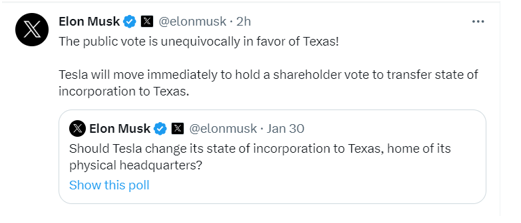
Another way out would be for Tesla to follow through on Musk’s latest suggestion: Reincorporation to Texas.  That would require a shareholder vote, but Tesla’s stock is, like, 40-50% retail, with another chunk held by Musk and Musk allies, it’s not literally impossible that the vote would succeed.

But can you even imagine what the lawsuit would look like if Musk’s board proposed reincorporation to Texas on the basis of Musk’s Twitter poll, after a shocking indictment of its stewardship? 

Musk texas

There is currently pending a lawsuit challenging a Delaware reincorporation to Nevada.  It’s a novel claim that the controlling shareholder is seeking to avoid Delaware’s strict standards for reviewing conflicted transactions.  I have no idea how that will come out; it’s a dilemma for the Delaware courts.

But in Tesla’s case – and someone correct me if I’m wrong – it’s not quite as obvious that the formal legal standards in Texas are so different from Delaware’s.  They seem pretty MBCA-like: universal demand, there may be some limits on what counts as interested/dependence/independence but nothing a clever plaintiff couldn’t plead around.  That’s not the reason Musk wants to go there; he wants to go there because he expects the judges will be biased in his favor. 

Suing shareholders would argue that the reincorporation was intended to protect Musk’s ego and his power, not shareholder value.  Which brings us back to the question posed by Tornetta: Is shareholder value measured by stock prices alone?

As for me, here’s to another round of edits to my Twitter v. Musk paper, now forthcoming in the Virginia Law & Business Review.

Dear BLPB Readers:

“HOWARD UNIVERSITY SCHOOL OF LAW invites applications for two visiting faculty
positions during the 2024-2025 academic year. Howard University, a culturally
diverse, comprehensive, research intensive and historically Black private university,
provides an educational experience of exceptional quality at the undergraduate,
graduate, and professional levels to students of high academic standing and
potential.

Position 1 – We are hiring a visiting law professor for a full-year podium visit. This
professor will teach one section of our first-year contracts course, which is a full
year course. In addition to the contracts course, we are open to a wide range of
other offerings in both semesters with a particular interest in business courses and
upper level writing seminars.

Position 2 – We are hiring a visiting law professor for a Fall 2024 podium visit. This
professor will teach one section of our fall first-year civil procedure course. In
addition to the civil procedure course, we are open to a wide range of other
offerings in the fall semester with a particular interest in business courses and
upper level writing seminars.”

The complete announcement about these positions is here: Download HUSL Visiting Faculty Announcement – AALS 01.18.24[61]

The University of Chicago Business Law Review recently published an interesting and engaging article written by David Rosenfeld.  The article is entitled “Insider Abstention and Rule 10b5-1 Plans” and is available on SSRN.  The SSRN abstract for David’s article follows.

Company insiders will typically be in possession of material non-public information (MNPI) about their companies. In order to allow insiders the opportunity to trade, the SEC adopted Rule 10b5-1, which provides an affirmative defense to insider trading liability if the trades are made pursuant to a written plan or trading instruction entered into when the trader was not aware of MNPI. Over the years, there has been considerable concern that insiders were abusing Rule 10b5-1 plans by adopting plans just prior to trading, adopting multiple plans, or even terminating plans when they turned out to be unprofitable. The SEC recently adopted new rules designed to curb some of the more abusive practices, but one significant problem remains: while Rule 10b5-1 plans are supposed to be irrevocable, insiders who back out of plans have so far escaped liability under the central anti-fraud provision of the federal securities laws, principally because a violation of that provision requires an actual trade.

The issue of “insider abstention”—insiders who decide not to trade based on MNPI—has long bedeviled insider trading law and policy. Insider abstention is typically undetectable and unknowable, raising insurmountable issues of proof, while the general requirement that fraud be “in connection with the purchase or sale of a security” imposes a rigid legal barrier. But Rule 10b5-1 plans stand on a different evidentiary footing: they are written plans, communicated to third parties, creating a clear record of intent. The only real question is whether legal liability can attach in the absence of an actual purchase or sale of a security.

Traditionally, the answer to this question has been no. The SEC staff has stated on a few occasions that cancellation of a Rule 10b5-1 plan would not in itself lead to liability under Rule 10b-5 because terminating a plan would not meet the “in connection with” requirement. However, Rule 10b-5 is not the only statutory provision that has been used to prosecute insider trading. The SEC has frequently prosecuted insider trading under Section 17(a) of the Securities Act, a provision that applies not only to the “sale” of securities but extends more broadly to “offers” to sell securities. And criminal authorities have increasingly been prosecuting in sider trading under mail and wire fraud statutes that do not have an “in connection with” requirement at all. These other statutory provisions could provide a basis for insider trading liability in the context of a cancelled or terminated Rule 10b5-1 plan.

I had the opportunity to review this paper in an earlier draft and found it illuminating and helpful.  I was interested in the piece in part because of recurrent concerns about insider trading abuses and reforms relating to Rule 10b5-1 plans.  As readers may recognize, the BLPB has featured posts in this regard, including this one by John Anderson. 

In this article, as in other aspects of David’s work, David brings the keen eye of a former U.S. Securities and Exchange Commission enforcement professional to the question–an undoubtedly valuable lens.  Moreover, insider trading discussion groups in which I have participated at conferences in recent years have increasingly focused on the creative enforcement of insider trading under legal theories outside Section 10(b) of and Rule 10b-5 under the Securities Exchange Act of 1934, as amended.  David’s article acknowledges and extends the reach of this trend.  Overall, the article is a fun and insightful read.


We just finished our second week of the semester and I’m already exhausted, partly because I just submitted the first draft of a law review article that’s 123 pages with over 600 footnotes on a future-proof framework for AI regulation to the University of Tennessee Journal of Business Law. I should have stuck with my original topic of legal ethics and AI.

But alas, who knew so much would happen in 2023? I certainly didn’t even though I spent the entire year speaking on AI to lawyers, businesspeople, and government officials. So, I decided to change my topic in late November as it became clearer that the EU would finally take action on the EU AI Act and that the Brussels effect would likely take hold requiring other governments and all the big players in the tech space to take notice and sharpen their own agendas.

But I’m one of the lucky ones because although I’m not a techie, I’m a former chief privacy officer, and spend a lot of time thinking about things like data protection and cybersecurity, especially as it relates to AI. And I recently assumed the role of GC of an AI startup. So, because I’m tech-adjacent, I’ve spent hours every day immersed in the legal and tech issues related to large and small language models, generative AI (GAI), artificial general intelligence (AGI), APIs, singularity, the Turing test, and the minutiae of potential regulation around the world. I’ve become so immersed that I actually toggled between listening to the outstanding Institute for Well-Being In Law virtual conference and the FTC’s 4-hour tech summit yesterday with founders, journalists, economists, and academics. Adding more fuel to the fire, just before the summit kicked off, the FTC announced an inquiry into the partnerships and investments of  Alphabet, Inc., Amazon.com, Inc., Anthropic PBC, Microsoft Corp., and OpenAI, Inc. Between that and the NY Times lawsuit against OpenAI and Microsoft alleging billions in damages for purported IP violations, we are living in interesting times.

If you’ve paid attention to the speeches at Davos, you know that it was all AI all the time. I follow statements from the tech leaders like other people follow their fantasy football stats or NCAA brackets. Many professors, CEOs, and general consumers, on the other hand, have been caught by surprise by the very rapid acceleration of the developments, particularly related to generative AI.

However, now more members of the general public are paying attention to the concept of deepfakes and demanding legislation in part because the supernova that is Taylor Swift has been victimized by someone creating fake pornographic images of her. We should be even more worried about the real and significant threat to the integrity of the fifty global elections and occurring in 2024 where members of the public may be duped into believing that political candidates have said things that they did not, such as President Biden telling people not to vote in the New Hampshire primary and to save their votes for November.

For those of us who teach in law schools in the US and who were either grading or recovering from grading in December, we learned a few days before Christmas that Lexis was rolling out its AI solution for 2Ls and 3Ls. Although I had planned to allow and even teach my students the basics of prompt engineering and using AI as a tool (and not a substitute for lawyering) in my business associations, contract drafting, and business and human rights class, now I have to also learn Lexis’ solution too. I feel for those professors who still ban the use of generative AI or aren’t equipped to teach students how to use it ethically and effectively.

Even so, I’m excited and my students are too. The legal profession is going to change dramatically over the next two years, and it’s our job as professors to prepare our students. Thompson Reuters, the ABA, and state courts have made it clear that we can’t sit by on the sidelines hoping that this fad will pass.

Professionally, I have used AI to redraft an employee handbook in my client’s voice (using my employment law knowledge, of course), prepare FAQs for another client’s code of conduct in a very specialized industry, prepare interview questions for my podcast, and draft fact patterns for simulations for conferences and in class. I’ve also tested its ability to draft NDAs and other simple agreements using only ChatGPT. It didn’t do so well there, but that’s because I know what I was looking for. And when I gave additional instructions, for example, about drafting a mutual indemnification clause and then a separate supercap, it did surprisingly well. But I know what should be in these agreements. The average layperson does not, something that concerns Chief Justice Roberts and should concern us all.

How have you changed your teaching with the advent of generative AI? If you’re already writing or teaching about AI or just want more resources, join the 159 law professors in a group founded by Professors April Dawson and Dan Linna. As for my law review article, I’m sure a lot of it will be obsolete by the time it’s published, but it should still be an interesting, if not terrifying, read for some.

So, there was a lot going on in Twitter v. Musk, some of it in the actual case, but much of it in the speculation of we legal types as we gamed out various potential scenarios.

One scenario that kept recurring was whether Delaware would in fact have the ability to actually enforce a judgment against Elon Musk, should he choose to simply defy court orders.  That was never a likely scenario; Musk is a repeat player in Delaware and it was never feasible for him to remain the CEO of a public company organized in Delaware while running from the Delaware courts.

But if that happened, it seemed one solution would be for Delaware to seize his Tesla shares, and his SpaceX shares, and then either sell them or more likely simply hold them until he complied with the judgment.  The logic was that, according to DGCL §169, shares of a Delaware corporation exist, in the abstract, within the state of Delaware, and Court of Chancery Rule 70 says:

If a judgment directs a party to execute a conveyance of land or to deliver deeds or other documents or to perform any other specific act and the party fails to comply within the time specified… On application of the party entitled to performance, the Register shall issue a writ of attachment or sequestration against the property of the disobedient party to compel obedience to the judgment. The Court may also in proper cases adjudge the party in contempt. If real or personal property is within the jurisdiction of the Court, the Court in lieu of directing a conveyance thereof may enter a judgment divesting the title of any party and vesting it in others and such judgment has the effect of a conveyance executed in due form of law. When any order or judgment is for the delivery of possession, the party in whose favor it is entered is entitled to a writ of execution or assistance upon application to the Register in Chancery. The provisions of this paragraph shall not be construed to replace any statutory authority granted this Court to compel performance by a substitute.

…For failure to obey a restraining or injunctive order, or to obey or to perform any order, an attachment may be ordered by the Court upon the filing in the cause of an affidavit showing service on the defendant, or that the defendant has knowledge of the order and setting forth the facts constituting the disobedience. …

Which, as I read it, grants Chancery pretty wide latitude to force compliance with court orders by seizing property within its jurisdiction.

And, in fact, on October 3, 2022 – right before Twitter v. Musk settled – VC Laster issued an opinion in In re Stream TV Networks Omnibus Agreement Litigation doing just that.

Now a big difference between that case and Twitter was, in that case, the shares themselves were the subject of the dispute.  SeeCubic had been ordered to transfer its assets to Stream, and instead of doing so, it arranged matters to ensure that certain shares of a Delaware company were seized by another company, Hawk.  Stream filed an emergency motion to get the shares back, and VC Laster relied on Section 169 and Chancery Court Rule 70 to order that Hawk be divested of the shares, and that they be vested in Stream.  So yes, it seemed a Delaware Chancery court could in fact simply order that shares of a Delaware company be transferred to someone else or sequestered to ensure compliance with a court order, and there did not seem to be a reason why the same principle wouldn’t apply to assets unrelated to a particular dispute.

But then!  In May 2023, then-Superior Court Judge LeGrow (now on the Delaware Supreme Court) decided Deng v. HK XU Ding.  There, Plaintiff Deng sold shares of iFresh, a Delaware corporation, to Defendant HK.  HK never paid the full purchase price, however, and Deng sued in New York for the remainder of the purchase price.  He won a default judgment of around $2.5 million, and then went to Delaware to execute.  The assets available to satisfy the monetary judgment were, of course, the iFresh shares, so Deng sought to attach them.

The problem was that these shares actually had been certificated, and the physical certificates had been seized by Chinese authorities.  Deng argued that didn’t matter; Judge LeGrow held that it did.

Relying on DGCL §324(a) and 6 Del. C. §8-112, Judge LeGrow held that when certificates of the stock exist, they may be attached to satisfy a debt only if the physical shares are seized.  The Delaware Supreme Court heard oral argument on that question earlier this month.

So, I’ll openly admit I don’t know how far the two situations interact; maybe not at all.  Sections 324 and 8-112 are about creditors satisfying debts, not about seizing for the purpose of forcing compliance with a court order/as a sanction for contempt, and possibly those are different scenarios.  (If you are a Delaware law maven who has a definitive answer, please drop a comment.)  But if LeGrow’s interpretation holds up across all scenarios, that would mean future Musks could, if they wanted to, evade sanction in Delaware by I guess going to DTC and getting physical certificates of their shares, and then sticking them in a vault in another state.  Or Bermuda or the Cayman Islands.  Of course, that would make them hard for anyone to seize, and I have no idea whether that would interfere with attempts to use them as security for personal loans, as Musk and many other executives do.

Edit:  I should add that another complexifying factor here is that the Chinese government obviously thinks it has possession of the shares. If Delaware holds that you do not need the physical certificates, is it challenging the claim of the Chinese government?  That presumably is a fight Delaware does not want to have; the problem is, there is a difference between the owner refusing to turn over the certificates to avoid a judgment, and another creditor/claimant refusing to turn them over.  The plaintiff in Deng admits there is a bona fide purchaser exception, but not every certificate seizure will involve those.

On March 1, 2024, the SEC will host an Investor Advocacy Clinic Summit both virtually and in Washington D.C.  The event will run from 11:00 a.m. to 4:00 p.m. EST.  It’s an opportunity for faculty and law students to:

LEARN about the work of the ten-law school investor advocacy clinics, and the benefits of these clinical programs for law students, law schools, and their communities.

HEAR perspectives from the SEC Chair, SEC Commissioners, and guest speakers.

ENGAGE with SEC staff about the work of the different Divisions within the Commission.

FIND out about job opportunities at the SEC and the federal government post-law school graduation.

This is the link to RSVP.

You can access the flyer for the event here:  Download 2024 IAC Summit Evite -RSVP

As you may know or recall, I am teaching an advanced business law course that leverages the characters and transactions featured in HBO Max’s Succession.  I reported on the course here back in November. The inspiration for the course came in part from the work some of us did to produce a series of educational sessions as the Waystar Royco School of Law last year.  I posted on that lecture series here on the BLPB, too, including here.

From that series of Zoomcasts, a publication opportunity, some press inquiries, and a few new friendships followed, as well as the idea for my Succession course.  We are only a few classes in so far, but we had the pleasure of hosting friend-of-the-BLPB Ben Means in class today.  As you may know, Ben directs South Carolina’s innovative Family and Small Business Program.  He also participated int he Waystar Royco School of Law (ad)venture and was a super guest.  We covered a lot of ground on family businesses, big and small, in our 75 minutes together this morning.  Thank you, Ben.

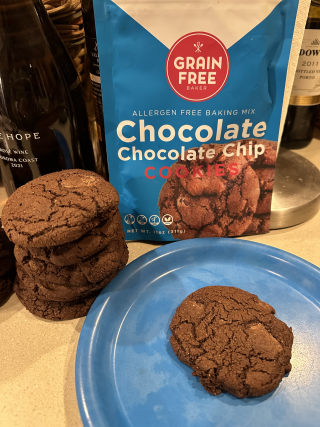
This class meeting and my Securities Regulation teaching today had me thinking about small businesses and innovation.  That reminded me that I keep forgetting to blog about a nifty small business that I was introduced to last year.  The business is The Grain Free Baker.  I learned about the business from one of my fellow BLPB editors, Colleen Baker.  It is her sister’s business.  As a cook, a foodie, and a business lawyer supportive of entrepreneurship, it was fun to learn about the business–founded by a Baker who is a baker!  You can read about it here

It is the need to bring money into businesses like this that helps drive me to teach a new generation of law students to be corporate finance lawyers.  It is essential that lawyers understand, I argued earlier today, what a security is and what the legal implications of offering and selling securities are if they are to use their law degrees to support start-ups and small businesses.  Although many entrepreneurs will seek out commercial loans to finance their businesses, corporate finance transactions are desired or needed by others.

I hope those of you who are instructors also can find passion projects that inspire your teaching.  They can be so helpful in motivating instruction at downtimes during the semester.  That has been true for me.  And what’s not to like about financing businesses that produce amazing products like the mix that made these cookies?!

BLPB(GrainFreeBaker)