Washington and Lee University School of Law (“W&L Law”) invites up to ten tenure-track or tenured legal scholars to join its faculty for an intensive four-day writing retreat at House Mountain Inn located in the Shenandoah Valley, a home to artists, artisans, and scholars alike. Nestled high atop the slopes of Big House Mountain, the House Mountain Inn offers 1,000 private acres of mountain preserve with breathtaking views of the surrounding natural beauty. The scenic location offers the ideal setting for this retreat dedicated to intensive academic writing, meaningful peer engagement, and the cultivation of long-term professional relationships among leading legal scholars from across the country. This retreat reflects the W&L Law faculty’s deep dedication to advancing impactful legal scholarship and its commitment to nurturing curiosity, collaboration, and community.

The 2026 Writing Retreat will meet from Sunday, June 14, to Thursday, June 18, 2026. Attendees are asked to join the retreat for its full duration in order to support a shared, immersive writing experience for all participants.

FUNDING

W&L Law will provide lodging and meals for all attendees at House Mountain Inn for four nights, plus a travel stipend up to $500. Funding for the retreat is generously provided by W&L Law’s Frances Lewis Law Center, an independently endowed institute dedicated to enriching the intellectual life of the law school community and supporting legal scholarship and academic exchange.

SUBMISSION GUIDELINES

The Writing Retreat will alternate annually between private law and public law. All tenure-track and tenured faculty at U.S. law schools are eligible to apply so long as the proposed research project relates to the topics listed below.

The 2026 Writing Retreat will focus on private-law scholarship, including the following areas: Antitrust; Intellectual Property; Banking and Financial Law; International Business Transactions; Bankruptcy, Civil Litigation, Arbitration, and Third-Party Funding; Contracts and Commercial Law; Corporate and Securities Law; Private Law Theory; Business Law and Technology; Property; Trusts and Estates; Taxation; and Torts.

Applicants for the Writing Retreat should submit a curriculum vitae and a research proposal of no more than 1,500 words explaining the project that they plan to develop at the retreat. The proposal should include the project’s topic, research methodology, stage of development, potential contribution to scholarship and practice, and its relationship to one or more of the topics listed above.

Applicants for the Writing Retreat should email CV and research proposal as PDFs to Kish Parella (parellak@wlu.edu) and Wendy Rice (ricew@wlu.edu) with subject heading “2026 W&L Law Writing Retreat.Submissions are due by March 15 at 5:00 pm. Submissions will be reviewed by a committee of W&L Law faculty. Applicants will be notified of the committee’s decisions by early April.

ABOUT W&L LAW

Founded in 1749, Washington and Lee University is one of the nation’s oldest institutions of higher learning, and its Law School reflects that enduring academic tradition. The Law School fosters a collaborative environment in which scholarly inquiry thrives allowing its faculty to engage deeply with complex legal issues while maintaining a collegial and supportive academic culture. Located in the historic and scenic Shenandoah Valley of Virginia, the Law School offers a setting that is both intellectually stimulating and uniquely conducive to focused scholarly work.

I was fortunate to run into my friend Pamela Foohey at a reception at the Association of American Law Schools annual meeting last week. I had known that the book on consumer bankruptcy she coauthored (with Robert Lawless and Deborah Thorne) had been released. But I had not yet read it. I was especially lucky to catch Pamela that night when she had a copy of the book with her. After a brief conversation, she was kind enough to offer it to me. I began reading it on the flight home. So far, it is an illuminating and fascinating read. 

The book I am referencing, Debt’s Grip, reports on the most recent iteration of the Consumer Bankruptcy Project. For those who may be unfamiliar with the Consumer Bankruptcy Project, it is a long-term (now over 40 years in duration), periodic review of consumer bankruptcies. This most recent study involves the reporting and analysis of eleven years of data assembled from bankruptcy case files and surveys of the related households. While some of the takeaways are unsurprising, the book’s documentation of the nature the filers, their cases, and the outcomes paints a compelling picture of the greater socioeconomic environment in which consumer bankruptcies have been taking place.

Debt’s Grip self-describes its contours and findings in a number of ways in the introduction. Two passages from the introduction really stuck with me.

  • “The experiences of bankruptcy filers show how households collapse under the pressure of having to fend for themselves financially. Their bankruptcies collectively lay bare the structural reasons people continue to struggle. This book is the story of what happens to everyday people when risk remains privatized for decades while income inequality widens, told through the struggles of those who turned to the consumer bankruptcy system for help.” (p. 3)
  • “In reality, people cannot ‘personal finance’ themselves out of skyrocketing rent, medical costs, and wage stagnation. Despite what they may hear about budgeting, many people are one illness, one job loss, or one unexpected pregnancy away from a financial tailspin. That financial tailspin, almost necessarily, will lead some people to file for bankruptcy, and the bankruptcy files will tell us the story of that tailspin.” (p. 7)

Compelling words.

Honestly, this book “had me at ‘hello.’” The subject matter is undeniably interesting, and not just for business lawyers. The text is well written–accessible and clear. I look forward to getting into all the details (even as, or maybe because, I am getting increasingly invested in a new semester).

NORTHERN ILLINOIS UNIVERSITY COLLEGE OF LAW invites applications for one entry-level tenure-track faculty position with interest in teaching contracts, business law and related areas, beginning August 2026.

Duties include engaging in high-quality teaching and research, as well as being an active participant in law-school and university service.

Qualifications include a J.D. degree from an ABA-accredited law school  (or a law school program that is deemed substantively equivalent to an ABA-approved J.D. program for purposes of taking a US State bar examination); ability to engage in high-quality teaching; ability to engage in high-quality research; and ability to be an active participant in law school and university service.

Preferred qualifications include a record of scholarly publication, teaching experience (particularly in a law school), legal-practice experience, a strong law-school record, law-journal membership, and clerkship experience.

If you wish to apply or have questions, please contact Professor David Rosenfeld, Chair of the Appointments Committee, at niucol@niu.edu. Preference will be given to applications received by February 13, 2026, though applications will be accepted until the position is filled.

To be officially considered for the position or positions, a cover letter, résumé, and contact information for three current professional references will be required to be uploaded to NIU’s applicant-tracking system.  NIU Law is a public law school. It resides at the heart of a diverse and active R2 university campus of over 15,000 students in DeKalb, Illinois, located on the western edge of the Chicago metropolitan area.

In accordance with applicable statutes and regulations, NIU is an equal opportunity employer and does not discriminate on the basis of race, color, national origin, ancestry, sex, religion, age, physical and mental disability, marital status, veteran status, sexual orientation, gender identity, gender expression, political affiliation, or any other factor unrelated to professional qualifications, and will comply with all applicable federal and state statutes, regulations and orders pertaining to nondiscrimination, equal opportunity and affirmative action. In compliance with federal law, all persons hired will be required to verify identity and eligibility to work in the United States and to complete the required employment eligibility verification document form upon hire.

Where we last left off, a couple of companies had adopted forum selection bylaws purporting to shunt all derivative actions to the Delaware Court of Chancery – intending, I will swear with my last breath – to capture state law fiduciary claims.  When they got hit with the relatively-uncommon federal law Exchange Act derivative claims (under Section 14(a)), they celebrated their fortune and sought to enforce the bylaws against those, as well, even though Chancery has no jurisdiction over Exchange Act claims, which would, of course, mean just immediate dismissal.

They lost in the Seventh Circuit, but prevailed in the Ninth, which ultimately resulted in Delaware passing a new statute prohibiting forum selection bylaws from denying access to any court in the state of Delaware with jurisdiction to hear the claim at all – a law that is currently working mischief on the SEC’s attempt to encourage the use of arbitration in order to break securities class actions.

Anyhoo, the latest on this concerns a pair of securities actions filed in the Northern District of California against Block, alleging that the board failed to ensure compliance with various anti-money laundering statutes and things of that nature.  (Neither case appears to be available yet on Lexis or Westlaw, but Law360 reported on them here).

One case was a standard securities class action; earlier this week, the court denied Block’s motion to dismiss.  The other was a derivative action against Block, alleging both Section 14(a) claims and Section 10(b) claims, and state law breach of fiduciary claims, including Caremark violations and an insider trading/Brophy claim. 

But Block had adopted what is by now a fairly standard forum selection bylaw, requiring that derivative actions be filed in the Court of Chancery, except for Exchange Act claims.  The exact text of the bylaw stated:

For the avoidance of doubt, nothing contained in this Section 7.7 shall apply to any action brought to enforce a duty or liability created by the Exchange Act or any successor thereto

What to do?

Well, in the derivative action, the company sought dismissal, alleging that this was fundamentally a state law breach of fiduciary action that belonged in state court, and the Exchange Act claims were tacked on to keep the case in federal court (and duplicative of the class action to boot). 

The district court barely entertained the suggestion.  In a broader opinion holding that the plaintiffs had stated a claim on the merits, the court quickly held that the action fell within the terms of the forum selection carveout because “Plaintiffs’ claims under the Exchange Act predominate in this action.”

So now, the California district court will hear both the state law derivative claims, and the Exchange Act derivative claims, in a single action.

I suppose Block was right, there is a risk now that plaintiffs will add Exchange Act claims to state law fiduciary claims if they want to be heard in federal court, which is why, at the very least, companies should seek to sever them.  That could, I suppose, occur in the bylaw itself, or perhaps in briefing – in this case, Block mentioned the possibility of severance, but only in a footnote in its reply, and the court did not entertain the possibility.  Maybe Block would have succeeded on that argument if it had tried harder, though there’s also a real possibility that federal district courts will only be inclined to sever if they’re dismissing the Exchange Act claims anyway, and that’s … the worst of all worlds for defendants.

And some other things.

New Shareholder Primacy podcast!  This week, me and Mike Levin talk about the Delaware Supreme Court’s decision restoring Elon Musk’s pay, and about how activists recruit director candidates.  Here at Apple, here at Spotify, and here at Youtube.

And also – if you just can’t get enough of me opining on DExit and related subjects, here’s me talking to Rob Du Boff of Bloomberg’s ESG Currents.

A couple of months ago, I posted about the case of Cannon v. Romeo Systems, where the CEO and sole director of a startup failed to notice an edit in a stock warrant that ultimately guaranteed the holder far more shares in his company than he had expected, with disastrous consequences. Mostly, it’s a tale of sloppiness; he signed a contract without reviewing it for changes, and then – when warned by KPMG of discrepancies between his own cap table and the terms of the warrant – ignored it. Negligent, perhaps, but understandable.

Unfortunately, as the case continues, our CEO seems to have … learned very little.

The CEO is appealing the decision, and under Delaware law, if he wants to stay the judgment, he has to post security for the full amount awarded to the plaintiff, which is over $27 million. He petitioned to be permitted to post not in cash, but in private company stock – a completely different private company than the one in the original dispute, and one for which he also serves as Chair and CEO. But, of course, in order to use private company stock, he had to provide evidence of its value. Here is what VC Fioravanti found:

First, there was a discrepancy between the CEO’s representations as to his percentage ownership of the company, and the cap table submitted in support of his petition.

Second, the CEO miscalculated the implied valuation of the company based on its latest funding round – twice.

Third, the CEO’s implied valuation based on the funding round left out – wait for it – warrants that investors received for additional stock purchases.

I mean … maybe this is just a recurring problem with private companies but, oof, the optics for the appeal.

And so, we reach the end of another calendar year . . . .  And it has been a busy one for the Clayton Center for Entrepreneurial Law at Tennessee Winston Law.  The change in the calendar, like the change in seasons, always seems to be a time of reflection for me.  And that reflection typically leads to a sense of gratitude.  I will share some of what I am thankful for here.

I appreciate so much the wonderful stewardship of Brian Krumm, who directed the Clayton Center for the first seven months of 2025.  We are a student-focused institution, and Brian exemplifies that in all that he does for our business law program.  And as the ongoing coach of our students in four upcoming transactional law competitions (The Closer at Baylor Law, the Wayne State University Law & Taft Stettinius & Hollister Transactional Law Competition, Syracuse Law’s Transatlantic Negotiation Competition, and the William & Mary Colonial Cup), Brian will continue to earn my respect and gratitude as the academic year continues, for that work and so much more.

I am grateful for our newest business law colleague, Andrew Appleby.  In a semester of professional and personal transitions, he has weathered the storm well and is already a student favorite who is contributing curricular ideas and offering fresh viewpoints.  Our tax law program is something we always have been proud of, and Andrew brings broad and deep experience in tax and other areas of business law, adding strength to the Clayton Center’s multifaceted, interdisciplinary approach to training students for a wide range of business law careers in the public and private sectors. Andrew and Michelle Kwon, together with our emeritus colleagues Amy Hess and Don Leatherman, offer us many ways to ensure that students have a strong, practical foundation in tax law when they leave us with their law degrees in hand.

And, having just finished grading an amazing set of memoranda and draft instrument and agreement provisions crafted by my Corporate Finance students, I also want to proclaim publicly my gratitude for them.  Each project was unique; each student expended their knowledge and capacity as they worked on their research, planning, and drafting over the course of the semester.  Based on their final work product, I would hire so many of them!  And the growth that I saw . . . .  Well, it is inspiring.

And inspiration is a good thing.  The new semester here starts next week.  And so there soon will be more to come, more to be grateful for. The Clayton Center–and business law education with it–has come a long way in over a quarter of a century of working with law students (as have our logos, as the three mugs in the photo help illustrate!). I have been thinking a lot about that as I continue to process Tina Stark’s passing.

With all of the foregoing in mind, I send all of you new year greetings. 2026, here we come!  For those of you who, like me, are gearing up for our annual national law teacher’s conference and the new semester at the same time, I wish you well in accomplishing all that in short order.  I hope to see and visit with some of you in New Orleans.  Beignets and chicory coffee at Café du Monde are on the menu for me, as are a Mother’s oyster po’ boy and a Central Grocery and Deli muffuletta.

Tina L. Stark Emory Law, October 2007

Transactional lawyering and the education of transactional lawyers has been transformed by Tina L. Stark (Weisenfeld). You may have known her for her wonderful books–Drafting Contracts: How & Why Lawyers Do What They Do and Negotiating and Drafting Contract Boilerplate are on my bookshelves and those of so many others. You may have heard her speak at a conference or symposium.

Yet, many of us also knew Tina on a more personal level. Some of us had her as an instructor or as a colleague. Long a consultant and advisor to law schools, bar associations, and legal employers on transactional legal education and training, Tina also held full-time administrative and teaching appointments at Emory University School of Law and Boston University School of Law and was a visitor at Fordham University School of Law. Earlier in her career, she was an adjunct law professor at Fordham Law and the Maurice A. Deane School of Law at Hofstra University.

Tina passed away earlier this week. But her presence will continue to be felt in so many ways. She and I initially bonded over our not only our love of teaching plainly from practical materials but also our identical higher education academic background–a Brown University undergraduate degree and a law degree from New York University School of Law. In leaving a short online tribute on the memorial website created in her honor and memory, I noted her moxie. Whether we were speaking on a law teacher or continuing legal education panel, arguing about a contract drafting principle or norm, or discussing current events in the broader world, Tina exhibited a transparency, wit, courage, and determination that was inspirational. If at first she could not convince you of the error of your thoughts or ways, she would persevere in endeavoring to change your mind. She was a force to be reckoned with, in the best possible way. Her generosity and kindness infused every personal and professional interaction.

Tina will also be remembered by many as the core founding member and initial chair of the Association of American Law Schools Section on Transactional Law and Skills. Of those in the group of us who promoted the creation of that section, none was more driven and passionate than Tina. The whole thing was her idea. She was (as we often have noted) the mother of our section, and I was honored to serve with her on the executive committee and later as section chair.

Tina’s physical presence will continue to be missed in the legal academy–and especially among us business law profs–for years to come. But we are grateful she left behind so much of herself in her writings, recordings, students, and–yes–in so many of us. She is now free of her earthly burdens. It is time for all of us in transactional and continuing legal education to persevere in carrying on the mission.

An online obituary for Tina can be found here. A memorial service is being held on Sunday, December 28 at 11:00 am (Eastern Time) and is available by livestream here. I assume that many also will honor her and her work at the 2025 Association of American Law Schools annual meeting in January. I will look forward to doing that.

Recently, Walmart shifted its listing from the New York Stock Exchange to the NASDAQ.  The move, apparently, had nothing to do with the formal policies of the exchanges, and everything to do with the fact that the NASDAQ is associated with tech stocks.  Walmart is trying to sell itself as a tech company, and part of that effort involves actually shifting exchanges.

To some extent, the benefits of this move rely on an assumption of market inefficiency, i.e., the well known phenomenon where stocks trade differently depending on index inclusion; Walmart is betting that if it’s added to the NASDAQ 100, it will trade like the rest of the index.

But it’s also an exercise in branding.  Walmart, I gather, hopes for an image revitalization; it’s signaling a business model, and a commitment to a digital business strategy, and it hopes investors will share that vision.

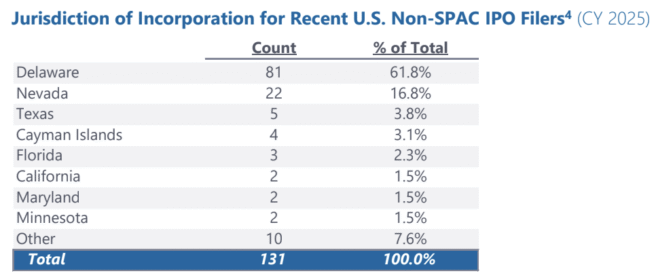
I’ve been thinking that, in the wake of the chartering wars, state of incorporation may serve a similar function.  I’ve previously posted that Texas has adopted an anti-woke approach to corporate governance, and I think for most firms, that’s not a particularly desirable stance; they’d much rather, at least, choose Nevada, where they get a full promise of noninterference.  But some firms may appreciate the branding – like, obviously, Musk-led companies, since Musk’s persona is intertwined with his companies.  And, apparently, crypto companies: both Coinbase and Enhanced announced moves to Texas, which fits well with the conservative/libertarian bent of the crypto industry. (There may be more practical reasons, as well; they may believe that declaring allyship with the Texas legislature will help shield them from other kinds of legal action).  Or, to put it another way, if incorporation in Delaware was once viewed as a mechanism to bond to a particular governance structure, incorporation in Texas may bond a firm to a particular political approach to business strategy (product development, marketing, hiring, etc), that could attract consumers and employees but – since I assume these groups largely do not attend to state of incorporation – is more likely intended to appeal to investors that share those political commitments.

This is a guest post from Megan Wischmeier Shaner, the Kenneth E. McAfee Chair in Law and President’s Associates Presidential Professor, at the University of Oklahoma College of Law.

On May 29, 2025, Oklahoma appeared poised to become the thirty-second state with a dedicated business court or commercial/complex litigation docket. SB 632 would create two new business courts in Oklahoma with jurisdiction over “complex cases” which could include claims involving antitrust or trade regulation, intellectual property, securities law issues, professional malpractice, contracts, commercial property, intra-business disputes, insurance coverage, environmental claims, product liability and e-commerce, among others. Modeled, in part, off Delaware’s Court of Chancery, the judges would be appointed by the governor for 8-year terms and must have ten or more years of experience in complex civil business litigation, practicing business transaction law, and/or serving as a judge or clerk of court with civil jurisdiction. Jury trials would only occur upon application by a party to a suit within a specified time period.

Shortly after SB 632 was signed by the governor two attorneys filed a legal challenge with the state supreme court asserting the legislation was unconstitutional. (White & Waddell v. Stitt, 2025 OK 68, C.A. No. 123222 (Okla. Oct. 7, 2025)). The Oklahoma Association for Justice filed an amicus brief in the litigation supporting the petitioners’ arguments as well as raising additional issues regarding the constitutionality of the legislation.

In a 6-2 decision, the Oklahoma supreme court held SB 632 was unconstitutional on several grounds. First, the court found that the creation of a new business court, separate from the Oklahoma district courts, exceeded the boundaries of the legislature’s power to create courts as set forth in the state constitution. Article VII, Section 1 of the Oklahoma constitution enumerates eight courts which have judicial power to adjudicate disputes in the state and a business court is not one of the existing, enumerated courts with judicial power. Second, the court held that even if SB 632 created a business court division within the district court system (one of the eight enumerated courts), such judges must be “elected by the voters of the several respective districts or counties at a non-partisan election in the manner provided by statute.” (Okla. Const. Art. VII, § 9). Because SB 632 mandated a selection process that allowed the governor to appoint the judges from a list of three candidates provided by the Speaker of the House of Representatives (and not the independent Oklahoma Judicial Nominating Commission) it was unconstitutional. Interestingly, both of these constitutional requirements regarding the structure of the Oklahoma judiciary were put in place following a bribery scandal in the 1960’s involving three justices on the state supreme court. The constitutional amendments were intended to limit the legislature’s power and influence over the judiciary and eliminate partisan appointment and election of judges.  In a time where it seems the state and federal judiciary are becoming more politicized; Oklahoma’s 1967 court reforms seem to protect its judiciary from some of those political pressures.

Even if Oklahoma’s business courts had withstood the constitutional challenges, they would not have had an impact on what looks to be a three-horse race among Delaware, Texas, and Nevada for corporate charters. Nevertheless, the issues raised in the Oklahoma litigation are relevant to the discussions taking place in Texas and Nevada regarding the structures of their respective business courts, especially with respect to judicial selection and terms.

Texas

In Texas there is speculation whether the issues raised in White & Waddell could be applicable to the Texas Business Court. Texas HB 19 provides that its Business Court judges are appointed by the governor for two-year terms. Similar to Oklahoma, Article V, Section 7(b) of the Texas Constitution provides that district judges are to “be elected by the qualified voters at a General Election,” thus raising constitutional questions about the judicial appointment process. Unlike Oklahoma, however, the Texas constitution provides that the legislature can “establish such other courts as it may deem necessary and prescribe the jurisdiction and organization thereof,” and this power was specifically cited in the creation of the Texas Business Court. Whether this broad grant of legislative power to create the Business Court includes structuring the judicial selection process in a different manner than district judges is unclear.  

Nevada

While not directly addressed in its opinion, the Oklahoma supreme court flagged other constitutional problems implicated by its business court structure, including more stringent judge qualifications, different starting and ending term dates, longer terms, high salaries and designated law clerks, and circumvention of the Judicial Nominating Commission’s role in recommending judicial nominees to the governor. Combined with the special appointment process for business court judges, the legislature was in effect creating a new class of judges within the district court system in violation of the constitution. Objections to business court judges receiving “special” treatment is something that has also been raised in the debates surrounding how Nevada should reshape its business court. Following a proposal to amend the Nevada state constitution to establish a dedicated business court with appointed judges (ARJ8), the chief justice of the Nevada Supreme Court announced plans to pursue the creation of a Commission to Study the Adjudication of Business Law. In so doing the chief justice expressed the desire to see more resources going to existing courts as opposed to the creation of new structures. Moreover, the chief justice and state legislators have expressed concerns over the judicial selection process proposed in the constitutional amendment: (i) that the legislature’s involvement in the nominating commission would, at a minimum, create the appearance of political motivation, and (ii) that the retention vote system would create two tiers of judges in Nevada – those appointed to the business court and others that must be elected. These concerns about different “classes” of state court judges are not unique to Nevada but apply to Texas’ structure (where legislators earlier this year unsuccessfully attempted to extend the judicial terms on the business court) and other states like Oklahoma considering how to create their own business court.

Well, restoring Elon Musk’s 2018 pay package and awarding $1 in nominal damages instead is, I suppose, one way of distracting from the Epstein files.

No one needs a recap of where we were on Elon Musk’s 2018 pay package, but just in case: in 2024, Chancellor McCormick concluded after a trial that Elon Musk was a controlling shareholder of Tesla, and that the pay package was a conflicted transaction that was not entirely fair to the stockholders. In particular, she found that Musk himself controlled the process by which the compensation committee set his pay, and largely made up his own contract with the comp committee serving as a rubber stamp. As a remedy, she ordered that the pay package be rescinded.

Today, the Delaware Supreme Court did not question any of Chancellor McCormick’s actual findings regarding how Musk’s 2018 pay package was negotiated, the control and interference that Musk exercised over the process, or even the unfairness of the award itself. Instead, the sole basis for the holding is a kind of Rumpelstiltskin argument: the plaintiffs used the word “rescission” when requesting a remedy, but this case does not meet the technical requirements for rescission – because rescission requires that both parties be restored to the status quo ante, and there’s no way to give Musk back his years working for Tesla after 2018. “It is undisputed,” said the Court, “that Musk fully performed under the 2018 Grant, and Tesla and its stockholders were rewarded for his work.”

(It was disputed, actually. Per Chancellor McCormick, “Defendants failed to prove that Musk’s less-than-full time efforts for Tesla were solely or directly responsible for Tesla’s recent growth, or that the Grant was solely or directly responsible for Musk’s efforts.” Details.)

Nor could the appreciation in value of his preexisting equity stake serve as a substitute to restore the status quo, because, per the Court, “[t]he benefits from his preexisting equity stake were not the compensation he was promised if he achieved the 2018 Grant milestones.” Which is an argument that proceeds on the assumption that Tesla’s “promise” was a fair one achieved at arm’s length, rather than one manipulated by Musk himself – which is … not what Chancellor McCormick found.

Okay, so the plaintiffs can’t technically receive rescission, because both parties can’t be restored to their 2018 positions. What about remedies like disgorgement or rescissory damages, then, would they be appropriate? A ha! Plaintiffs used the word “rescission,” not “rescissory damages” and not “disgorgement,” so the Court need not ponder such unlikely hypotheticals.

Which is to say, in the grand tradition of Paramount v. Time, widely viewed as a response to Martin Lipton’s Interco memo, the opinion reeks of political expediency (an impression buttressed by the fact that it was issued per curiam – no individual judge wanted to be associated). The Court took a hot potato and found a way to toss it without saying anything at all.

But one difference between Tornetta and the Paramount v. Time decision is that in Paramount, the Court found a way to protect the interests of corporate stakeholders from a rapacious form of shareholder wealth maximization. In Tornetta it … did the other thing.

And … a Very Special Shareholder Primacy podcast! Me and Mike Levin close out the year with a crossover episode with our sister pod, Proxy Countdown, featuring Matt Moscardi and Damion Rallis of Free Float LLC. Here on Spotify, here on Apple, and here on YouTube.